
Summary of Lewis Model successes Provides simple process
- Slides: 8
Summary of Lewis Model successes • Provides simple process leading to sensible predictions of electronic distributions in most (but not all) compounds in both ground and excited states • Lewis structures lead to simple and accurate predictions of molecular shapes • Lewis predictions of electronic distributions provide simple way to predict chemical interaction and relative stabilities, and provides basis for general acid-base model of reactivity (Angelo will tell us more…Friday)
SOME ISSUES WITH THE LEWIS OCTET MODEL (the nitpicking starts…) 1. How come the bond shapes in molecules look so little like the original atomic orbitals ? ? 2. How does it explain PCl 5 , SF 6 ? How come SO 3 has no dipole ? 3. How does octet model account for the observed reactivity trend of ethane vs ethene vs ethyne with halogens and ozone ? 4. How come ethene sticks to Pt, Rh and Ni in catalysis, but ethane doesn’t ? ? ? 5. How can you get all those electrons between carbons in double and triple bonds ? Don’t they repel ?
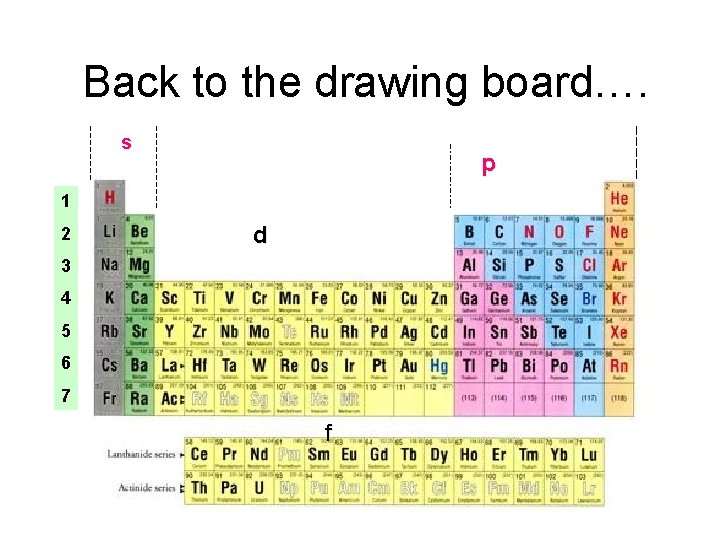
Back to the drawing board…. s p 1 2 d 3 4 5 6 7 f
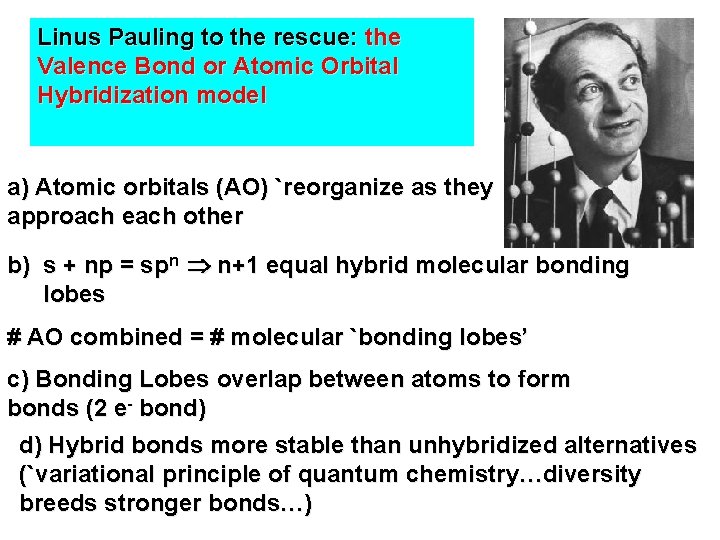
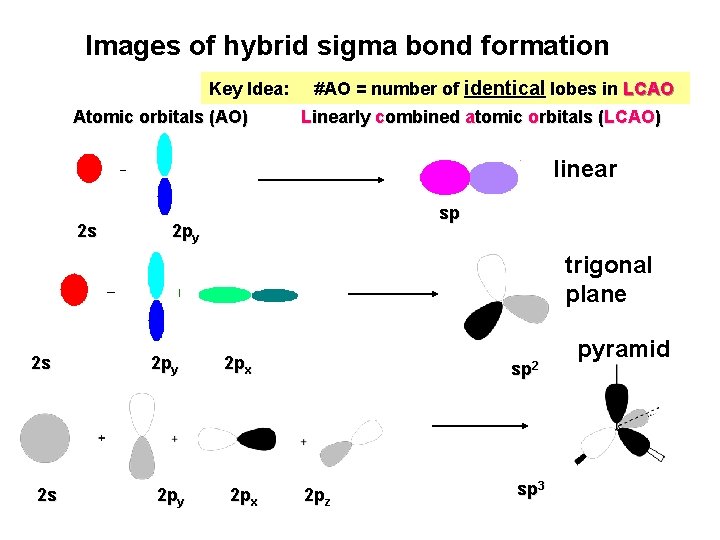
Linus Pauling to the rescue: the Valence Bond or Atomic Orbital Hybridization model a) Atomic orbitals (AO) `reorganize as they approach each other b) s + np = spn n+1 equal hybrid molecular bonding lobes # AO combined = # molecular `bonding lobes’ c) Bonding Lobes overlap between atoms to form bonds (2 e- bond) d) Hybrid bonds more stable than unhybridized alternatives (`variational principle of quantum chemistry…diversity breeds stronger bonds…)
Images of hybrid sigma bond formation Key Idea: Atomic orbitals (AO) #AO = number of identical lobes in LCAO Linearly combined atomic orbitals (LCAO) linear 2 s sp 2 py trigonal plane 2 s 2 s 2 py 2 px sp 2 2 pz sp 3 pyramid
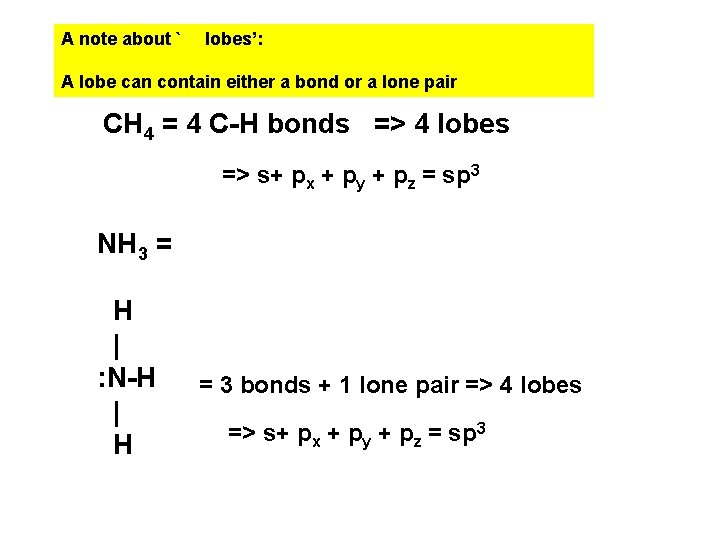
A note about ` lobes’: A lobe can contain either a bond or a lone pair CH 4 = 4 C-H bonds => 4 lobes => s+ px + py + pz = sp 3 NH 3 = H | : N-H | H = 3 bonds + 1 lone pair => 4 lobes => s+ px + py + pz = sp 3
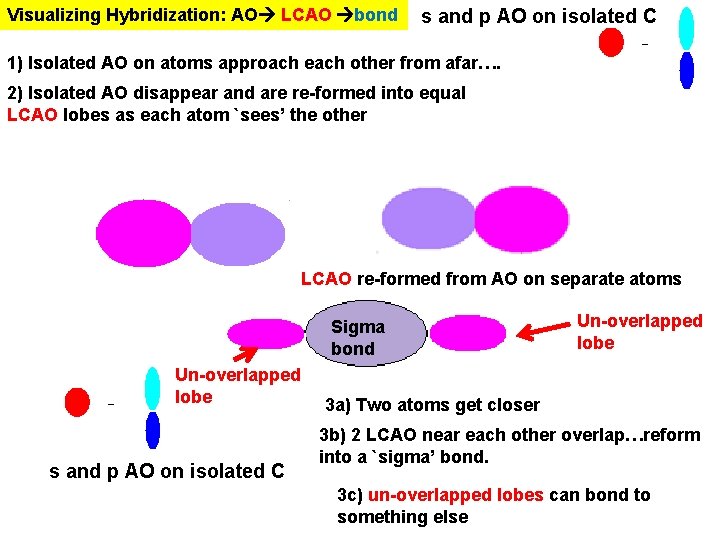
Visualizing Hybridization: AO LCAO bond s and p AO on isolated C 1) Isolated AO on atoms approach each other from afar…. 2) Isolated AO disappear and are re-formed into equal LCAO lobes as each atom `sees’ the other LCAO re-formed from AO on separate atoms Sigma bond Un-overlapped lobe s and p AO on isolated C Un-overlapped lobe 3 a) Two atoms get closer 3 b) 2 LCAO near each other overlap…reform into a `sigma’ bond. 3 c) un-overlapped lobes can bond to something else
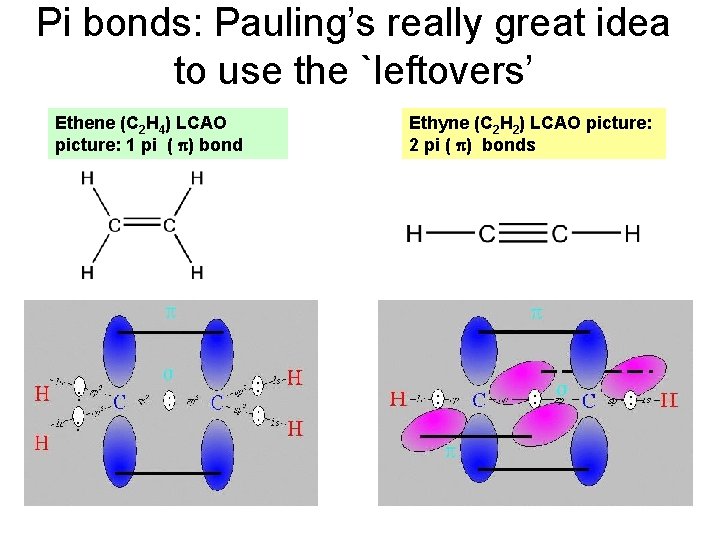
Pi bonds: Pauling’s really great idea to use the `leftovers’ Ethene (C 2 H 4) LCAO picture: 1 pi ( ) bond Ethyne (C 2 H 2) LCAO picture: 2 pi ( ) bonds