
Summary of LDRAs participation in SATE 2011 Introductions

- Slides: 28
Summary of LDRA’s participation in SATE 2011
Introductions • Clive Pygott – Member ISO software vulnerabilities working group – Member MISRA C++ committee – Member of the working group drafting a proposed secure. C annex for the C language definition • Jay Thomas – Field Applications Engineer • Liz Whiting (not present today) – Member MISRA C committee
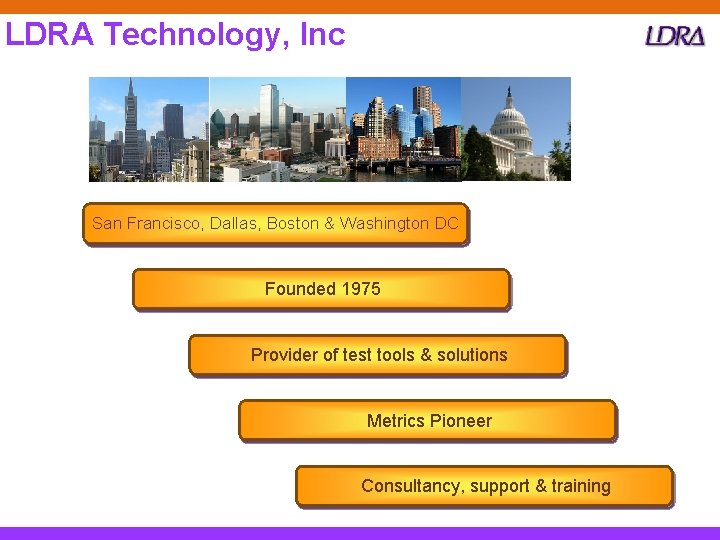
LDRA Technology, Inc San Francisco, Dallas, Boston & Washington DC Founded 1975 Provider of test tools & solutions Metrics Pioneer Consultancy, support & training
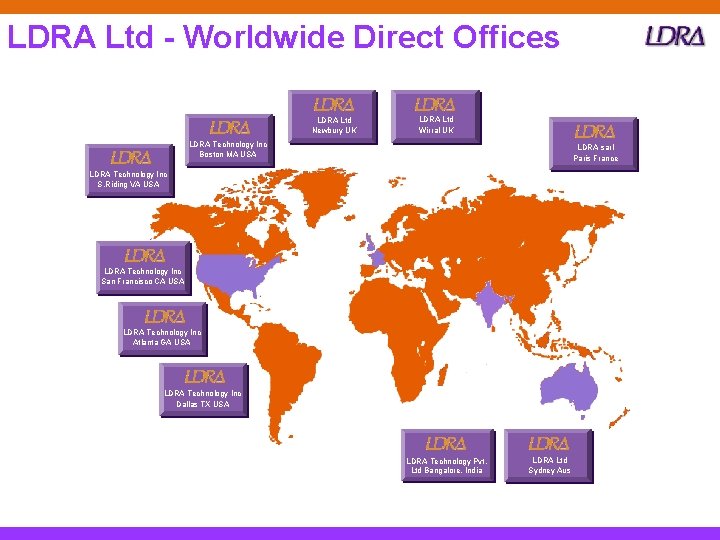
LDRA Ltd - Worldwide Direct Offices LDRA Ltd Newbury UK LDRA Ltd Wirral UK LDRA Technology Inc Boston MA USA LDRA sarl Paris France LDRA Technology Inc S. Riding VA USA LDRA Technology Inc San Francisco CA USA LDRA Technology Inc Atlanta GA USA LDRA Technology Inc Dallas TX USA LDRA Technology Pvt. Ltd Bangalore, India LDRA Ltd Sydney Aus
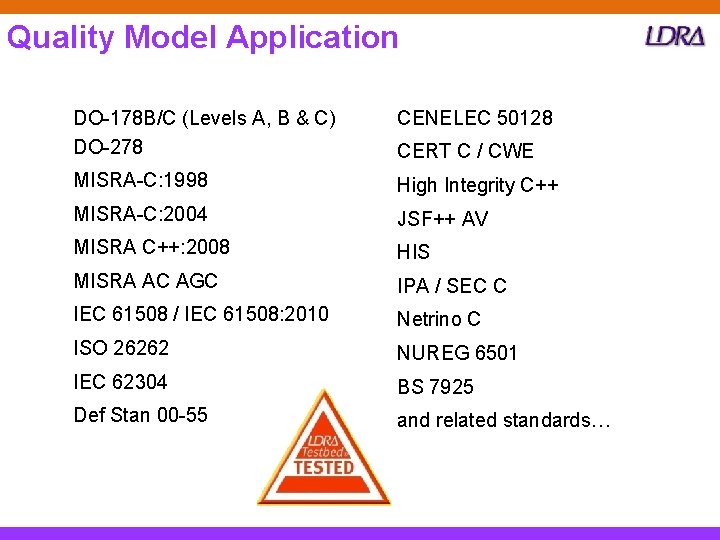
Quality Model Application DO-178 B/C (Levels A, B & C) DO-278 CENELEC 50128 MISRA-C: 1998 High Integrity C++ MISRA-C: 2004 JSF++ AV MISRA C++: 2008 HIS MISRA AC AGC IPA / SEC C IEC 61508 / IEC 61508: 2010 Netrino C ISO 26262 NUREG 6501 IEC 62304 BS 7925 Def Stan 00 -55 and related standards… CERT C / CWE
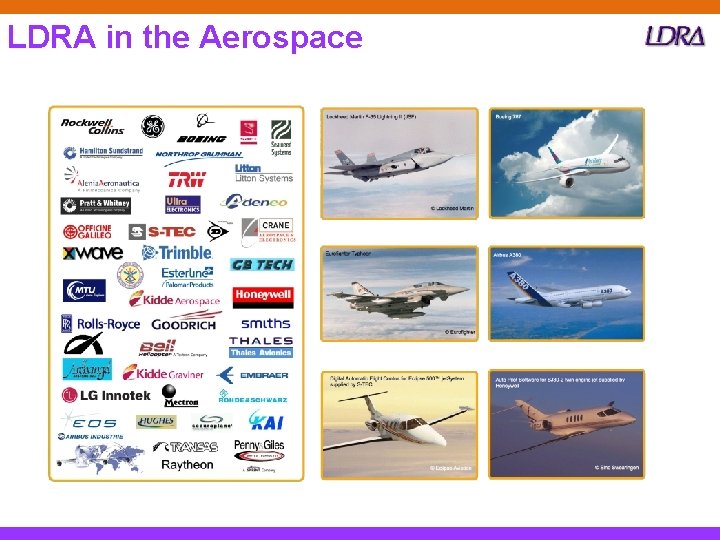
LDRA in the Aerospace
LDRA in Power LDRA ‘Power Tools’
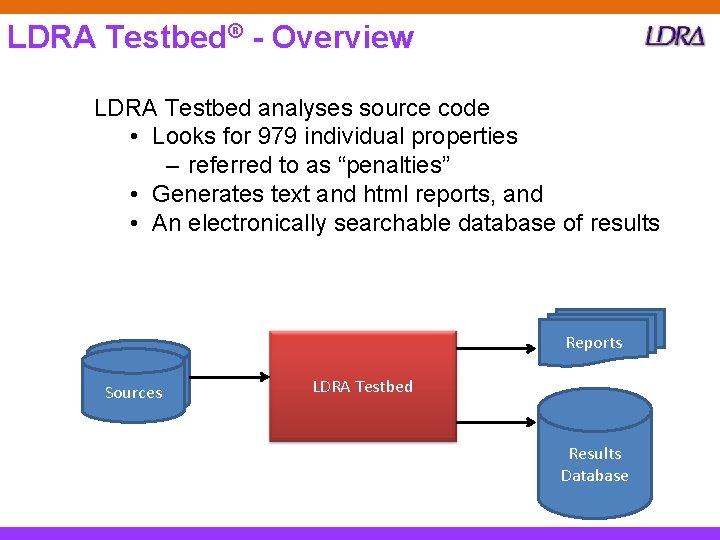
LDRA Testbed® - Overview LDRA Testbed analyses source code • Looks for 979 individual properties – referred to as “penalties” • Generates text and html reports, and • An electronically searchable database of results Reports Sources LDRA Testbed Results Database
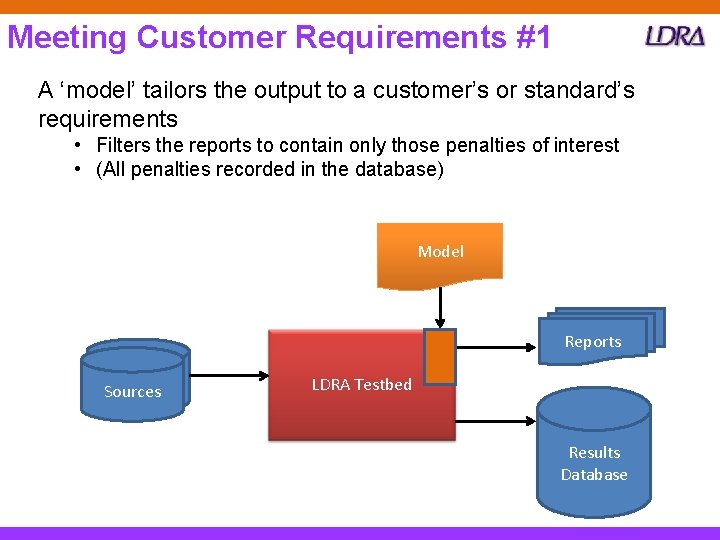
Meeting Customer Requirements #1 A ‘model’ tailors the output to a customer’s or standard’s requirements • Filters the reports to contain only those penalties of interest • (All penalties recorded in the database) Model Reports Sources LDRA Testbed Results Database
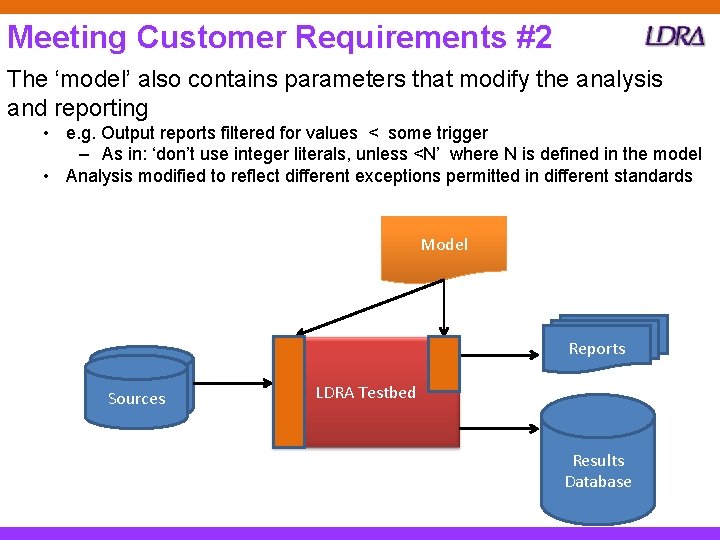
Meeting Customer Requirements #2 The ‘model’ also contains parameters that modify the analysis and reporting • e. g. Output reports filtered for values < some trigger – As in: ‘don’t use integer literals, unless <N’ where N is defined in the model • Analysis modified to reflect different exceptions permitted in different standards Model Reports Sources LDRA Testbed Results Database
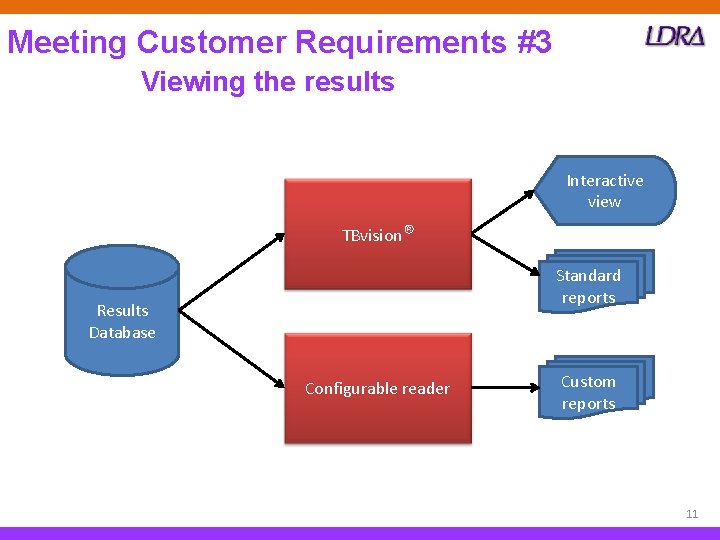
Meeting Customer Requirements #3 Viewing the results Interactive view TBvision® Standard reports Results Database Configurable reader Custom reports 11
SATE tasks • Create a model – Mapping CWE rules to existing penalties • 113 CWE issues mapped to 215 LDRA penalties • Configure a results database reader for SATE specific features – To post-process the analysis results, for manual review – To generate the SATE required XML report • For the synthetic tests – Use the analysis to improve the detection of CWE issues – and reduce false positives – Contextual information, such as “Good”/”Bad” function names used to configure the results reader • For the application tests, such as Dovecot – Sample the 917 files, looking for issues likely to be significant – Repeat the analysis on the fixed code
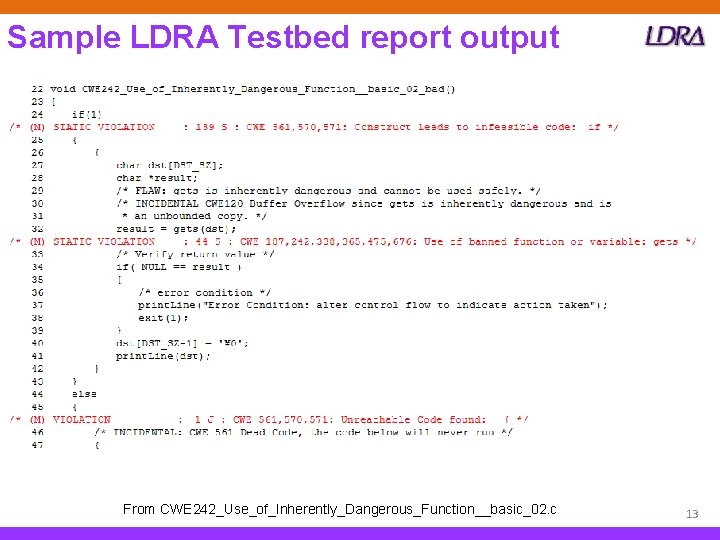
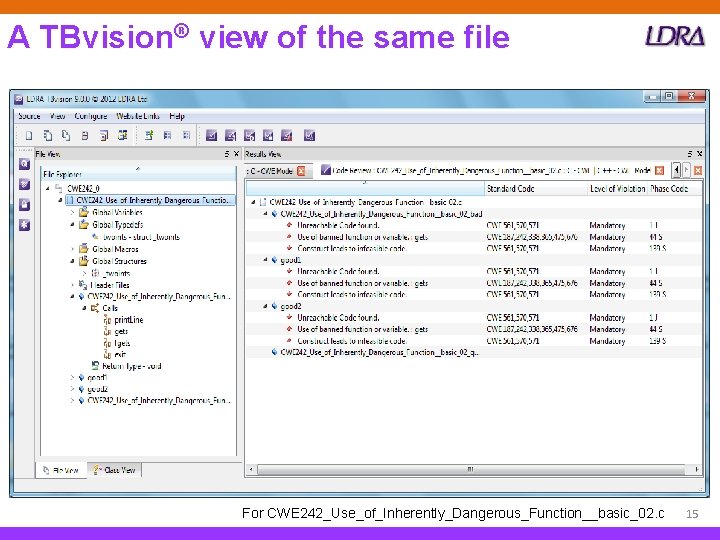
Sample LDRA Testbed report output From CWE 242_Use_of_Inherently_Dangerous_Function__basic_02. c 13
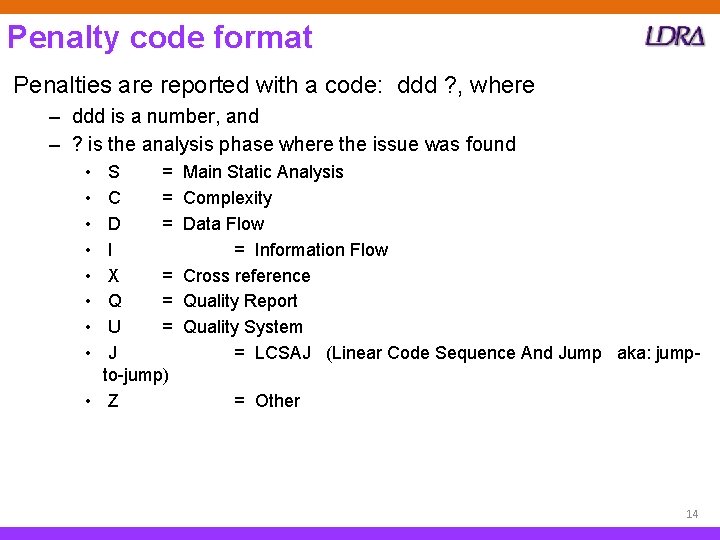
Penalty code format Penalties are reported with a code: ddd ? , where – ddd is a number, and – ? is the analysis phase where the issue was found • • S = C = D = I X = Q = U = J to-jump) • Z Main Static Analysis Complexity Data Flow = Information Flow Cross reference Quality Report Quality System = LCSAJ (Linear Code Sequence And Jump aka: jump= Other 14
A TBvision® view of the same file For CWE 242_Use_of_Inherently_Dangerous_Function__basic_02. c 15
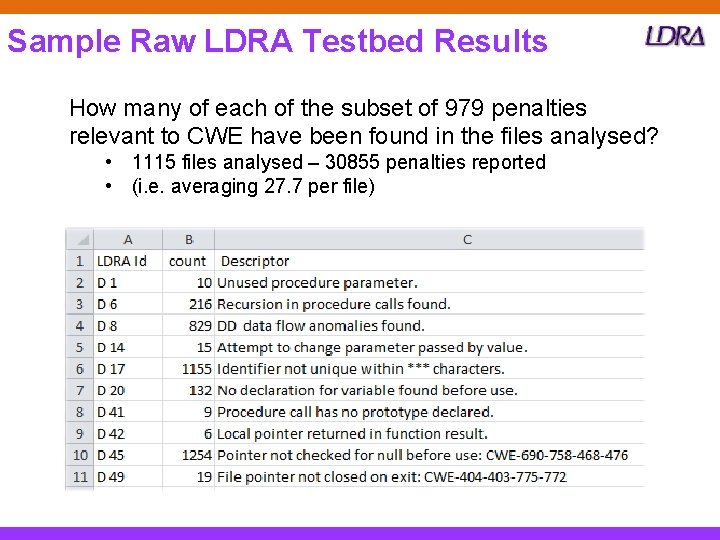
Sample Raw LDRA Testbed Results How many of each of the subset of 979 penalties relevant to CWE have been found in the files analysed? • 1115 files analysed – 30855 penalties reported • (i. e. averaging 27. 7 per file)
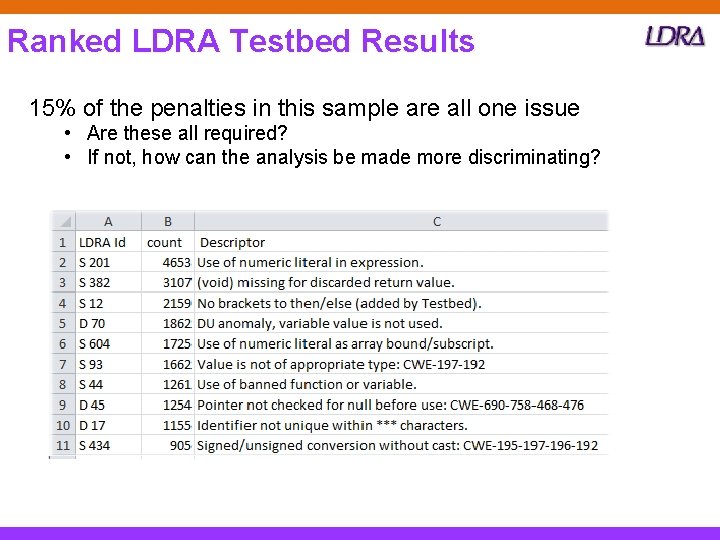
Ranked LDRA Testbed Results 15% of the penalties in this sample are all one issue • Are these all required? • If not, how can the analysis be made more discriminating?
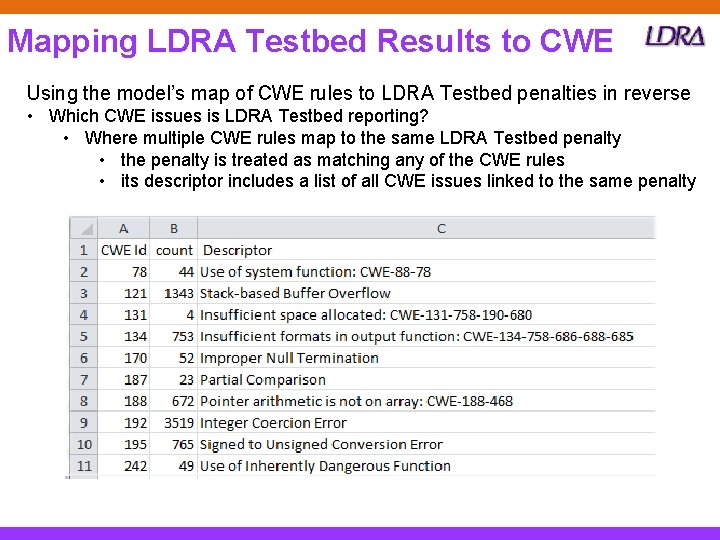
Mapping LDRA Testbed Results to CWE Using the model’s map of CWE rules to LDRA Testbed penalties in reverse • Which CWE issues is LDRA Testbed reporting? • Where multiple CWE rules map to the same LDRA Testbed penalty • the penalty is treated as matching any of the CWE rules • its descriptor includes a list of all CWE issues linked to the same penalty
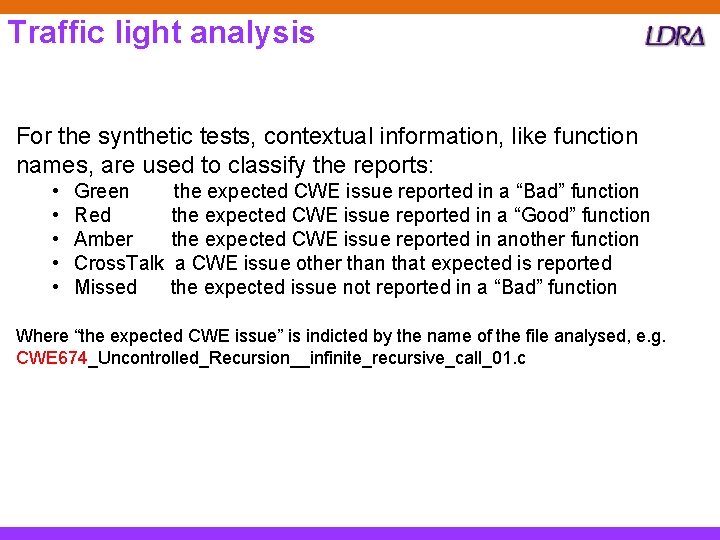
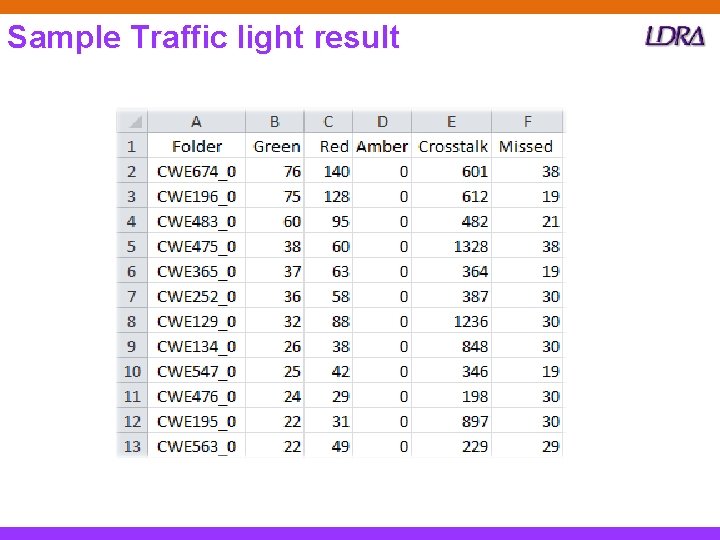
Traffic light analysis For the synthetic tests, contextual information, like function names, are used to classify the reports: • • • Green Red Amber Cross. Talk Missed the expected CWE issue reported in a “Bad” function the expected CWE issue reported in a “Good” function the expected CWE issue reported in another function a CWE issue other than that expected is reported the expected issue not reported in a “Bad” function Where “the expected CWE issue” is indicted by the name of the file analysed, e. g. CWE 674_Uncontrolled_Recursion__infinite_recursive_call_01. c
Sample Traffic light result
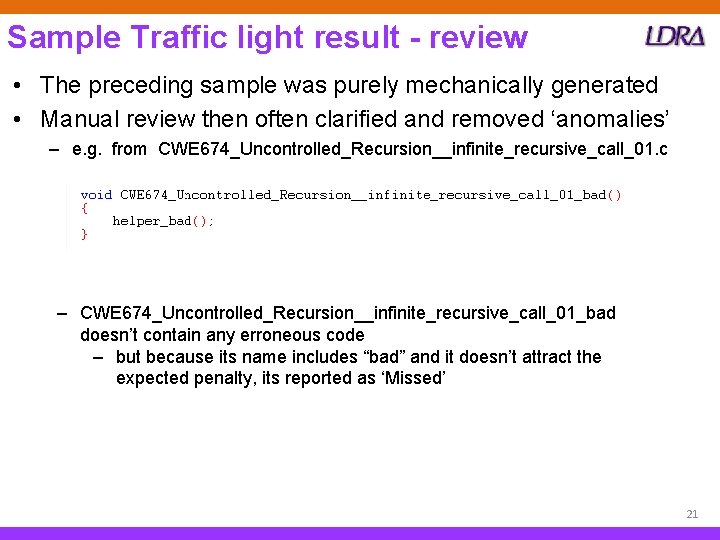
Sample Traffic light result - review • The preceding sample was purely mechanically generated • Manual review then often clarified and removed ‘anomalies’ – e. g. from CWE 674_Uncontrolled_Recursion__infinite_recursive_call_01. c ‒ CWE 674_Uncontrolled_Recursion__infinite_recursive_call_01_bad doesn’t contain any erroneous code ‒ but because its name includes “bad” and it doesn’t attract the expected penalty, its reported as ‘Missed’ 21
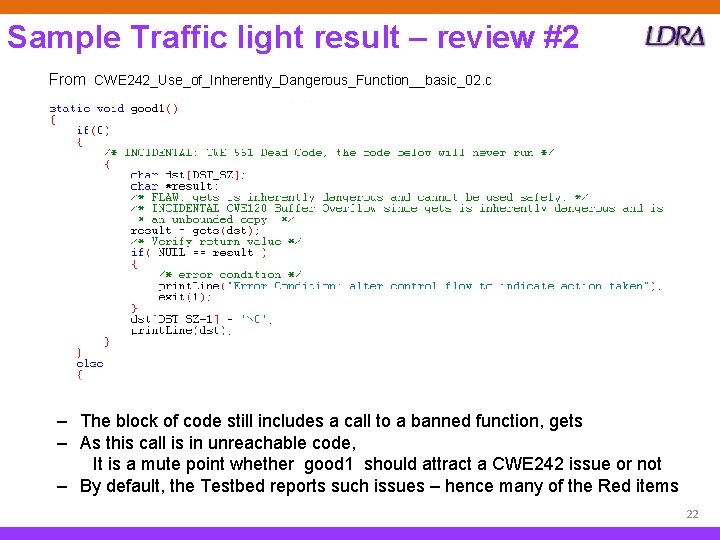
Sample Traffic light result – review #2 From CWE 242_Use_of_Inherently_Dangerous_Function__basic_02. c ‒ The block of code still includes a call to a banned function, gets ‒ As this call is in unreachable code, It is a mute point whether good 1 should attract a CWE 242 issue or not – By default, the Testbed reports such issues – hence many of the Red items 22
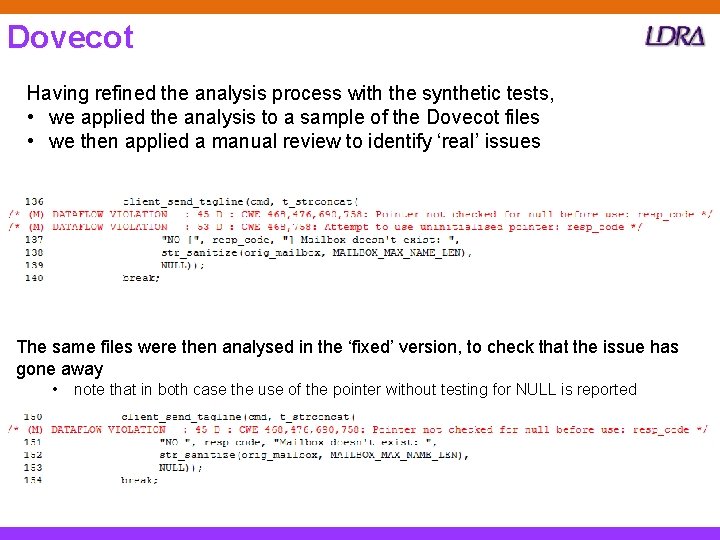
Dovecot Having refined the analysis process with the synthetic tests, • we applied the analysis to a sample of the Dovecot files • we then applied a manual review to identify ‘real’ issues The same files were then analysed in the ‘fixed’ version, to check that the issue has gone away • note that in both case the use of the pointer without testing for NULL is reported
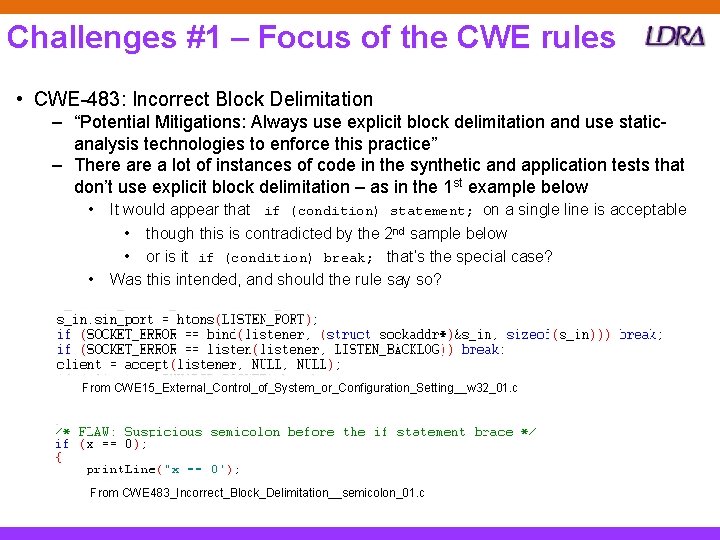
Challenges #1 – Focus of the CWE rules • CWE-483: Incorrect Block Delimitation – “Potential Mitigations: Always use explicit block delimitation and use staticanalysis technologies to enforce this practice” – There a lot of instances of code in the synthetic and application tests that don’t use explicit block delimitation – as in the 1 st example below • • It would appear that if (condition) statement; on a single line is acceptable • though this is contradicted by the 2 nd sample below • or is it if (condition) break; that’s the special case? Was this intended, and should the rule say so? From CWE 15_External_Control_of_System_or_Configuration_Setting__w 32_01. c From CWE 483_Incorrect_Block_Delimitation__semicolon_01. c
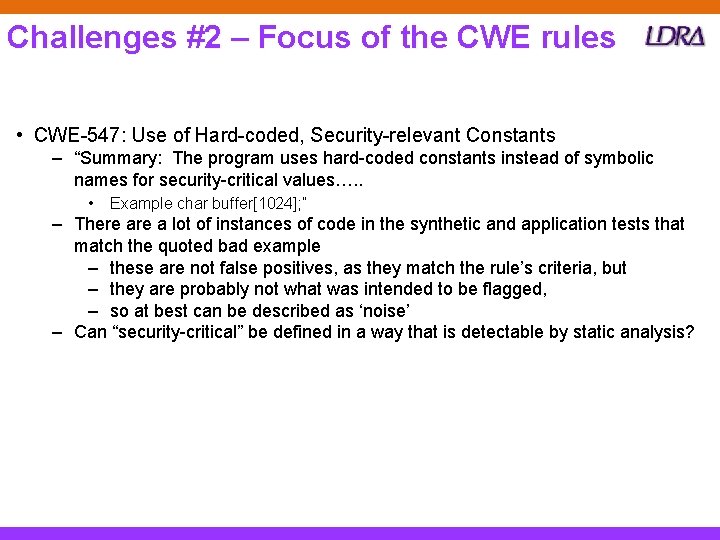
Challenges #2 – Focus of the CWE rules • CWE-547: Use of Hard-coded, Security-relevant Constants – “Summary: The program uses hard-coded constants instead of symbolic names for security-critical values…. . • Example char buffer[1024]; ” – There a lot of instances of code in the synthetic and application tests that match the quoted bad example – these are not false positives, as they match the rule’s criteria, but – they are probably not what was intended to be flagged, – so at best can be described as ‘noise’ – Can “security-critical” be defined in a way that is detectable by static analysis?
Challenges #3 – Focus of the CWE rules Some rules are expressed in a way that is not amenable to static analysis – including some with associated synthetic tests For example: • CWE-222: Truncation of Security-relevant Information – “The application truncates the display, recording, or processing of securityrelevant information in a way that can obscure the source or nature of an attack” • CWE-440: Expected Behavior Violation – “A feature, API, or function being used by a product behaves differently than the product expects” Neither of these rules is the parent of a more detailed requirement Also, the SATE model solution involves recognising the use of specific algorithms and vulnerabilities associated with those algorithms – On the whole, static analysis doesn’t recognise algorithms 26
Conclusions • During the course of the evaluation, we made significant improvement in the accuracy of CWE issue reporting • A holistic approach is needed – mechanical analysis has to be backed up with manual review – The challenge on the analysis is to reduce the manual burden, without loosing issues of concern • ‘Contextual ignoring’ is promoted by security field – our background is largely in safety – software safety ought to be a superset of security, but – the safety domain is inherently pessimistic • the expectation is that all potential issues will be reported – The security domain appears more focussed on outcomes • ‘tell me about issues that will affect the output, not may’ – Hence the requirement for ‘contextual ignoring’ • ‘is the context such that this potential error can be ignored? ’
For further information: www. ldra. com info@ldra. com