
Summary of Information Seen on Musculoskeletal Examination Skin

- Slides: 10
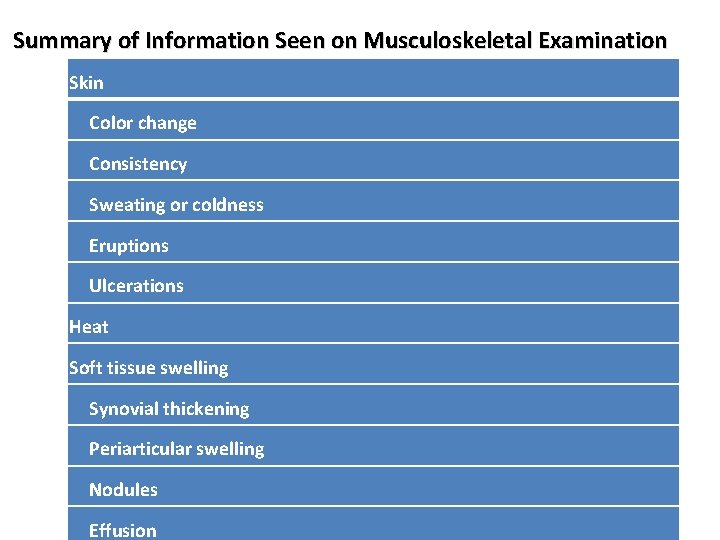
Summary of Information Seen on Musculoskeletal Examination Skin Color change Consistency Sweating or coldness Eruptions Ulcerations Heat Soft tissue swelling Synovial thickening Periarticular swelling Nodules Effusion
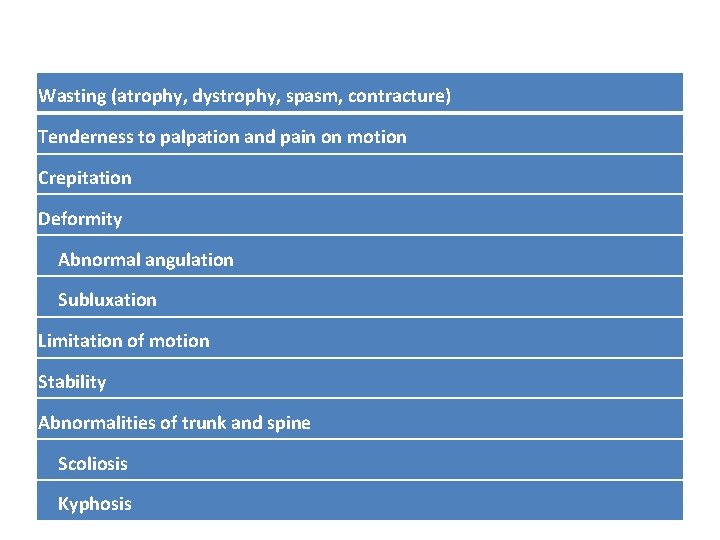
Wasting (atrophy, dystrophy, spasm, contracture) Tenderness to palpation and pain on motion Crepitation Deformity Abnormal angulation Subluxation Limitation of motion Stability Abnormalities of trunk and spine Scoliosis Kyphosis
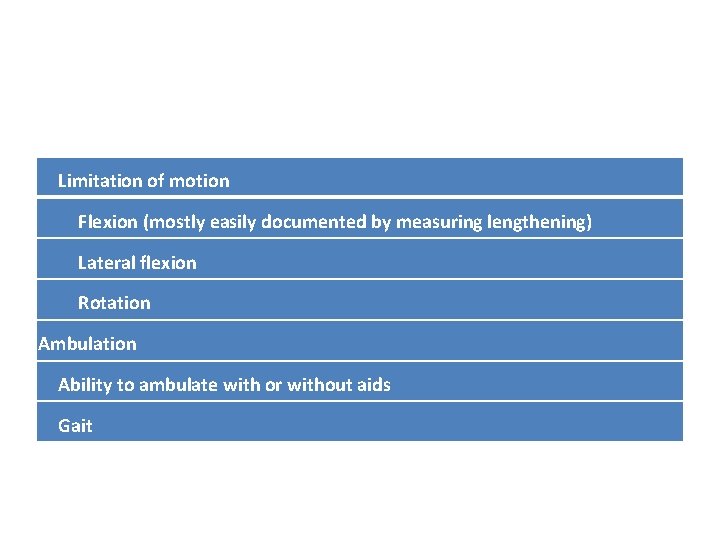
Limitation of motion Flexion (mostly easily documented by measuring lengthening) Lateral flexion Rotation Ambulation Ability to ambulate with or without aids Gait
If abnormalities are detected in the musculoskeletal examination, there are several questions that the examiner should keep in mind while collecting and recording the data: Is the problem a local one or are many areas involved? Is the problem symmetrical? Is the functional abnormality due to: A defect in the forces acting on the joint? A defect in the fulcrum (joint) itself? Are there systemic manifestations (e. g. , rash, fever)?
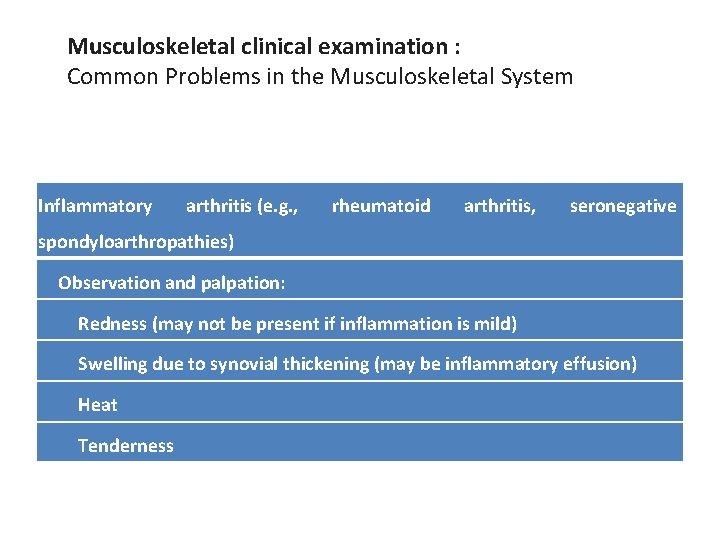
Musculoskeletal clinical examination : Common Problems in the Musculoskeletal System Inflammatory arthritis (e. g. , rheumatoid arthritis, seronegative spondyloarthropathies) Observation and palpation: Redness (may not be present if inflammation is mild) Swelling due to synovial thickening (may be inflammatory effusion) Heat Tenderness
Functional: Limitation of motion due to pain Additional data if problem has been present for a long time (as in the nonspecific inflammatory arthritides such as rheumatoid arthritis): Pain Observation and palpation: Deformity due to subluxation may be present
Functional: Motion may be limited due to: Fibrous contractures of the periarticular soft tissues Joint destruction Joint may be unstable due to: Destruction of cartilage and bone Rupture of tendon(s)
Degenerative joint disease (osteoarthritis) Observation and palpation: Redness and increased warmth may be present if joint is secondarily inflamed due to trauma No palpable synovial thickening Effusion may be present Bony enlargement at joint margins Heberden's nodes on distal interphalangeal joints of fingers Tenderness frequently over tendon insertions and bursae about joints
Functional: Pain on motion Palpable crepitus on passive motion Instability frequently due to loss of cartilage and loosening of capsule Traumatic arthritis Observation and palpation: May be ecchymosis Soft tissue swelling (depending on severity of trauma may involve periarticular tissue or may be limited to effusion within joint capsule) Tenderness to pressure
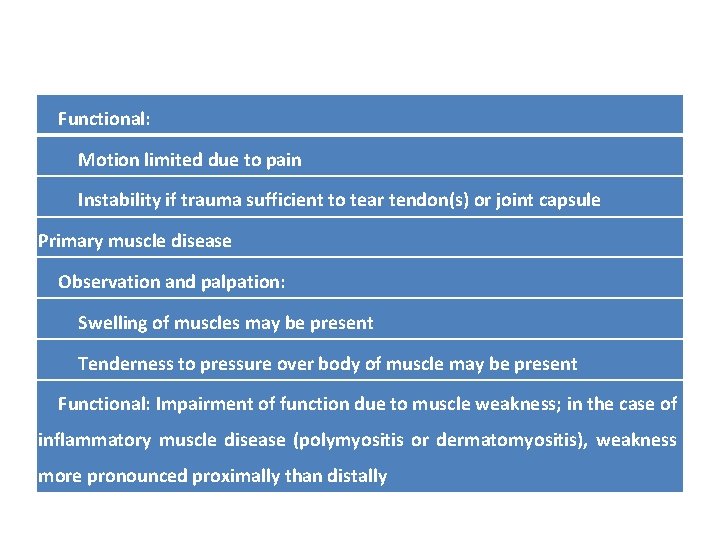
Functional: Motion limited due to pain Instability if trauma sufficient to tear tendon(s) or joint capsule Primary muscle disease Observation and palpation: Swelling of muscles may be present Tenderness to pressure over body of muscle may be present Functional: Impairment of function due to muscle weakness; in the case of inflammatory muscle disease (polymyositis or dermatomyositis), weakness more pronounced proximally than distally