
Summary How to Construct Binary Salt and Mineral
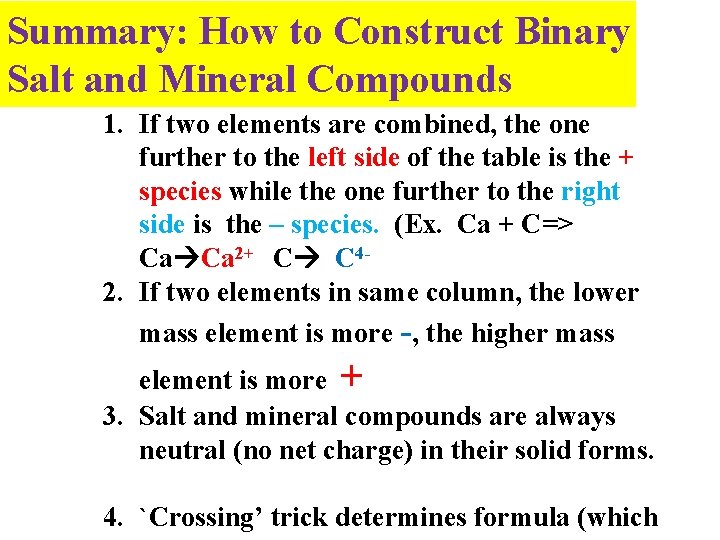
Summary: How to Construct Binary Salt and Mineral Compounds 1. If two elements are combined, the one further to the left side of the table is the + species while the one further to the right side is the – species. (Ex. Ca + C=> Ca Ca 2+ C C 42. If two elements in same column, the lower mass element is more -, the higher mass element is more + 3. Salt and mineral compounds are always neutral (no net charge) in their solid forms. 4. `Crossing’ trick determines formula (which
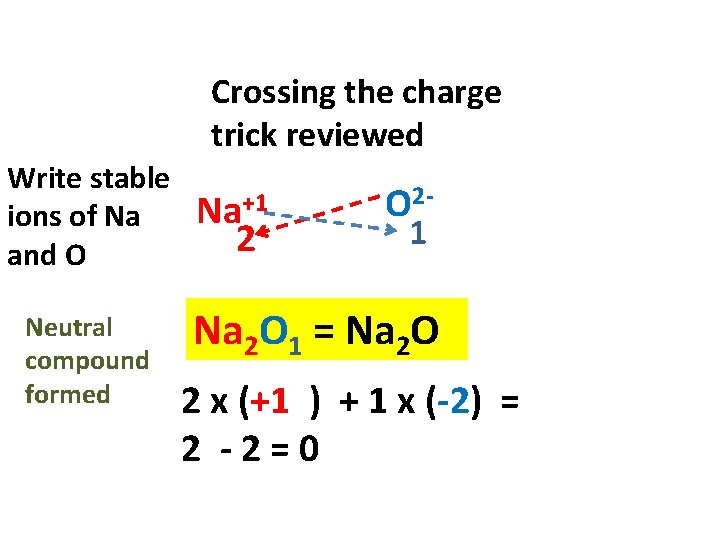
Crossing the charge trick reviewed Write stable ions of Na and O Neutral compound formed Na+1 2 O 21 Na 2 O 1 = Na 2 O 2 x (+1 ) + 1 x (-2) = 2 -2=0
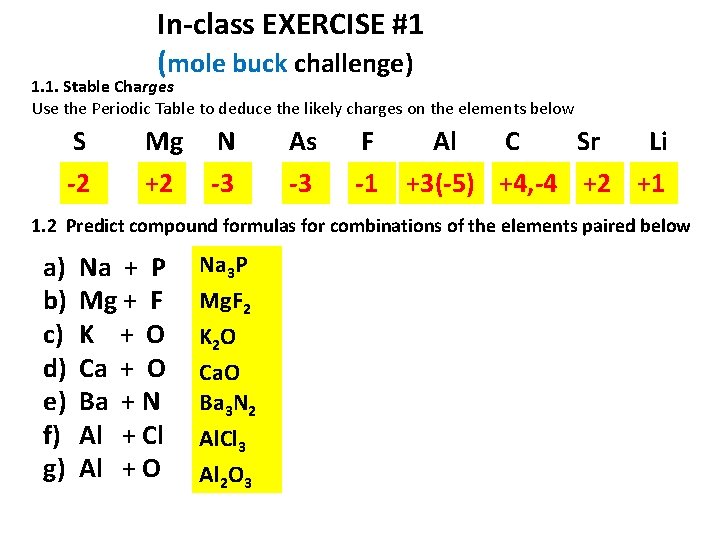
In-class EXERCISE #1 (mole buck challenge) 1. 1. Stable Charges Use the Periodic Table to deduce the likely charges on the elements below S Mg N As F -2 +2 -3 -3 -1 Al C Sr Li +3(-5) +4, -4 +2 +1 1. 2 Predict compound formulas for combinations of the elements paired below a) b) c) d) e) f) g) Na + P Mg + F K + O Ca + O Ba + N Al + Cl Al + O Na 3 P Mg. F 2 K 2 O Ca. O Ba 3 N 2 Al. Cl 3 Al 2 O 3
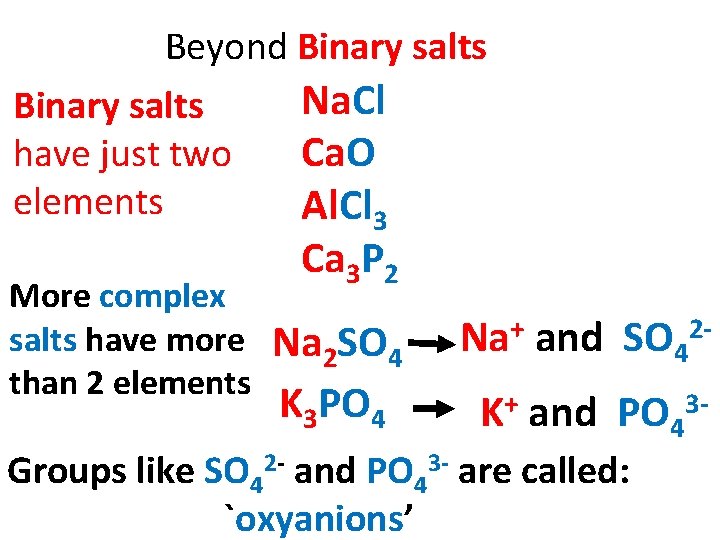
Beyond Binary salts Na. Cl Binary salts have just two Ca. O elements Al. Cl 3 More complex salts have more than 2 elements Ca 3 P 2 Na 2 SO 4 K 3 PO 4 Na+ and SO 42 K+ and PO 43 - Groups like SO 42 - and PO 43 - are called: `oxyanions’
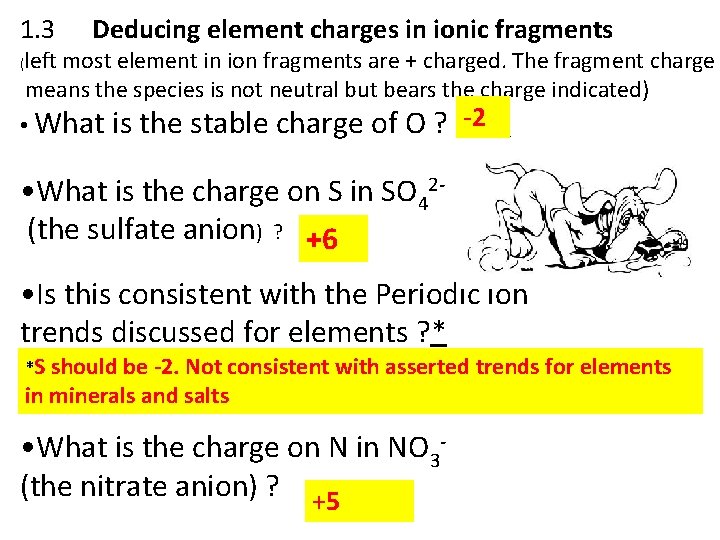
1. 3 ( Deducing element charges in ionic fragments left most element in ion fragments are + charged. The fragment charge means the species is not neutral but bears the charge indicated) -2 • What is the stable charge of O ? ____ • What is the charge on S in SO 42(the sulfate anion) ? +6 _____ • Is this consistent with the Periodic ion trends discussed for elements ? * *S should be -2. Not consistent with asserted trends for elements in minerals and salts • What is the charge on N in NO 3(the nitrate anion) ? ______ +5
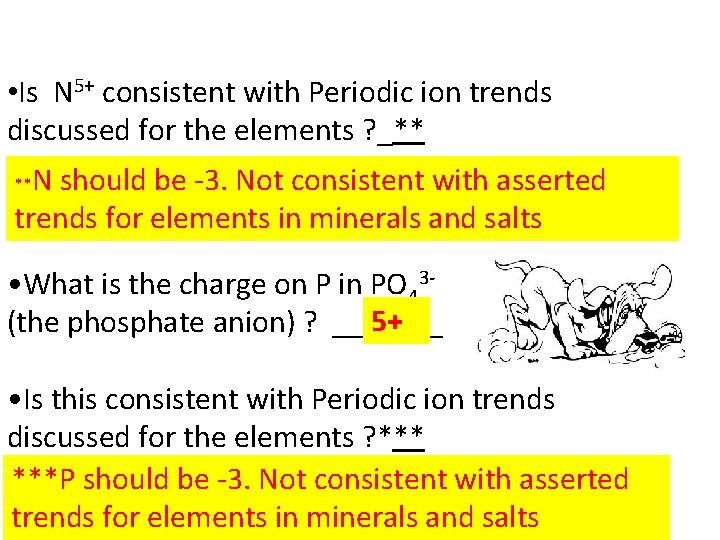
• Is N 5+ consistent with Periodic ion trends discussed for the elements ? _** N should be -3. Not consistent with asserted trends for elements in minerals and salts ** • What is the charge on P in PO 435+ (the phosphate anion) ? _______ • Is this consistent with Periodic ion trends discussed for the elements ? ***P should be -3. Not consistent with asserted • trends for elements in minerals and salts
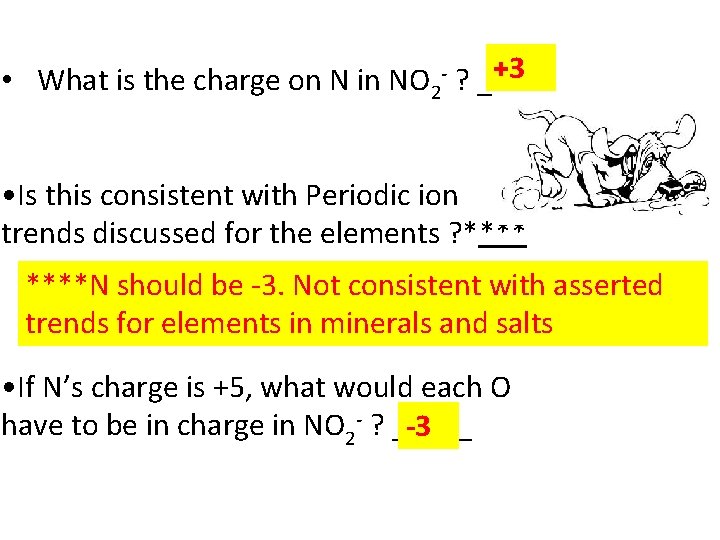
+3 • What is the charge on N in NO 2 - ? _____ • Is this consistent with Periodic ion trends discussed for the elements ? ****N should be -3. Not consistent with asserted trends for elements in minerals and salts • If N’s charge is +5, what would each O have to be in charge in NO 2 - ? _____ -3
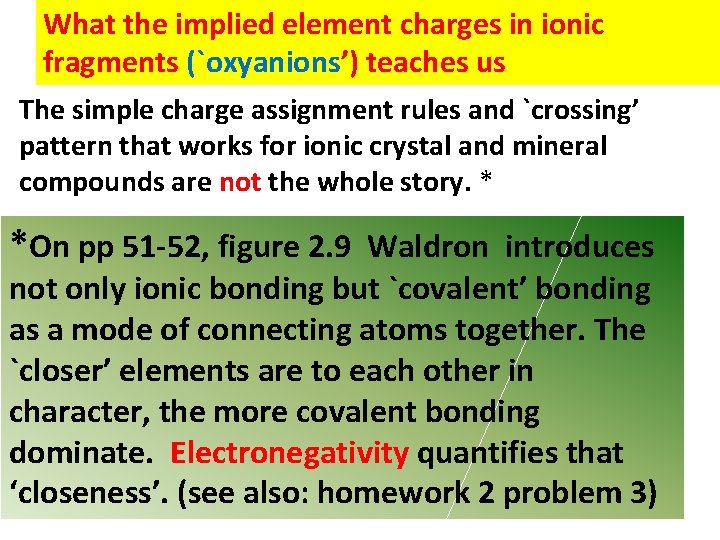
What the implied element charges in ionic fragments (`oxyanions’) teaches us The simple charge assignment rules and `crossing’ pattern that works for ionic crystal and mineral compounds are not the whole story. * *On pp 51 -52, figure 2. 9 Waldron introduces not only ionic bonding but `covalent’ bonding as a mode of connecting atoms together. The `closer’ elements are to each other in character, the more covalent bonding dominate. Electronegativity quantifies that ‘closeness’. (see also: homework 2 problem 3)
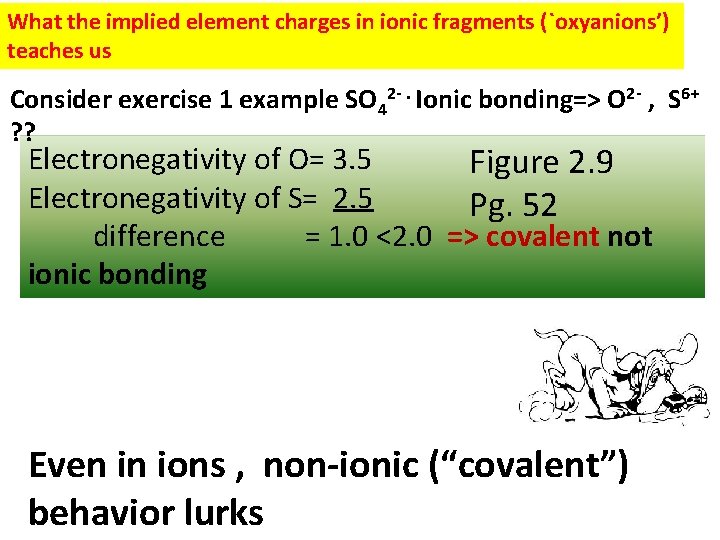
What the implied element charges in ionic fragments (`oxyanions’) teaches us Consider exercise 1 example SO 42 -. Ionic bonding=> O 2 - , S 6+ ? ? Electronegativity of O= 3. 5 Figure 2. 9 Electronegativity of S= 2. 5 Pg. 52 difference = 1. 0 <2. 0 => covalent not ionic bonding Even in ions , non-ionic (“covalent”) behavior lurks
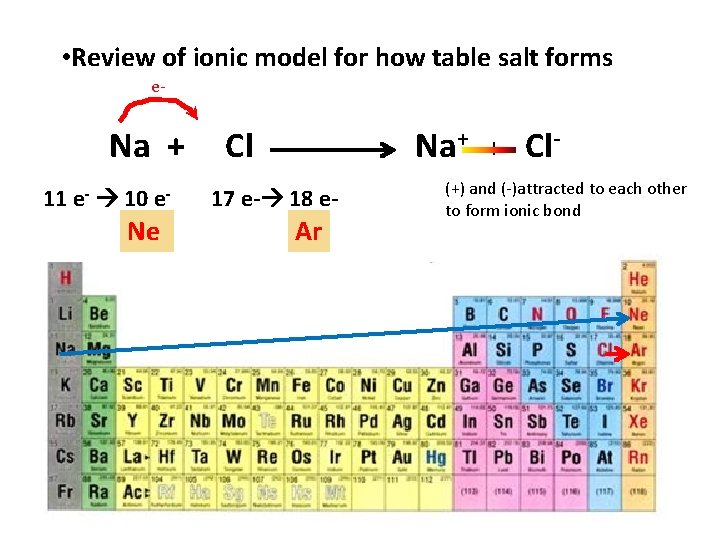
• Review of ionic model for how table salt forms e- Na + 11 e- 10 e- Ne Cl Na+ 17 e- 18 e- Ar + Cl- (+) and (-)attracted to each other to form ionic bond
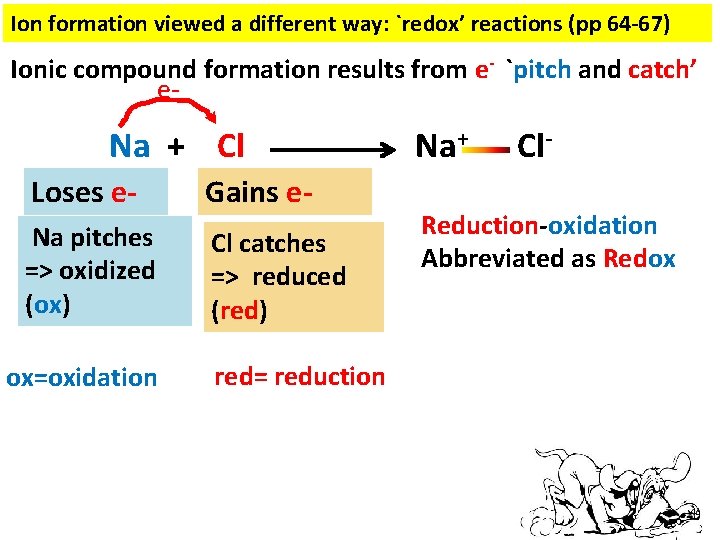
Ion formation viewed a different way: `redox’ reactions (pp 64 -67) Ionic compound formation results from e- `pitch and catch’ e- Na + Cl Loses e- Gains e- Na pitches => oxidized (ox) Cl catches => reduced (red) ox=oxidation red= reduction Na+ Cl- Reduction-oxidation Abbreviated as Redox
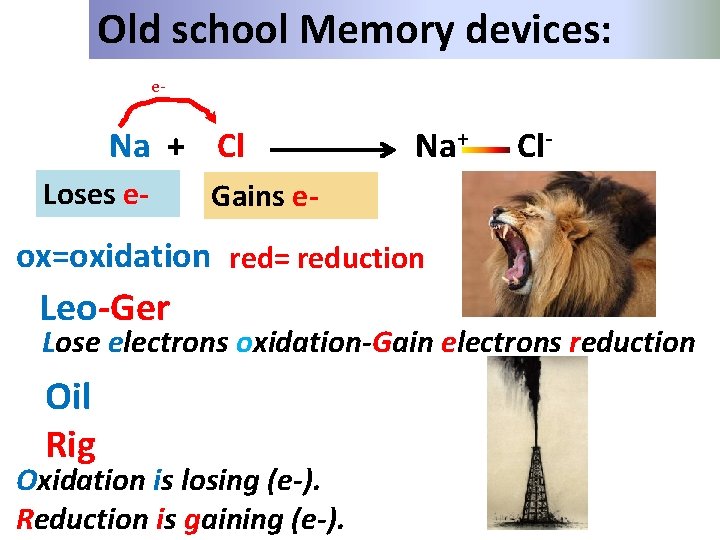
Old school Memory devices: e- Na + Cl Loses e- Na+ Cl- Gains e- ox=oxidation red= reduction Leo-Ger Lose electrons oxidation-Gain electrons reduction Oil Rig Oxidation is losing (e-). Reduction is gaining (e-).
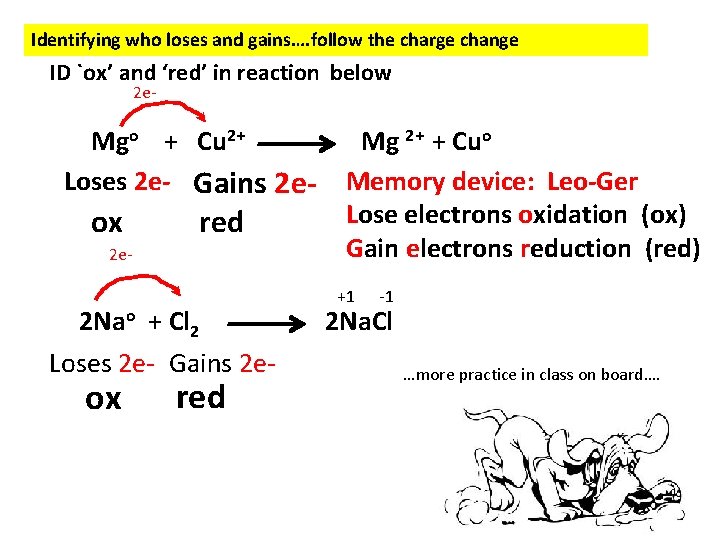
Identifying who loses and gains…. follow the charge change ID `ox’ and ‘red’ in reaction below 2 e- Mgo + Cu 2+ Loses 2 e- Gains 2 e- ox red 2 e- 2 Nao + Cl 2 Loses 2 e- Gains 2 e- ox red Mg 2+ + Cuo Memory device: Leo-Ger Lose electrons oxidation (ox) Gain electrons reduction (red) +1 -1 2 Na. Cl …more practice in class on board….
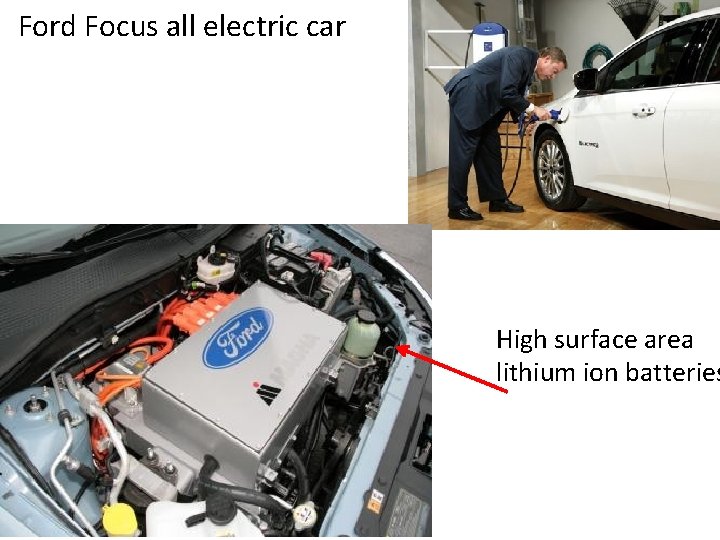
Ford Focus all electric car High surface area lithium ion batteries
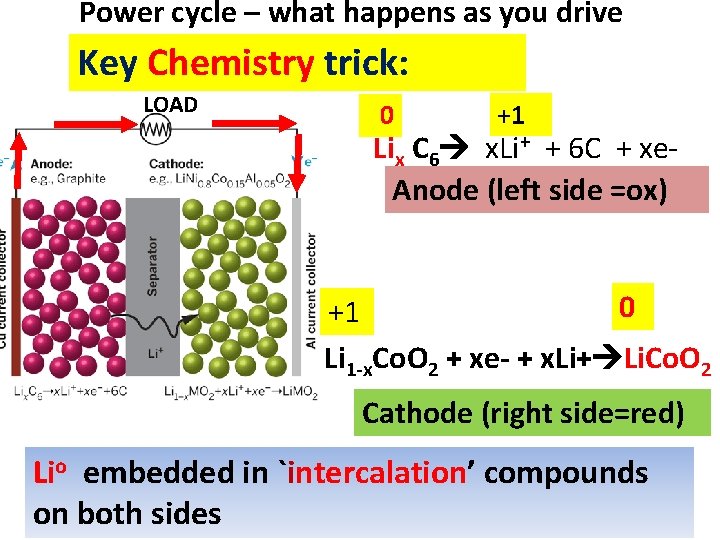
Power cycle – what happens as you drive Key Chemistry trick: 0 LOAD +1 Lix C 6 x. Li+ + 6 C + xe. Anode (left side =ox) 0 +1 Li 1 -x. Co. O 2 + xe- + x. Li+ Li. Co. O 2 Cathode (right side=red) Lio embedded in `intercalation’ compounds on both sides

http: //www. youtube. com/watch? v=6 ev. FK 8 y-zdw
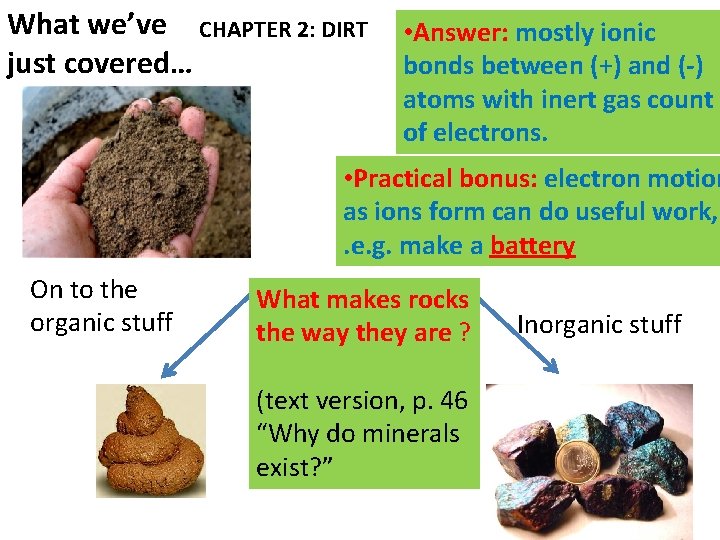
What we’ve CHAPTER 2: DIRT just covered… • Answer: mostly ionic bonds between (+) and (-) atoms with inert gas count of electrons. • Practical bonus: electron motion as ions form can do useful work, . e. g. make a battery On to the organic stuff What makes rocks the way they are ? (text version, p. 46 “Why do minerals exist? ” Inorganic stuff
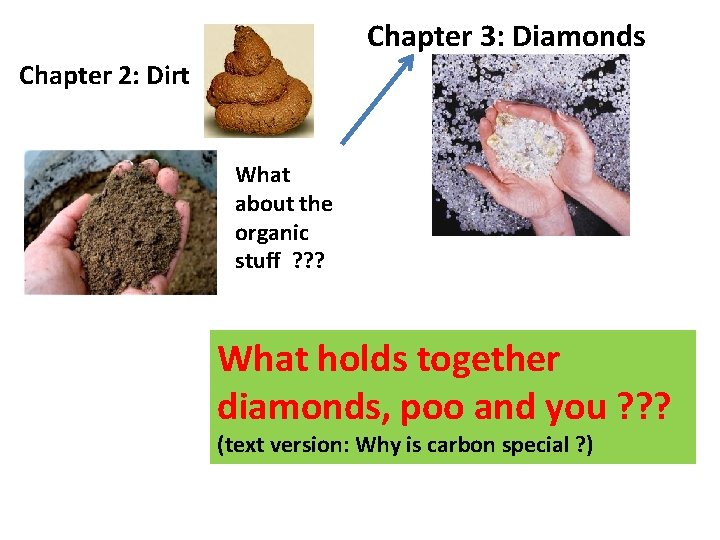
Chapter 3: Diamonds Chapter 2: Dirt What about the organic stuff ? ? ? What holds together diamonds, poo and you ? ? ? (text version: Why is carbon special ? )
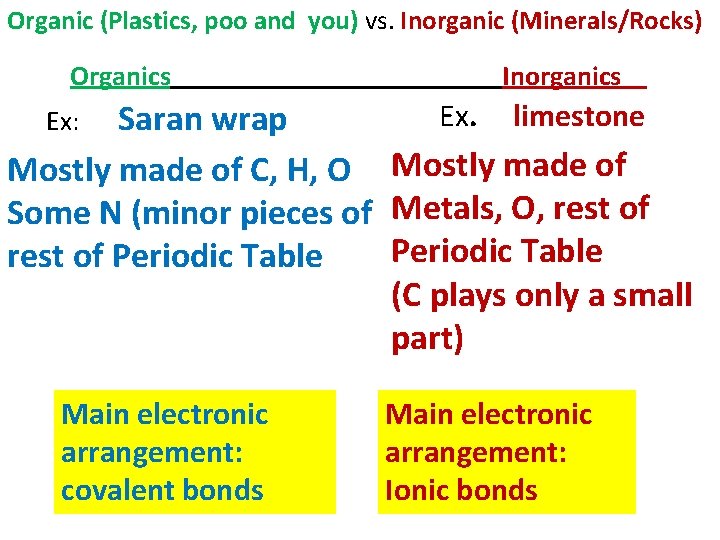
Organic (Plastics, poo and you) vs. Inorganic (Minerals/Rocks) Organics Inorganics Ex. limestone Saran wrap Mostly made of C, H, O Mostly made of Some N (minor pieces of Metals, O, rest of Periodic Table (C plays only a small part) Ex: Main electronic arrangement: covalent bonds Main electronic arrangement: Ionic bonds
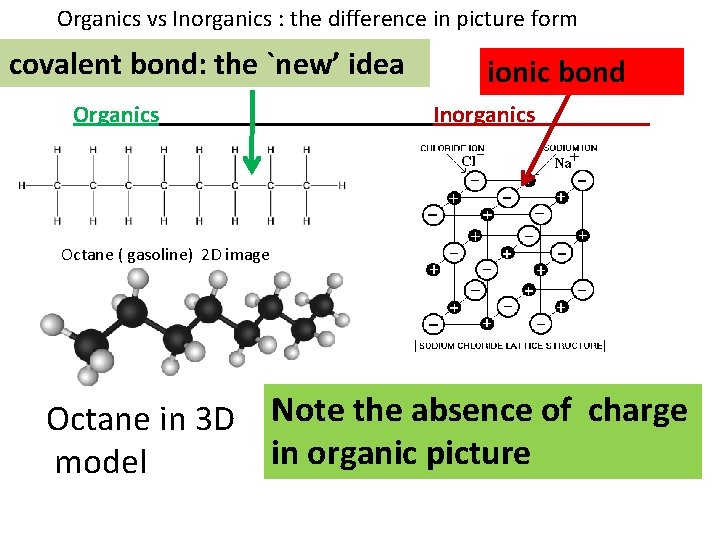
Organics vs Inorganics : the difference in picture form covalent bond: the `new’ idea Organics ionic bond Inorganics Octane ( gasoline) 2 D image Octane in 3 D model Note the absence of charge in organic picture
Language basics of the `covalent’ bond Other common names for covalent bond • Electron pair bond • Valence bond or valence pair bond • Lewis pair bond • Shared electron bond
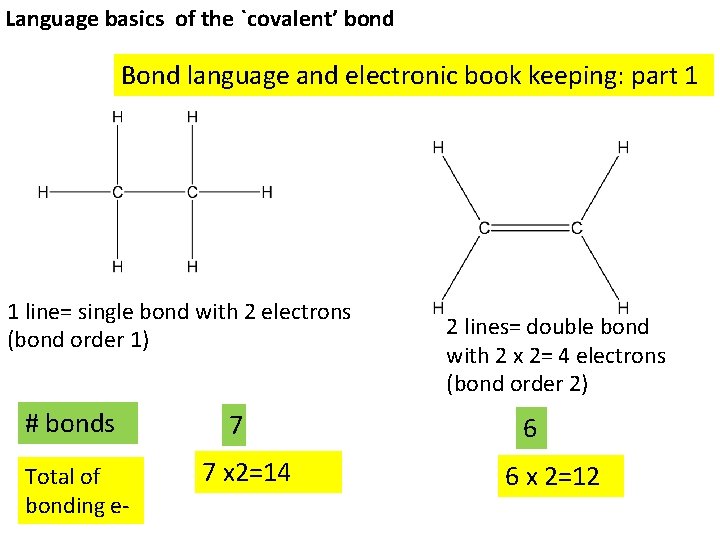
Language basics of the `covalent’ bond Bond language and electronic book keeping: part 1 1 line= single bond with 2 electrons (bond order 1) # bonds Total of bonding e- 7 7 x 2=14 2 lines= double bond with 2 x 2= 4 electrons (bond order 2) 6 6 x 2=12
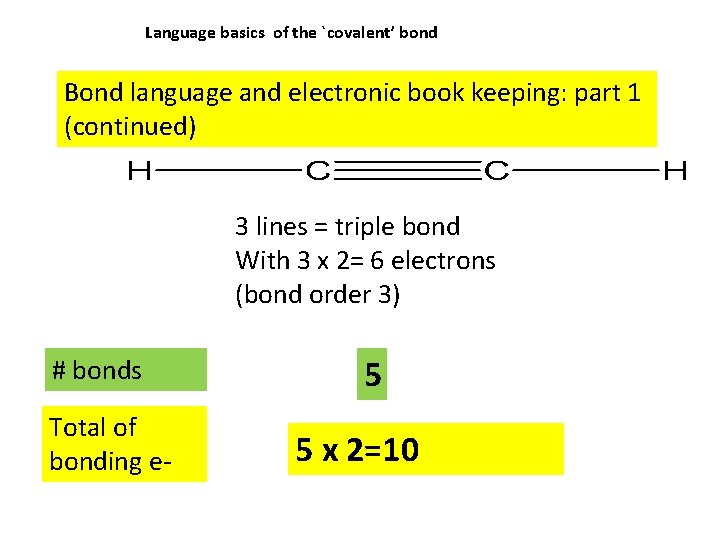
Language basics of the `covalent’ bond Bond language and electronic book keeping: part 1 (continued) 3 lines = triple bond With 3 x 2= 6 electrons (bond order 3) # bonds Total of bonding e- 5 5 x 2=10
In-class Board practice counting bonds and electrons for organics
- Slides: 24