
Summary 1 Learning Theories politics and power timeline
- Slides: 4
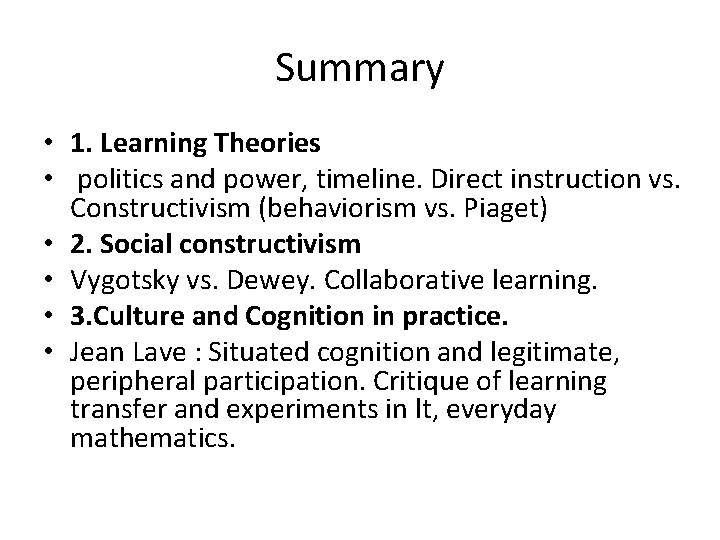
Summary • 1. Learning Theories • politics and power, timeline. Direct instruction vs. Constructivism (behaviorism vs. Piaget) • 2. Social constructivism • Vygotsky vs. Dewey. Collaborative learning. • 3. Culture and Cognition in practice. • Jean Lave : Situated cognition and legitimate, peripheral participation. Critique of learning transfer and experiments in lt, everyday mathematics.
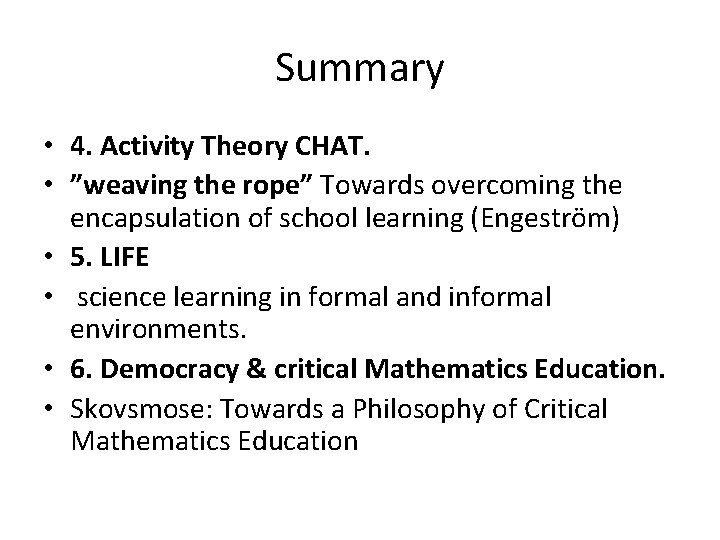
Summary • 4. Activity Theory CHAT. • ”weaving the rope” Towards overcoming the encapsulation of school learning (Engeström) • 5. LIFE • science learning in formal and informal environments. • 6. Democracy & critical Mathematics Education. • Skovsmose: Towards a Philosophy of Critical Mathematics Education
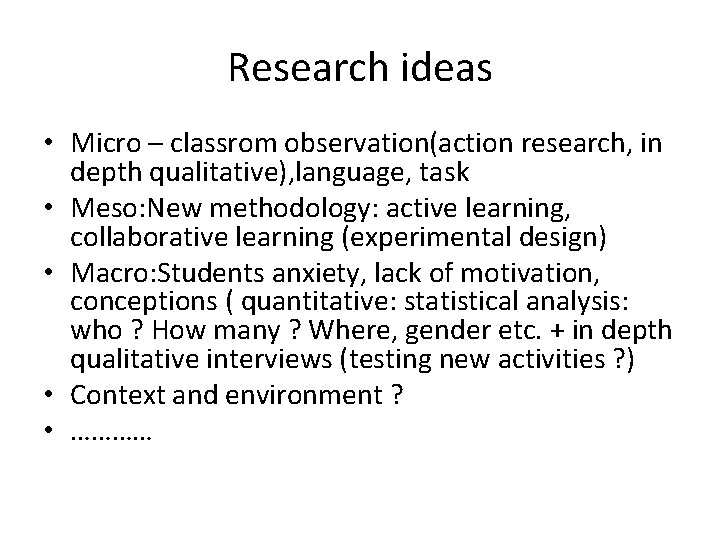
Research ideas • Micro – classrom observation(action research, in depth qualitative), language, task • Meso: New methodology: active learning, collaborative learning (experimental design) • Macro: Students anxiety, lack of motivation, conceptions ( quantitative: statistical analysis: who ? How many ? Where, gender etc. + in depth qualitative interviews (testing new activities ? ) • Context and environment ? • …………
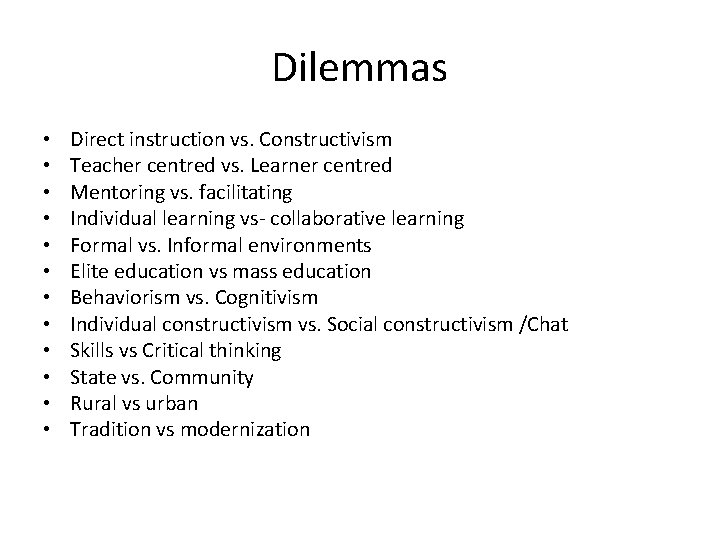
Dilemmas • • • Direct instruction vs. Constructivism Teacher centred vs. Learner centred Mentoring vs. facilitating Individual learning vs- collaborative learning Formal vs. Informal environments Elite education vs mass education Behaviorism vs. Cognitivism Individual constructivism vs. Social constructivism /Chat Skills vs Critical thinking State vs. Community Rural vs urban Tradition vs modernization