
Summarizing Getting to the Point The MAIN IDEA

- Slides: 21
Summarizing Getting to the Point (The MAIN IDEA)
Summary Short account of the central ideas of a text Summaries are not a place for… § Opinions § Background knowledge § Very specific details – even if they are very interesting
How To Summarize Nonfiction 1. Read the text. 2. Ask: – Who? – What? – When? – Where? – Why?
Mary had a little lamb whose fur was white as snow, and everywhere that Mary went the lamb was sure to go. It followed her to school one day, which was against the rules, and made the children laugh and play to see a lamb in school.
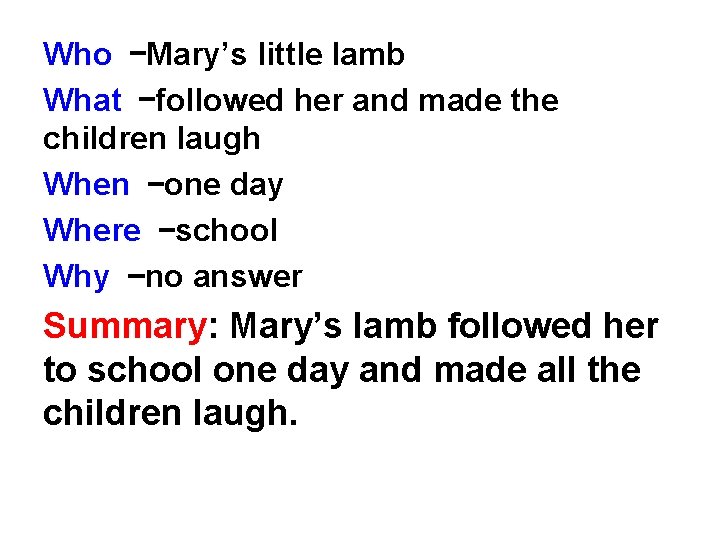
Who –Mary’s little lamb What –followed her and made the children laugh When –one day Where –school Why –no answer Summary: Mary’s lamb followed her to school one day and made all the children laugh.
How To Summarize Fiction A good tool for fiction summary is this formula: Someone wanted…but…so…then. …
The itsy bitsy spider went up the water spout. Down came the rain and washed the spider out. Out came the sun and dried up all the rain. And the itsy bitsy spider went up the spout again.
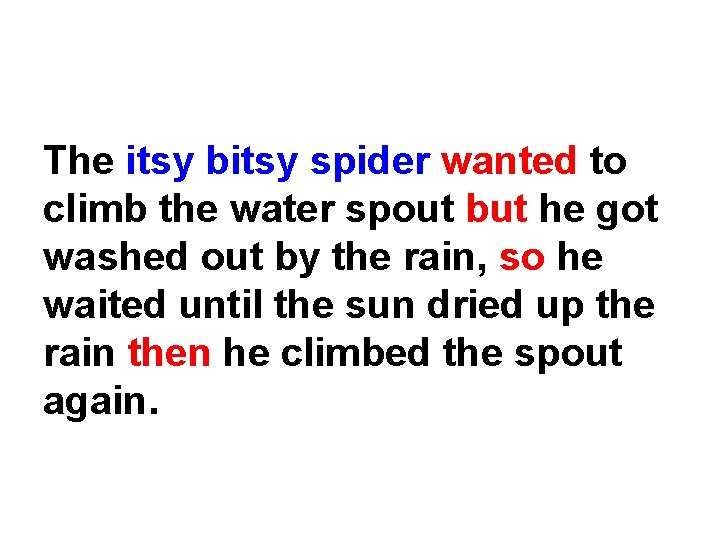
The itsy bitsy spider wanted to climb the water spout but he got washed out by the rain, so he waited until the sun dried up the rain then he climbed the spout again.
To create summaries without these models/tools, just remember: Your Answer… § Should be in complete sentences § Should cover main point and key ideas § Should be in your own words § Shouldn’t just be a word or two
Should It Go in My Summary? Only major ideas and necessary information should go into a summary. Ask yourself: “Do you need this information to understand the text? ” If the answer is yes, put it into your own words in your summary.
Main Idea and Key Points The main idea is what the text is about. Key points are arguments or information that are used to support the main idea. Key points may be developed or elaborated with supporting details. Your summary should only include main ideas and VERY IMPORTANT key points, not supporting details.
Main Idea and Summary If you are creating a one-sentence summary of a passage or a paragraph, you are basically stating the MAIN IDEA. When you go beyond one sentence to describe what’s going on in a passage, you are basically creating SUMMARY. MAIN IDEA and SUMMARY are LINKED.
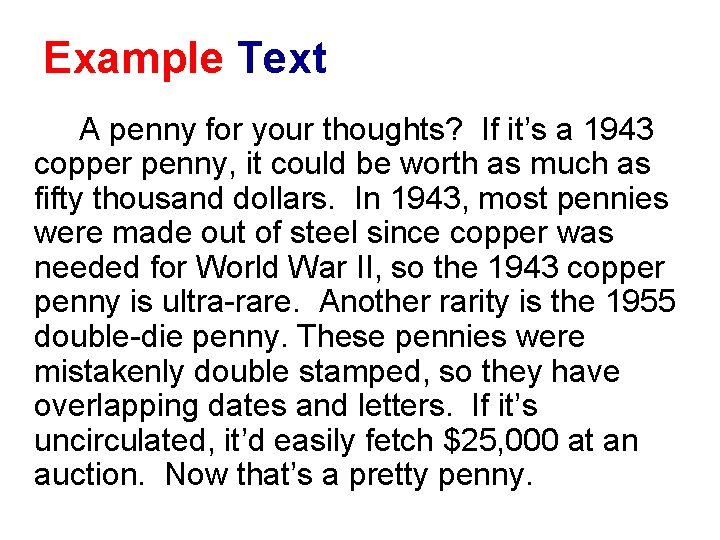
Example Text A penny for your thoughts? If it’s a 1943 copper penny, it could be worth as much as fifty thousand dollars. In 1943, most pennies were made out of steel since copper was needed for World War II, so the 1943 copper penny is ultra-rare. Another rarity is the 1955 double-die penny. These pennies were mistakenly double stamped, so they have overlapping dates and letters. If it’s uncirculated, it’d easily fetch $25, 000 at an auction. Now that’s a pretty penny.
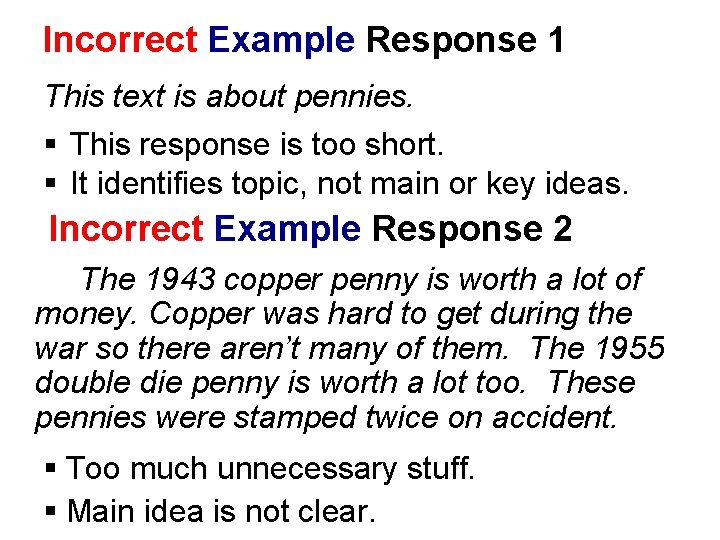
Incorrect Example Response 1 This text is about pennies. § This response is too short. § It identifies topic, not main or key ideas. Incorrect Example Response 2 The 1943 copper penny is worth a lot of money. Copper was hard to get during the war so there aren’t many of them. The 1955 double die penny is worth a lot too. These pennies were stamped twice on accident. § Too much unnecessary stuff. § Main idea is not clear.
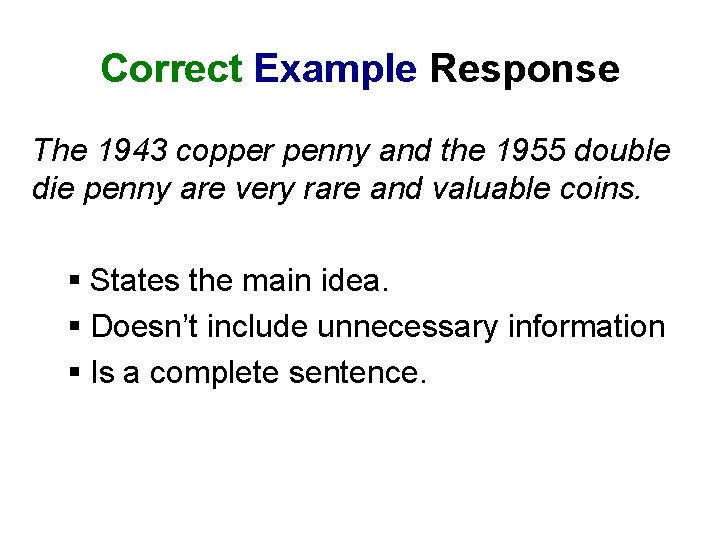
Correct Example Response The 1943 copper penny and the 1955 double die penny are very rare and valuable coins. § States the main idea. § Doesn’t include unnecessary information § Is a complete sentence.
Practice Summarizing nursery rhymes. Directions 1. We will read each nursery rhyme. 2. Summarize the nursery rhyme in one sentence. 3. Include key information/main idea. 4. We will discuss our answers.
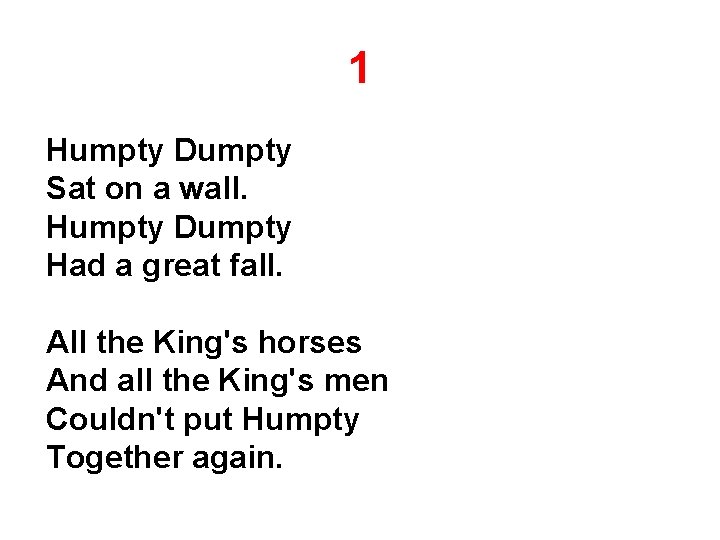
1 Humpty Dumpty Sat on a wall. Humpty Dumpty Had a great fall. All the King's horses And all the King's men Couldn't put Humpty Together again.
2 Old Mother Hubbard Went to the cupboard To give her poor dog a bone. But when she got there The cupboard was bare, And so the poor dog had none.
3 Jack and Jill went up the hill, To fetch a pail of water. Jack fell down and broke his crown, And Jill came tumbling after. Up Jack got and home did trot, As fast as he could caper, And went to bed to mend his head With vinegar and brown paper.
4 Little Miss Muffet Sat on a tuffet, Eating some curds and whey. Along came a spider Who sat down beside her And frightened Miss Muffet away.
Example Answers 1. An egg fell off a wall and broke, and no one could fix it. 2. An woman found she had no food to feed her dog. 3. A boy fell, hurt his head, and went home to have it bandaged. 4. A spider scared away a girl who was trying to have her lunch.