
Summarizing and Note Taking Thought for the Day

![Quick Write n "What [summarizing and note-taking] both have in common is the notion](https://slidetodoc.com/presentation_image_h2/15138cfda586557faed1f044e891a15a/image-8.jpg "Quick Write n \"What [summarizing and note-taking] both have in common is the notion")
![References Marzano, R. J. [et al. ] (2001). A Handbook for Classroom Instruction that](https://slidetodoc.com/presentation_image_h2/15138cfda586557faed1f044e891a15a/image-18.jpg "References Marzano, R. J. [et al. ] (2001). A Handbook for Classroom Instruction that")
- Slides: 18
Summarizing and Note. Taking
Thought for the Day “The important thing in science is not so much to obtain new facts as to discover new ways of thinking about them. ”
Graffiti Mat
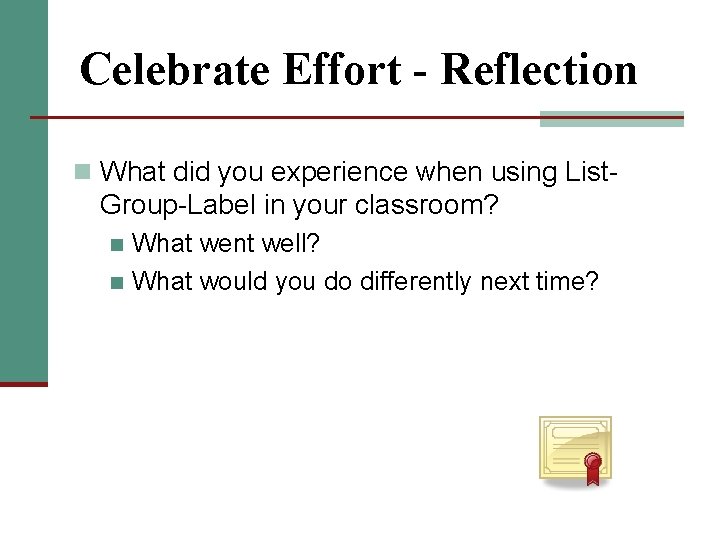
Celebrate Effort - Reflection n What did you experience when using List- Group-Label in your classroom? What went well? n What would you do differently next time? n
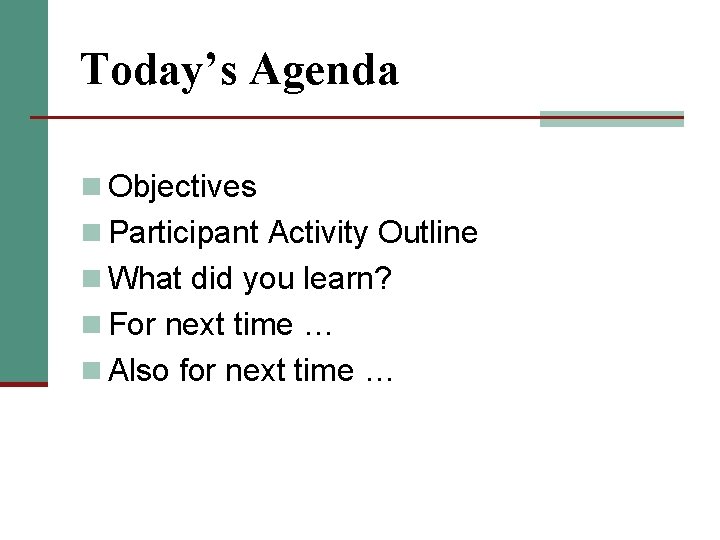
Today’s Agenda n Objectives n Participant Activity Outline n What did you learn? n For next time … n Also for next time …
Objectives After completing Session Nine and its fieldwork, teacher participants will be able to … n utilize the online modules. n describe the specific strategies, research generalizations, and resulting classroom implications for the summarizing and notetaking strategies.
Objectives (Continued) n recognize the ways in which they currently use the summarizing and note-taking strategies as part of their practice. n recognize when these instructional strategies are used appropriately and meaningfully at their grade level range. n assess their own use of the instructional strategies in their classrooms.
Quick Write n "What [summarizing and note-taking] both have in common is the notion that the student is taking what's out there – what the teacher said, or what they read, or what they observed – and they're encoding it themselves. They're putting their own translation on it. And that's the critical aspect of this category. " - Robert Marzano, Mc. REL
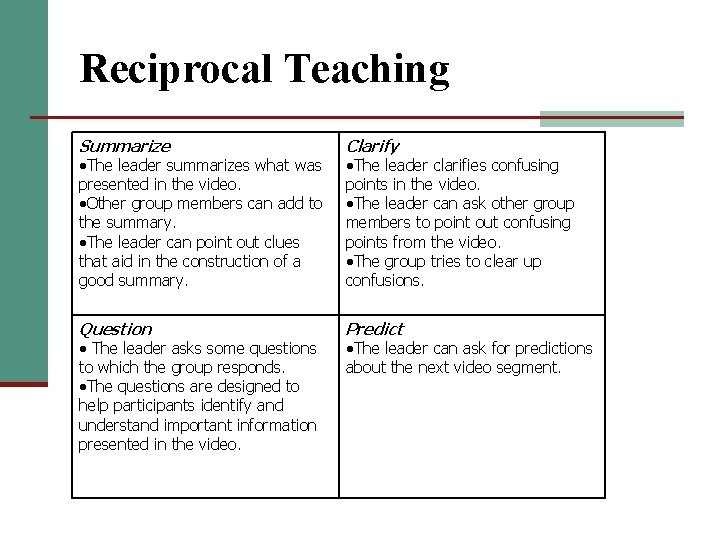
Reciprocal Teaching Summarize The leader summarizes what was Clarify The leader clarifies confusing Question The leader asks some questions Predict The leader can ask for predictions presented in the video. Other group members can add to the summary. The leader can point out clues that aid in the construction of a good summary. to which the group responds. The questions are designed to help participants identify and understand important information presented in the video. points in the video. The leader can ask other group members to point out confusing points from the video. The group tries to clear up confusions. about the next video segment.
Questions n What changes might you make in your classroom related to summarizing and notetaking? n What kinds of explicit modeling or guided practice might you need to provide for your students? n What steps might you take next?
Rule-Based Summary Strategy n Delete trivial material that is unnecessary to understanding n Delete redundant material n Substitute super ordinate terms for lists (e. g. , “flowers” for “daisies, tulips, and roses”) n Select a topic sentence, or invent one if it is missing
Summary Frames n Of all the summary frames, which is the best to use with your specific content area. Why?
Objectives After completing Session Nine and its fieldwork, teacher participants will be able to … n utilize the online modules. n describe the specific strategies, research generalizations, and resulting classroom implications for the summarizing and notetaking strategies.
Objectives (Continued) n recognize the ways in which they currently use the summarizing and note-taking strategies as part of their practice. n recognize when these instructional strategies are used appropriately and meaningfully at their grade level range. n assess their own use of the instructional strategies in their classrooms.
For next time … n Test out your Experimental Inquiry hypothesis n Are you ready to use the summary frame or combination notes in your classroom? n Write a half-page reflection on your experiences. n n n What went well? What would you do differently next time? Be prepared to share
Also for next time … n Be sure to participate in the online discussion. n Our focus will be on the “Generating and Testing Hypotheses” strategy. n To prepare, please skim Chapter 9 of Classroom Instruction that Works. n Use the advance organizer for Generating and Testing Hypotheses.
Any Questions?
References Marzano, R. J. [et al. ] (2001). A Handbook for Classroom Instruction that Works. Alexandria, VA: Association for Supervision and Curriculum Development. Marzano, R. J. , Pickering, D. J. , and Pollock, J. E. (2005). Classroom Instruction that Works: Researchbased Strategies for Increasing Student Achievement. Upper Saddle River, NJ: Pearson Education, Inc.