
Summarisation The Incredible Shrinking Information Summaries The Basics

Summarisation The Incredible Shrinking Information
Summaries: The Basics What is summarising? • Summarising involves taking the main ideas from a piece of text and rewriting them in your own words. A summary is significantly shorter than the original text and tends to give an overview of a topic area.
Summaries: The Basics Tips for summarising • Highlight the main ideas in the text you want to summarise (do not include any minor details) • Combine these ideas together in your own words • Correctly interpret the original • Do not include your own opinion or add extra information
Summaries: The Basics Tips for summarising • Use your own words and not those of the original author (unless using quotation marks) • Remember to cite your source using a recognised referencing format • Keep reminding your reader that you are summarising the work of someone else: – The author goes on to say that. . . – The text further states that. . .
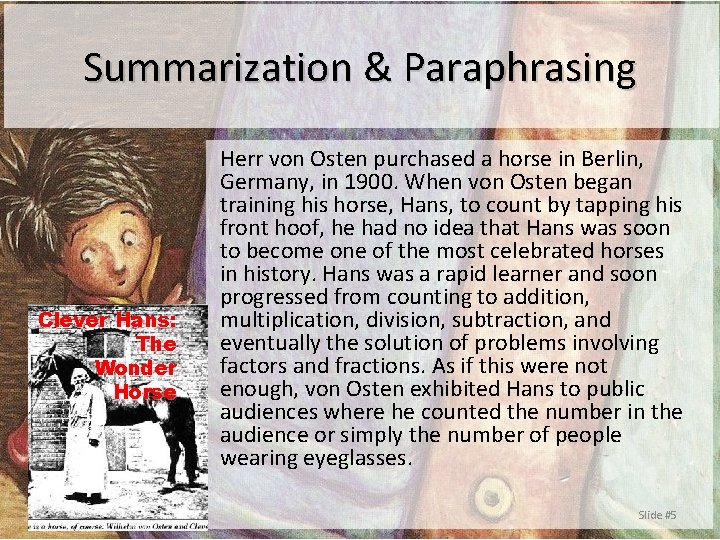
Summarization & Paraphrasing Clever Hans: The Wonder Horse Last edited January 2, 2022 Herr von Osten purchased a horse in Berlin, Germany, in 1900. When von Osten began training his horse, Hans, to count by tapping his front hoof, he had no idea that Hans was soon to become one of the most celebrated horses in history. Hans was a rapid learner and soon progressed from counting to addition, multiplication, division, subtraction, and eventually the solution of problems involving factors and fractions. As if this were not enough, von Osten exhibited Hans to public audiences where he counted the number in the audience or simply the number of people wearing eyeglasses. Slide #5
Summarization & Paraphrasing Clever Hans’s Greatest Hits Still responding only with taps, Hans could tell time, use a calendar, display an ability to recall musical pitch, and perform numerous other seemingly fantastic feats. After von Osten taught Hans an alphabet which could be coded into hoof beats, the horse could answer virtually any question -- oral or written. It seemed that Hans, a common horse, had complete comprehension of the German language, the ability to produce the equivalent of words and numerals, and an intelligence beyond that of many human beings. (Mark L. Knapp, Nonverbal Communications in Human Interaction)
Summarization & Paraphrasing Plagiarized Summary According to Mark L. Knapp, in 1900 in Berlin, Germany, Herr von Osten purchased a horse. When von Osten trained the horse to count by rapping his hoof, he did not know that Hans would become one of the most famous horses in history. Hans was a rapid learner and soon could do arithmetic and other tricks. After Herr von Osten taught Hans a coded alphabet, it seemed Hans, a horse, understood German well and knew more than many people. Reasoning and Writing Well Last edited January 2, 2022 Slide #7
Acceptable Summary Mark L. Knapp tells an amazing story of a horse owned by Herr von Osten of Germany in the early 1900 s. His owner taught Hans to do arithmetic, drummed out with a front hoof. Then von Osten began showing the horse in public, where Hans computed the total of persons with spectacles and did other tricks. He seemed to have learned the alphabet, for he could tap out a response to most queries. Many people were convinced Hans knew German well. In fact, he appeared brighter than many people. Reasoning and Writing Well
3: Improper Summarization: Paraphrasing Acceptable Paraphrase To explain how animals “read” nonverbal signals, Mark L. Knapp tells a strange story of a horse bought by Herr von Osten in Berlin, Germany. While teaching the horse, Hans, to rap out numbers with a fore hoof, von Osten did not suspect that the animal would ever become famous. But Hans learned so fast that he could soon do arithmetic. When von Osten showed Hans in public, the horse “counted the number of people wearing eyeglasses. ” He could even “tell time, ” read a calendar, remember musical pitch, and do other tricks. When von Osten drilled the horse in the alphabet, tapped out with a hoof, Hans responded to almost any query. He appeared not only to understand German well, but also to know more than many people. Reasoning and Writing Well Last edited January 2, 2022 Slide #9
3: Improper Summarization: • Remember: – Regardless of whether you summarize or paraphrase, you must cite your source otherwise it’s plagiarism – no matter how properly you’ve done it. Last edited January 2, 2022 Slide #10
- Slides: 10