
Sula 2 The arrest Shadracks arrest suggests the

- Slides: 14
Sula 2
The arrest • Shadrack’s arrest suggests the values of the town: • Order • Regulation • Peace • Reason • Individual responsibility and self-control.
Shadrack’s release • Despite his obvious trauma, the army/society refuses to care for him. • Values of personal responsibility are imposed upon him. • He faces only impersonal institutions (military hospital, prison).
National Suicide Day • What is this day? How do we make sense of it? • How does the community deal with Shadrack’s warnings? • Pages 13 -4.
Helene and Social Recognition • Helene is respected in her community, “an impressive woman, ” who possesses great beauty and authority (18). • This is how she views herself--but only in relation to the community.
Mirrors and Self-Knowledge • Shadrack only comes to believe in the coherence of his own body when he sees himself in the mirror (13). • His belief that he is indeed one person, with solid borders, and not many people, with porous borders, is founded in this moment.
Helene and the South • If our knowledge about ourselves and our identities comes from outside of us (in the community, society, family, etc), then this knowledge can presumably be disrupted. • Page 19.
Helene • Helene tries her best to disrupt the ontological violence she anticipates. • “She bought some deep-brown wool and three-fourths of a yard of matching velvet. Out of this she made herself a heavy but elegant dress with velvet collar and pockets” (19).
Interpellation • Interpellation refers to the way our identities are socially determined. • Our self-recognition depends on social recognition. • For example: the policeman’s ‘hail. ’
Helene • In groups: what happens when Helene steps on the train? • Page 20 -1.
Nel • “I’m not Nel. I’m me” (28). • How do we make sense of this?
Bodies • In Bottom, the simple everyday task of reproducing bodily life is much more immediate. • Examples: Helene and Nel urinating in he fields; Eva freeing Boy’s stool; Eva begging for food; Plum’s addiction; Shadrack’s derangement.
Freedom and Sexuality • In her introduction to Sula, Morrison writes: “Female freedom always means sexual freedom. ” • What does this mean? How does this play out in Sula?
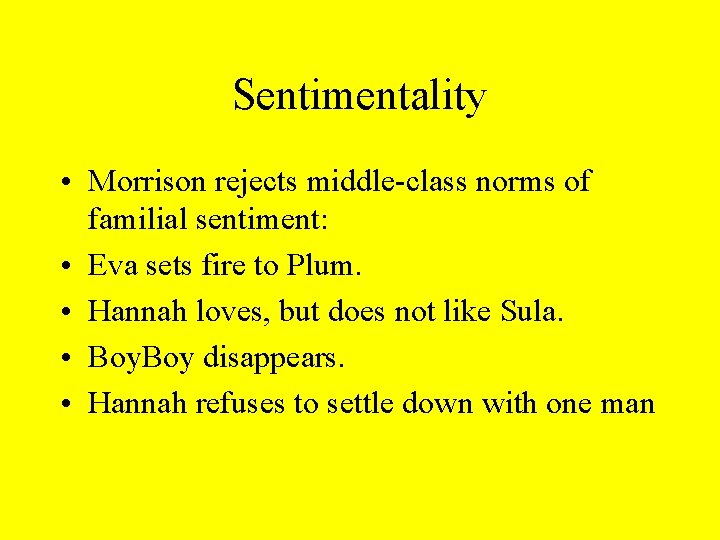
Sentimentality • Morrison rejects middle-class norms of familial sentiment: • Eva sets fire to Plum. • Hannah loves, but does not like Sula. • Boy disappears. • Hannah refuses to settle down with one man