
SUICIDE INTERVENTION PREVENTION Jim Messina Ph D CMHC
- Slides: 83
SUICIDE: INTERVENTION & PREVENTION Jim Messina, Ph. D. , CMHC, NCC, DCMHS-T Material in this Presentation is available at: Suicide Intervention and Prevention Strategies A Training Resource at: http: //www. coping. us/suicideintervention. html
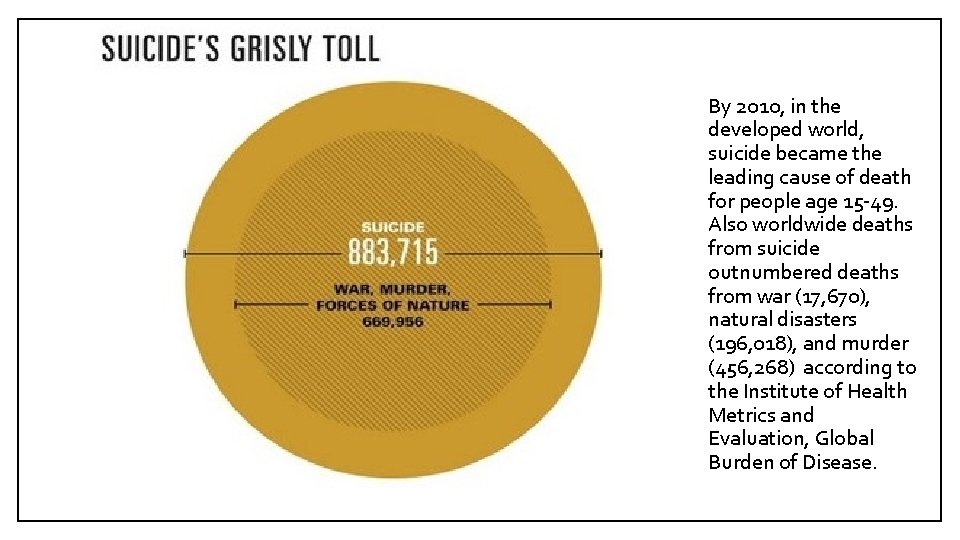
By 2010, in the developed world, suicide became the leading cause of death for people age 15 -49. Also worldwide deaths from suicide outnumbered deaths from war (17, 670), natural disasters (196, 018), and murder (456, 268) according to the Institute of Health Metrics and Evaluation, Global Burden of Disease.
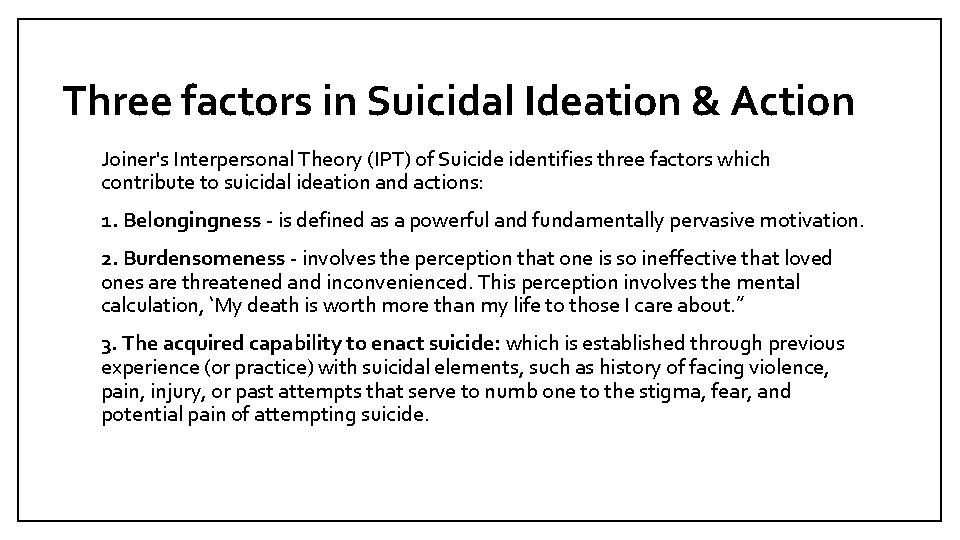
Prologue On June 25, 2013 a letter appeared in Gawker online from Daniel Somers, 30, who was a veteran who served in Operation Iraqi Freedom who on June 10, 2013 committed suicide. His wife Angeline shared this letter to let us all know how bad things have become. Daniel suffered from PTSD, TBI and "other effects of the war. “ There is a need to take at look at theory on suicide first posted by Thomas J Joiner Jr in 2005 called Interpersonal Psychological Theory of Suicide to see what contributes to "suicidal" ideation and attempts to develop a program of suicide prevention and intervention which addresses the suicidal risk factors and enables the people being served to have greater hope in life to accept life on life's terms and not give up and turn away from living.
Three factors in Suicidal Ideation & Action Joiner's Interpersonal Theory (IPT) of Suicide identifies three factors which contribute to suicidal ideation and actions: 1. Belongingness - is defined as a powerful and fundamentally pervasive motivation. 2. Burdensomeness - involves the perception that one is so ineffective that loved ones are threatened and inconvenienced. This perception involves the mental calculation, ‘My death is worth more than my life to those I care about. ” 3. The acquired capability to enact suicide: which is established through previous experience (or practice) with suicidal elements, such as history of facing violence, pain, injury, or past attempts that serve to numb one to the stigma, fear, and potential pain of attempting suicide.
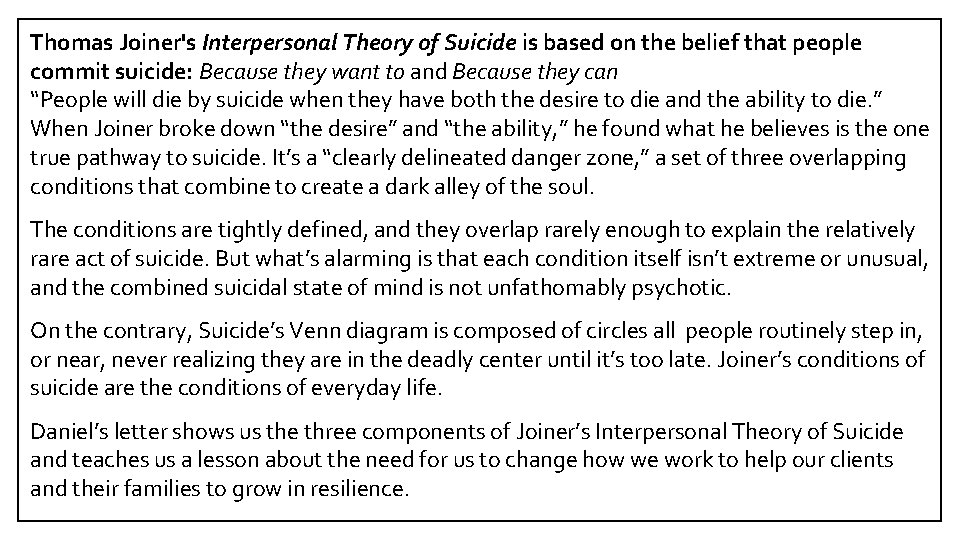
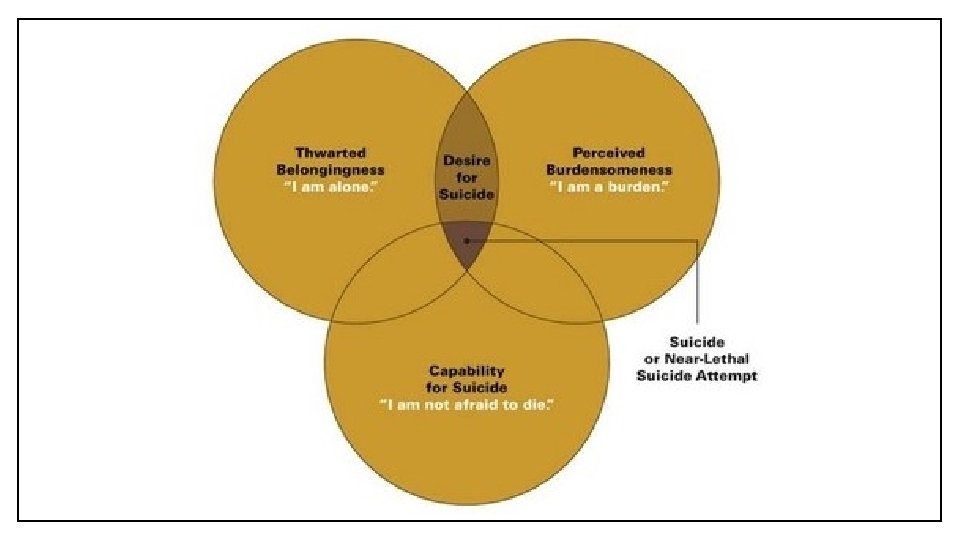
Thomas Joiner's Interpersonal Theory of Suicide is based on the belief that people commit suicide: Because they want to and Because they can “People will die by suicide when they have both the desire to die and the ability to die. ” When Joiner broke down “the desire” and “the ability, ” he found what he believes is the one true pathway to suicide. It’s a “clearly delineated danger zone, ” a set of three overlapping conditions that combine to create a dark alley of the soul. The conditions are tightly defined, and they overlap rarely enough to explain the relatively rare act of suicide. But what’s alarming is that each condition itself isn’t extreme or unusual, and the combined suicidal state of mind is not unfathomably psychotic. On the contrary, Suicide’s Venn diagram is composed of circles all people routinely step in, or near, never realizing they are in the deadly center until it’s too late. Joiner’s conditions of suicide are the conditions of everyday life. Daniel’s letter shows us the three components of Joiner’s Interpersonal Theory of Suicide and teaches us a lesson about the need for us to change how we work to help our clients and their families to grow in resilience.
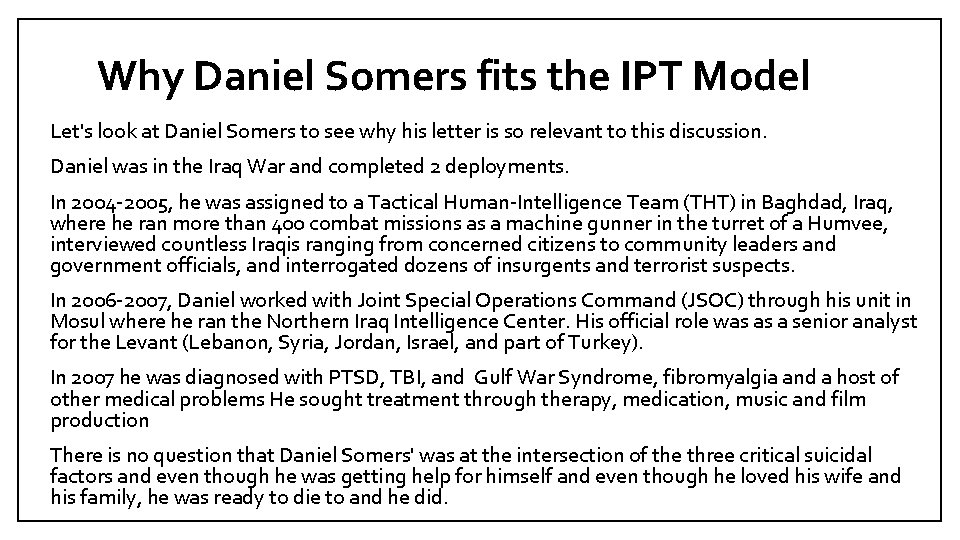
Why Daniel Somers fits the IPT Model Let's look at Daniel Somers to see why his letter is so relevant to this discussion. Daniel was in the Iraq War and completed 2 deployments. In 2004 -2005, he was assigned to a Tactical Human-Intelligence Team (THT) in Baghdad, Iraq, where he ran more than 400 combat missions as a machine gunner in the turret of a Humvee, interviewed countless Iraqis ranging from concerned citizens to community leaders and government officials, and interrogated dozens of insurgents and terrorist suspects. In 2006 -2007, Daniel worked with Joint Special Operations Command (JSOC) through his unit in Mosul where he ran the Northern Iraq Intelligence Center. His official role was as a senior analyst for the Levant (Lebanon, Syria, Jordan, Israel, and part of Turkey). In 2007 he was diagnosed with PTSD, TBI, and Gulf War Syndrome, fibromyalgia and a host of other medical problems He sought treatment through therapy, medication, music and film production There is no question that Daniel Somers' was at the intersection of the three critical suicidal factors and even though he was getting help for himself and even though he loved his wife and his family, he was ready to die to and he did.
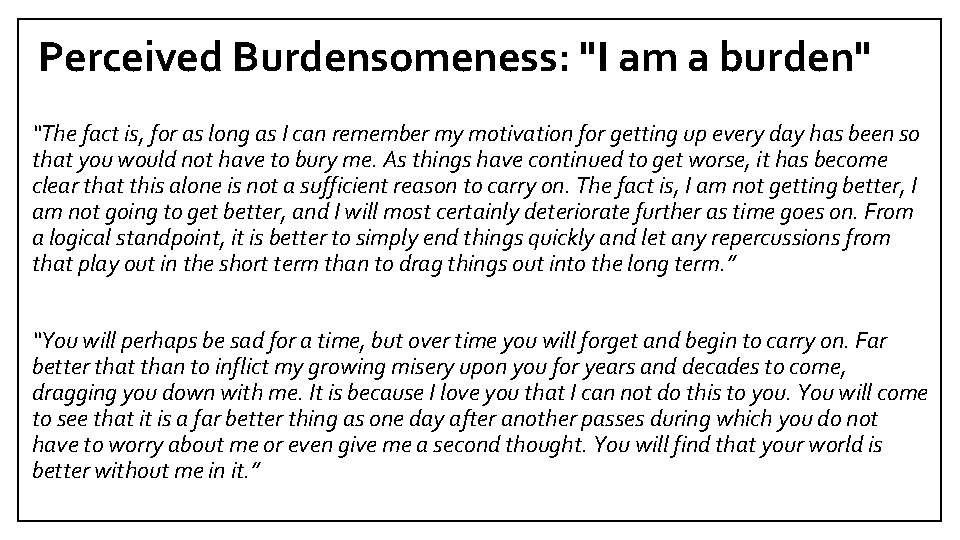
Perceived Burdensomeness: "I am a burden" “The fact is, for as long as I can remember my motivation for getting up every day has been so that you would not have to bury me. As things have continued to get worse, it has become clear that this alone is not a sufficient reason to carry on. The fact is, I am not getting better, I am not going to get better, and I will most certainly deteriorate further as time goes on. From a logical standpoint, it is better to simply end things quickly and let any repercussions from that play out in the short term than to drag things out into the long term. ” “You will perhaps be sad for a time, but over time you will forget and begin to carry on. Far better that than to inflict my growing misery upon you for years and decades to come, dragging you down with me. It is because I love you that I can not do this to you. You will come to see that it is a far better thing as one day after another passes during which you do not have to worry about me or even give me a second thought. You will find that your world is better without me in it. ”
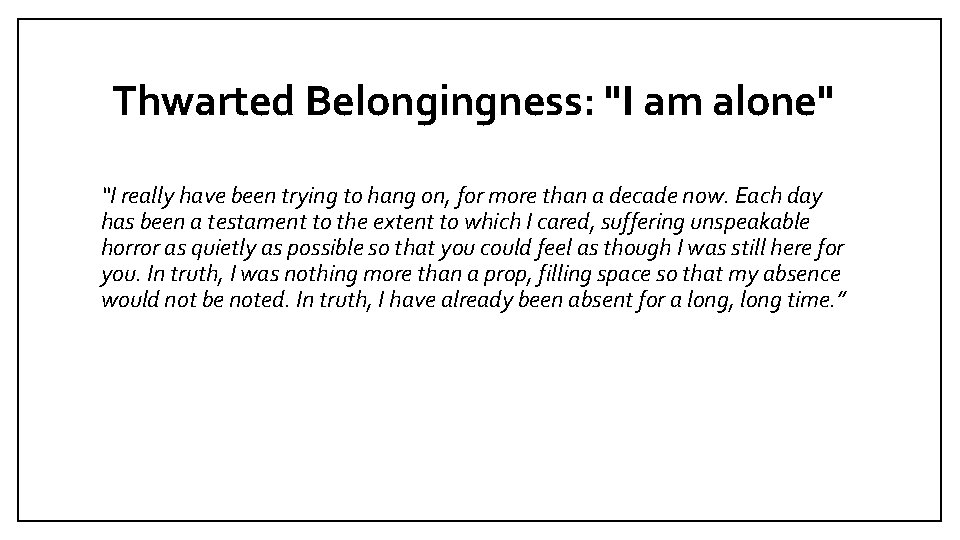
Thwarted Belongingness: "I am alone" “I really have been trying to hang on, for more than a decade now. Each day has been a testament to the extent to which I cared, suffering unspeakable horror as quietly as possible so that you could feel as though I was still here for you. In truth, I was nothing more than a prop, filling space so that my absence would not be noted. In truth, I have already been absent for a long, long time. ”
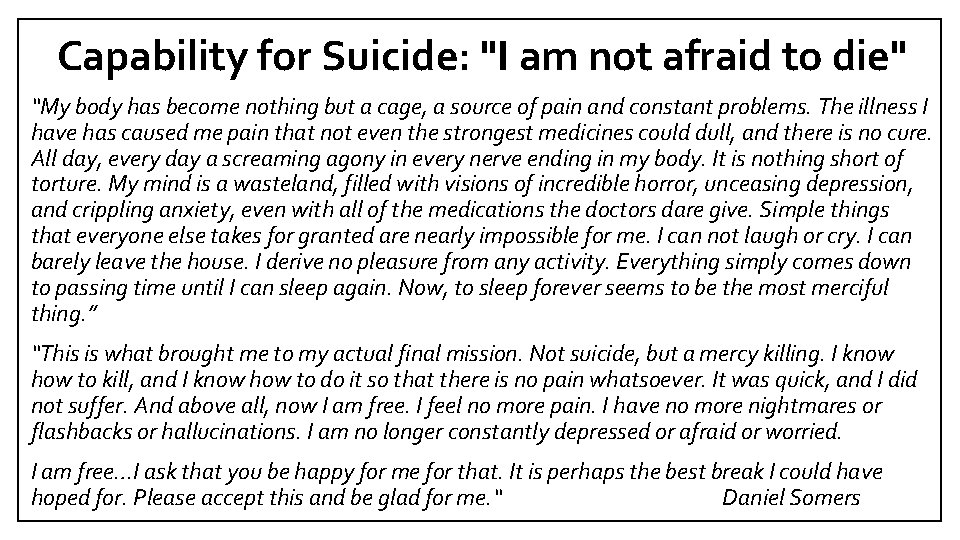
Capability for Suicide: "I am not afraid to die" “My body has become nothing but a cage, a source of pain and constant problems. The illness I have has caused me pain that not even the strongest medicines could dull, and there is no cure. All day, every day a screaming agony in every nerve ending in my body. It is nothing short of torture. My mind is a wasteland, filled with visions of incredible horror, unceasing depression, and crippling anxiety, even with all of the medications the doctors dare give. Simple things that everyone else takes for granted are nearly impossible for me. I can not laugh or cry. I can barely leave the house. I derive no pleasure from any activity. Everything simply comes down to passing time until I can sleep again. Now, to sleep forever seems to be the most merciful thing. ” “This is what brought me to my actual final mission. Not suicide, but a mercy killing. I know how to kill, and I know how to do it so that there is no pain whatsoever. It was quick, and I did not suffer. And above all, now I am free. I feel no more pain. I have no more nightmares or flashbacks or hallucinations. I am no longer constantly depressed or afraid or worried. I am free…I ask that you be happy for me for that. It is perhaps the best break I could have hoped for. Please accept this and be glad for me. “ Daniel Somers
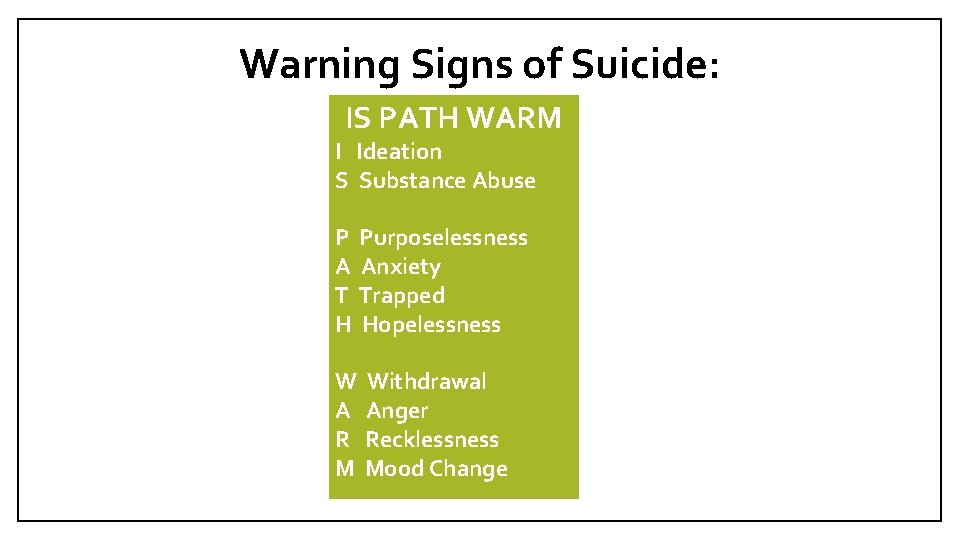
Warning Signs of Suicide: IS PATH WARM I Ideation S Substance Abuse P Purposelessness A Anxiety T Trapped H Hopelessness W A R M Withdrawal Anger Recklessness Mood Change
Myths about Suicide Myth: Most people who die by suicide don’t make future plans Fact: The suicidal mind is characterized by ambivalence. People make plans for their jobs, trips and relationship in the days and weeks leading up to their suicides. Myth: Suicide is selfish, a reflection of excessive self-focus. Fact: It is Important to distinguish aborted attempts from actual attempts and suicide and one must rule psychopaths from the persons with aborted attempts Myth: Suicide is an easy escape, one that cowards use. Fact: In clinical case studies of Holocaust victims/survivors it was found that often the self-preservation instinct resulting in “Hesitation” wounds Myth: A person who talks about suicide won’t really follow through. FACT: Eight out of 10 people who commit suicide have spoken about their intent before killing themselves. Myth: Only insane people commit suicide. FACT: People who commit suicide may feel hopeless and depressed, but have not necessarily lost touch with reality. Suicide is 4 times more likely for depressed people. Myth: Talking about suicide might prompt the person to act. FACT: Discussing the subject openly shows that you take the person seriously and that you care. It’s helpful, not harmful.
More Myths about Suicide Myth: Suicide is a problem among old people – not young people. FACT: Suicide is a problem among the elderly. But the suicide rate among 15 -24 -year-olds has tripled in the past 30 years. Myth: No one I know is the type to commit suicide. FACT: Suicide occurs among young people of ALL types – rich and poor, athletic and non-athletic, popular and unpopular, etc. . Myth: People who attempt suicide are just trying to get attention. FACT: Possibly, but unless someone gives them some appropriate attention, the results could be fatal. Myth: Once a person decides to commit suicide, nothing can stop that person. FACT: On the contrary, most people want to be stopped from taking their lives. (But remember – not everyone can be stopped, though the effort of trying may save a life. ) Myth: People who attempt suicide really want to die. FACT: Most people want to end their pain, not their lives. But they have given up hope that they or anyone else can help them. Myth: People often die by suicide “on a whim. ” FACT: There is almost always evidence of prior planning. Mental preparation for the actual suicide event is an essential characteristic of the phenomenon. In some cases, planning may be “shelved” for a period of time
Glossary of Terms Related to Suicide THOUGHTS 1. Non-Suicidal Self-Directed Violence Ideation Self-reported thoughts regarding a person’s desire to engage in self-inflicted potentially injurious behavior. There is no evidence of suicidal intent. For example, persons engage in Non-Suicidal Self. Directed Violence Ideation in order to attain some other end (e. g. , to seek help, regulate negative mood, punish others, to receive attention). 2. Suicidal Ideation Thoughts of engaging in suicide-related behavior. For example, intrusive thoughts of suicide without the wish to die would be classified as Suicidal Ideation, Without Intent. 3. Non-Suicidal Self-Directed Violence, Preparatory Acts or preparation towards engaging in Self-Directed Violence, but before potential for injury has begun. This can include anything beyond a verbalization or thought, such as assembling a method (e. g. , buying a gun, collecting pills) or preparing for one’s death by suicide (e. g. , writing a suicide note, giving things away). For example, hoarding medication for the purpose of overdosing would be classified as Suicidal Self-Directed Violence, Preparatory.
Glossary of Terms Related to Suicide 4. Non-Suicidal Self-Directed Violence Behavior that is self-directed and deliberately results in injury or the potential for injury to oneself. There is no evidence, whether implicit or explicit, of suicidal intent. For example, persons engage in Non-Suicidal Self-Directed Violence in order to attain some other end (e. g. , to seek help, regulate negative mood, punish others, to receive attention). BEHAVIORS 5. Undetermined Self-Directed Violence Behavior that is self-directed and deliberately results in injury or the potential for injury to oneself. Suicidal intent is unclear based upon the available evidence. For example, the person is unable to admit positively to the intent to die (e. g. , unconsciousness, incapacitation, intoxication, acute psychosis, disorientation, or death); OR the person is reluctant to admit positively to the intent to die for other or unknown reasons. 6. Suicidal Self-Directed Violence Behavior that is self-directed and deliberately results in injury or the potential for injury to oneself. There is evidence, whether implicit or explicit, of suicidal intent. For example, a person with the wish to die cutting her wrists with a knife would be classified as Suicide Attempt, With Injury.
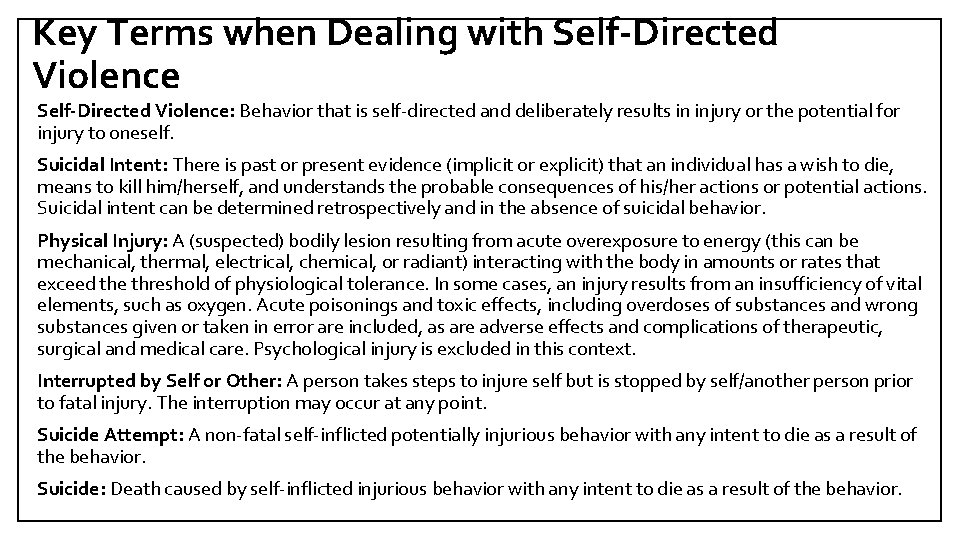
Key Terms when Dealing with Self-Directed Violence: Behavior that is self-directed and deliberately results in injury or the potential for injury to oneself. Suicidal Intent: There is past or present evidence (implicit or explicit) that an individual has a wish to die, means to kill him/herself, and understands the probable consequences of his/her actions or potential actions. Suicidal intent can be determined retrospectively and in the absence of suicidal behavior. Physical Injury: A (suspected) bodily lesion resulting from acute overexposure to energy (this can be mechanical, thermal, electrical, chemical, or radiant) interacting with the body in amounts or rates that exceed the threshold of physiological tolerance. In some cases, an injury results from an insufficiency of vital elements, such as oxygen. Acute poisonings and toxic effects, including overdoses of substances and wrong substances given or taken in error are included, as are adverse effects and complications of therapeutic, surgical and medical care. Psychological injury is excluded in this context. Interrupted by Self or Other: A person takes steps to injure self but is stopped by self/another person prior to fatal injury. The interruption may occur at any point. Suicide Attempt: A non-fatal self-inflicted potentially injurious behavior with any intent to die as a result of the behavior. Suicide: Death caused by self-inflicted injurious behavior with any intent to die as a result of the behavior.
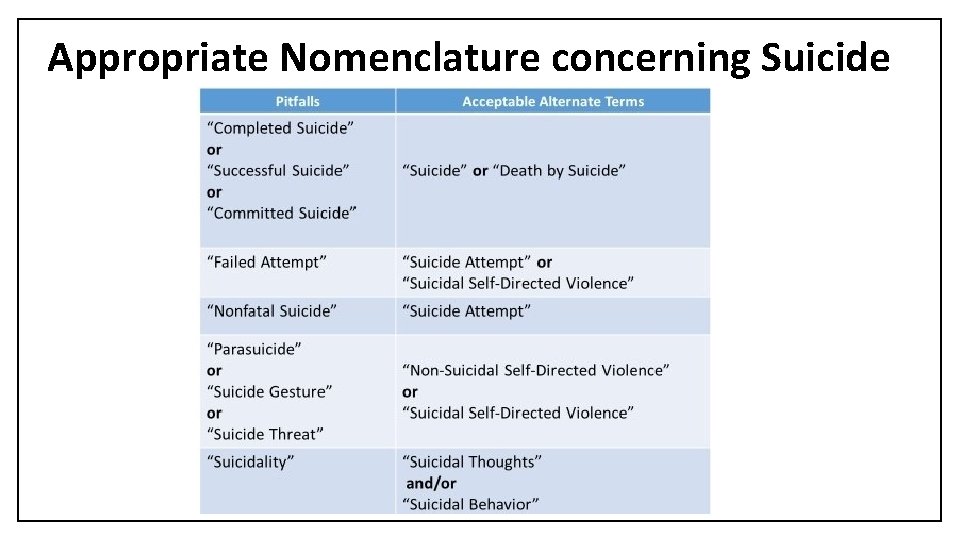
Appropriate Nomenclature concerning Suicide
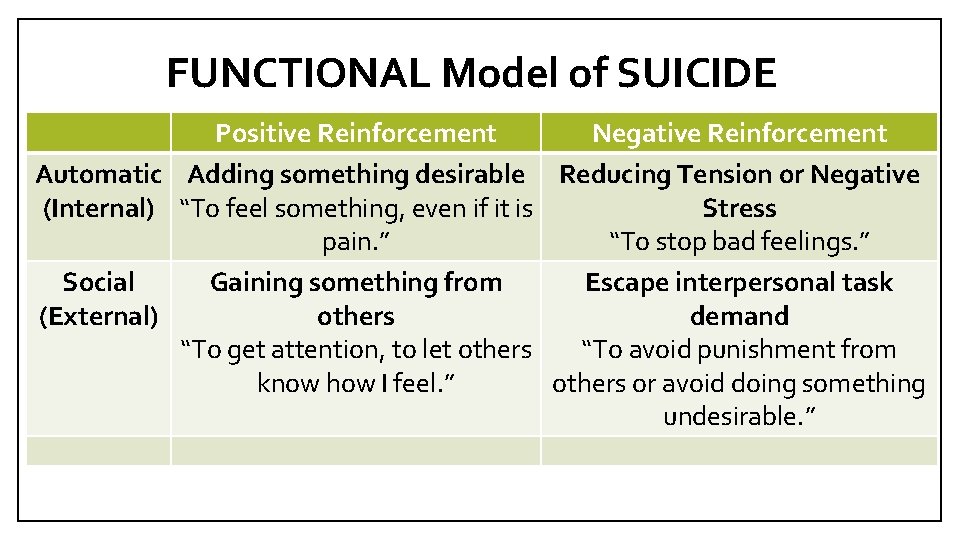
FUNCTIONAL Model of SUICIDE Positive Reinforcement Negative Reinforcement Automatic Adding something desirable Reducing Tension or Negative (Internal) “To feel something, even if it is Stress pain. ” “To stop bad feelings. ” Social Gaining something from Escape interpersonal task (External) others demand “To get attention, to let others “To avoid punishment from know how I feel. ” others or avoid doing something undesirable. ”
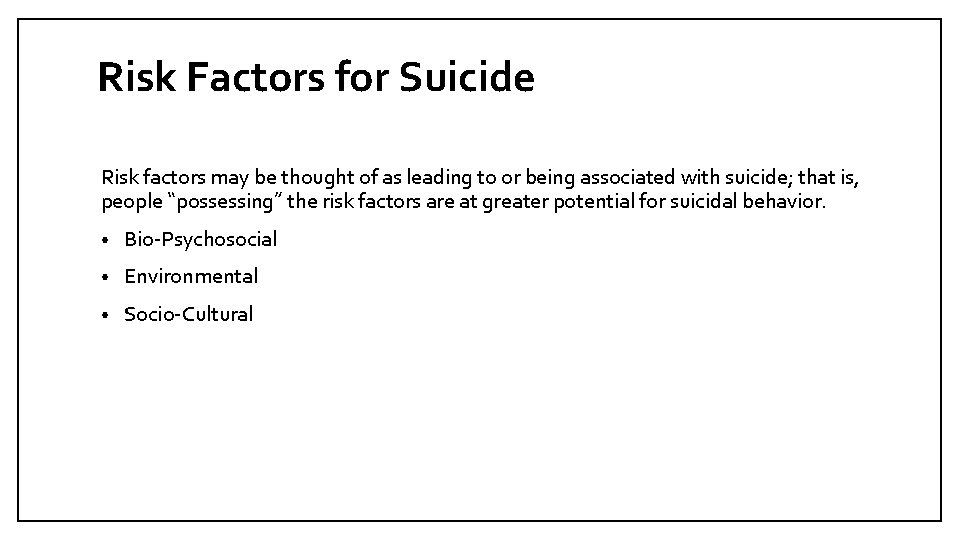
Risk Factors for Suicide Risk factors may be thought of as leading to or being associated with suicide; that is, people “possessing” the risk factors are at greater potential for suicidal behavior. • Bio-Psychosocial • Environmental • Socio-Cultural
Bio-Psychosocial Risk Factors Mental disorders, particularly mood disorders, schizophrenia, anxiety disorders and certain personality disorders Alcohol and other substance use disorders Hopelessness Impulsive and/or aggressive tendencies History of trauma or abuse Some major physical illnesses Previous suicide attempt Family history of suicide
Environmental Risk Factors Job, financial loss, drop out of school Homelessness Relational or social loss Easy access to lethal means Local clusters of suicides that have a contagious influence
Socio-Cultural Risk Factors Lack of Social Support: Isolation can lead to feelings of alienation and depression that may ultimately lead to suicidal thoughts and behaviors, research has shown that social support can help prevent someone moving from suicidal ideation to suicide attempts. Membership in Repressive Group: group membership can come with a price. Groups sometimes require stress-inducing obligations and high levels of commitment; and they may lead people to adopt behavioral and attitudinal norms (rather than thinking for themselves). These types of groups can feel repressive and stifling and may actually contribute to suicidal thoughts and feelings. In extreme cases, groups can even demand that someone sacrifice him or herself for the "greater good. “ Social Norms: Social norms regarding suicide can influence its meaning (i. e. , whether it is stigmatized) as well as its frequency. Many societies and religious traditions ban suicide and view it as a sin or taboo behavior. Others portray suicide as a legitimate behavior in certain circumstances. For instance, some Islamic groups promote suicide as a means of martyrdom in a war against an enemy. Among Buddhist monks, self-sacrifice for religious reasons can be viewed as an honorable act. In India, it is acceptable for a widow to burn herself on her husband's funeral pyre. The Hindu code of conduct condones suicide for incurable diseases or as a response to great misfortune.
Suicidal Warning Signs for Adults Threatening to hurt or kill oneself or talking about wanting to hurt or kill oneself Looking for ways to kill oneself by seeking access to firearms, pills, or other means Talking or writing about death, dying, or suicide when these actions are out of the ordinary for the person Feeling hopeless Feeling rage or uncontrolled anger or seeking revenge Acting reckless or engaging in risk activities – seemingly without thinking
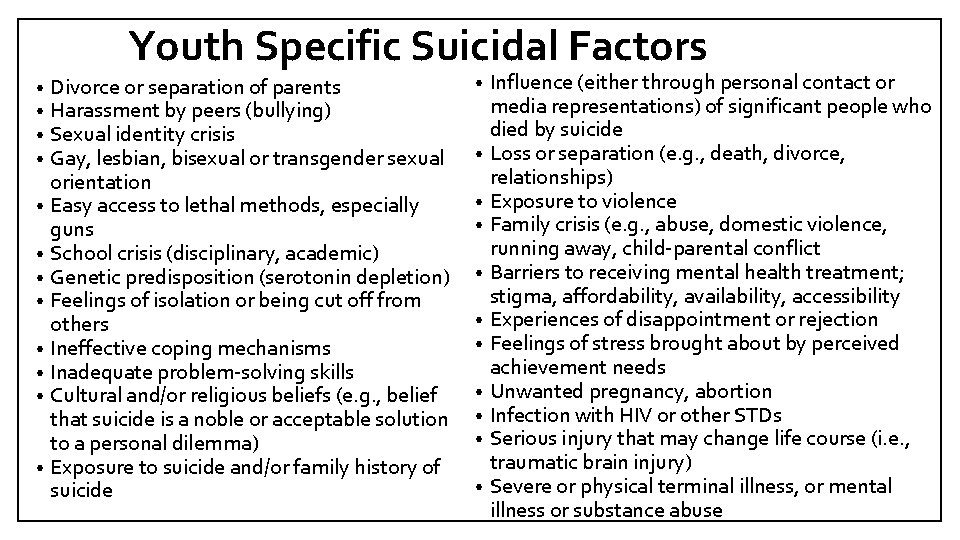
Youth Specific Suicidal Factors Divorce or separation of parents Harassment by peers (bullying) Sexual identity crisis Gay, lesbian, bisexual or transgender sexual orientation • Easy access to lethal methods, especially guns • School crisis (disciplinary, academic) • Genetic predisposition (serotonin depletion) • Feelings of isolation or being cut off from others • Ineffective coping mechanisms • Inadequate problem-solving skills • Cultural and/or religious beliefs (e. g. , belief that suicide is a noble or acceptable solution to a personal dilemma) • Exposure to suicide and/or family history of suicide • • Influence (either through personal contact or media representations) of significant people who died by suicide • Loss or separation (e. g. , death, divorce, relationships) • Exposure to violence • Family crisis (e. g. , abuse, domestic violence, running away, child-parental conflict • Barriers to receiving mental health treatment; stigma, affordability, availability, accessibility • Experiences of disappointment or rejection • Feelings of stress brought about by perceived achievement needs • Unwanted pregnancy, abortion • Infection with HIV or other STDs • Serious injury that may change life course (i. e. , traumatic brain injury) • Severe or physical terminal illness, or mental illness or substance abuse •
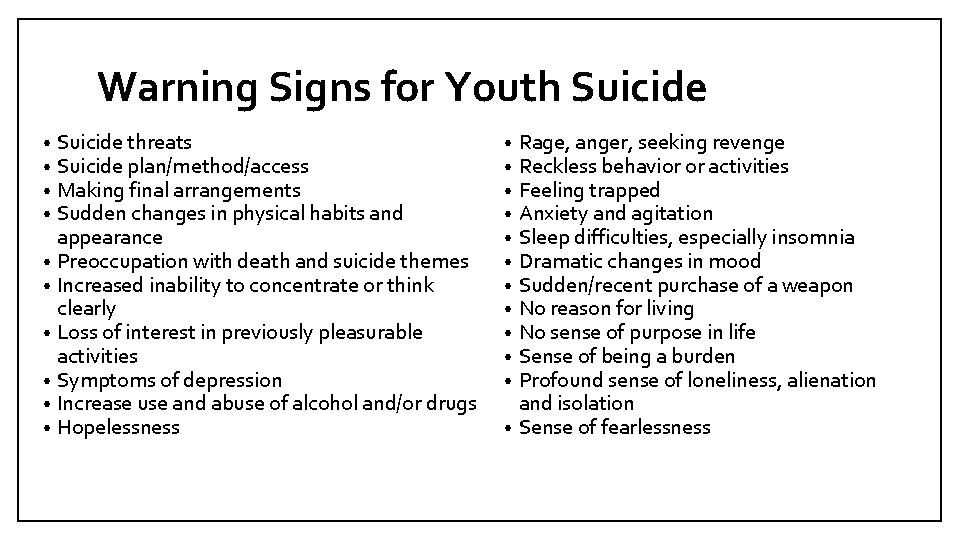
Warning Signs for Youth Suicide threats Suicide plan/method/access Making final arrangements Sudden changes in physical habits and appearance • Preoccupation with death and suicide themes • Increased inability to concentrate or think clearly • Loss of interest in previously pleasurable activities • Symptoms of depression • Increase use and abuse of alcohol and/or drugs • Hopelessness • • Rage, anger, seeking revenge Reckless behavior or activities Feeling trapped Anxiety and agitation Sleep difficulties, especially insomnia Dramatic changes in mood Sudden/recent purchase of a weapon No reason for living No sense of purpose in life Sense of being a burden Profound sense of loneliness, alienation and isolation • Sense of fearlessness • • •
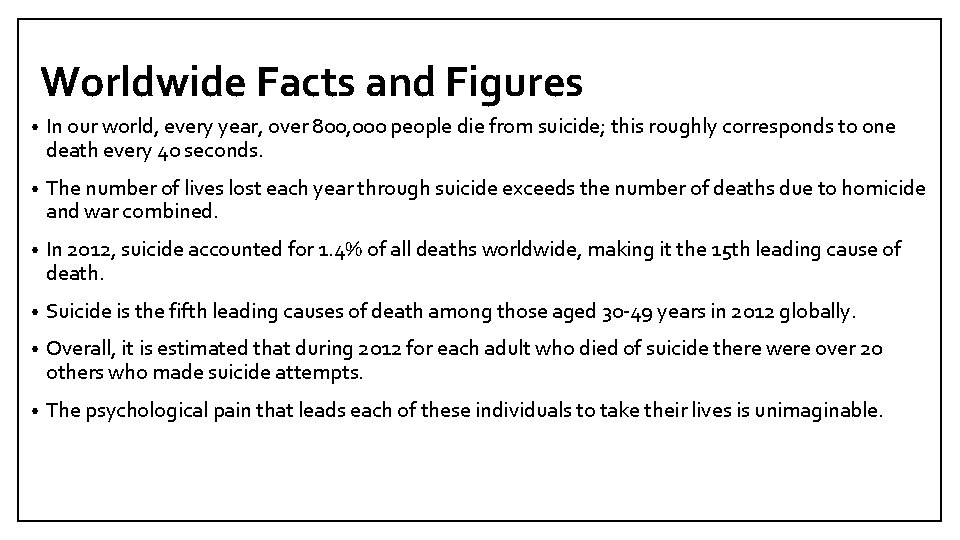
Worldwide Facts and Figures • In our world, every year, over 800, 000 people die from suicide; this roughly corresponds to one death every 40 seconds. • The number of lives lost each year through suicide exceeds the number of deaths due to homicide and war combined. • In 2012, suicide accounted for 1. 4% of all deaths worldwide, making it the 15 th leading cause of death. • Suicide is the fifth leading causes of death among those aged 30 -49 years in 2012 globally. • Overall, it is estimated that during 2012 for each adult who died of suicide there were over 20 others who made suicide attempts. • The psychological pain that leads each of these individuals to take their lives is unimaginable.
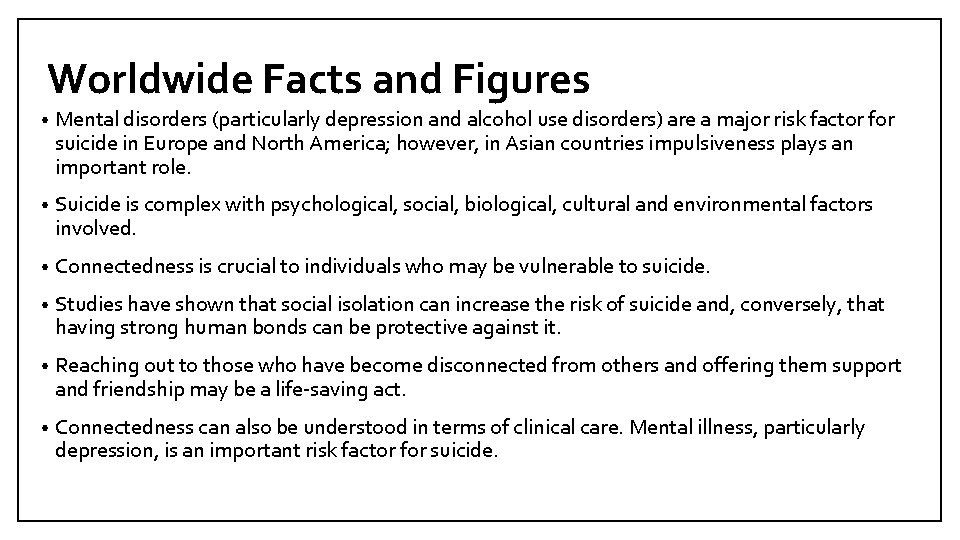
Worldwide Facts and Figures • Mental disorders (particularly depression and alcohol use disorders) are a major risk factor for suicide in Europe and North America; however, in Asian countries impulsiveness plays an important role. • Suicide is complex with psychological, social, biological, cultural and environmental factors involved. • Connectedness is crucial to individuals who may be vulnerable to suicide. • Studies have shown that social isolation can increase the risk of suicide and, conversely, that having strong human bonds can be protective against it. • Reaching out to those who have become disconnected from others and offering them support and friendship may be a life-saving act. • Connectedness can also be understood in terms of clinical care. Mental illness, particularly depression, is an important risk factor for suicide.
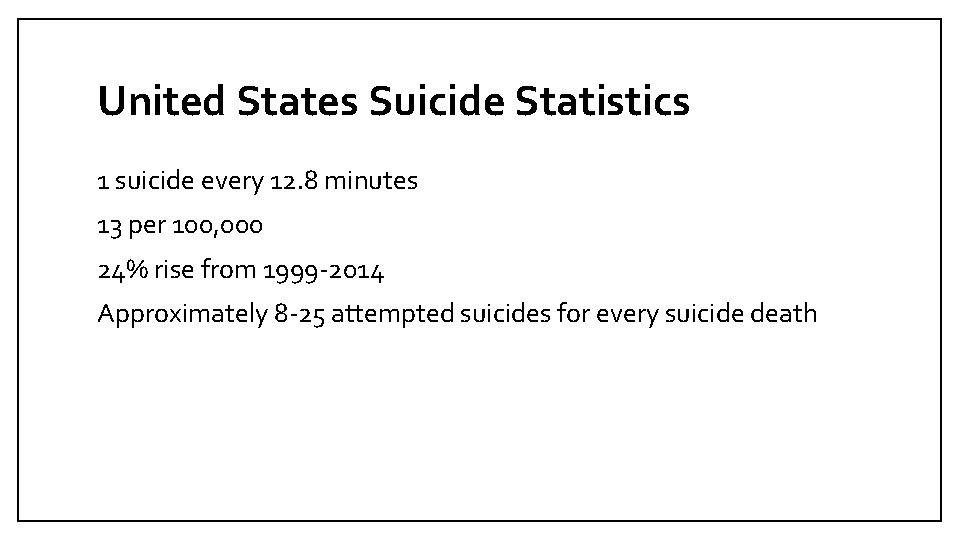
United States Suicide Statistics 1 suicide every 12. 8 minutes 13 per 100, 000 24% rise from 1999 -2014 Approximately 8 -25 attempted suicides for every suicide death
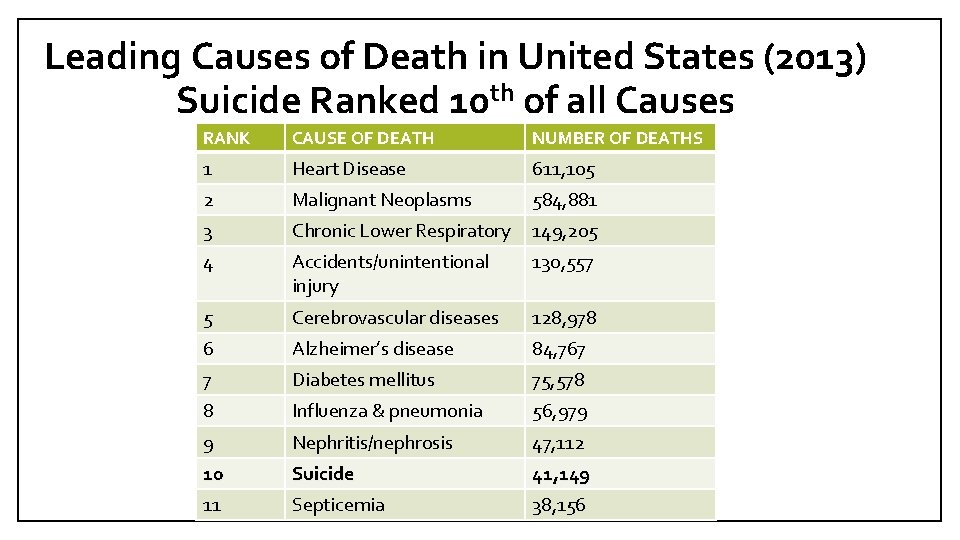
Leading Causes of Death in United States (2013) Suicide Ranked 10 th of all Causes RANK CAUSE OF DEATH NUMBER OF DEATHS 1 Heart Disease 611, 105 2 Malignant Neoplasms 584, 881 3 Chronic Lower Respiratory 149, 205 4 Accidents/unintentional injury 130, 557 5 Cerebrovascular diseases 128, 978 6 Alzheimer’s disease 84, 767 7 Diabetes mellitus 75, 578 8 Influenza & pneumonia 56, 979 9 Nephritis/nephrosis 47, 112 10 Suicide 41, 149 11 Septicemia 38, 156
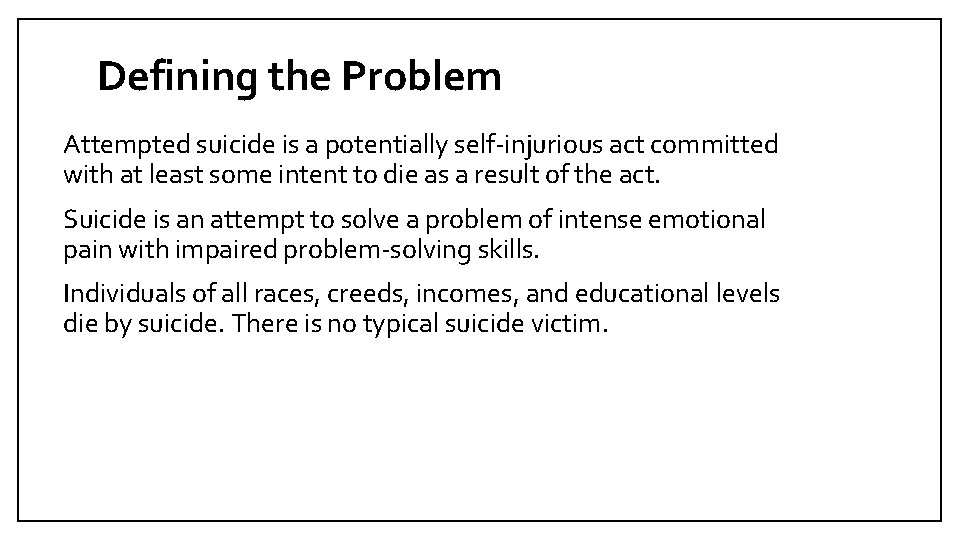
Defining the Problem Attempted suicide is a potentially self-injurious act committed with at least some intent to die as a result of the act. Suicide is an attempt to solve a problem of intense emotional pain with impaired problem-solving skills. Individuals of all races, creeds, incomes, and educational levels die by suicide. There is no typical suicide victim.
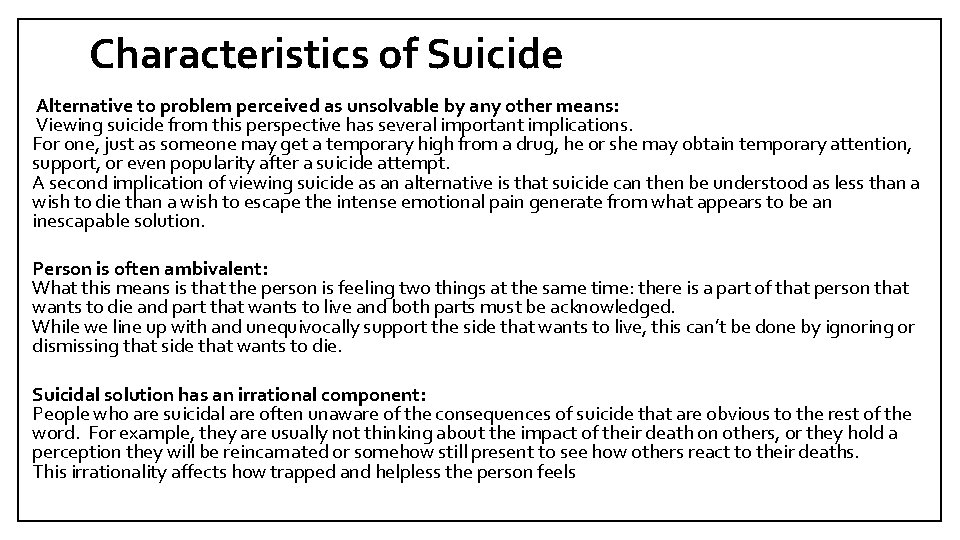
Characteristics of Suicide Alternative to problem perceived as unsolvable by any other means: Viewing suicide from this perspective has several important implications. For one, just as someone may get a temporary high from a drug, he or she may obtain temporary attention, support, or even popularity after a suicide attempt. A second implication of viewing suicide as an alternative is that suicide can then be understood as less than a wish to die than a wish to escape the intense emotional pain generate from what appears to be an inescapable solution. Person is often ambivalent: What this means is that the person is feeling two things at the same time: there is a part of that person that wants to die and part that wants to live and both parts must be acknowledged. While we line up with and unequivocally support the side that wants to live, this can’t be done by ignoring or dismissing that side that wants to die. Suicidal solution has an irrational component: People who are suicidal are often unaware of the consequences of suicide that are obvious to the rest of the word. For example, they are usually not thinking about the impact of their death on others, or they hold a perception they will be reincarnated or somehow still present to see how others react to their deaths. This irrationality affects how trapped and helpless the person feels
Death by Suicide and Psychiatric Diagnosis Psychological autopsy studies done in various countries from over almost 50 years report the same outcomes. 90% of people who die by suicide are suffering from one or more psychiatric disorders: • Major Depressive Disorder • Bipolar Disorder, Depressive Phase • Alcohol or Substance Abuse • Schizophrenia • Personality Disorders such as Borderline Personality Disorder
Depression • Four out of ten children and adolescents will have a second episode of depression within two years. • Depressed adolescents are at an increased risk for substance abuse and pregnancy. • Over half of depressed youth will attempt suicide, and at least 7% will ultimately die as a result. • Early identification and treatment of depression can save lives.
Signs of Depression • Loss of interest in normal daily activities • Feeling sad or down • Feeling hopeless • Crying spells for no apparent reason • Problems sleeping • Trouble focusing or concentrating • Difficulty making decisions • Unintentional weight gain or loss • Irritability • Restlessness • Being easily annoyed • Feeling fatigued or weak • Feeling worthless • Loss of interest in sex • Thoughts of suicide or suicidal behavior • Unexplained physical problems, such as back pain or headaches
Signs of Depression in Youth • Oversensitivity to criticism • Risk-taking, hyperactivity • Low self-esteem • Indecision, withdrawal, inactivity • Somatic symptoms and complaints • Aggression, hostility • Sleep disturbances • Eating disorders
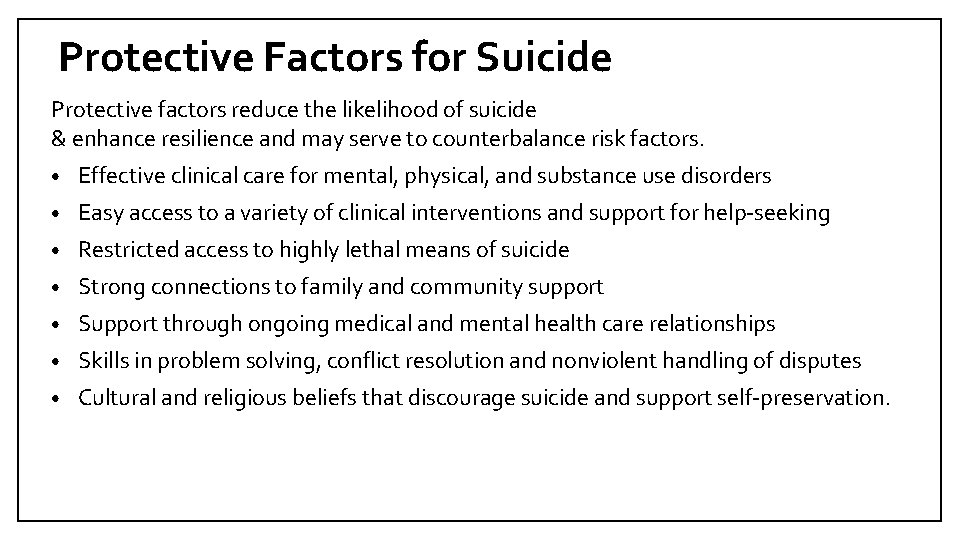
Protective Factors for Suicide Protective factors reduce the likelihood of suicide & enhance resilience and may serve to counterbalance risk factors. • Effective clinical care for mental, physical, and substance use disorders • Easy access to a variety of clinical interventions and support for help-seeking • Restricted access to highly lethal means of suicide • Strong connections to family and community support • Support through ongoing medical and mental health care relationships • Skills in problem solving, conflict resolution and nonviolent handling of disputes • Cultural and religious beliefs that discourage suicide and support self-preservation.
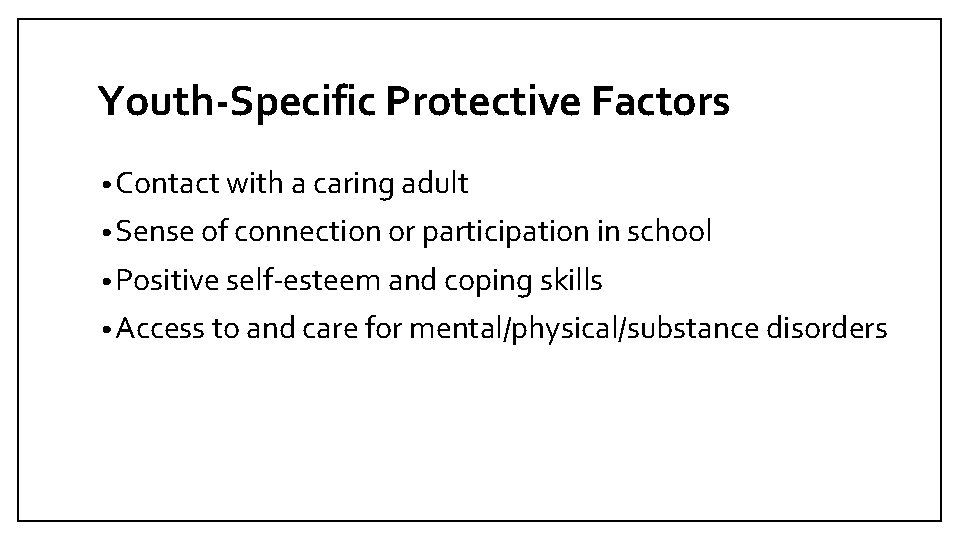
Youth-Specific Protective Factors • Contact with a caring adult • Sense of connection or participation in school • Positive self-esteem and coping skills • Access to and care for mental/physical/substance disorders
Suicide Assessment and Intervention Using Brief Cognitive Behavioral Therapy (BCBT)
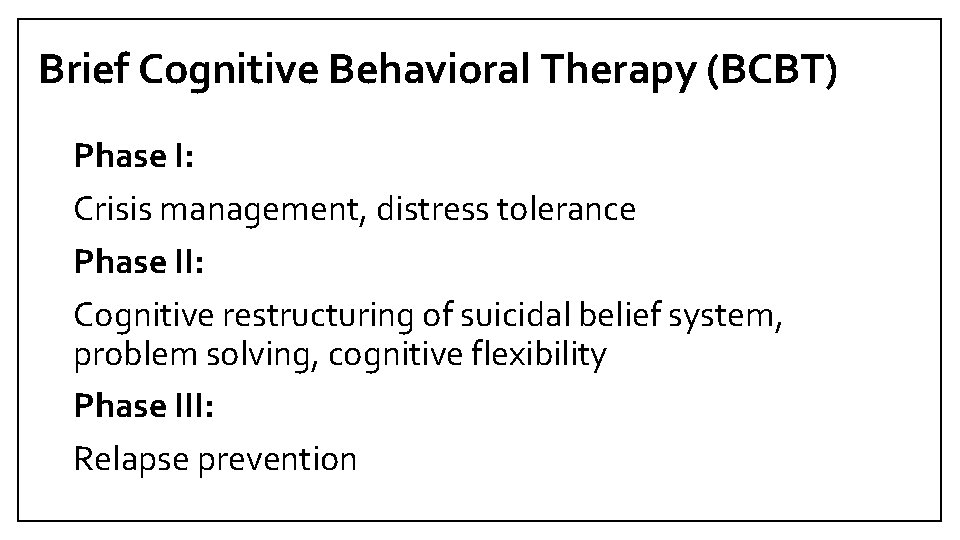
Brief Cognitive Behavioral Therapy (BCBT) Phase I: Crisis management, distress tolerance Phase II: Cognitive restructuring of suicidal belief system, problem solving, cognitive flexibility Phase III: Relapse prevention
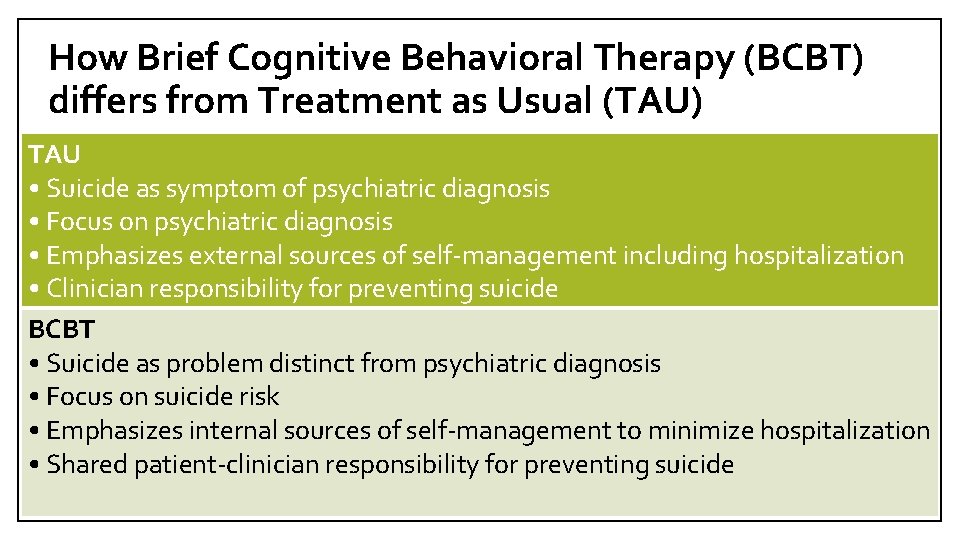
How Brief Cognitive Behavioral Therapy (BCBT) differs from Treatment as Usual (TAU) TAU • Suicide as symptom of psychiatric diagnosis • Focus on psychiatric diagnosis • Emphasizes external sources of self-management including hospitalization • Clinician responsibility for preventing suicide BCBT • Suicide as problem distinct from psychiatric diagnosis • Focus on suicide risk • Emphasizes internal sources of self-management to minimize hospitalization • Shared patient-clinician responsibility for preventing suicide
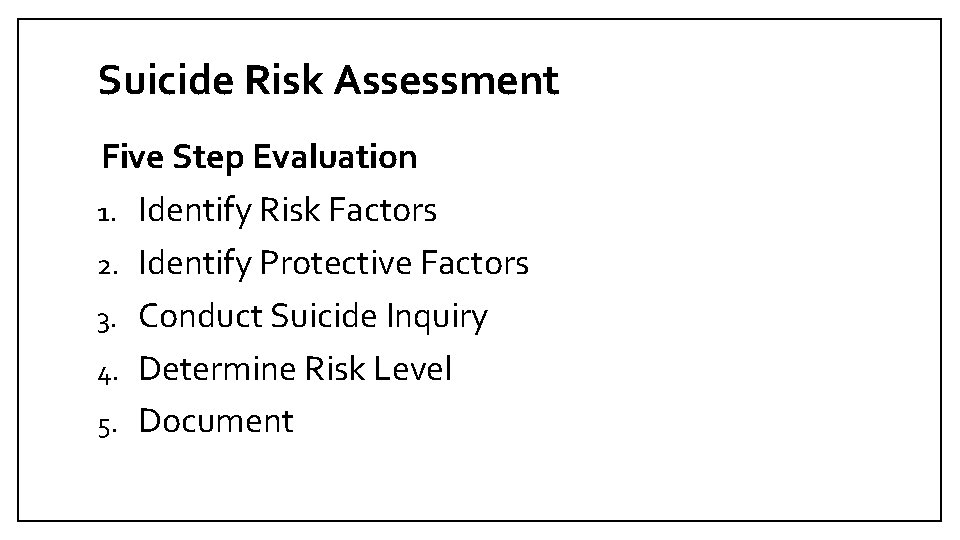
Suicide Risk Assessment Five Step Evaluation 1. Identify Risk Factors 2. Identify Protective Factors 3. Conduct Suicide Inquiry 4. Determine Risk Level 5. Document
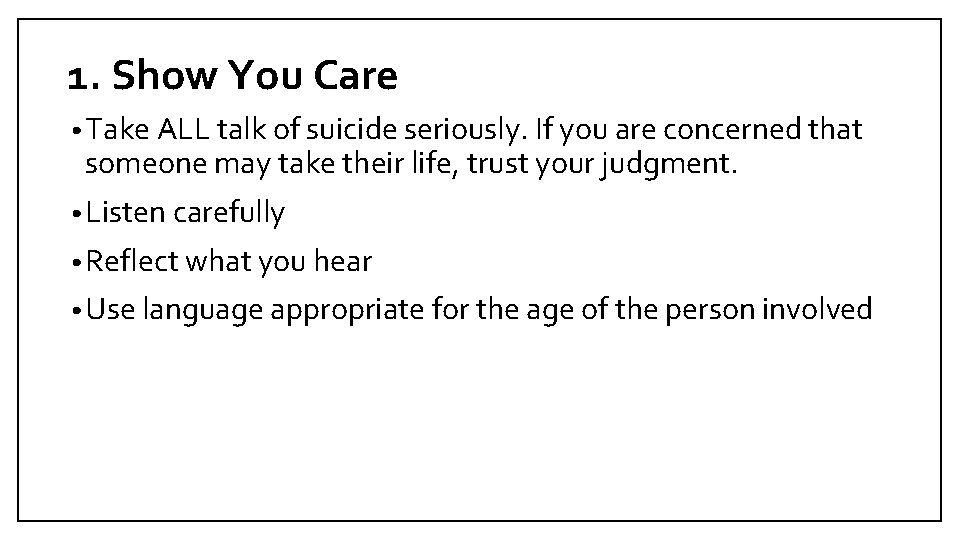
Intervention Three basic steps: 1. Show you care 2. Ask about suicide 3. Get help
1. Show You Care • Take ALL talk of suicide seriously. If you are concerned that someone may take their life, trust your judgment. • Listen carefully • Reflect what you hear • Use language appropriate for the age of the person involved
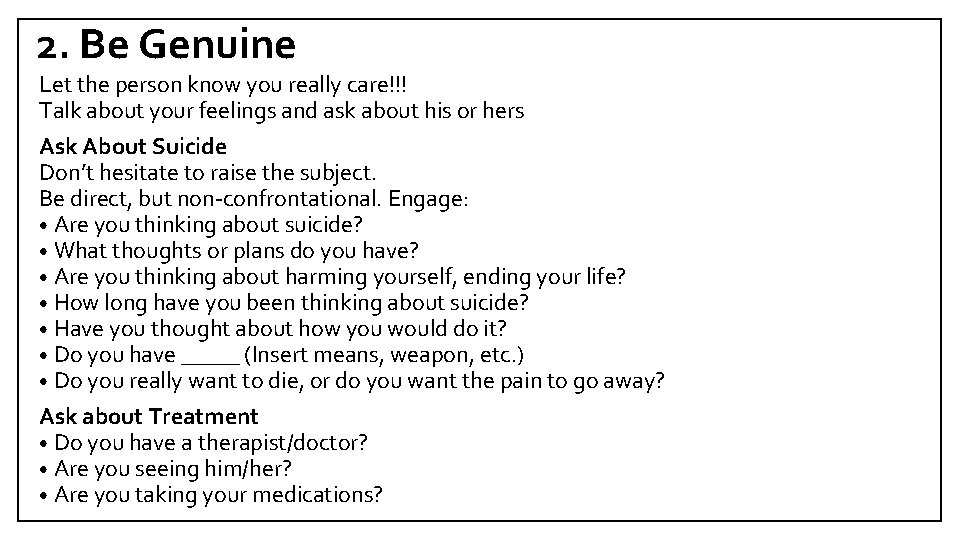
2. Be Genuine Let the person know you really care!!! Talk about your feelings and ask about his or hers Ask About Suicide Don’t hesitate to raise the subject. Be direct, but non-confrontational. Engage: • Are you thinking about suicide? • What thoughts or plans do you have? • Are you thinking about harming yourself, ending your life? • How long have you been thinking about suicide? • Have you thought about how you would do it? • Do you have _____ (Insert means, weapon, etc. ) • Do you really want to die, or do you want the pain to go away? Ask about Treatment • Do you have a therapist/doctor? • Are you seeing him/her? • Are you taking your medications?
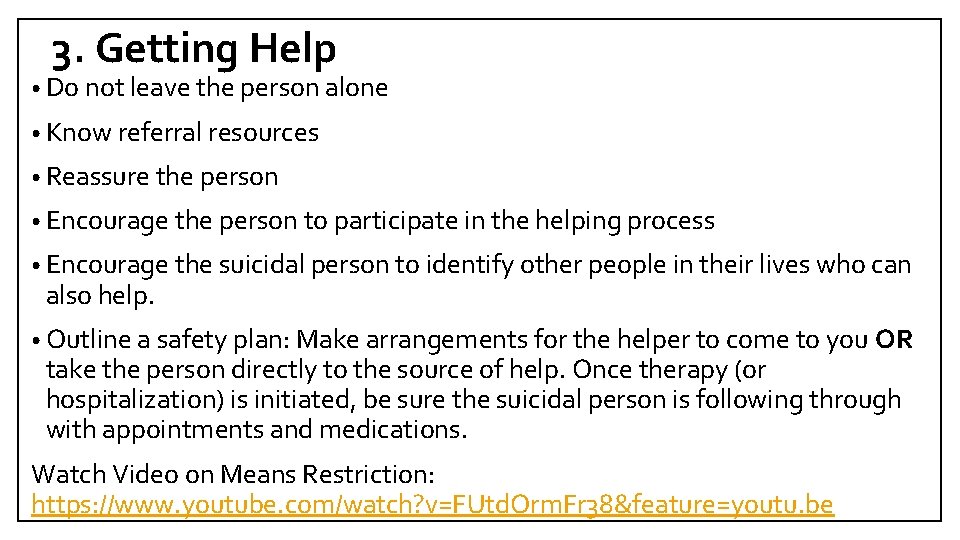
3. Getting Help • Do not leave the person alone • Know referral resources • Reassure the person • Encourage the person to participate in the helping process • Encourage the suicidal person to identify other people in their lives who can also help. • Outline a safety plan: Make arrangements for the helper to come to you OR take the person directly to the source of help. Once therapy (or hospitalization) is initiated, be sure the suicidal person is following through with appointments and medications. Watch Video on Means Restriction: https: //www. youtube. com/watch? v=FUtd. Orm. Fr 38&feature=youtu. be
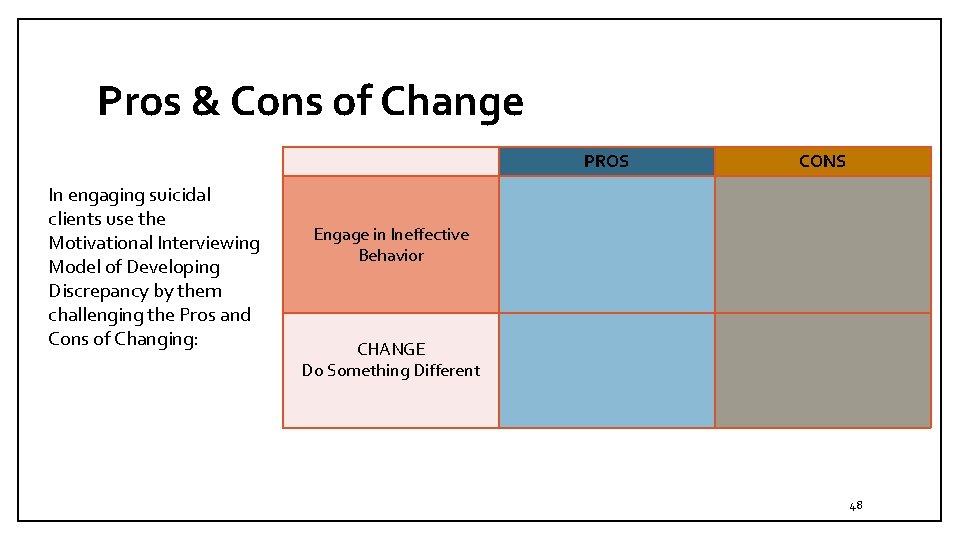
Pros & Cons of Change PROS In engaging suicidal clients use the Motivational Interviewing Model of Developing Discrepancy by them challenging the Pros and Cons of Changing: CONS Engage in Ineffective Behavior CHANGE Do Something Different 48
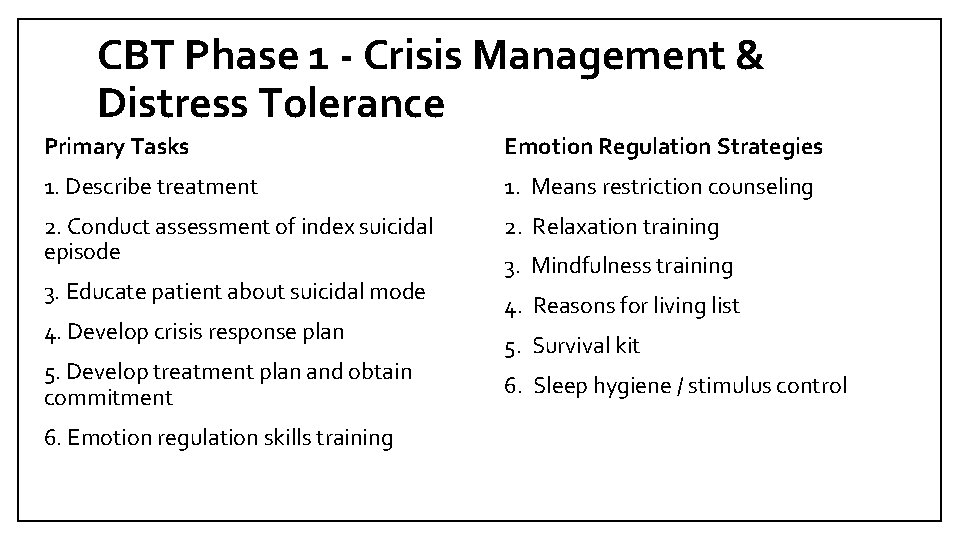
CBT Phase 1 - Crisis Management & Distress Tolerance Primary Tasks Emotion Regulation Strategies 1. Describe treatment 1. Means restriction counseling 2. Conduct assessment of index suicidal episode 2. Relaxation training 3. Educate patient about suicidal mode 4. Develop crisis response plan 5. Develop treatment plan and obtain commitment 6. Emotion regulation skills training 3. Mindfulness training 4. Reasons for living list 5. Survival kit 6. Sleep hygiene / stimulus control
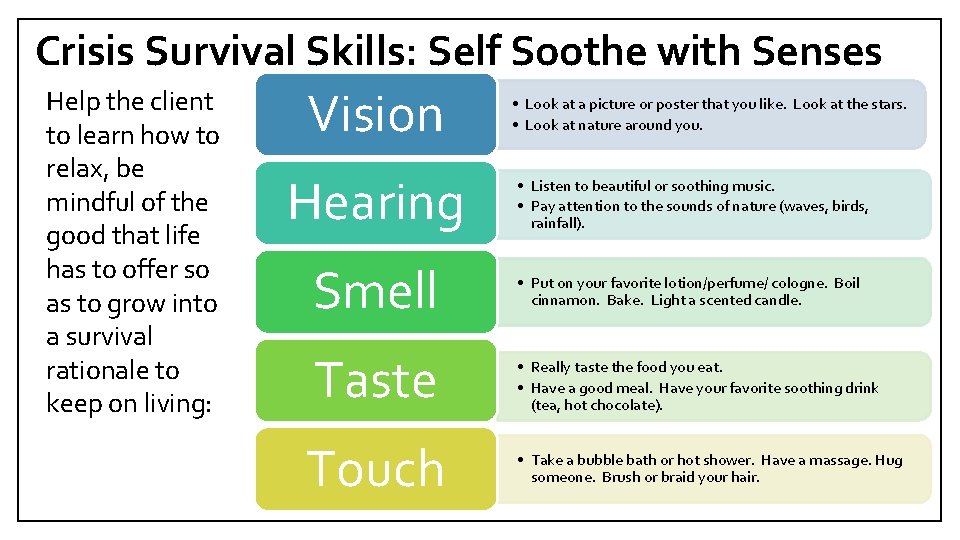
Crisis Survival Skills: Self Soothe with Senses Help the client to learn how to relax, be mindful of the good that life has to offer so as to grow into a survival rationale to keep on living: Vision • Look at a picture or poster that you like. Look at the stars. • Look at nature around you. Hearing • Listen to beautiful or soothing music. • Pay attention to the sounds of nature (waves, birds, rainfall). Smell • Put on your favorite lotion/perfume/ cologne. Boil cinnamon. Bake. Light a scented candle. Taste • Really taste the food you eat. • Have a good meal. Have your favorite soothing drink (tea, hot chocolate). Touch • Take a bubble bath or hot shower. Have a massage. Hug someone. Brush or braid your hair.
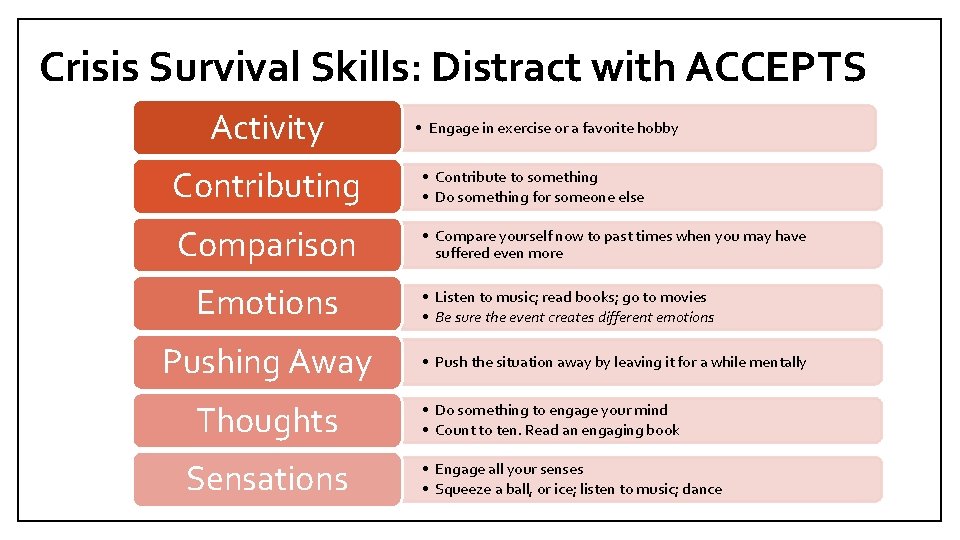
Crisis Survival Skills: Distract with ACCEPTS Activity • Engage in exercise or a favorite hobby Contributing • Contribute to something • Do something for someone else Comparison • Compare yourself now to past times when you may have suffered even more Emotions Pushing Away Thoughts Sensations • Listen to music; read books; go to movies • Be sure the event creates different emotions • Push the situation away by leaving it for a while mentally • Do something to engage your mind • Count to ten. Read an engaging book • Engage all your senses • Squeeze a ball, or ice; listen to music; dance
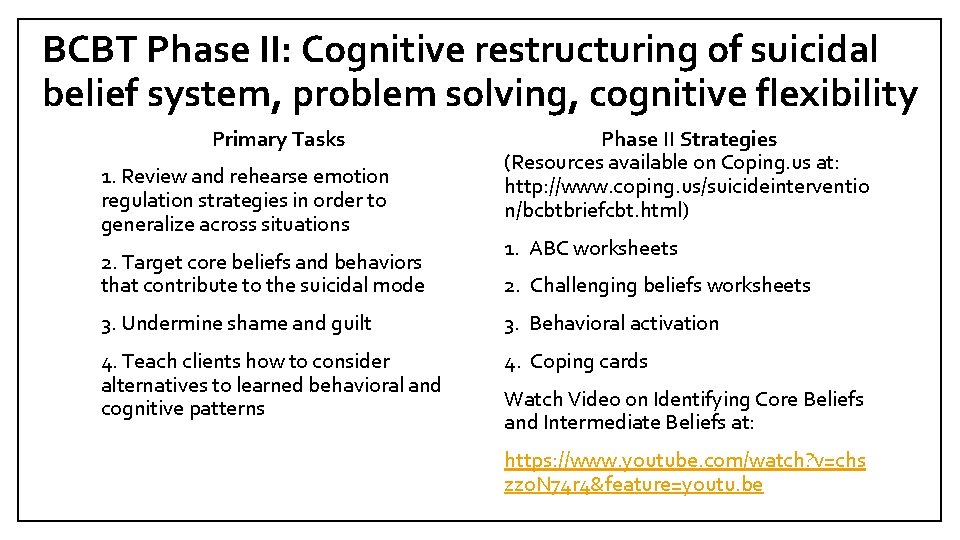
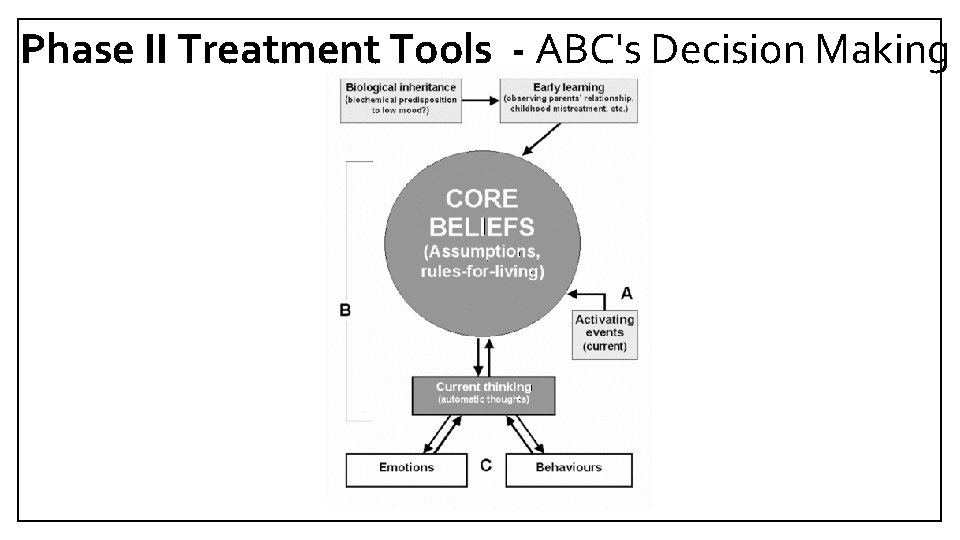
BCBT Phase II: Cognitive restructuring of suicidal belief system, problem solving, cognitive flexibility Primary Tasks 1. Review and rehearse emotion regulation strategies in order to generalize across situations 2. Target core beliefs and behaviors that contribute to the suicidal mode Phase II Strategies (Resources available on Coping. us at: http: //www. coping. us/suicideinterventio n/bcbtbriefcbt. html) 1. ABC worksheets 2. Challenging beliefs worksheets 3. Undermine shame and guilt 3. Behavioral activation 4. Teach clients how to consider alternatives to learned behavioral and cognitive patterns 4. Coping cards Watch Video on Identifying Core Beliefs and Intermediate Beliefs at: https: //www. youtube. com/watch? v=chs zzo. N 74 r 4&feature=youtu. be
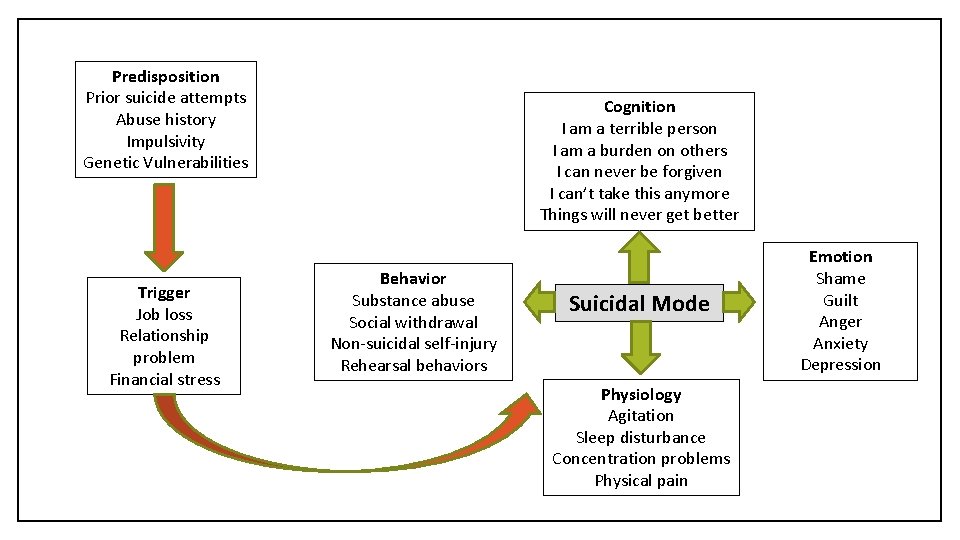
Predisposition Prior suicide attempts Abuse history Impulsivity Genetic Vulnerabilities Trigger Job loss Relationship problem Financial stress Cognition I am a terrible person I am a burden on others I can never be forgiven I can’t take this anymore Things will never get better Behavior Substance abuse Social withdrawal Non-suicidal self-injury Rehearsal behaviors Suicidal Mode Physiology Agitation Sleep disturbance Concentration problems Physical pain Emotion Shame Guilt Anger Anxiety Depression
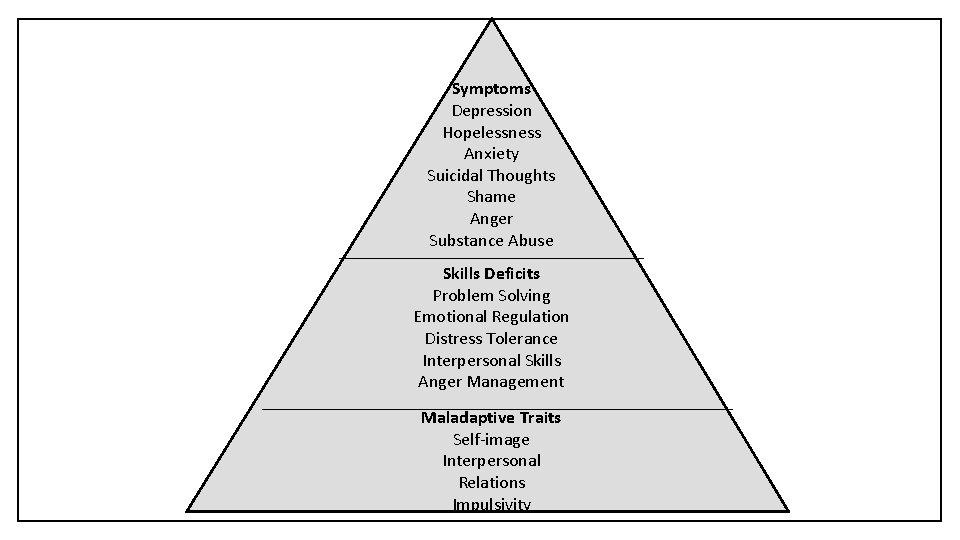
Symptoms Depression Hopelessness Anxiety Suicidal Thoughts Shame Anger Substance Abuse Skills Deficits Problem Solving Emotional Regulation Distress Tolerance Interpersonal Skills Anger Management Maladaptive Traits Self-image Interpersonal Relations Impulsivity
Phase II Treatment Tools - ABC's Decision Making
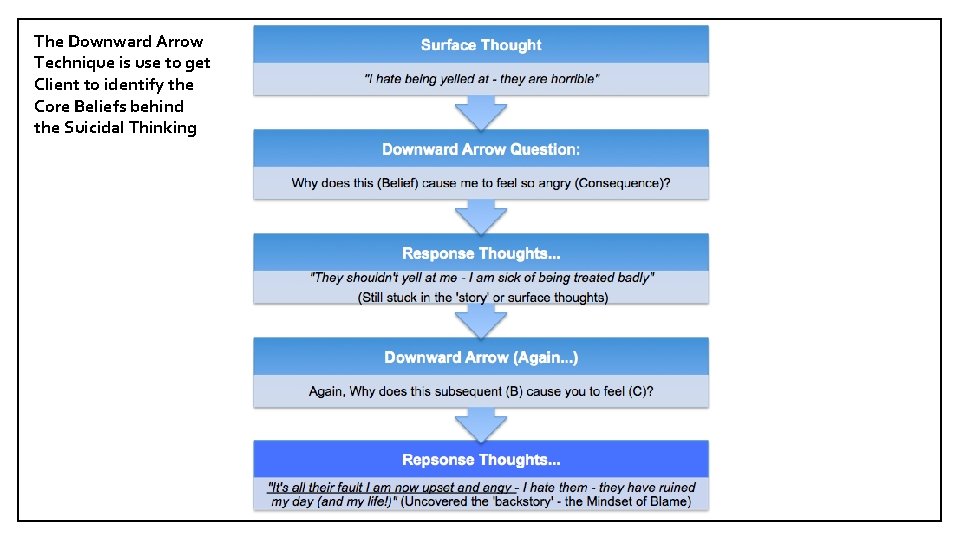
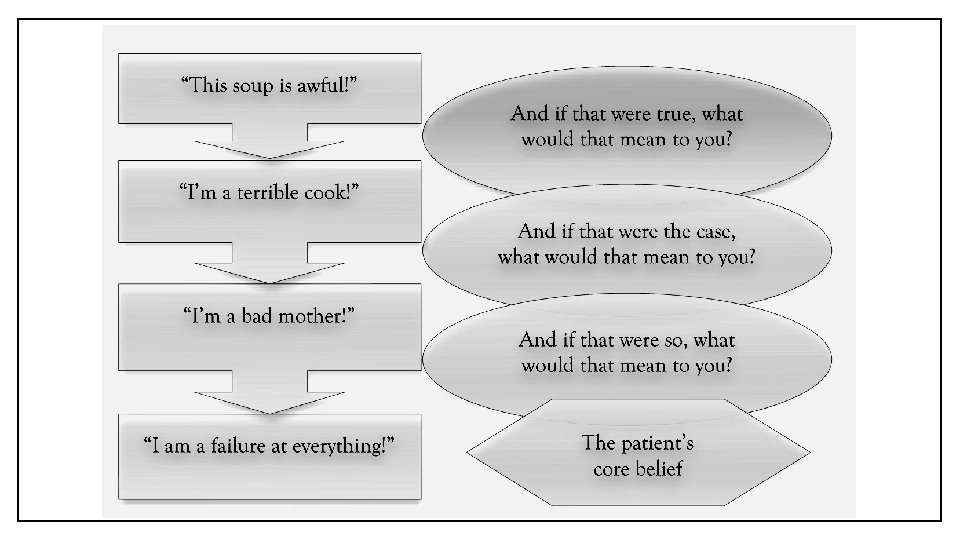
The Downward Arrow Technique is use to get Client to identify the Core Beliefs behind the Suicidal Thinking
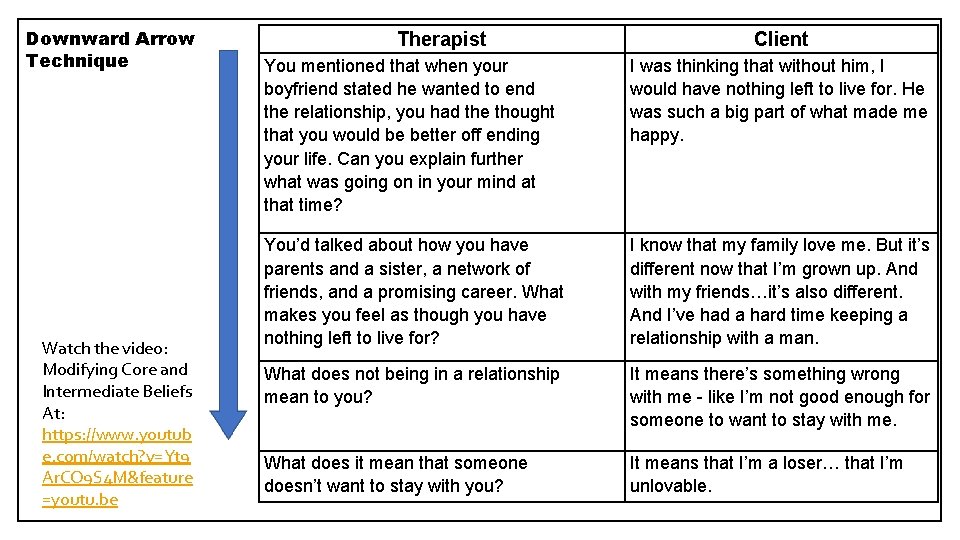
Downward Arrow Technique Watch the video: Modifying Core and Intermediate Beliefs At: https: //www. youtub e. com/watch? v=Yt 9 Ar. CO 9 S 4 M&feature =youtu. be Therapist Client You mentioned that when your boyfriend stated he wanted to end the relationship, you had the thought that you would be better off ending your life. Can you explain further what was going on in your mind at that time? I was thinking that without him, I would have nothing left to live for. He was such a big part of what made me happy. You’d talked about how you have parents and a sister, a network of friends, and a promising career. What makes you feel as though you have nothing left to live for? I know that my family love me. But it’s different now that I’m grown up. And with my friends…it’s also different. And I’ve had a hard time keeping a relationship with a man. What does not being in a relationship mean to you? It means there’s something wrong with me - like I’m not good enough for someone to want to stay with me. What does it mean that someone doesn’t want to stay with you? It means that I’m a loser… that I’m unlovable.
Reduce Emotional Vulnerability: ABC’s A: ACCUMULATE POSITIVE EXPERIENCES In the Short Term: Do pleasant things that are possible right now. • Increase pleasant activities that lead to positive emotions. • Do one thing each day from the Pleasant Activities List In the Long Term: Make changes in your life so positive events will occur more often. Build a life worth living. Work towards goals: Make list of positive events you want. List small steps towards goals. Take first step. Pay attention to relationships: Repair old relationships. Reach out for new relationships. Work on current relationships. • Avoid avoiding • Avoid giving up
ABC’s B: BUILD MASTERY Schedule one or more activities each day to build a sense of accomplishment. C: COPE AHEAD Create a plan ahead of time so that you are prepared to cope skillfully with emotional situations. Imagine yourself coping effectively.
Coping Cards: IMPROVE the Moment The Goal of Use of Coping Cards is to help the clients to IMPROVE Through Imagery, Meaning, Prayer, Relaxation, One thing at a time so as to gain meaning and value from current life circumstances, . Imagery • Imagine a calming and safe place • Imagine stress and anxiety draining out Meaning • Find a meaning or value to what you are suffering. • Focus on positive, growth from challenges. Prayer Relaxation One thing… • Turn things over to a Higher Power • Find support, strength, or faith to cope • Use deep breathing and follow your breath • Use muscle relaxation and other ways to relax • Focus you attention on one thing in the moment. • Keep yourself physically and mentally in present 63
BCBT Phase III: Relapse Prevention Primary Tasks 1. Conduct relapse prevention task repeatedly 2. Review index suicidal episode several times until patient demonstrates ability to problem solve 3. Develop hypothetical future crises and conduct imaginal exposure with patient imagining effective use of problem solving skills Relapse Prevention Tasks 1. Educate client about relapse prevention task 2. Answer questions and address concerns 3. Instruct client to remain in present tense 4. Prompt client during task to increase emotional vividness and specificity 5. As client demonstrates competency, increase complexity and difficulty of task 6. Process task following completion
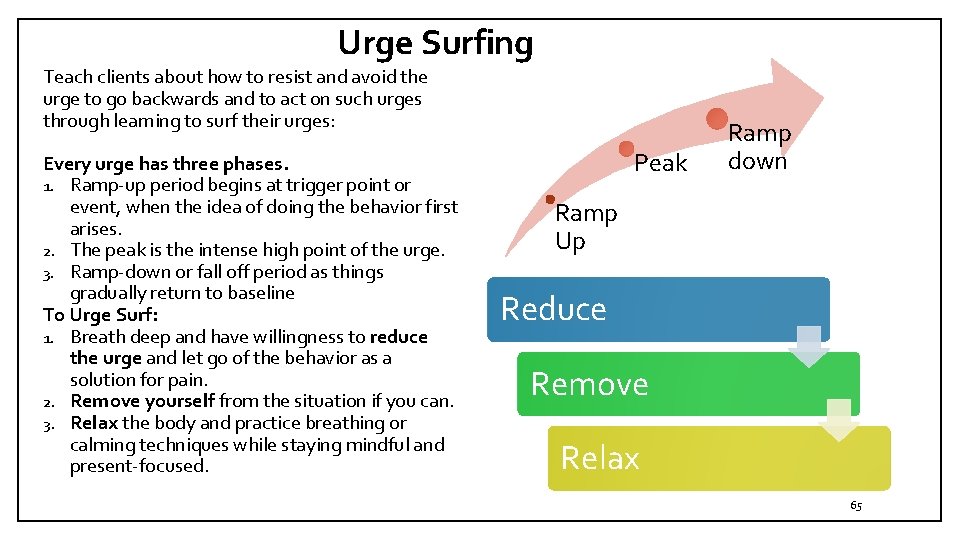
Urge Surfing Teach clients about how to resist and avoid the urge to go backwards and to act on such urges through learning to surf their urges: Every urge has three phases. 1. Ramp-up period begins at trigger point or event, when the idea of doing the behavior first arises. 2. The peak is the intense high point of the urge. 3. Ramp-down or fall off period as things gradually return to baseline To Urge Surf: 1. Breath deep and have willingness to reduce the urge and let go of the behavior as a solution for pain. 2. Remove yourself from the situation if you can. 3. Relax the body and practice breathing or calming techniques while staying mindful and present-focused. Peak Ramp down Ramp Up Reduce Remove Relax 65
BCBT Final session 1. Review treatment log contents 2. Determine final “lesson learned” for treatment log 3. Educate client on follow-up procedures as needed 4. Provide client with token of treatment completion (e. g. , coin, certificate, etc. ) Note: This section on Brief Cognitive Behavior Therapy (BCBT) for Suicide Intervention and Prevention is based on the following book: Bryan, C. J. (Ed). (2015). Cognitive Behavioral Therapy for Preventing Suicide Attempts: A Guide to Brief Treatments Across Clinical Settings (Clinical Topics in Psychology and Psychiatry). New York: Rutledge. The BCBT Model is based on this Treatment Manual: Wenzel, A. , Brown, G. K. , & Beck, A. T. (2009). Cognitive therapy for suicidal patients. Washington, DC: American Psychological Association. This book functions as the Treatment Manual for BCBT and CBT for Suicide Intervention and Prevention.
Resiliency & Early Prevention
What is resilience? • Everyone experiences stress and difficult circumstances during their life. • Most people can handle these tough times and may even be able to make something good from a difficult situation. • Resilience is the ability to bounce back after experiencing trauma or stress, to adapt to changing circumstances and respond positively to difficult situations. • It is the ability to learn and grow through the positive and the negative experiences of life, turning potentially traumatic experiences into constructive ones. • Being resilient involves engaging with friends and family for support, and using coping strategies and problem-solving skills effectively to work through difficulties.
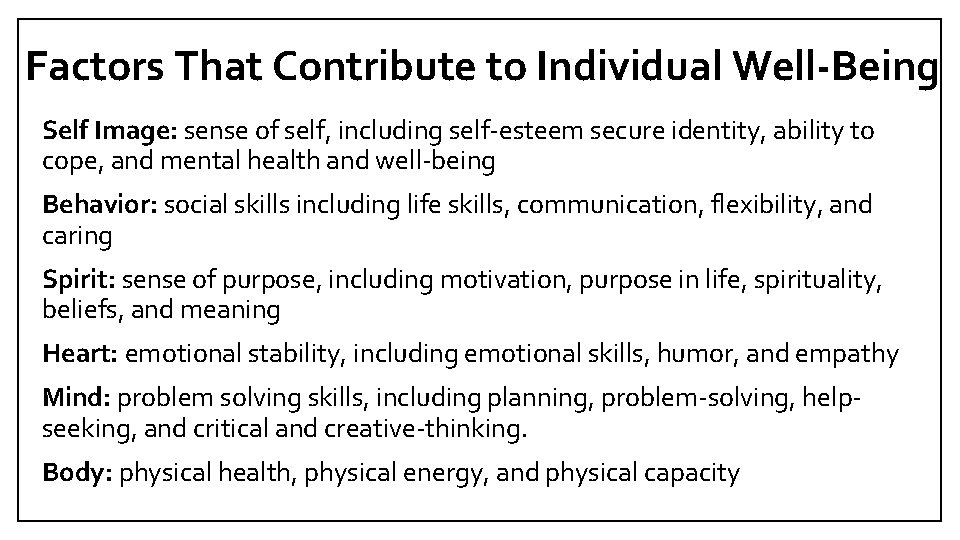
Factors That Contribute to Individual Well-Being Self Image: sense of self, including self-esteem secure identity, ability to cope, and mental health and well-being Behavior: social skills including life skills, communication, flexibility, and caring Spirit: sense of purpose, including motivation, purpose in life, spirituality, beliefs, and meaning Heart: emotional stability, including emotional skills, humor, and empathy Mind: problem solving skills, including planning, problem-solving, helpseeking, and critical and creative-thinking. Body: physical health, physical energy, and physical capacity
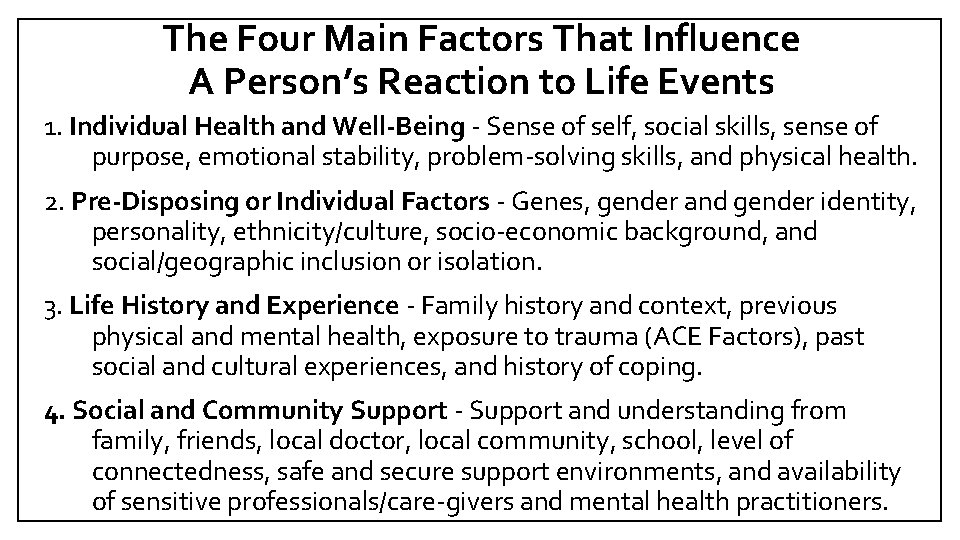
The Four Main Factors That Influence A Person’s Reaction to Life Events 1. Individual Health and Well-Being - Sense of self, social skills, sense of purpose, emotional stability, problem-solving skills, and physical health. 2. Pre-Disposing or Individual Factors - Genes, gender and gender identity, personality, ethnicity/culture, socio-economic background, and social/geographic inclusion or isolation. 3. Life History and Experience - Family history and context, previous physical and mental health, exposure to trauma (ACE Factors), past social and cultural experiences, and history of coping. 4. Social and Community Support - Support and understanding from family, friends, local doctor, local community, school, level of connectedness, safe and secure support environments, and availability of sensitive professionals/care-givers and mental health practitioners.
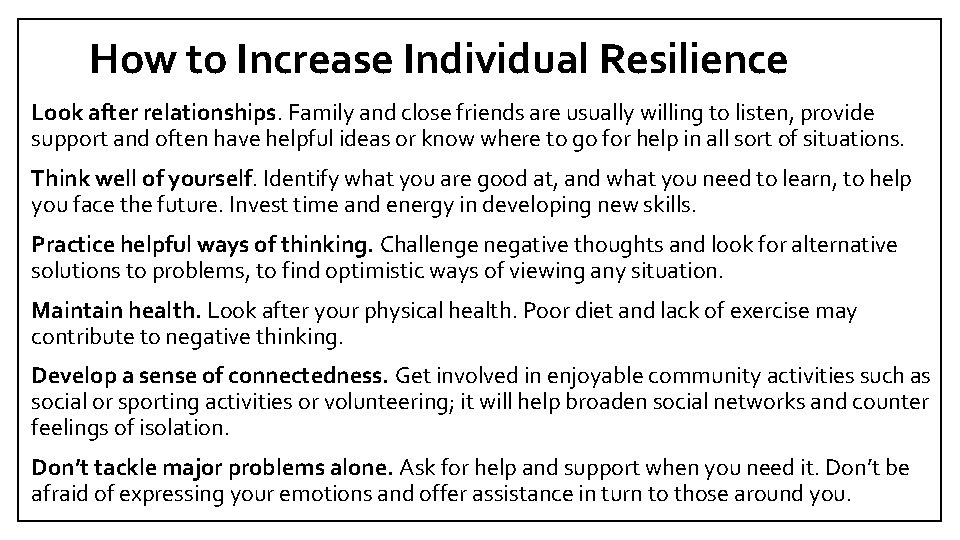
How to Increase Individual Resilience Look after relationships. Family and close friends are usually willing to listen, provide support and often have helpful ideas or know where to go for help in all sort of situations. Think well of yourself. Identify what you are good at, and what you need to learn, to help you face the future. Invest time and energy in developing new skills. Practice helpful ways of thinking. Challenge negative thoughts and look for alternative solutions to problems, to find optimistic ways of viewing any situation. Maintain health. Look after your physical health. Poor diet and lack of exercise may contribute to negative thinking. Develop a sense of connectedness. Get involved in enjoyable community activities such as social or sporting activities or volunteering; it will help broaden social networks and counter feelings of isolation. Don’t tackle major problems alone. Ask for help and support when you need it. Don’t be afraid of expressing your emotions and offer assistance in turn to those around you.
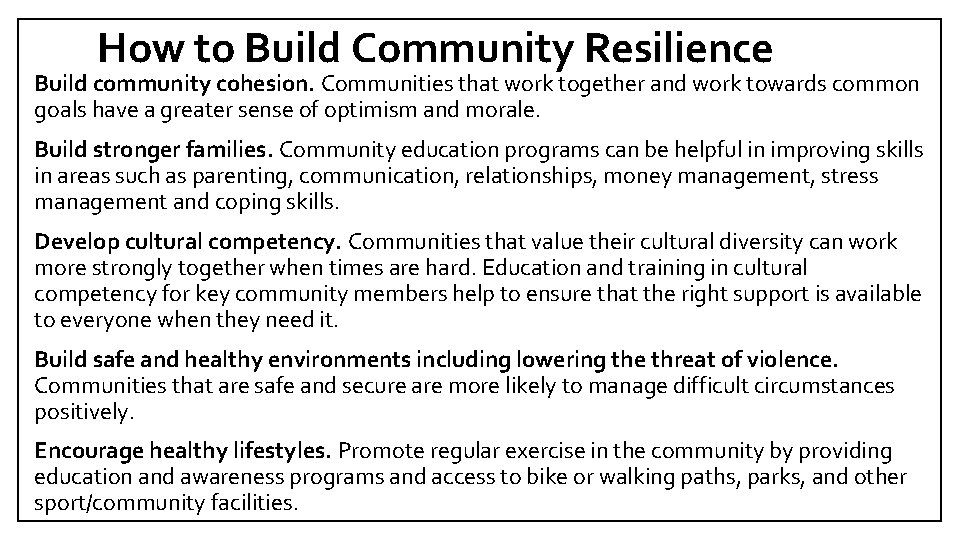
How to Build Community Resilience Build community cohesion. Communities that work together and work towards common goals have a greater sense of optimism and morale. Build stronger families. Community education programs can be helpful in improving skills in areas such as parenting, communication, relationships, money management, stress management and coping skills. Develop cultural competency. Communities that value their cultural diversity can work more strongly together when times are hard. Education and training in cultural competency for key community members help to ensure that the right support is available to everyone when they need it. Build safe and healthy environments including lowering the threat of violence. Communities that are safe and secure are more likely to manage difficult circumstances positively. Encourage healthy lifestyles. Promote regular exercise in the community by providing education and awareness programs and access to bike or walking paths, parks, and other sport/community facilities.
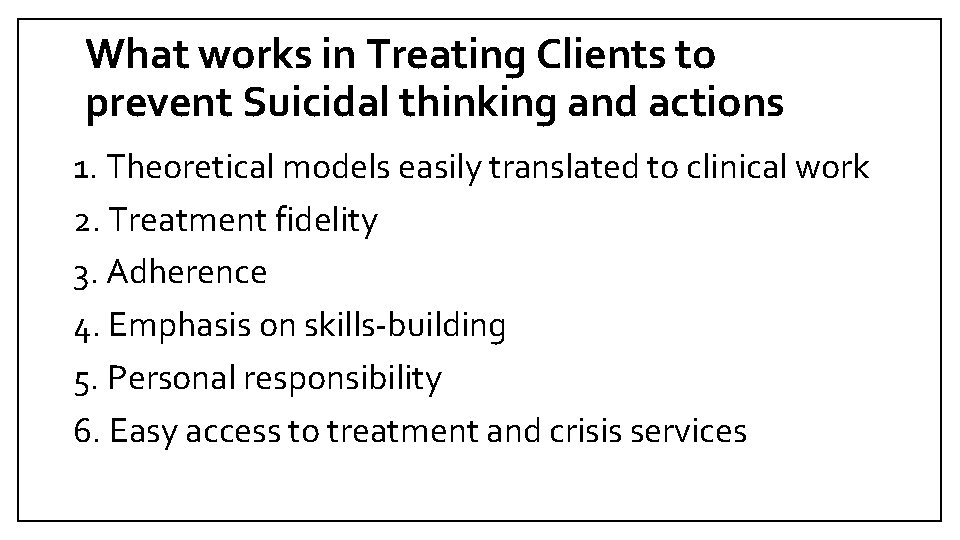
What works in Treating Clients to prevent Suicidal thinking and actions 1. Theoretical models easily translated to clinical work 2. Treatment fidelity 3. Adherence 4. Emphasis on skills-building 5. Personal responsibility 6. Easy access to treatment and crisis services
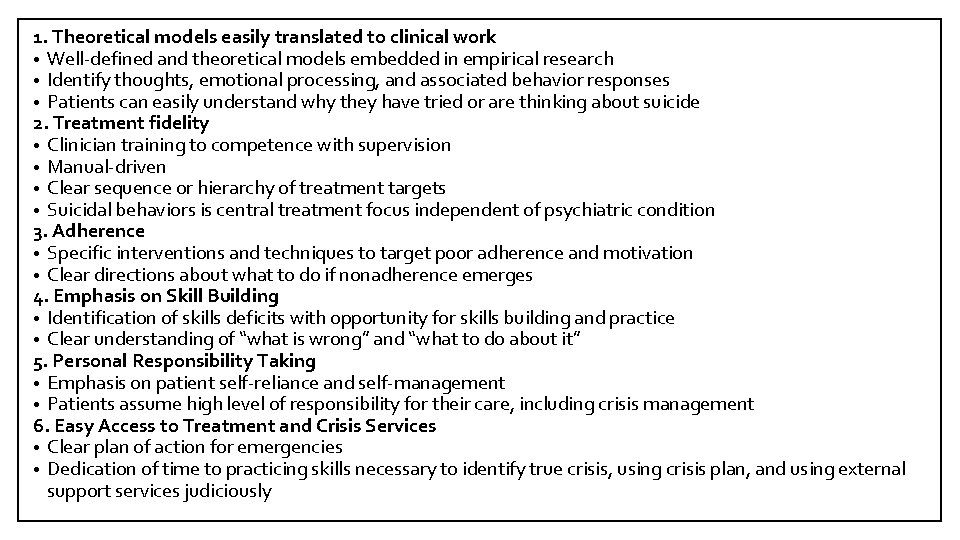
1. Theoretical models easily translated to clinical work • Well-defined and theoretical models embedded in empirical research • Identify thoughts, emotional processing, and associated behavior responses • Patients can easily understand why they have tried or are thinking about suicide 2. Treatment fidelity • Clinician training to competence with supervision • Manual-driven • Clear sequence or hierarchy of treatment targets • Suicidal behaviors is central treatment focus independent of psychiatric condition 3. Adherence • Specific interventions and techniques to target poor adherence and motivation • Clear directions about what to do if nonadherence emerges 4. Emphasis on Skill Building • Identification of skills deficits with opportunity for skills building and practice • Clear understanding of “what is wrong” and “what to do about it” 5. Personal Responsibility Taking • Emphasis on patient self-reliance and self-management • Patients assume high level of responsibility for their care, including crisis management 6. Easy Access to Treatment and Crisis Services • Clear plan of action for emergencies • Dedication of time to practicing skills necessary to identify true crisis, using crisis plan, and using external support services judiciously
Cultural Competency in Suicide Prevention
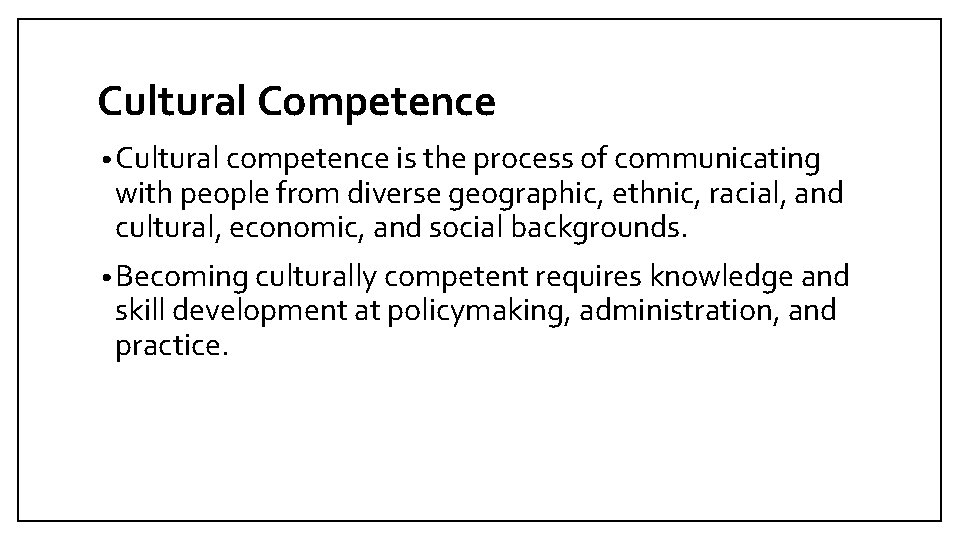
Cultural Competence • Cultural competence is the process of communicating with people from diverse geographic, ethnic, racial, and cultural, economic, and social backgrounds. • Becoming culturally competent requires knowledge and skill development at policymaking, administration, and practice.
Steps to Take 1. Become more aware of the various cultures that exist within your community. 2. Assess personal cultural values while acknowledging each of our own perceptions of the world; and 3. Work to understand the dynamics that may occur when members of different cultures interact.
Culturally Appropriate Strategies 1. Prevention strategies are culturally competent when they demonstrate sensitivity to cultural differences and similarities, while demonstrating effectiveness in using cultural symbols to communicate a message. 2. Seek input from your target population before developing and implementing prevention strategies. 3. Develop written guidelines that help guide the cultural competence of program staff. 4. Continuously review all strategies, policies, procedures, and practices to ensure they are culturally competent.
The Importance of Faith/Spirituality Reason for living; Suicide is not an option: While examining the relationship between spirituality, social desirability, and reasons for living, Ellis and Smith (1991) found a positive correlation between religious well-being and the total reason for living. Suicide unacceptable: Ellis &Smith (1991) also found a strong relationship between the adaptive cognitive beliefs which people report as reasons for not considering suicide and their existential beliefs. While examining public opinions, Singh, Williams & Ryther (1986) found that survey respondents with attributes of higher education, lower religiosity, and high commitment to freedom of expression were more likely to consider suicide as acceptable. Ellis JB & Smith PC. (1991). Spiritual well-being, social desirability and reasons for living: Is there a connection? International Journal of Social Psychiatry. 37(1), 57 -63. Singh BK, Williams JS, & Ryther BJ (1986). Public approval of suicide; A situational analysis. Suicide & Life Threatening Behavior, 16(4), 409 – 418.
The Importance of Faith/Spirituality Suicidal ideation: In his study on the relationship between religion and suicidal ideation in a cohort of Latin-American immigrants, Hovey (1999) found that self-perception of religiosity, influence of religion, and church attendance were significantly negatively associated with suicidal ideation. A multiple regression analysis showed that the influence of religion was a significant predictor of suicidal ideation. Suicide attempts: Kaslow et al (2004) in their study examining the personal factors associated with suicidal behavior among African American women and men, found that, compared with nonattempters, attempters reported more psychological distress, aggression, substance use, maladaptive coping strategies, less religiosity/spirituality, and lower levels of ethnic identity. Hovey, J. D. (1999) Religion and suicidal ideation in a sample of Latin American immigrants. Psychological Reports, 85(1), 171 -177. Kaslow, N. J. , Price, A. W. & Wyckoff, S. Person factors associated with suicidal behavior among African American women and men. Cultural Diversity Ethnic Minorities Psychology, 10(1), 5 -22.
Resources
The National Suicide Prevention Lifeline (NSPL) 1 -800 -273 -TALK (8255) 24 -hour confidential crisis hotline www. suicidepreventionlifeline. org Statewide Office of Suicide Prevention (SOSP) Resources and information: www. Help. Promote. Hope. com Suicide Prevention Resource Center (SPRC) Resources and information www. sprc. org American Association of Suicidology (AAS) National non-profit dedicated to the understanding and prevention of suicide www. Suicidology. org Suicide Prevention Action Network USA (SPAN USA) National non-profit that works to increase awareness regarding the toll of suicide on our nation and to develop political will to ensure that the government effectively addresses suicide. www. spanusa. org The Florida Suicide Prevention Implementation Project (FSPIP) A site for those who are interested in taking action to prevent the tragic loss of life to suicide. http: //preventsuicide. fmhi. usf. edu
Suicide Awareness Voices of Education (SAVE) Dedicated to educating about suicide and speaking for suicide survivors. www. save. org National Strategy for Suicide Prevention (NSPP) (2001) Our nation’s blueprint for suicide prevention, which was developed through the combined work of advocates, clinicians, researchers, and survivors. http: //mentalhealth. samhsa. gov/Suicide. Prevention/ Surgeon General’s Call to Action to Prevention Suicide, 1999 A semi-annual report by the U. S. Surgeon General about suicide and suicide prevention in the United States. http: //www. surgeongeneral. gov/library/calltoaction Youth Risk Behavior Survey (YRBS) National survey to understand how youth in America feels. Measures risk factors in their lives, asks about suicide attempts, etc. http: //www. cdc. gov/Health. Youth/yrbs/index. htm Jason Foundation National organization funded through corporations which has a curriculum that is implemented in schools across the nation. www. jasonfoundation. com