
Suicidal Attempt Hanging By Intensive Care United Christian
Suicidal Attempt Hanging By Intensive Care United Christian Hospital
Epidemiology of Suicide and Hanging • The overall rate of suicide in the United States is 11. 2 per 100, 000, accounting for over 31, 000 deaths each year. • Suicide rates are highest among men who are older than 69 years (Figure 1). Among people under 45 years of age, suicide is the fifth most frequent cause of death; it is more frequent than homicide and only slightly less frequent than death from heart disease. Assessment and Treatment of Suicidal Patients. NEJM Vol 337: 910 -915 (13). Robert M. A. Hirschfeld, M. D. , and James M. Russell, M. D.
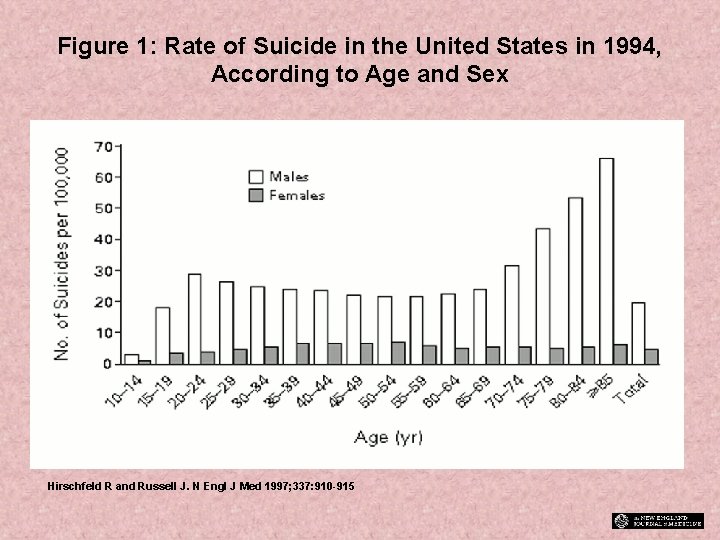
Figure 1: Rate of Suicide in the United States in 1994, According to Age and Sex Hirschfeld R and Russell J. N Engl J Med 1997; 337: 910 -915
Epidemiology of Suicide and Hanging • Hanging is one of the most commonly used methods for suicide worldwide. Its incidence has increased over the last 30 years. • Around 10% of hanging suicides occur in the controlled environments of hospitals, prisons, and police custody. • Around 90% occur in the community. • The most commonly used ligatures (rope, belts) and ligature points (beams, banisters, hooks, door knobs, and trees) • Around 50% of hanging suicides are not fully suspended--ligature points below head level are commonly used. • The Case fatality following attempted suicide by hanging is varied, but quoted around 70% The epidemiology and prevention of suicide by hanging: a systematic review. Int J Epidemiol. 2005; 34(2): 433 -42. Gunnell D; Bennewith O, et al.
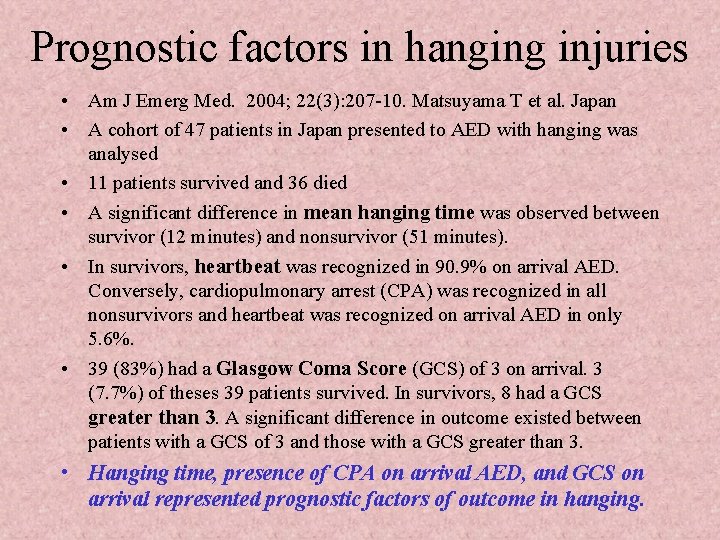
Prognostic factors in hanging injuries • Am J Emerg Med. 2004; 22(3): 207 -10. Matsuyama T et al. Japan • A cohort of 47 patients in Japan presented to AED with hanging was analysed • 11 patients survived and 36 died • A significant difference in mean hanging time was observed between survivor (12 minutes) and nonsurvivor (51 minutes). • In survivors, heartbeat was recognized in 90. 9% on arrival AED. Conversely, cardiopulmonary arrest (CPA) was recognized in all nonsurvivors and heartbeat was recognized on arrival AED in only 5. 6%. • 39 (83%) had a Glasgow Coma Score (GCS) of 3 on arrival. 3 (7. 7%) of theses 39 patients survived. In survivors, 8 had a GCS greater than 3. A significant difference in outcome existed between patients with a GCS of 3 and those with a GCS greater than 3. • Hanging time, presence of CPA on arrival AED, and GCS on arrival represented prognostic factors of outcome in hanging.
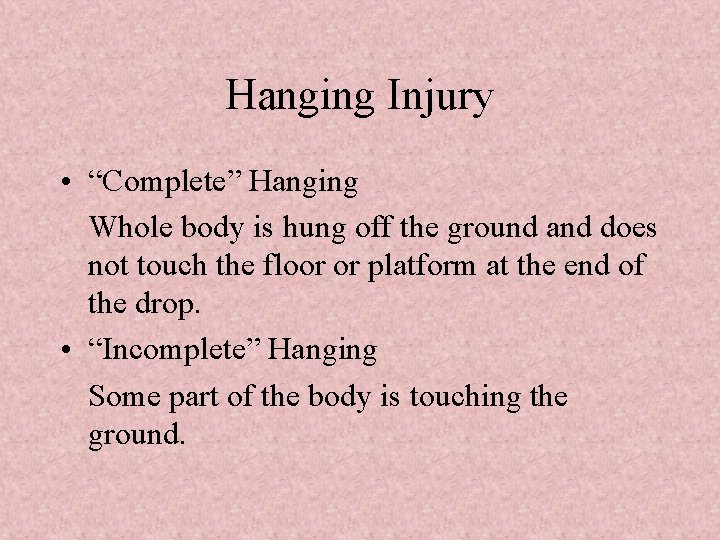
Hanging Injury • “Complete” Hanging Whole body is hung off the ground and does not touch the floor or platform at the end of the drop. • “Incomplete” Hanging Some part of the body is touching the ground.

Pathophysiology of Hanging Injury • Classical judicial hangings -Hanging is complete -The mechanism of death is effectively decapitation, with distraction of the head from the neck and torso, fracture of the upper cervical spine (typically traumatic spondylolysis of C 2 in the classic hangman fracture), and transection of the spinal cord.
Pathophysiology of Hanging Injury • Suicidal hangings -May be complete or incomplete hanging -Multiple mechanism and confounding factors
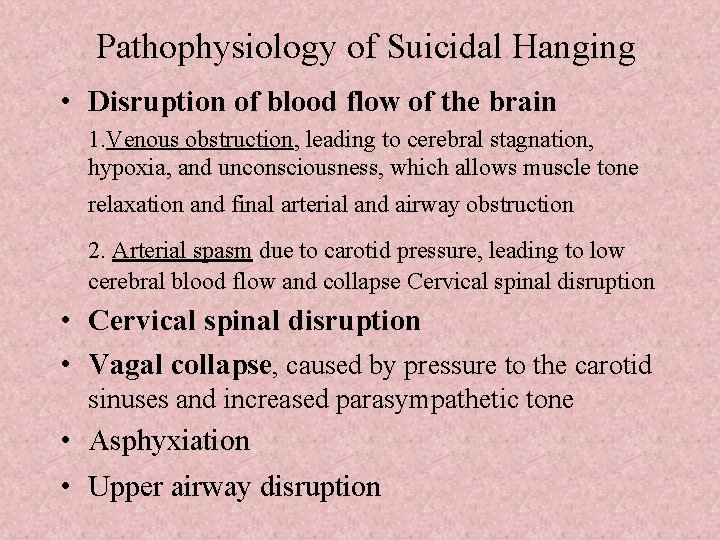
Pathophysiology of Suicidal Hanging • Disruption of blood flow of the brain 1. Venous obstruction, leading to cerebral stagnation, hypoxia, and unconsciousness, which allows muscle tone relaxation and final arterial and airway obstruction 2. Arterial spasm due to carotid pressure, leading to low cerebral blood flow and collapse Cervical spinal disruption • Cervical spinal disruption • Vagal collapse, caused by pressure to the carotid sinuses and increased parasympathetic tone • Asphyxiation • Upper airway disruption
Pathophysiology of Hanging Injury • None of the proposed mechanisms emphasize airway compromise alone. • Fatal outcome is believed to be contributed by multiple mechanism. Several reports exist of suicidal posttracheostomy patients who successfully hung themselves with ligatures well above the tracheostomy, where death did not appear to be related to spinal cord injury. • Significant cervical spine and associated injury to the spinal cord occurs in hangings that involve a fall from a distance greater than the body height. • Hanging Injuries and Strangulation. William Ernoehazy, et al, emedicine. 14 Feb, 2006
Management of Hanging Injury Initial Management • Airway • Breathing • Circulation • BCLS • ATLS
Airway shall be secured & Spine shall be stabilized
Management of Hanging Injury- Imaging • C-spine X-ray • Soft-tissue neck radiographs -Generally, a fractured hyoid bone indicates a severe, occult soft-tissue injury, even in a patient whose medical condition is otherwise stable. -Defer such studies until the airway is secure. • CT scanning of the neck -Provides increased sensitivity for the detection of subtle fractures and other soft-tissue abnormalities.
Complications of Hanging Injury • Respiratory complications: aspiration pneumonia and ARDS may develop • Tracheal stenosis • Neurologic sequelae: A wide array of complications may occur in survivors of strangulations and near-hangings, including muscle spasms, transient hemiplegia, central cord syndrome, and seizures. • Psychiatric disturbances: Psychosis, amnesia, and progressive dementia have been reported in hanging survivors. Nearly all patients who have undergone strangulation or near-hanging demonstrate restlessness and a propensity for violence
Pitfalls • Failure to adequately stabilize cervical spine • Failure to obtain soft-tissue neck radiographs • Failure to address the potential delayed airway compromise • Failure to diagnose suspected laryngeal injuries or carotid artery injury • Failure to seek other injuries or illnesses or poisoning.
- Slides: 15