
Suggestions and Limperitif Or how to tell people


- Slides: 10
Suggestions and L’imperitif Or how to tell people to do something
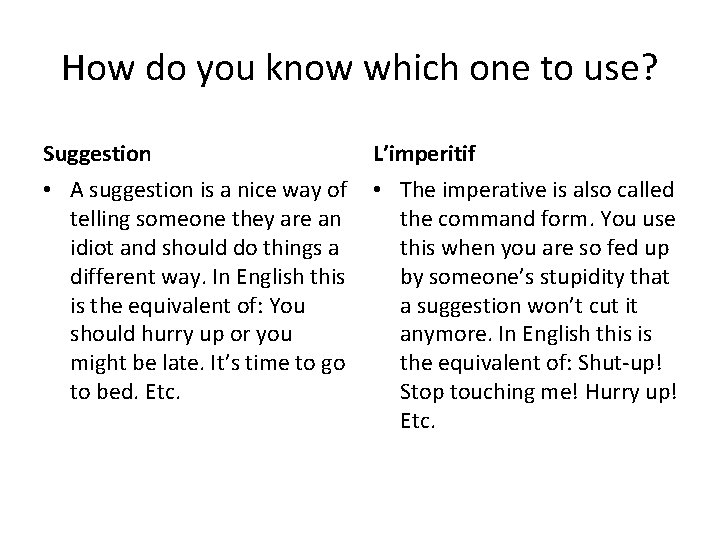
How do you know which one to use? Suggestion L’imperitif • A suggestion is a nice way of telling someone they are an idiot and should do things a different way. In English this is the equivalent of: You should hurry up or you might be late. It’s time to go to bed. Etc. • The imperative is also called the command form. You use this when you are so fed up by someone’s stupidity that a suggestion won’t cut it anymore. In English this is the equivalent of: Shut-up! Stop touching me! Hurry up! Etc.
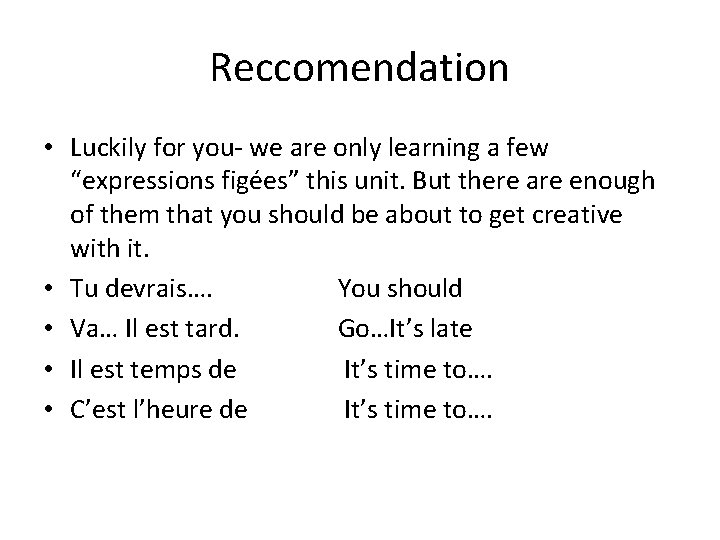
Reccomendation • Luckily for you- we are only learning a few “expressions figées” this unit. But there are enough of them that you should be about to get creative with it. • Tu devrais…. You should • Va… Il est tard. Go…It’s late • Il est temps de It’s time to…. • C’est l’heure de It’s time to….
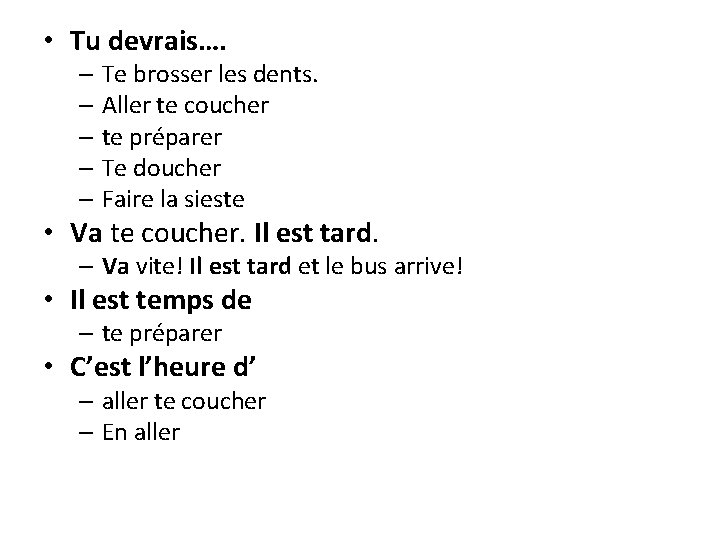
• Tu devrais…. – Te brosser les dents. – Aller te coucher – te préparer – Te doucher – Faire la sieste • Va te coucher. Il est tard. – Va vite! Il est tard et le bus arrive! • Il est temps de – te préparer • C’est l’heure d’ – aller te coucher – En aller
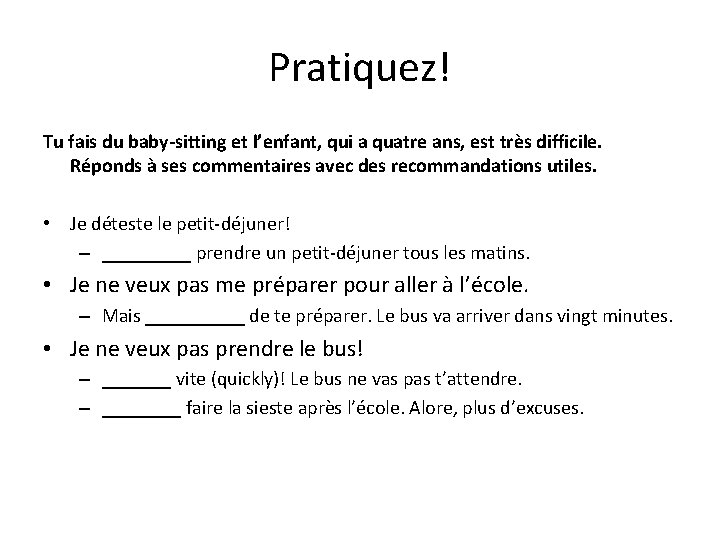
Pratiquez! Tu fais du baby-sitting et l’enfant, qui a quatre ans, est très difficile. Réponds à ses commentaires avec des recommandations utiles. • Je déteste le petit-déjuner! – _____ prendre un petit-déjuner tous les matins. • Je ne veux pas me préparer pour aller à l’école. – Mais _____ de te préparer. Le bus va arriver dans vingt minutes. • Je ne veux pas prendre le bus! – _______ vite (quickly)! Le bus ne vas pas t’attendre. – ____ faire la sieste après l’école. Alore, plus d’excuses.
L’imperatif • The imperitive is a command form. You can ONLY use tu, vous, or nous commands in French. (It doesn’t make much sense to command yourself…). Use the appropriate conjugation of the verb WITHOUT the pronoun tu, vous, or nous. • Ex. Tu prends ton livre…. . Prends ton livre. • Vous prenez vos livres…. . Prenez vos livres. • Nous prenons nos livres…. Prenons nos livres. • Remember to drop the final –s from the tu commands of –er verbs. Ex. Tu rentres tôt…. Rentre tôt.
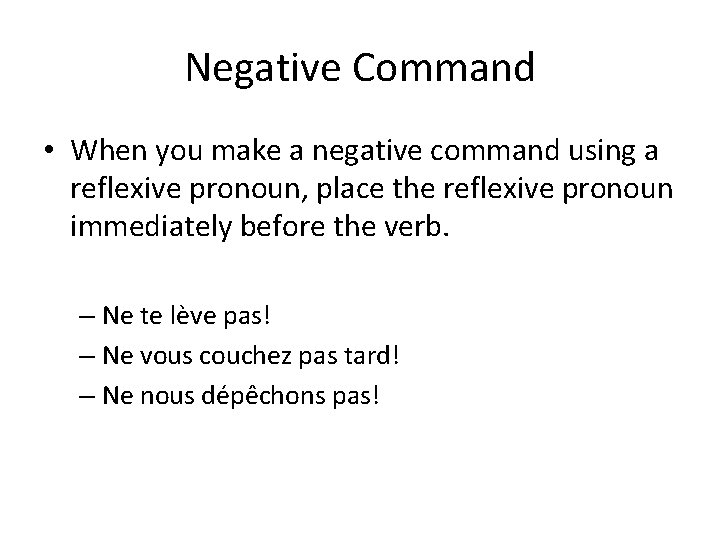
Negative Command • When you make a negative command using a reflexive pronoun, place the reflexive pronoun immediately before the verb. – Ne te lève pas! – Ne vous couchez pas tard! – Ne nous dépêchons pas!
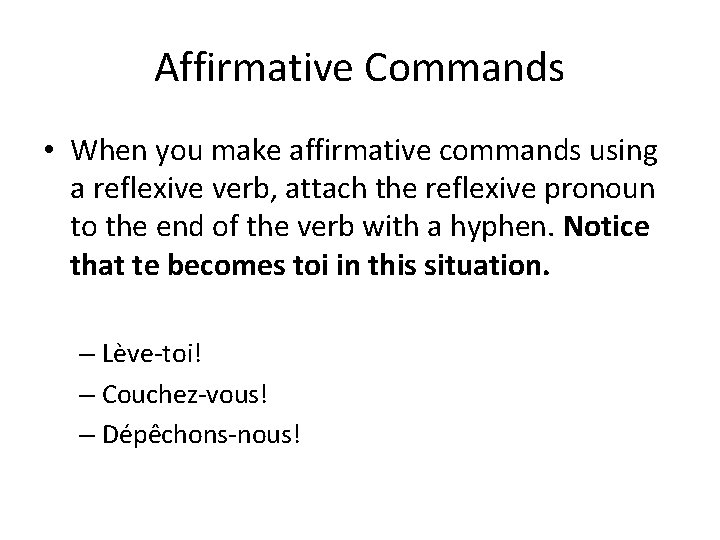
Affirmative Commands • When you make affirmative commands using a reflexive verb, attach the reflexive pronoun to the end of the verb with a hyphen. Notice that te becomes toi in this situation. – Lève-toi! – Couchez-vous! – Dépêchons-nous!
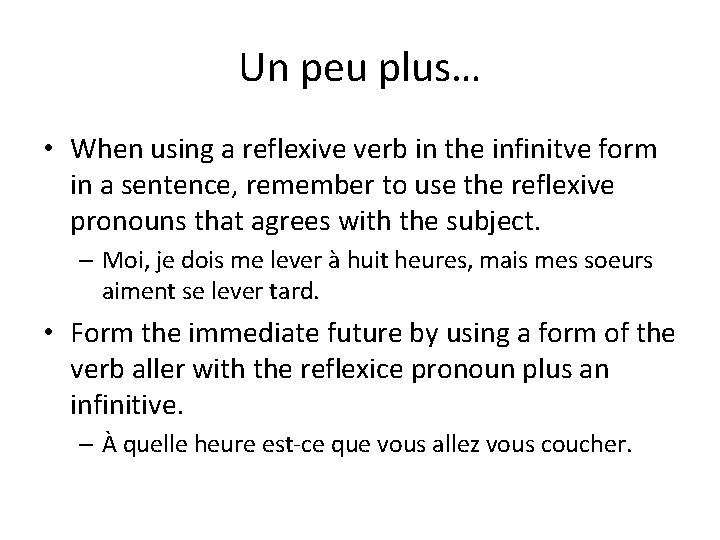
Un peu plus… • When using a reflexive verb in the infinitve form in a sentence, remember to use the reflexive pronouns that agrees with the subject. – Moi, je dois me lever à huit heures, mais mes soeurs aiment se lever tard. • Form the immediate future by using a form of the verb aller with the reflexice pronoun plus an infinitive. – À quelle heure est-ce que vous allez vous coucher.
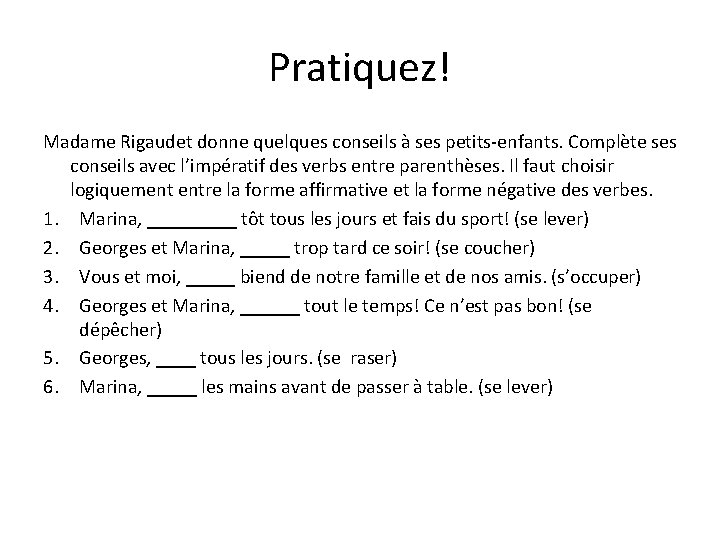
Pratiquez! Madame Rigaudet donne quelques conseils à ses petits-enfants. Complète ses conseils avec l’impératif des verbs entre parenthèses. Il faut choisir logiquement entre la forme affirmative et la forme négative des verbes. 1. Marina, _____ tôt tous les jours et fais du sport! (se lever) 2. Georges et Marina, _____ trop tard ce soir! (se coucher) 3. Vous et moi, _____ biend de notre famille et de nos amis. (s’occuper) 4. Georges et Marina, ______ tout le temps! Ce n’est pas bon! (se dépêcher) 5. Georges, ____ tous les jours. (se raser) 6. Marina, _____ les mains avant de passer à table. (se lever)