
Sugar Texts Telling the Sugar Story in 6

- Slides: 17
Sugar. Texts Telling the Sugar. Story in 6 Indo-European languages: What may and what must be conveyed? Viktor Smith, Copenhagen Business School vs. ikk@cbs. dk “Languages differ essentially in what they must convey and not in what they may convey” Roman Jakobson (1959: 236) Lingue e culture europee: tipologie a confronto, Cagliari, 13 -14 novembre 2007
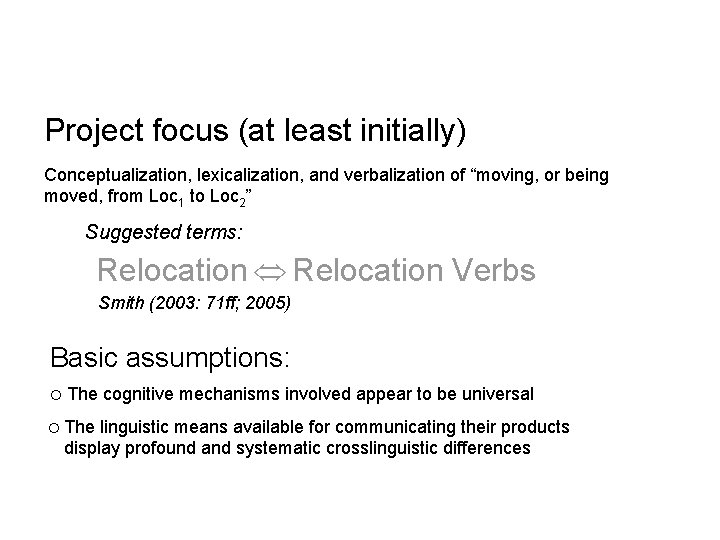
Project focus (at least initially) Conceptualization, lexicalization, and verbalization of “moving, or being moved, from Loc 1 to Loc 2” Suggested terms: Relocation Verbs Smith (2003: 71 ff; 2005) Basic assumptions: The cognitive mechanisms involved appear to be universal The linguistic means available for communicating their products display profound and systematic crosslinguistic differences
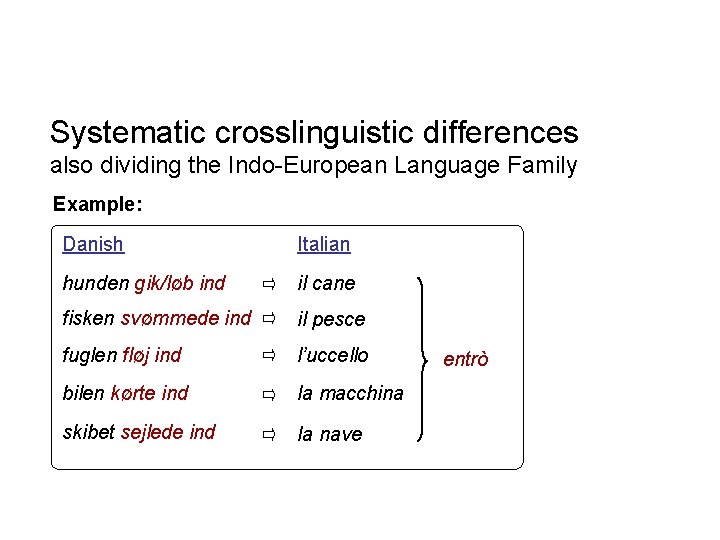
Systematic crosslinguistic differences also dividing the Indo-European Language Family Example: Danish Italian hunden gik/løb ind il cane fisken svømmede ind il pesce fuglen fløj ind l’uccello bilen kørte ind la macchina skibet sejlede ind la nave entrò
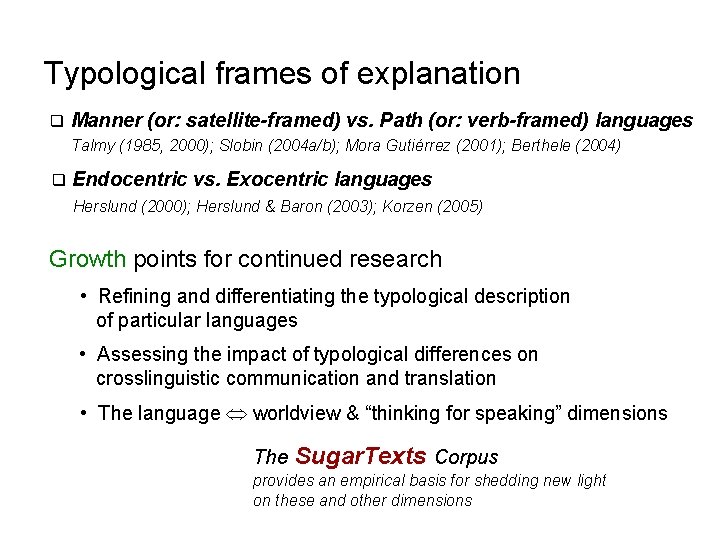
Typological frames of explanation q Manner (or: satellite-framed) vs. Path (or: verb-framed) languages Talmy (1985, 2000); Slobin (2004 a/b); Mora Gutiérrez (2001); Berthele (2004) q Endocentric vs. Exocentric languages Herslund (2000); Herslund & Baron (2003); Korzen (2005) Growth points for continued research • Refining and differentiating the typological description of particular languages • Assessing the impact of typological differences on crosslinguistic communication and translation • The language worldview & “thinking for speaking” dimensions The Sugar. Texts Corpus provides an empirical basis for shedding new light on these and other dimensions
The Sugar. Texts Corpus Multilingual text corpus containing authentic step-by-step descriptions of the processing of sugar beets into refined white sugar in a sugar factory, as found in textbooks, technical research reports, information folders, encyclopedias, sales material, on websites, etc. That is: Spontaneous verbalizations of uniform extralinguistic scenarios containing a wide variety of relocation processes and events in terms of both Path and Manner of motion Collected and screened by the joint effort of 8 master thesis students and 1 Ph. D student in collaboration with senior researchers at CBS Status: English: 17 texts, Italian: Italian 15 texts, French: French 26 texts, Spanish: Spanish 17 texts, Danish: Danish 17 texts, German: German 32 texts, Russian: 13 texts.
Related approaches Frog Stories The Mr. Bean Project Berman & Slobin 1994; Strömquist & Verhoeven 2004 Skytte et al. 1999
Virtues of the Sugar. Texts material: l Real-life texts produced by text writers simply doing their job l Immediate intelligibility to non-specialists and “fairy-tale appeal” l Path & Manner of motion change and combine in numerous ways throughout the process l The process media are affected and evolve along the process which further differentiates their motion potential l Realistic basis for testing the impact of typological differences on crosslinguistic communication: Translating technical process descriptions is a real-life challenge to thousands of translators! Text categorization: A, B & C texts depending on the intended reader’s expected degree of special knowledge
What we see. . . But how is it conceptualized and verbalized?
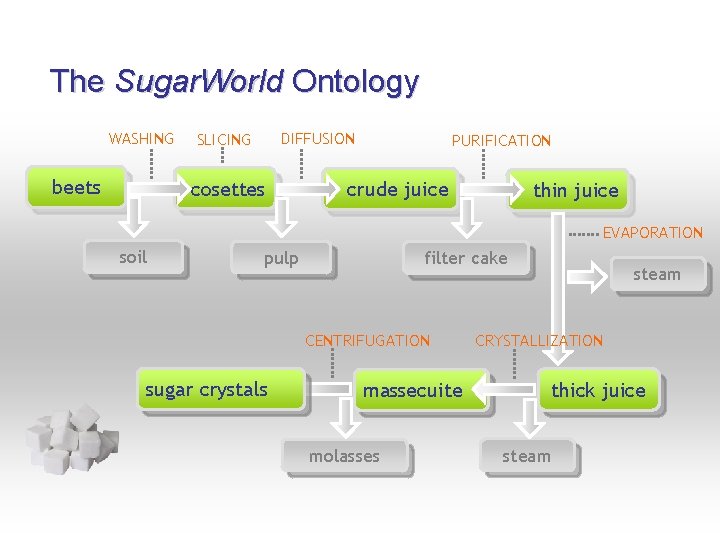
The Sugar. World Ontology WASHING beets DIFFUSION SLICING cosettes PURIFICATION crude juice thin juice EVAPORATION soil pulp filter cake CENTRIFUGATION sugar crystals massecuite molasses steam CRYSTALLIZATION thick juice steam
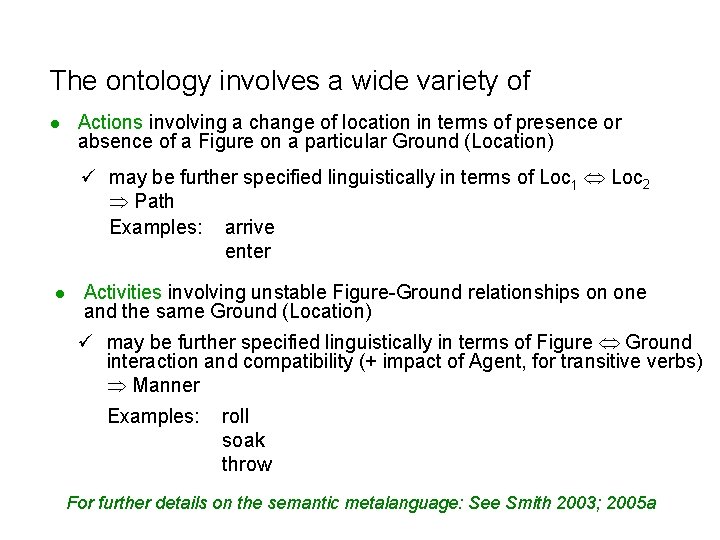
The ontology involves a wide variety of Actions involving a change of location in terms of presence or absence of a Figure on a particular Ground (Location) l may be further specified linguistically in terms of Loc 1 Loc 2 Path Examples: arrive enter l Activities involving unstable Figure-Ground relationships on one and the same Ground (Location) may be further specified linguistically in terms of Figure Ground interaction and compatibility (+ impact of Agent, for transitive verbs) Manner Examples: roll soak throw For further details on the semantic metalanguage: See Smith 2003; 2005 a
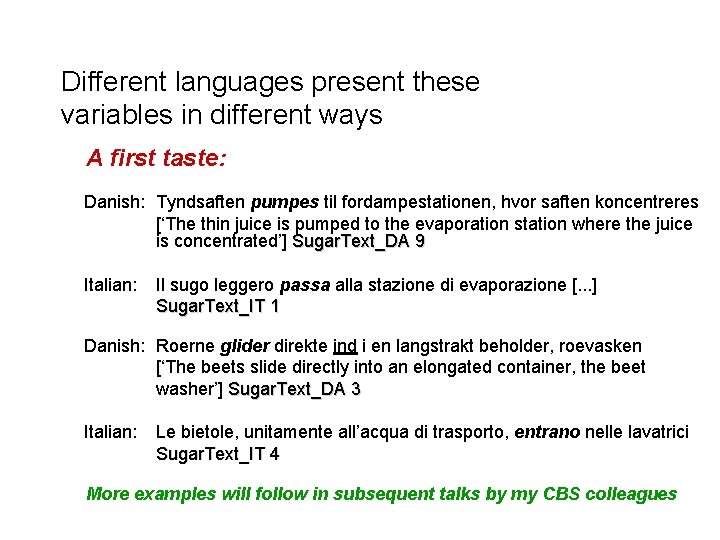
Different languages present these variables in different ways A first taste: Danish: Tyndsaften pumpes til fordampestationen, hvor saften koncentreres [‘The thin juice is pumped to the evaporation station where the juice is concentrated’] Sugar. Text_DA 9 Italian: Il sugo leggero passa alla stazione di evaporazione [. . . ] Sugar. Text_IT 1 Danish: Roerne glider direkte ind i en langstrakt beholder, roevasken [‘The beets slide directly into an elongated container, the beet washer’] Sugar. Text_DA 3 Italian: Le bietole, unitamente all’acqua di trasporto, entrano nelle lavatrici Sugar. Text_IT 4 More examples will follow in subsequent talks by my CBS colleagues
Still: What we present today does not exhaust the range of linguistic phenomena and questions that are currently being explored and could be explored in a Sugar. Texts context And we might even crystallize some new ideas today Everyone is invited!
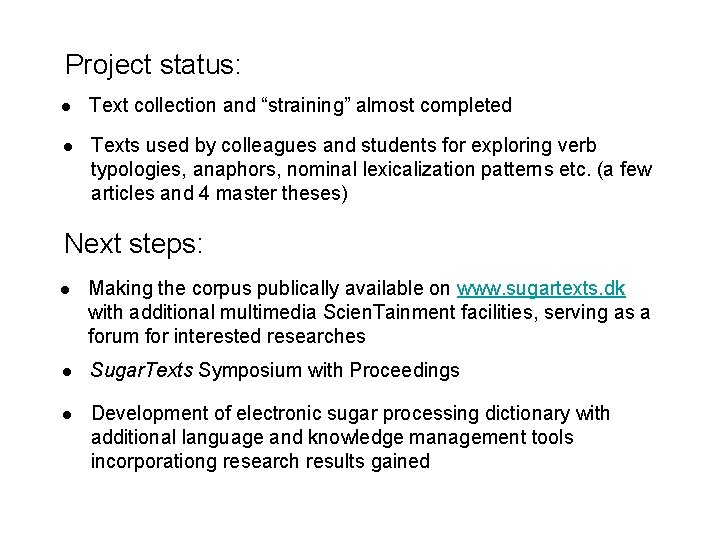
Project status: l Text collection and “straining” almost completed l Texts used by colleagues and students for exploring verb typologies, anaphors, nominal lexicalization patterns etc. (a few articles and 4 master theses) Next steps: l Making the corpus publically available on www. sugartexts. dk with additional multimedia Scien. Tainment facilities, serving as a forum for interested researches l Sugar. Texts Symposium with Proceedings l Development of electronic sugar processing dictionary with additional language and knowledge management tools incorporationg research results gained
Thank you for your attention!
Selective bibliography Berman R. A. & Slobin D. I. , eds. (1994). Relating events in narratives. Hillsdale, NJ: Lawrence Erlbaum Associates. Berthele, R. (2004): The typology of motion and posture verbs: A variationist account. In: B. Kortmann, ed. Dialectology Meets Typology. Dialect Grammar from a Cross Linguistic Perspective. Berlin & New York, 93 126. Blaser, E. & Sperling, G. (in preparation) When is motion? http: //ruccs. rutgers. edu/~blaser/motion. pdf Borst, A. (2000). Models of motion detection. In: Nature Neuroscience 3, 1168. Durst Andersen, P. (2002). Russian and English as two distinct subtypes of accusative languages, Scando Slavica Tomus 48. Durst Andersen, P. (2000). The English progressive as picture description. In: Acta Linguistica Hafniensia 32, 45 103. Durst Andersen, P. (1992). Mental grammar. Russian aspect and related issues. Columbus, Ohio: Slavica Publishers, Inc. Durst Andersen, P. & Herslund M. (1996). The syntax of Danish verbs. Lexical and syntactic transitivity. In: Content, expression, and structure. Studies in Danish functional grammar. In: H. Engberg Pedersen et al. , eds. Amsterdam/Philadelphia: John Benjamins, 65 102. Dodge, E. & Lakoff, G. (2005). On the neural basis of image schemas. In: B. Hampe, ed. From perception to meaning: Image schemas in cognitive linguistics. Berlin: De Gruyter. Ettin, T. (2007). Relokation i en endo / exocentrisk kontekst. En analyse af relokationsbegivenheder i danske og italienske Sugar. Texts med henblik på udformningen af en oversættelsesstrategi. [Relocation in an endo / exocentric context. An analysis of relocation events in Danish and Italian Sugar. Texts as a basis formulationg a translation strategy]. Master Thesis. Copenhagen: Copenhagen Business School. Fong, V. & Poulin, C. (1998). Locating linguistic variation in semantic templates. In: J. P. Koenig, ed. Discourse and cognition. Bridging the gap. Stanford, California: CSLI Publications, 29 39. Gennari, S. P. ; Sloman, S. A. ; Malt, B. C. & Fitch, W. T. (2002). Motion events in language and cognition. In: Cognition 83 (1), 49 79. Herslund, M. (1998). Typologi, leksikalisering og oversættelse. [Typology, lexicalization, and translation]. Lingvistisk Oversættelse. Copenhagen Working Papers in LSP 3. Copenhagen: Copenhagen Business School, 7 12. Herslund, M. (2000). Tipologia grammaticale e tipologia lessicale. In: I. Korzen & C. Marello, eds. Argomenti per una linguistica della traduzione. Notes pour une linguistique de la traducion. On linguistic aspects of trans lation. Gli argomenti umani 4. Alessandria: Edizioni del l'Orso, 11 18. Herslund, M. & Baron, I. (2003) Language as world view. Endocentric and exocentric representations of reality. In: I. Baron, ed. Language and culture. Copenhagen Studies in Languages 29, 29 42. Ibarretxe Antuñano, I. (2004). Language typologies in our language use: The case of Basque motion events in adult oral narratives. Cognitive Linguistics 3, 317 349.
Selective bibliography Korzen, I. (2005). Lingue endocentriche e lingue esocentriche: lseeico, testo e pensiero. In: I. Korzen & P. D’Achille, eds. Tipologia linguistica e società. Considerazioni inter e intralinguistiche. Firenze: Franco Cesati Editore, 31 54. Mora Gutiérrez, J. P. M. (2001). Directed motion in English and Spanish. In: Estudios de Lingüística Española 11. Nørgaard, K. ; Nielsen, L. Ø. B. (20079: Model for dansk fransk terminologisk vidensformidling inden for sukkerproduktion. [A model of Danish French knowledge transfer in the field of sugar manufacturing]. Master Thesis. Copenhagen: Copenhagen Business School. Ozol, S. (2004). Fra sukkerroe til sukkerskål: Onomasiologisk undersøgelse af danske og russiske relokationsverber baseret på Sugar. Texts. [From sugar beet to sugar pot: An onomasiological study of Danish and Russian relocation verbs based on Sugar. Texts. ] Master’s Thesis. Copenhagen: Copenhagen Business School. Palmer, S. E. (1999) Vision science. Photons to phenomenology. Cambridge, Mass. : The MIT Press. Papafragou, A. ; Massey, C. & Gleitman, L. (2001). Motion events in language and cognition. In: Proceedings of the 25 th Annual Boston University Conference on Language Development. Somerville, MA: Cascadilla Press. Papafragou, A. ; Massey, C. & Gleitman, L. (2002). Shake, rattle ‘n’ roll: the representation of motion in language and cognition. In: : Cognition 84, 189 219. Plungjan, V. A. (2002). O specifike vyraženija imennych prostranstvennych charakteristik v glagole: kategorija glagol´noj orientacii. In: V. A. Plugjan, ed. Grammatikal izacija prostranstvennych značenij. Moscow: Russkie slovari, 57 98. Rojo, A. & Valenzuela, J. (2001) ”How to say things with words: Ways of saying in English and Spanish”. In: Meta, XLVI, 3 467 477. Skytte, G. ; Korzen, I. ; Polito P. & Strudsholm, E. , eds. (1999). Strutturazione testuale in italiano e in daneses. Copenhagen: Museum Tusculanum Press. Sinha, C. & Kuteva, T. (1995) Distributed spatial semantics. In: Nordic Journal of Linguistics 18, 167 199. Slobin, D. (2004 a). The many ways to search for a frog: Linguistic typology and the expression of motion events. In: S. Strömquist & L. Verhoeven, eds. Relating events in narrative: Typological contextual perspectives. Mahwah, NJ: Lawrence Erlbaum Associates. Slobin, D. (2004 b). Relating narrative events in translation. In: D. Ravid & H. B. Shyldkrot, eds. Perspectives on language and language development: Essays in honor of Ruth A. Berman. Dordrecht: Kluwer. Slobin, D. (1996 a). Two ways to travel: Verbs of motion in English and Spanish. In: Grammatical constructions: Their form and meaning. M. Shibatani & S. Tompson, eds. Oxford: University Press, 195 219. Slobin, D. (1996 b). From “thought and language” to “thinking for speaking”. In: J. J. Gumperz & S. C. Levinson, eds. Rethinking linguistic relativity. Cambridge: University Press.
Selective bibliography Smith, V (2005 a). Modeling the semantics of relocation: For Sugar. Texts and beyond. Proceedings of the 7 th International conference on Terminology and Knowledge Engineering. Copenhagen: Copenhagen Business School. Smith, V. (2005 b). Motion at the sugar factory: Is Russian a genuine MANNER language? In: K. Ahmad; M. Rogers, eds. Proceedings of the 14 th European Symposium on Language for Special Purposes. Communication, culture, knowledge. Surrey: University of Surrey, 77 84. Smith, V. (2003). Talking about motion in Danish, French, and Russian: Some implications for LSP in theory and practice. In: LSP & Professional Communication 2, 66 90. Smith, V. (2000). On the contrastive study of lexicalization patterns for translation pur poses: some reflections on the levels of analysis. In: I. Korzen & C. Marello, eds. Argomenti per una linguistica della traduzione. Notes pour une linguistique de la traducion. On linguistic aspects of trans lation. Gli argomenti umani 4. Alessandria: Edizioni del l'Orso, 19 42. Strömqvist, S. ; Verhoeven, L. , eds. (2004). Relating events in narrative: Typological contextual perspectives. Mahwah, NJ: Lawrence Erlbaum Associates. Talmy, Leonard (2000). Towards a cognitive semantics: Volume 2: Typology and process in concept structuring. Cambridge, MA: MIT Press. Talmy, L. (1985). Lexicalization patterns: semantic structure in lexical forms. In: T. Shopen, ed. Language typology and syntactic description, Vol. III. Grammatical categories and the lexicon. Cambridge: University Press, 57 149. Tesnière, L. 1976 [1959]. Éléments de syntaxe structurale. IIième édition. Paris: Klincksieck. Tøgersen, M. (2007). Når ord taler: Terminologisk undersøgelse af udvalgte begreber i danske og tyske Sugar. Texts – med særlig fokus på leksikaliseringsforskelle. [When words talk: A terminological investigation on selected concepts in Danish and German Sugar. Texts with a special focus on lexicalization differences ]. Master Thesis. Copenhagen: Copenhagen Business School. Zacks, J. M. & Tversky, B. (2001). Event structure in perception and cognition. In: Psychological Bulletin 1, 3 21. Zlatev, J & Yangklang, P (2004). A third way to travel, the place of Thai (and other serial verb languages) in motion event typology. In: S. Strömqvist & L. Verhoeven, eds. Relating events in narrative: Typological contextual perspectives. Mahwah, NJ: Lawrence Erlbaum Associates. Zlatev, J. & David, C. (2004). Three ways to travel: Motion events in French, Swedish and Thai. In: A. Soares da Silva, A. Torres & M. Gonçalves, eds. Linguagem, Cultura e Cognição: Estudos de Linguística Cognitiva, eds. , Coimbra: Almedina.