
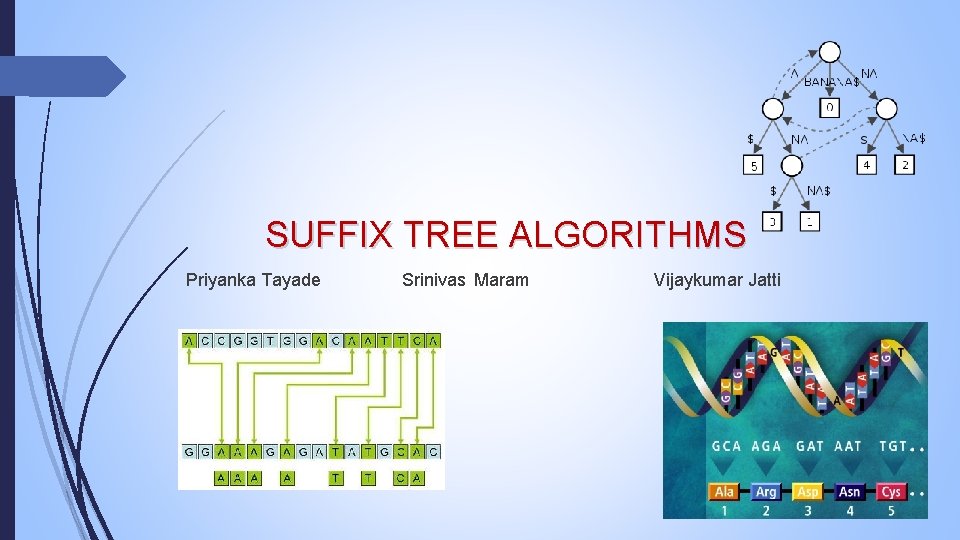
SUFFIX TREE ALGORITHMS Priyanka Tayade Srinivas Maram Vijaykumar
![step 2 Perform radix sort on tuples (s[i], rank of s[i+1] from step 1](https://slidetodoc.com/presentation_image_h2/9ed1fcfafdeeeb207e8360c8c8f30eed/image-34.jpg "step 2 Perform radix sort on tuples (s[i], rank of s[i+1] from step 1")
![Constructing LCP array Resulting Suffix Array: sa[ 0] = 8 = adbcd$ sa[ 1]](https://slidetodoc.com/presentation_image_h2/9ed1fcfafdeeeb207e8360c8c8f30eed/image-41.jpg "Constructing LCP array Resulting Suffix Array: sa[ 0] = 8 = adbcd$ sa[ 1]")
- Slides: 51
SUFFIX TREE ALGORITHMS Priyanka Tayade Srinivas Maram Vijaykumar Jatti
An Algorithm must be seen to be believed. -Donald Ervin Knuth
Why to study Suffix tree? Suffix trees can be built in linear time and space. Provides fundamental data structure with a huge number of applications. String Matching Longest Common Subsequence Longest common subsequence DNA contamination Genome scale projects
Preprocessing Strings Preprocessing the pattern speeds up pattern matching queries After preprocessing the pattern, KMP’s algorithm performs pattern matching in time proportional to the text size If the text is large, immutable and searched for often (e. g. , works by Shakespeare), we may want to preprocess the text instead of the pattern A trie is a compact data structure for representing a set of strings, such as all the words in a text A tries supports pattern matching queries in time proportional to the pattern size
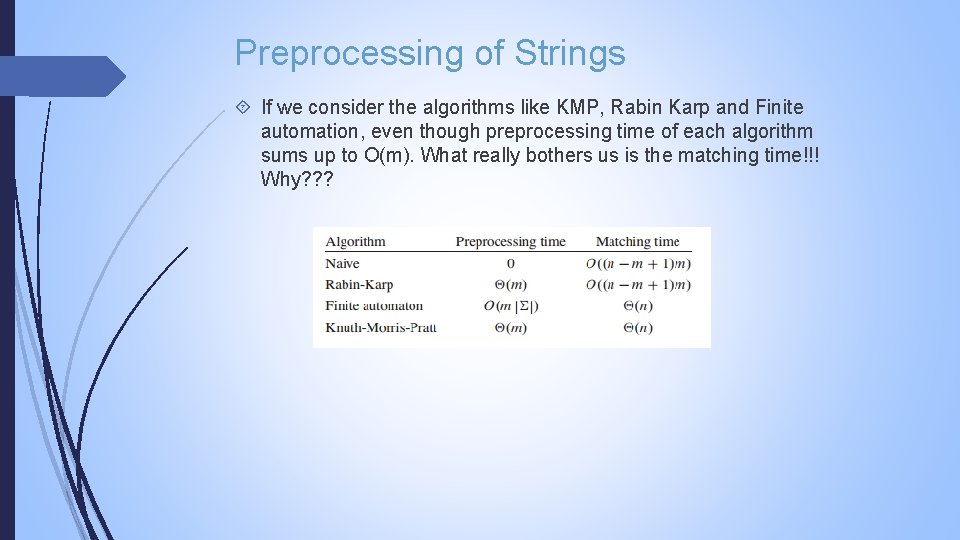
Preprocessing of Strings If we consider the algorithms like KMP, Rabin Karp and Finite automation, even though preprocessing time of each algorithm sums up to O(m). What really bothers us is the matching time!!! Why? ? ?
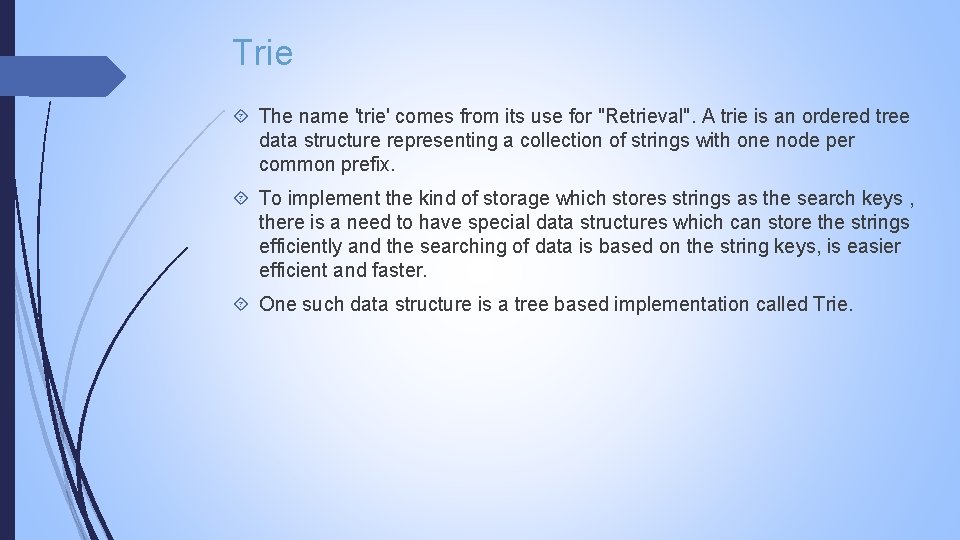
Trie The name 'trie' comes from its use for "Retrieval". A trie is an ordered tree data structure representing a collection of strings with one node per common prefix. To implement the kind of storage which stores strings as the search keys , there is a need to have special data structures which can store the strings efficiently and the searching of data is based on the string keys, is easier efficient and faster. One such data structure is a tree based implementation called Trie.
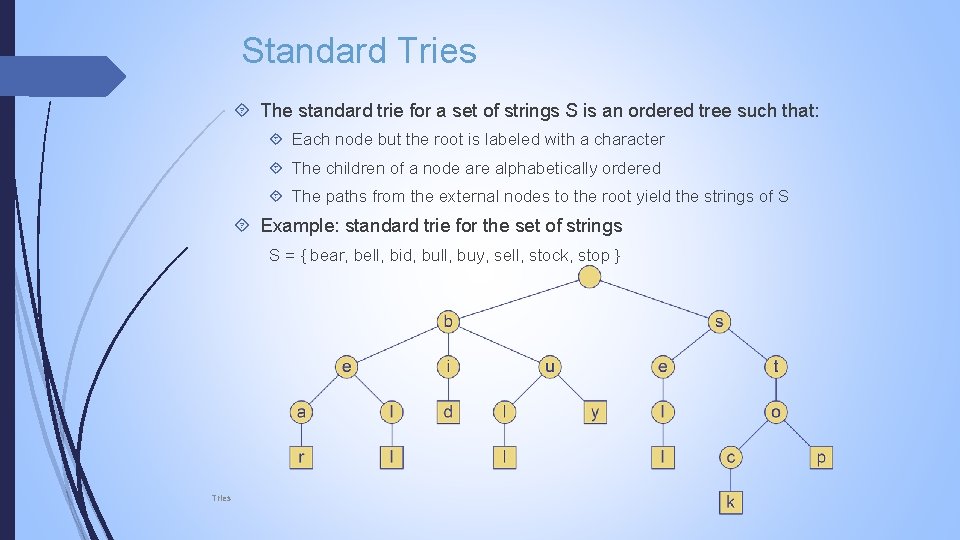
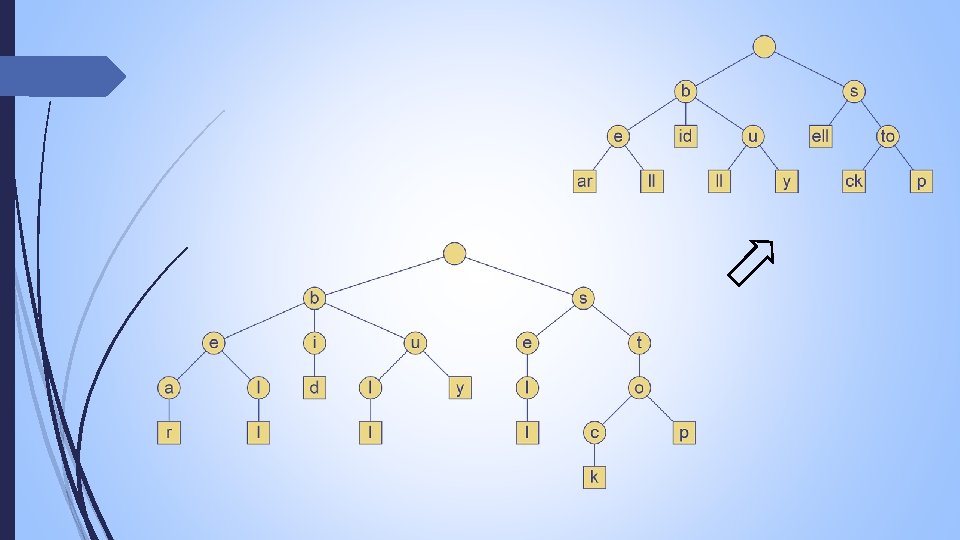
Standard Tries The standard trie for a set of strings S is an ordered tree such that: Each node but the root is labeled with a character The children of a node are alphabetically ordered The paths from the external nodes to the root yield the strings of S Example: standard trie for the set of strings S = { bear, bell, bid, bull, buy, sell, stock, stop } Tries
Compressed Tries A compressed trie has internal nodes of degree at least two It is obtained from standard trie by compressing chains of “redundant” nodes
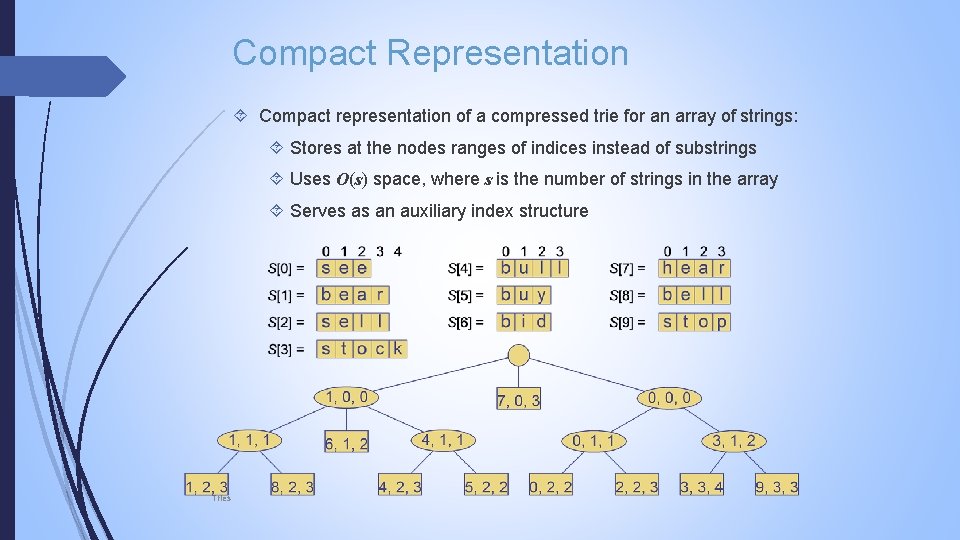
Compact Representation Compact representation of a compressed trie for an array of strings: Stores at the nodes ranges of indices instead of substrings Uses O(s) space, where s is the number of strings in the array Serves as an auxiliary index structure Tries
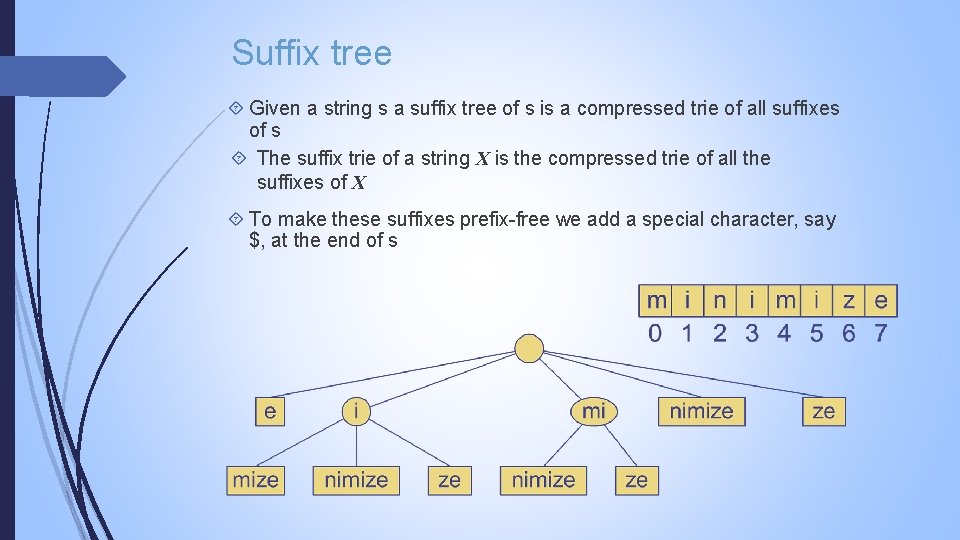
Suffix tree Given a string s a suffix tree of s is a compressed trie of all suffixes of s The suffix trie of a string X is the compressed trie of all the suffixes of X To make these suffixes prefix-free we add a special character, say $, at the end of s
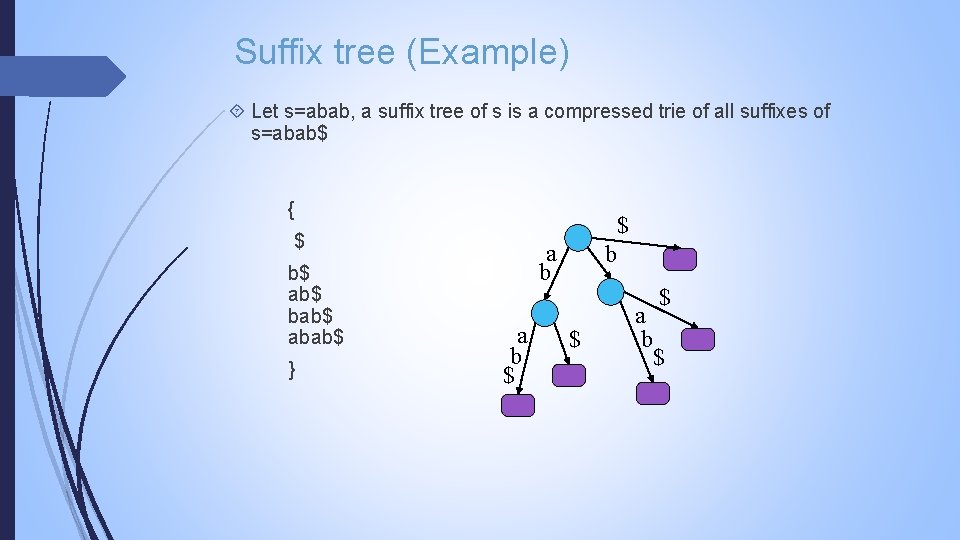
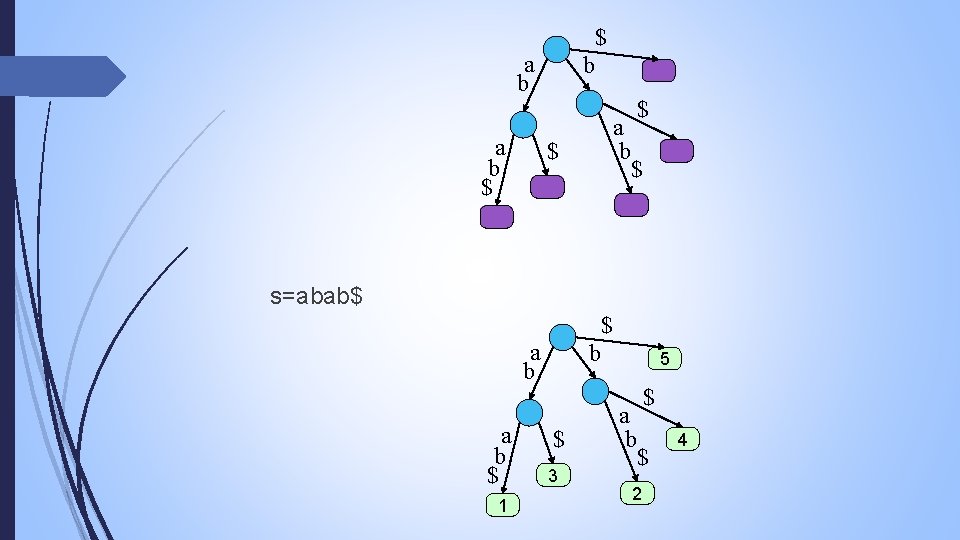
Suffix tree (Example) Let s=abab, a suffix tree of s is a compressed trie of all suffixes of s=abab$ { $ $ b$ ab$ bab$ abab$ } a b $ b $ a b $ $
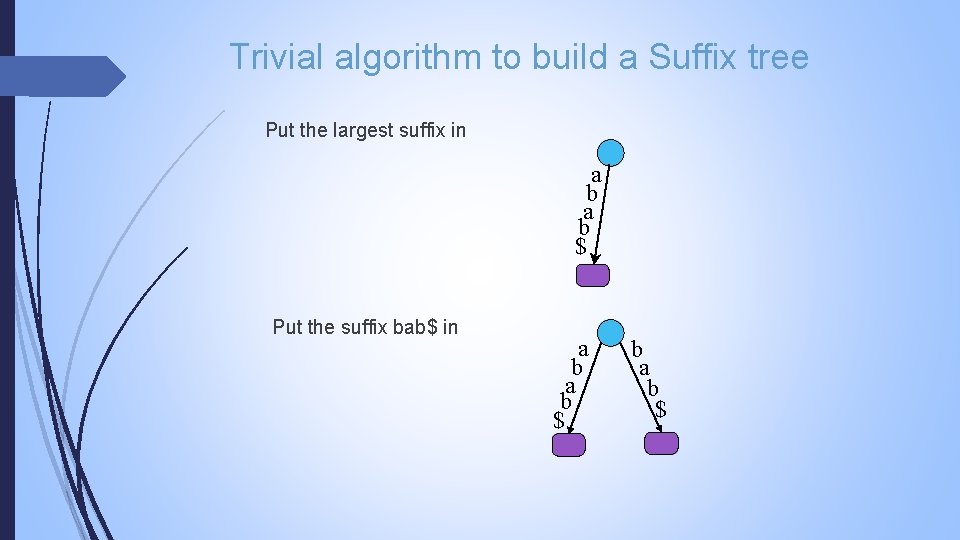
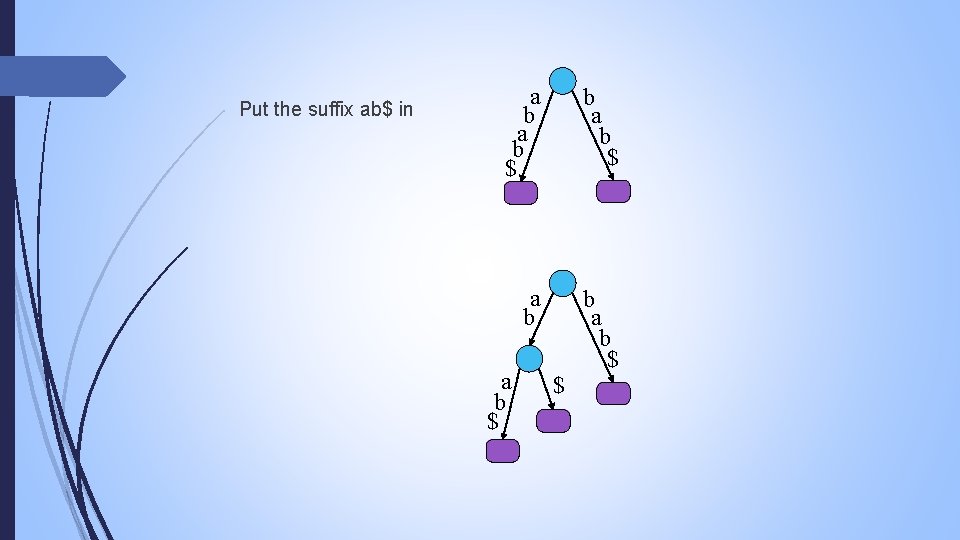
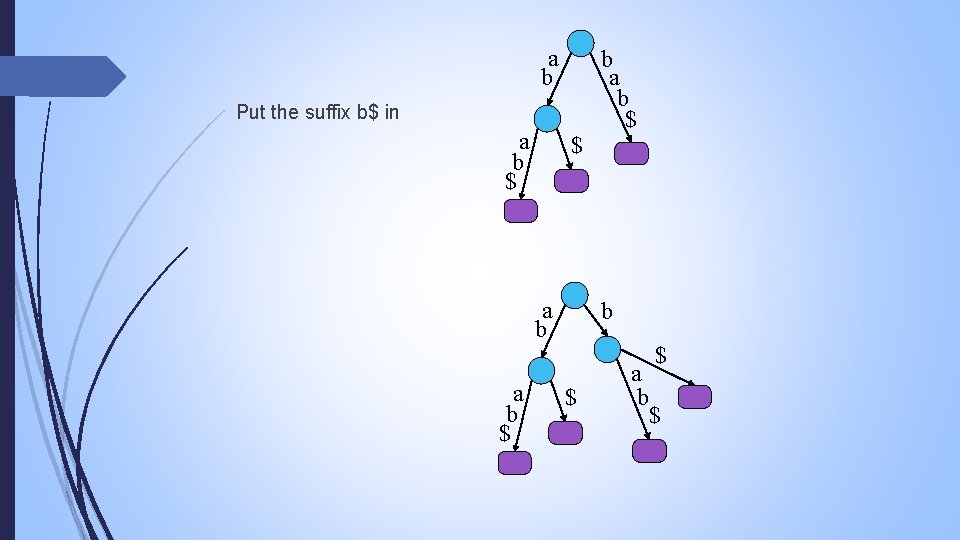
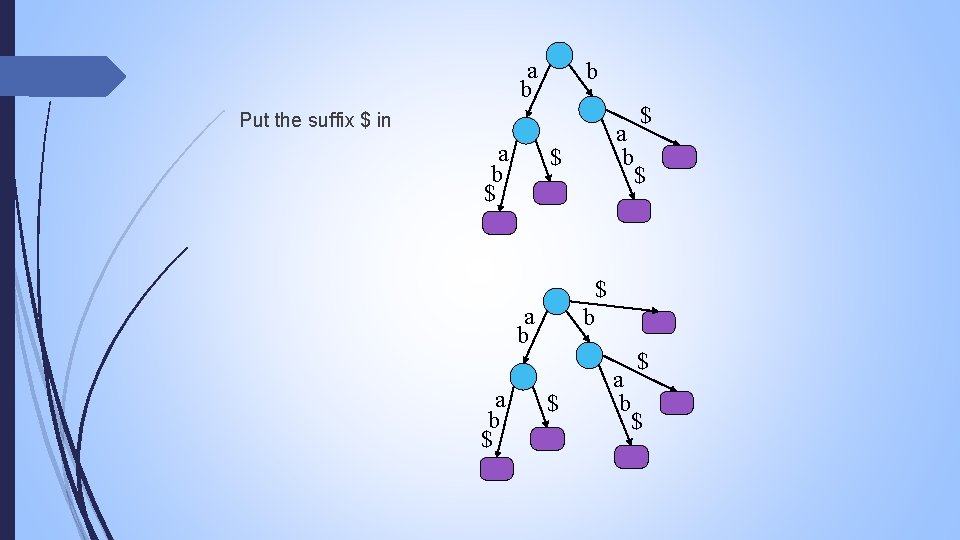
Trivial algorithm to build a Suffix tree Put the largest suffix in a b $ Put the suffix bab$ in a b $ b a b $
Put the suffix ab$ in a b $ b a b $ $
a b Put the suffix b$ in a b $ $ a b $ b a b $ $
a b b Put the suffix $ in a b $ $ $ $ a b $ b $ a b $ $
$ a b $ b $ a b $ $ s=abab$ $ a b $ 1 b $ 3 5 $ a b $ 2 4
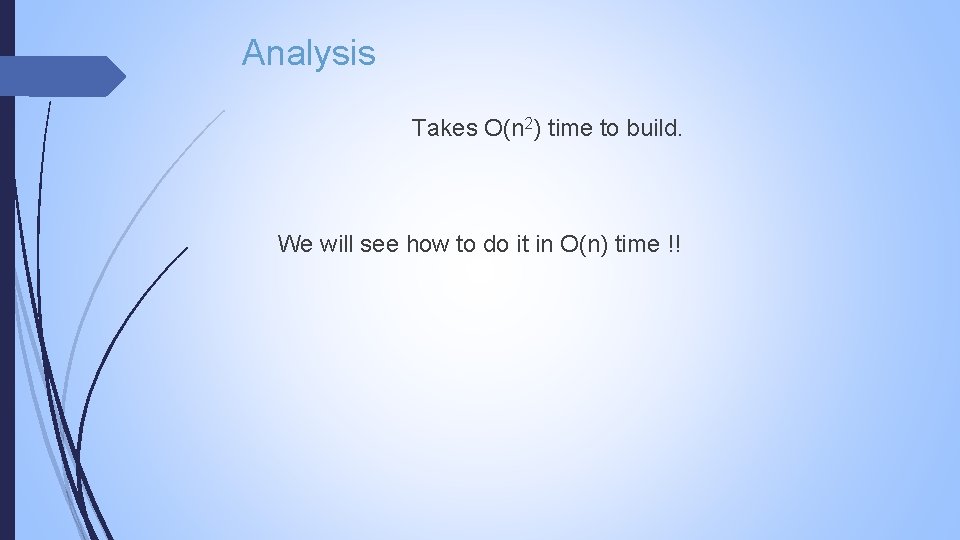
Analysis Takes O(n 2) time to build. We will see how to do it in O(n) time !!
Generalized suffix tree Given a set of strings S a generalized suffix tree of S is a compressed trie of all suffixes of s S To make these suffixes prefix-free we add a special char, say $, at the end of s To associate each suffix with a unique string in S add a different special character to each s
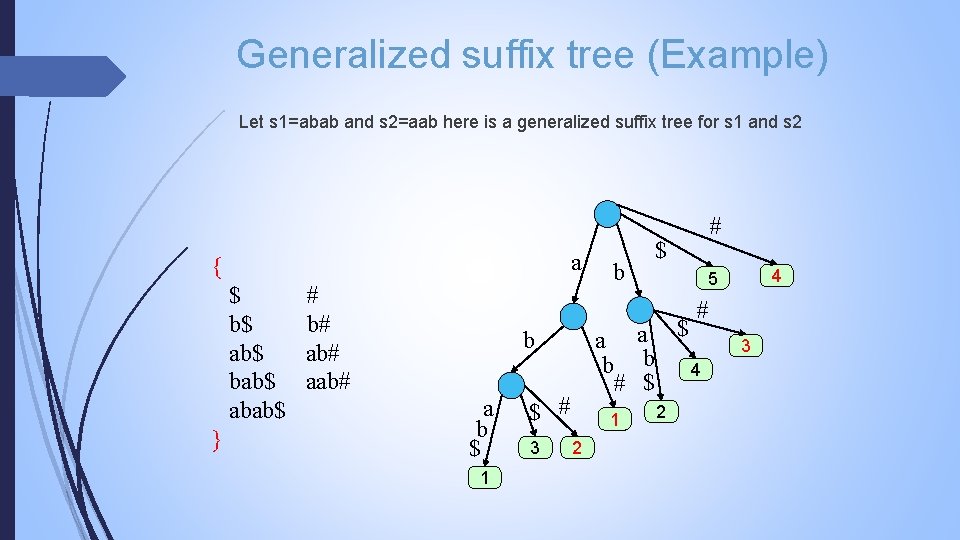
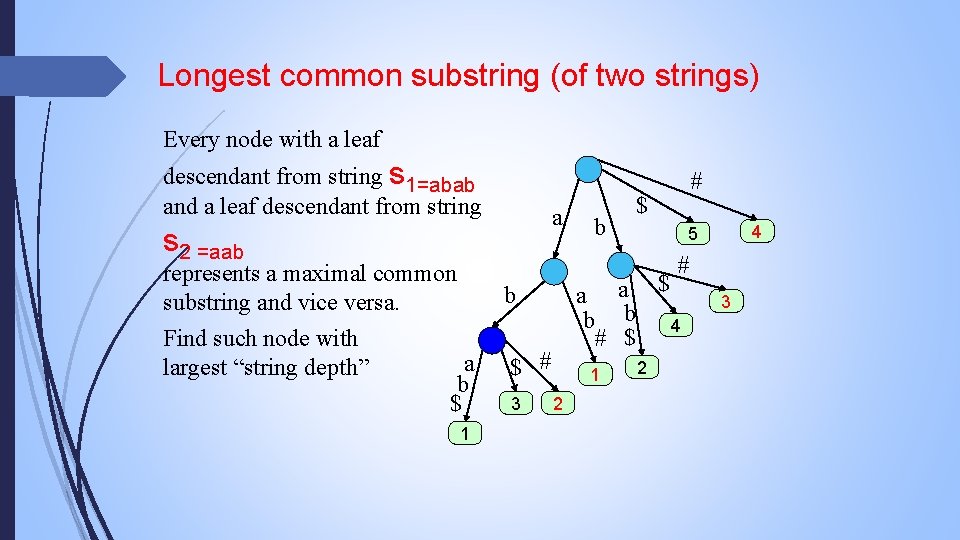
Generalized suffix tree (Example) Let s 1=abab and s 2=aab here is a generalized suffix tree for s 1 and s 2 a { $ b$ ab$ bab$ abab$ } # b# aab# b # $ 4 5 # a a $ b b 4 # $ b a b $ 1 $ # 3 1 2 2 3
So what can we do with it ? Matching a pattern against a database of strings
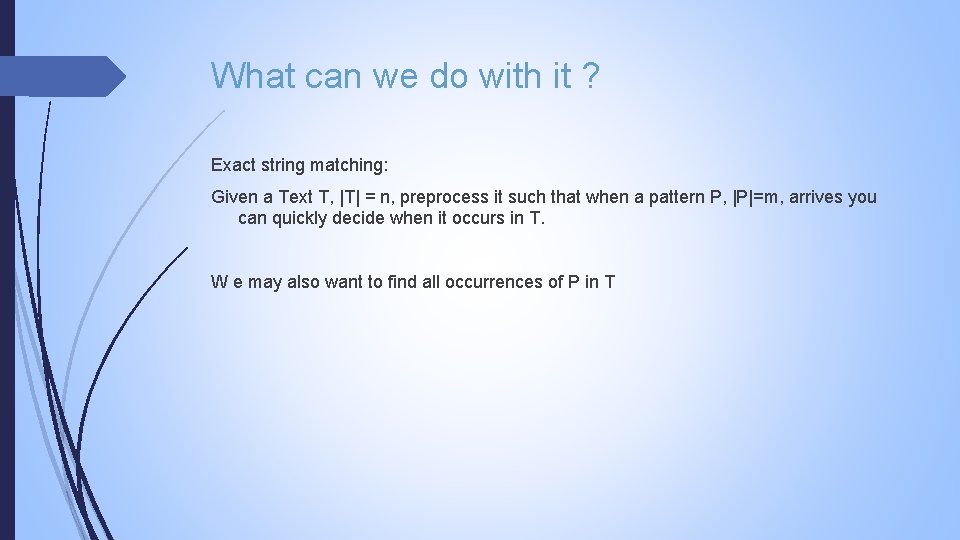
What can we do with it ? Exact string matching: Given a Text T, |T| = n, preprocess it such that when a pattern P, |P|=m, arrives you can quickly decide when it occurs in T. W e may also want to find all occurrences of P in T
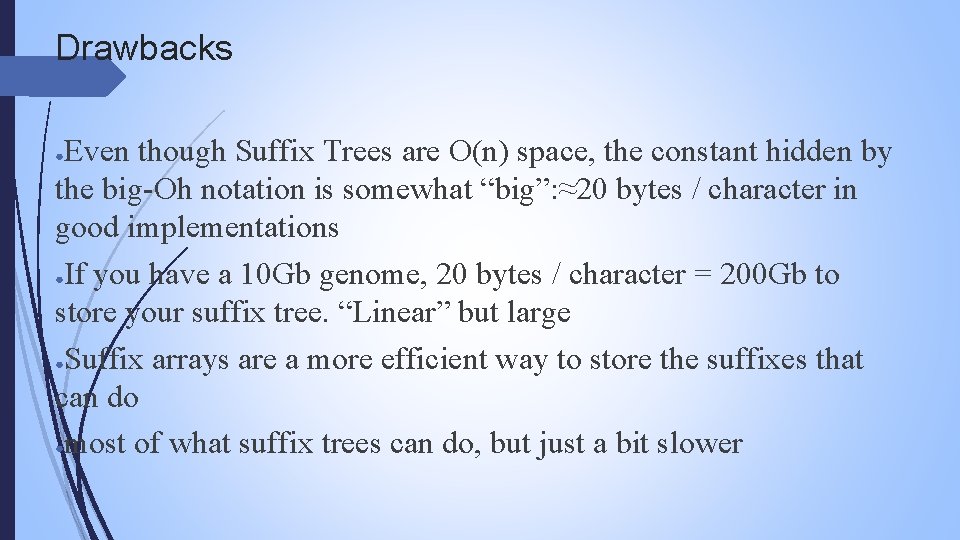
Drawbacks Even though Suffix Trees are O(n) space, the constant hidden by the big-Oh notation is somewhat “big”: ≈20 bytes / character in good implementations ●If you have a 10 Gb genome, 20 bytes / character = 200 Gb to store your suffix tree. “Linear” but large ●Suffix arrays are a more efficient way to store the suffixes that can do ●most of what suffix trees can do, but just a bit slower ●
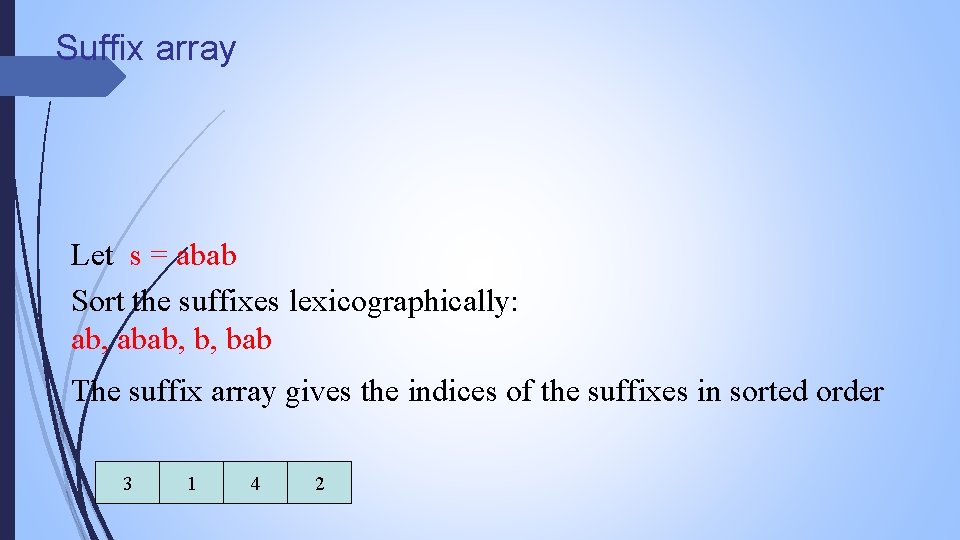
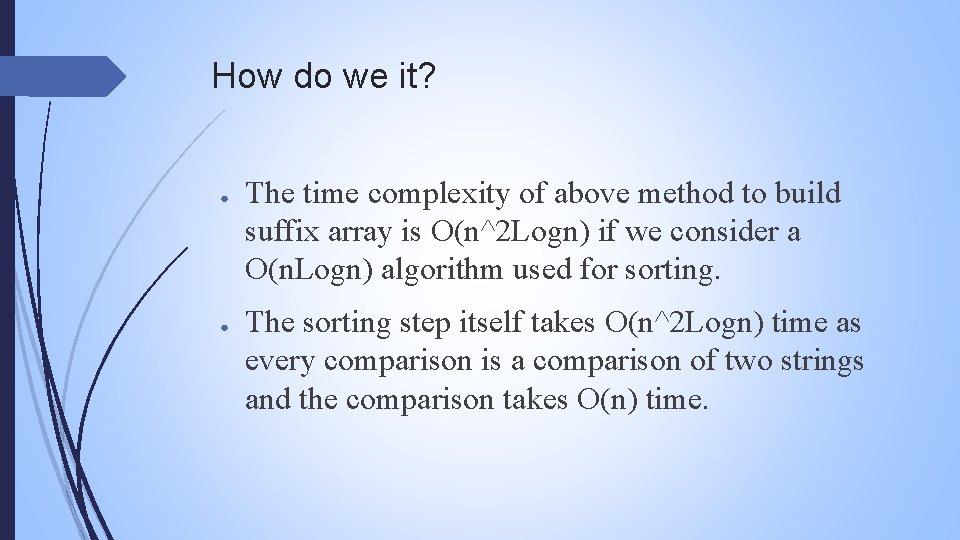
Suffix array Let s = abab Sort the suffixes lexicographically: ab, abab, b, bab The suffix array gives the indices of the suffixes in sorted order 3 1 4 2
How do we it? ● ● The time complexity of above method to build suffix array is O(n^2 Logn) if we consider a O(n. Logn) algorithm used for sorting. The sorting step itself takes O(n^2 Logn) time as every comparison is a comparison of two strings and the comparison takes O(n) time.
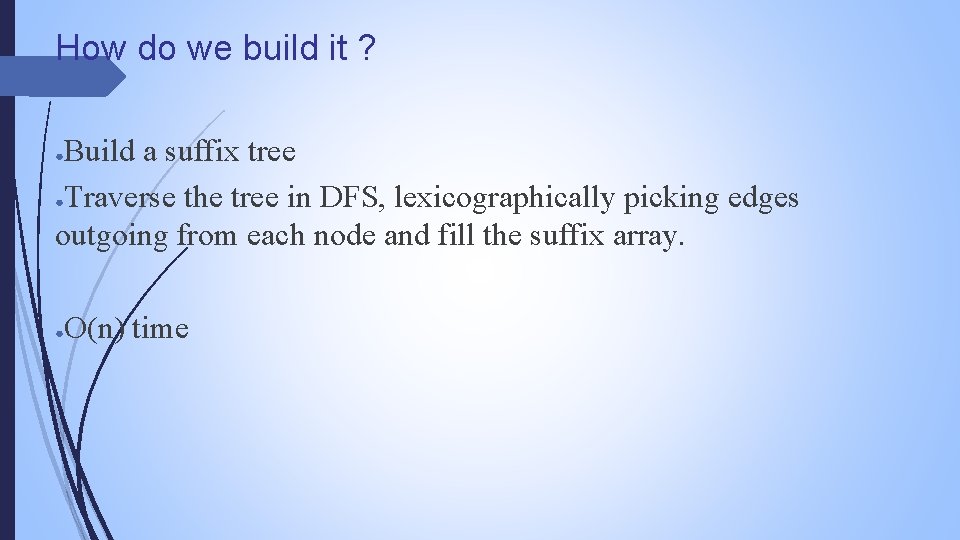
How do we build it ? Build a suffix tree ●Traverse the tree in DFS, lexicographically picking edges outgoing from each node and fill the suffix array. ● ● O(n) time
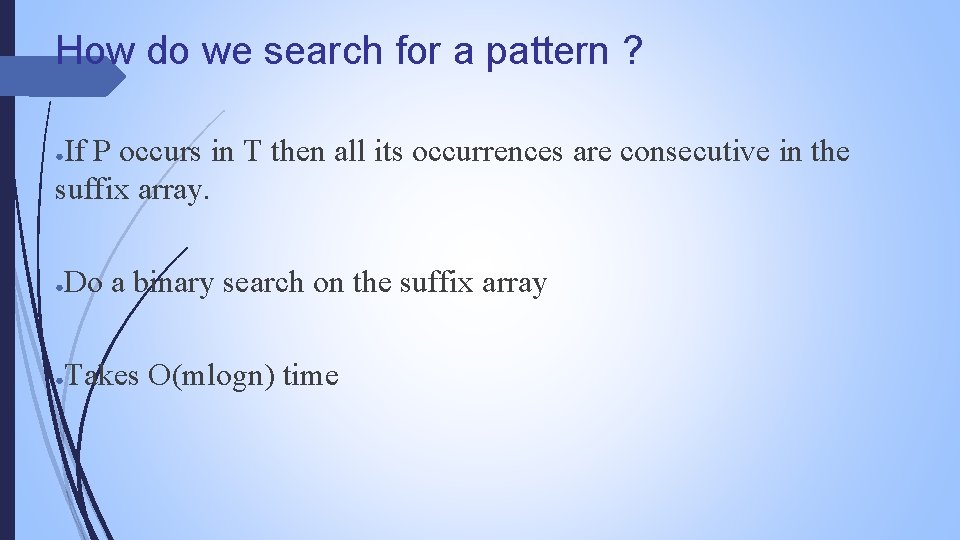
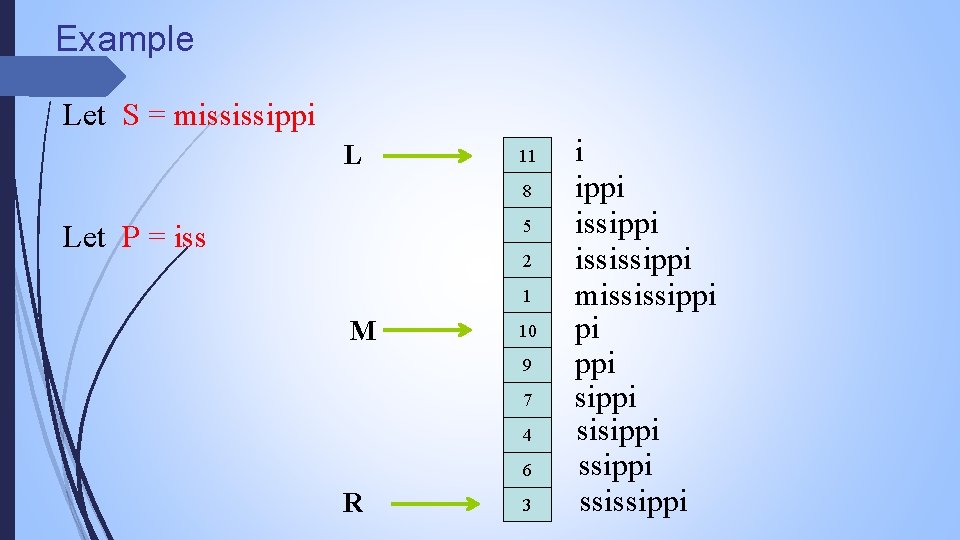
How do we search for a pattern ? If P occurs in T then all its occurrences are consecutive in the suffix array. ● ● Do a binary search on the suffix array ● Takes O(mlogn) time
Example Let S = mississippi L 11 8 5 Let P = iss 2 1 M 10 9 7 4 6 R 3 i ippi ississippi mississippi pi ppi sisippi ssissippi
Construction of suffix tree in linear time
Algorithms: Mc. Creight algorithm Ukkonen's algorithm Farach’s algorithm Kärkkäinen & Sanders Suffix Array and LCP array construction.
Steps Create a suffix array from the string in O(n) time. Using suffix array create a LCP array in O(n). Using Suffix Array and LCP Array , Create a suffix tree in O(n).
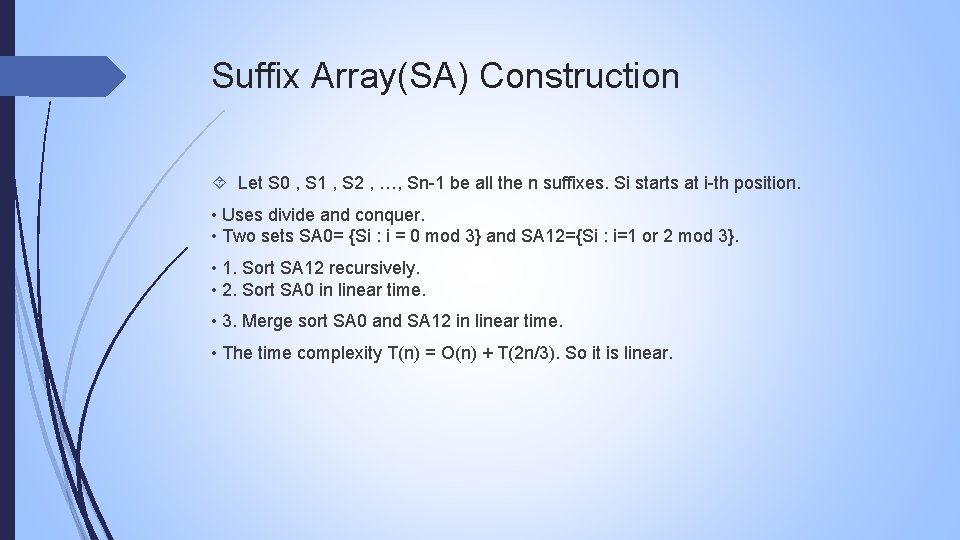
Suffix Array(SA) Construction Let S 0 , S 1 , S 2 , …, Sn-1 be all the n suffixes. Si starts at i-th position. • Uses divide and conquer. • Two sets SA 0= {Si : i = 0 mod 3} and SA 12={Si : i=1 or 2 mod 3}. • 1. Sort SA 12 recursively. • 2. Sort SA 0 in linear time. • 3. Merge sort SA 0 and SA 12 in linear time. • The time complexity T(n) = O(n) + T(2 n/3). So it is linear.
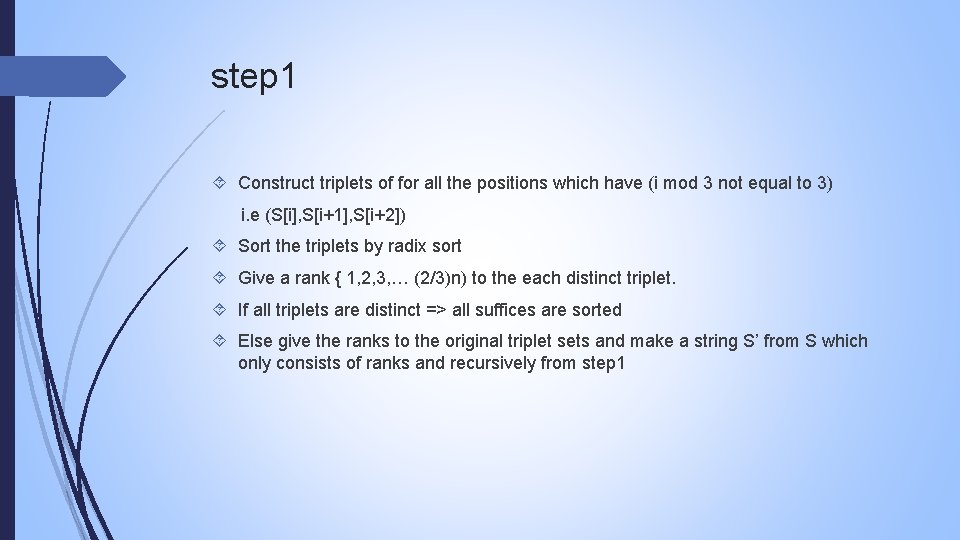
step 1 Construct triplets of for all the positions which have (i mod 3 not equal to 3) i. e (S[i], S[i+1], S[i+2]) Sort the triplets by radix sort Give a rank { 1, 2, 3, … (2/3)n) to the each distinct triplet. If all triplets are distinct => all suffices are sorted Else give the ranks to the original triplet sets and make a string S’ from S which only consists of ranks and recursively from step 1
step 2 Perform radix sort on tuples (s[i], rank of s[i+1] from step 1 )
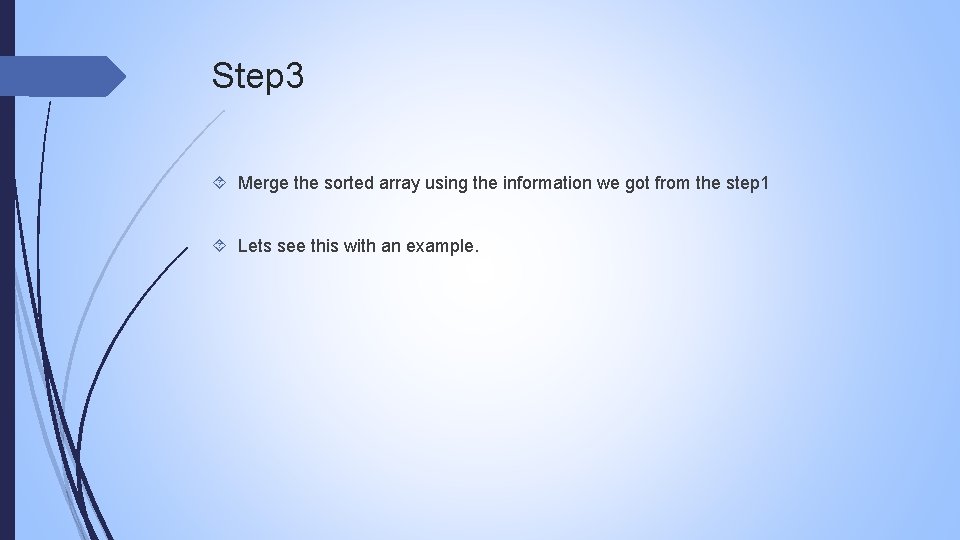
Step 3 Merge the sorted array using the information we got from the step 1 Lets see this with an example.
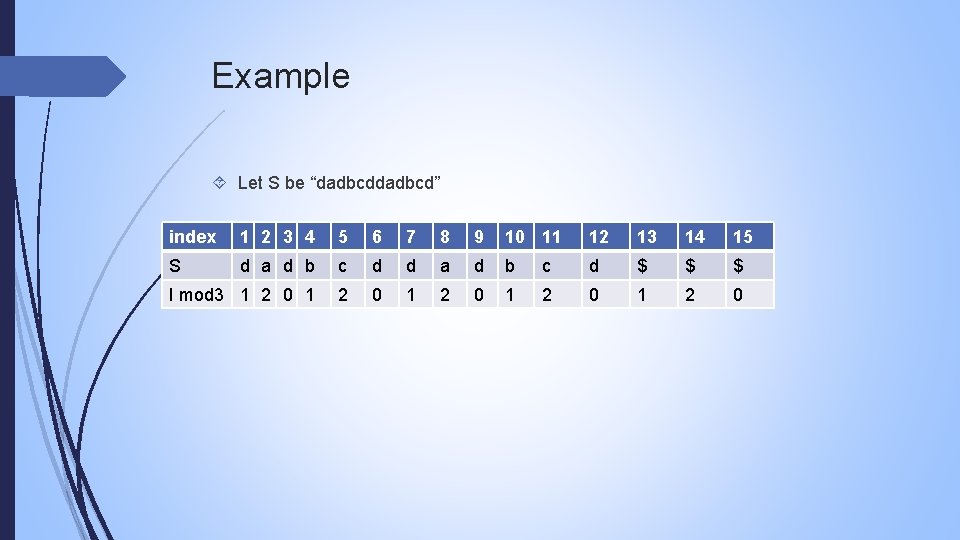
Example Let S be “dadbcd” index 1 2 3 4 5 6 7 8 9 10 11 12 13 14 15 S d a d b c d $ $ $ I mod 3 1 2 0 1 2 0
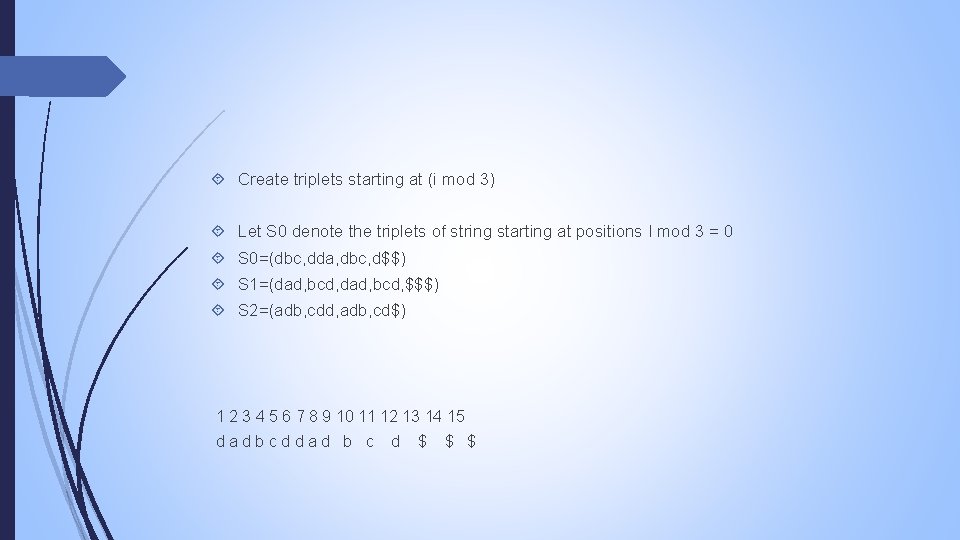
Create triplets starting at (i mod 3) Let S 0 denote the triplets of string starting at positions I mod 3 = 0 S 0=(dbc, dda, dbc, d$$) S 1=(dad, bcd, $$$) S 2=(adb, cdd, adb, cd$) 1 2 3 4 5 6 7 8 9 10 11 12 13 14 15 dadbcddad b c d $ $ $
Now concatenate S 1 and S 2 , then perform radix sort on them. Give them a rank.
If all the ranks given are unique then we can directly create a suffix tree based on the ranks. If not Create S’ by using ranks and original index. Then recursively call the suffix function for S`
Sort S 0 by using the result of the step 1 Merge SA(suffix array) of S 0 and SA of S 1. S 2 Construct LCP array from Suffix Array
Constructing LCP array Resulting Suffix Array: sa[ 0] = 8 = adbcd$ sa[ 1] = 2 = adbcddadbcd$ LCP[1] = 5; sa[ 2] = 10 = bcd$ LCP[2] = 0; sa[ 3] = 4 = bcddadbcd$ sa[ 4] = 11 = cd$ LCP[3] = 3; LCP[4] = 0; sa[ 5] = 5 = cddadbcd$ sa[ 6] = 12 = d$ LCP[5] = 2; LCP[6] = 3; sa[ 7] = 7 = dadbcd$ sa[ 8] = 1 = dadbcd$ sa[ 9] = 9 = dbcd$ LCP[7] = 1; LCP[8] = 6; LCP[9] = 1; sa[10] = 3 = dbcddadbcd$ LCP[10] = 4; sa[11] = 6 = ddadbcd$ LCP[11] = 1; We have a linear time algorithm for constructing LCP array.
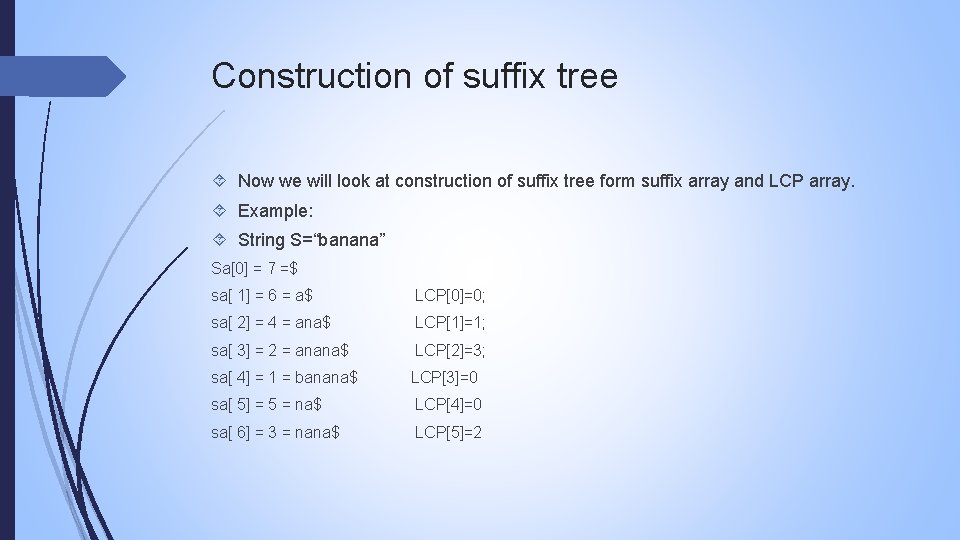
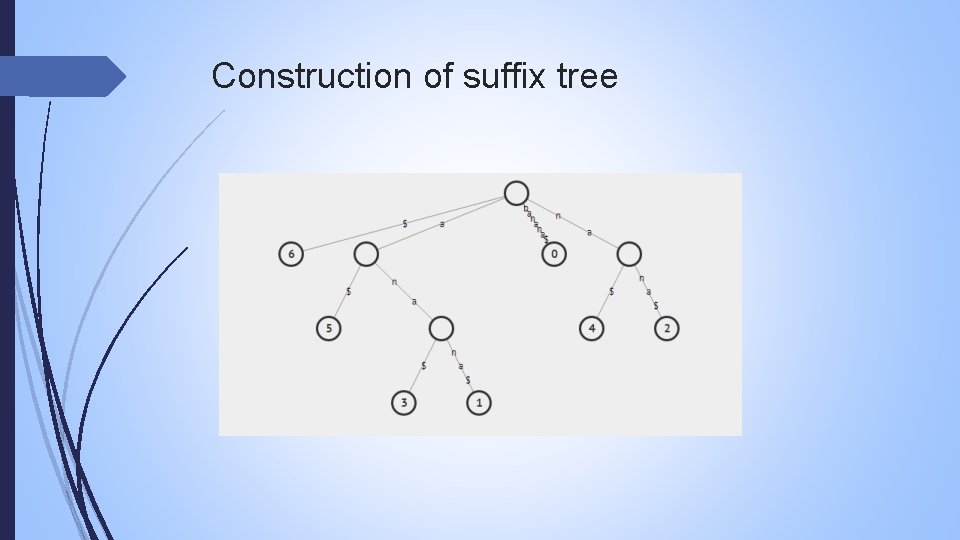
Construction of suffix tree Now we will look at construction of suffix tree form suffix array and LCP array. Example: String S=“banana” Sa[0] = 7 =$ sa[ 1] = 6 = a$ LCP[0]=0; sa[ 2] = 4 = ana$ LCP[1]=1; sa[ 3] = 2 = anana$ LCP[2]=3; sa[ 4] = 1 = banana$ LCP[3]=0 sa[ 5] = 5 = na$ LCP[4]=0 sa[ 6] = 3 = nana$ LCP[5]=2
Construction of suffix tree
Application ● Exact String Matching ● Longest common subsequence ● Search all Patterns ● Longest palindromic number ● Genome Project
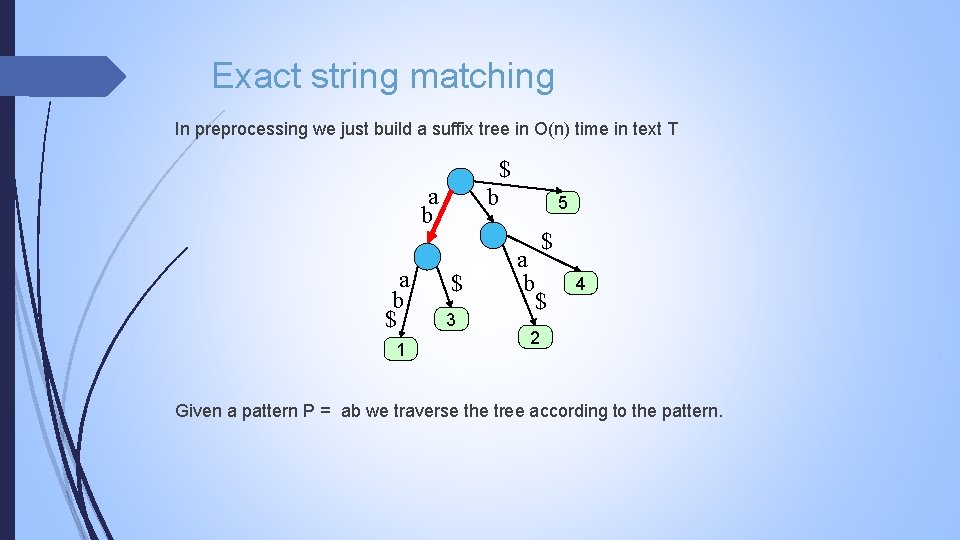
Exact string matching In preprocessing we just build a suffix tree in O(n) time in text T $ a b $ 1 b $ 3 5 $ a b $ 4 2 Given a pattern P = ab we traverse the tree according to the pattern.
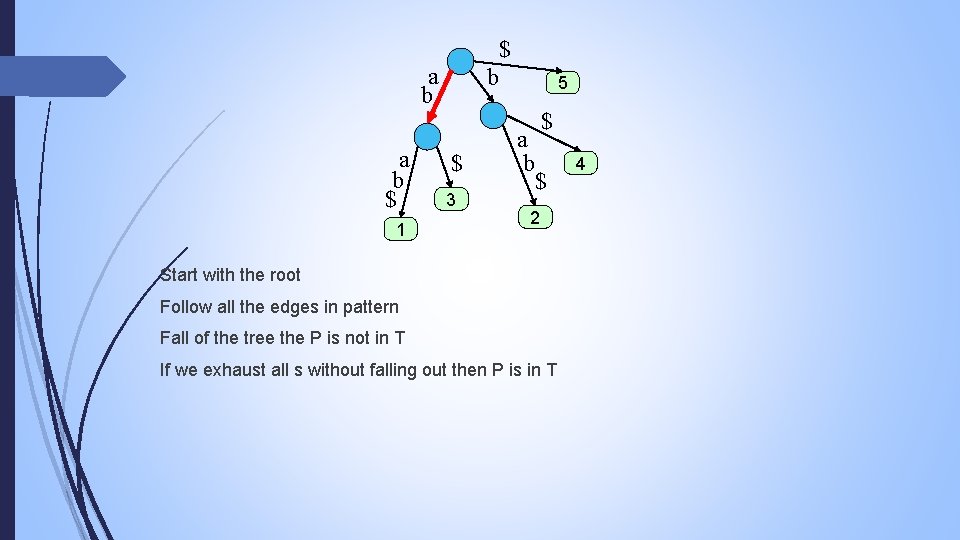
$ a b $ 1 b $ 3 5 $ a b $ 2 Start with the root Follow all the edges in pattern Fall of the tree the P is not in T If we exhaust all s without falling out then P is in T 4
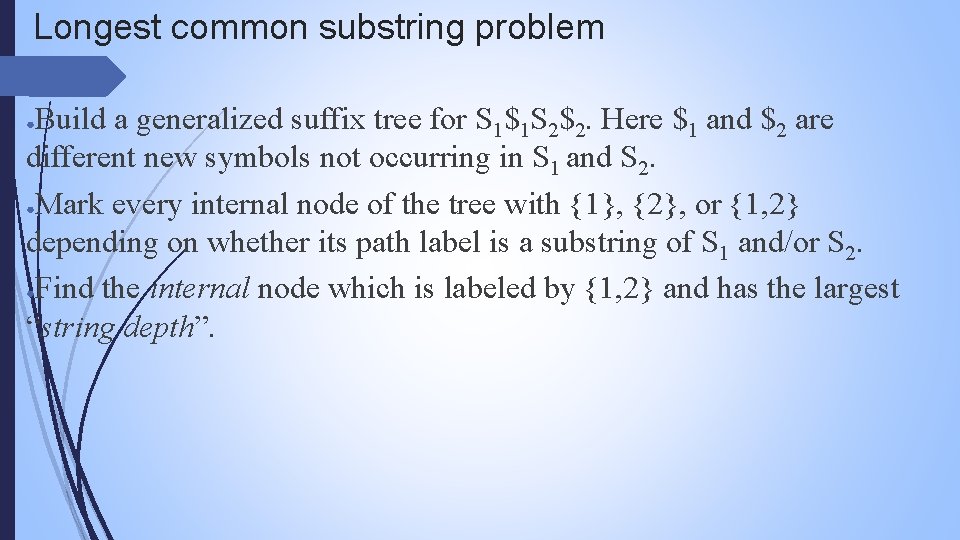
Longest common substring problem Build a generalized suffix tree for S 1$1 S 2$2. Here $1 and $2 are different new symbols not occurring in S 1 and S 2. ●Mark every internal node of the tree with {1}, {2}, or {1, 2} depending on whether its path label is a substring of S 1 and/or S 2. ●Find the internal node which is labeled by {1, 2} and has the largest “string depth”. ●
Longest common substring (of two strings) Every node with a leaf descendant from string s 1=abab and a leaf descendant from string a s 2 =aab b # $ 4 5 # represents a maximal common substring and vice versa. b Find such node with largest “string depth” $ # a b $ 1 3 a a $ b b 4 # $ 1 2 2 3
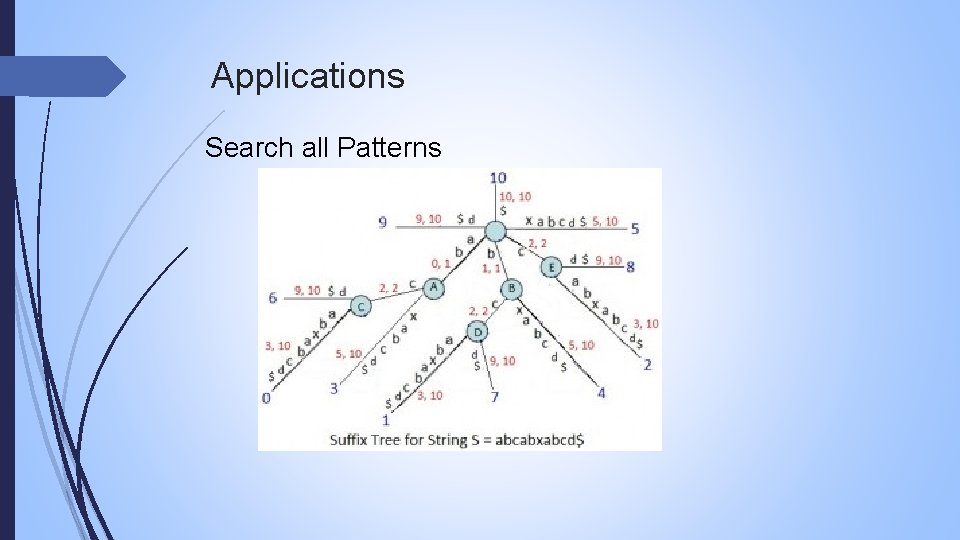
Applications Search all Patterns
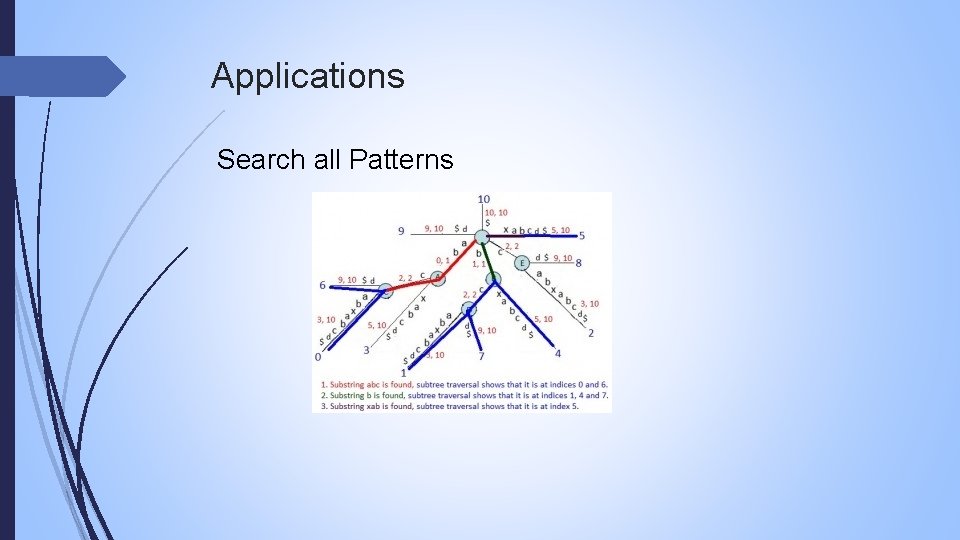
Applications Search all Patterns
FIN