
Sucrose Hydrolysis NonEnzymatic Acid Hydrolysis Versus Enzymatic Hydrolysis

- Slides: 16
Sucrose Hydrolysis Non-Enzymatic (Acid Hydrolysis) Versus Enzymatic Hydrolysis (Sucrase/Invertase)
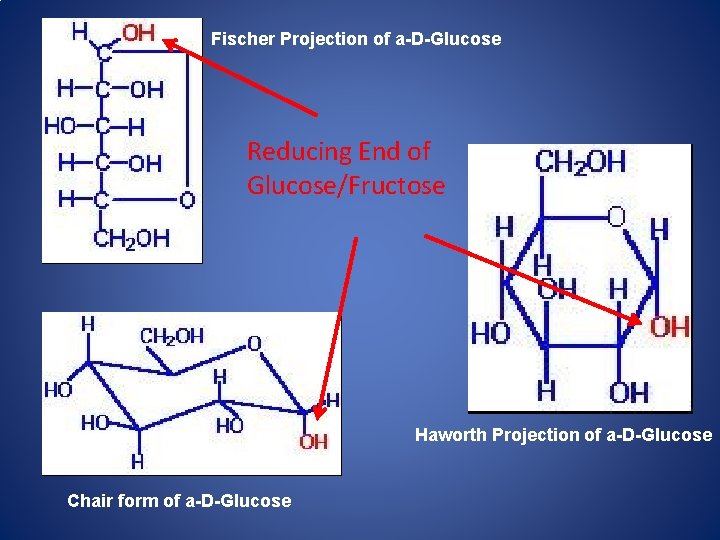
Fischer Projection of a-D-Glucose Reducing End of Glucose/Fructose Haworth Projection of a-D-Glucose Chair form of a-D-Glucose
Disaccharides • Bonds between sugar units are termed glycosidic bonds, and the resultant molecules are glycosides. • The linkage of two monosaccharides to form disaccharides involves a glycosidic bond. The important food disaccharides are sucrose, lactose, and maltose. No reducing capacity Reducing ends are not exposed due to 1, 2 bond Sucrose: prevalent in sugar cane and sugar beets, is composed of glucose and fructose through an α-(1, 2) glycosidic bond.
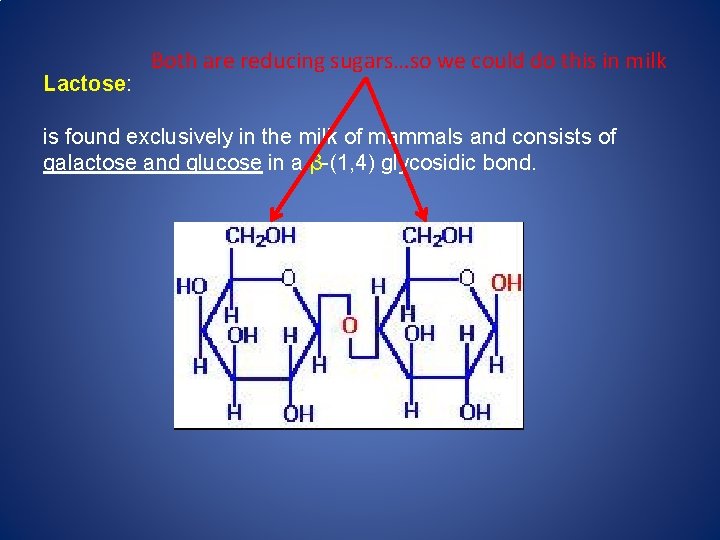
Lactose: Both are reducing sugars…so we could do this in milk is found exclusively in the milk of mammals and consists of galactose and glucose in a β-(1, 4) glycosidic bond.
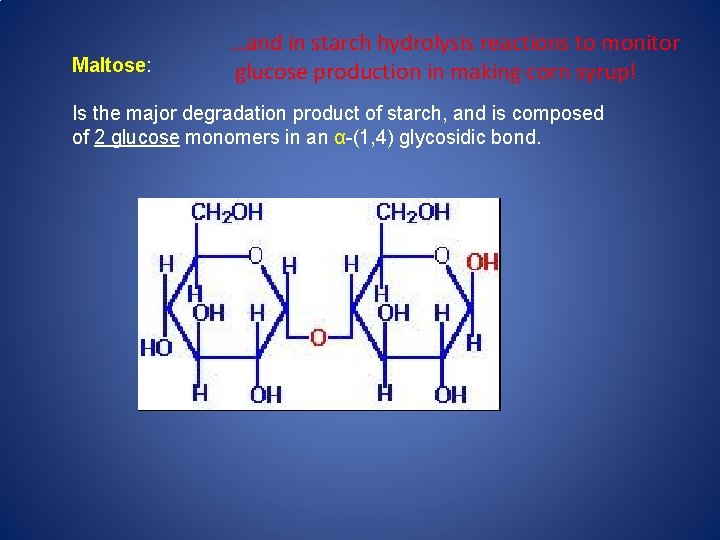
Maltose: …and in starch hydrolysis reactions to monitor glucose production in making corn syrup! Is the major degradation product of starch, and is composed of 2 glucose monomers in an α-(1, 4) glycosidic bond.
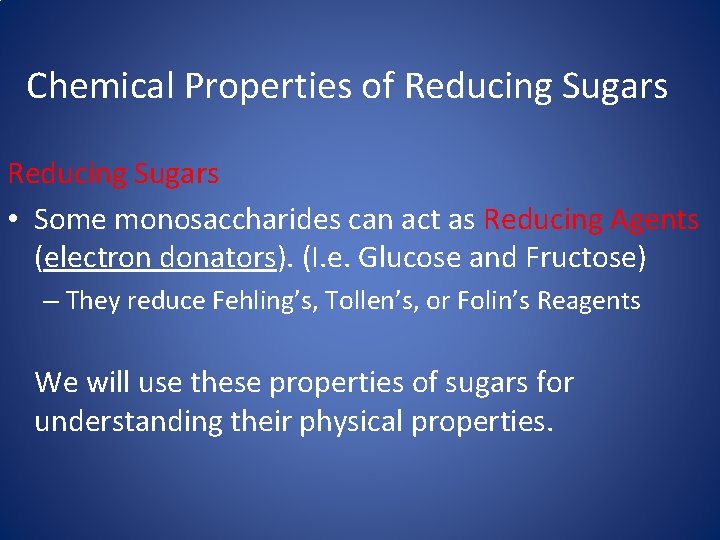
Chemical Properties of Reducing Sugars • Some monosaccharides can act as Reducing Agents (electron donators). (I. e. Glucose and Fructose) – They reduce Fehling’s, Tollen’s, or Folin’s Reagents We will use these properties of sugars for understanding their physical properties.
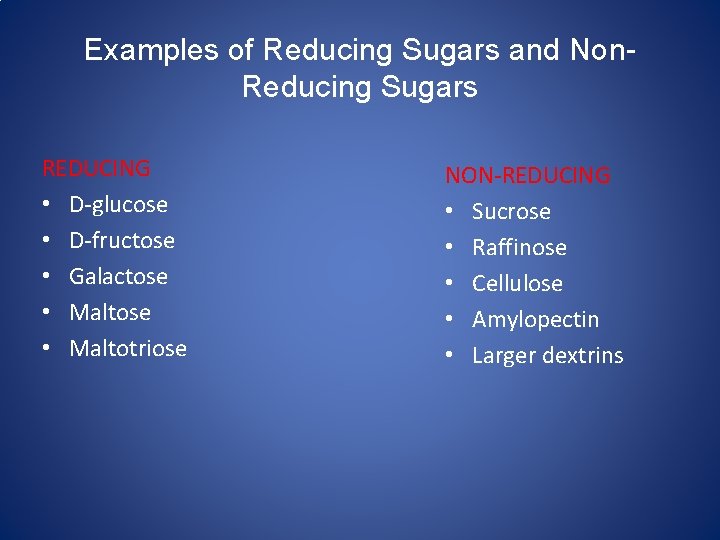
Examples of Reducing Sugars and Non. Reducing Sugars REDUCING • D-glucose • D-fructose • Galactose • Maltotriose NON-REDUCING • Sucrose • Raffinose • Cellulose • Amylopectin • Larger dextrins
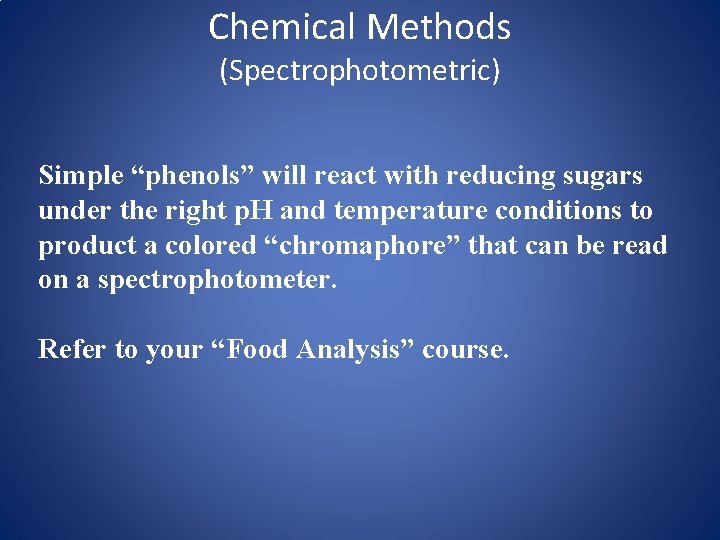
Chemical Methods (Spectrophotometric) Simple “phenols” will react with reducing sugars under the right p. H and temperature conditions to product a colored “chromaphore” that can be read on a spectrophotometer. Refer to your “Food Analysis” course.
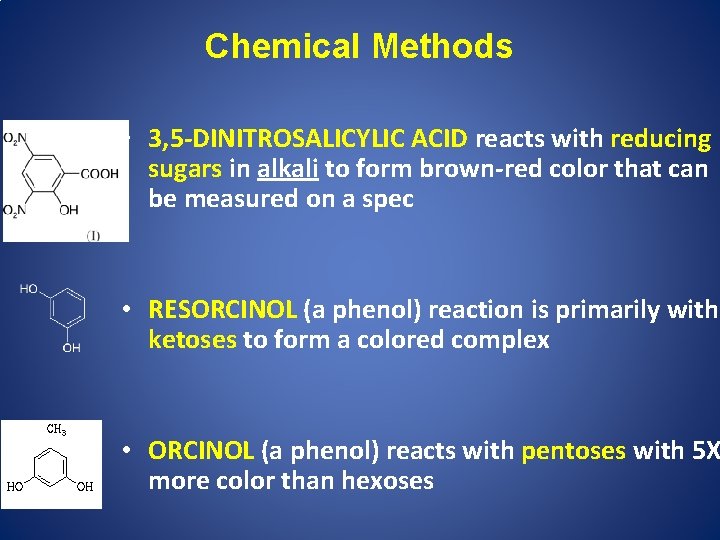
Chemical Methods • 3, 5 -DINITROSALICYLIC ACID reacts with reducing sugars in alkali to form brown-red color that can be measured on a spec • RESORCINOL (a phenol) reaction is primarily with ketoses to form a colored complex • ORCINOL (a phenol) reacts with pentoses with 5 X more color than hexoses
To the “extreme” n n Some methods detect the reaction of “going toooo far” with the sugar hydrolysis PHENOL mixed with SULFURIC ACID and heated with “digest” carbohydrates to create furans (furfural, 5 -hydroxymethyl furfural, furaldehyde) which condenses with phenol into a near pink color.
Going Tooo Far • In today’s lab, we want to optimally hydrolyze sucrose. • The goal is to get the MOST glucose and fructose possible (competition? ) • Too gentle, and no reducing sugar is created • Too harsh, and you will break-down your reducing sugars into aldehydes. • Aldehydes will not react with 3, 5 -DNSA
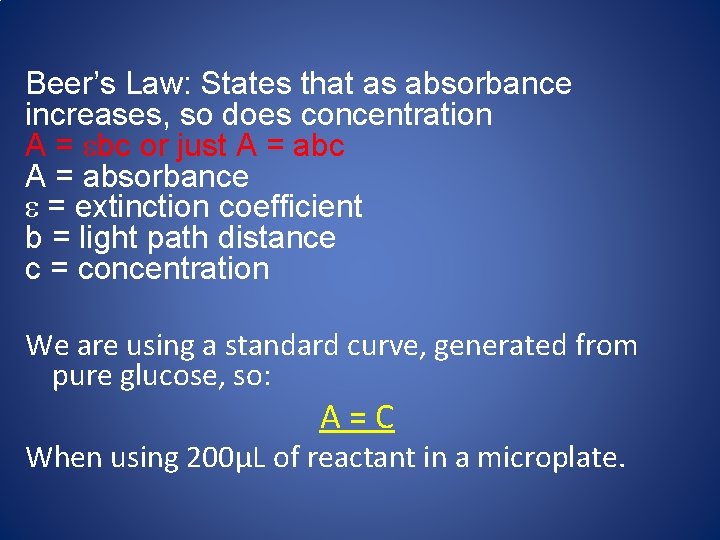
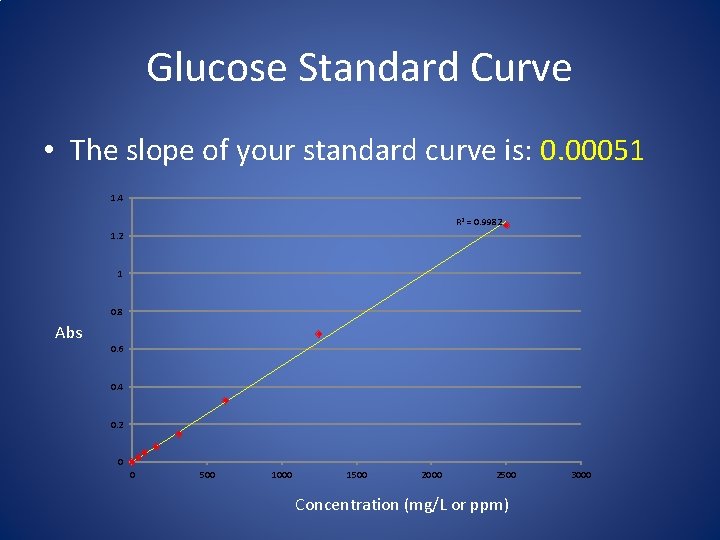
Beer’s Law: States that as absorbance increases, so does concentration A = ebc or just A = abc A = absorbance e = extinction coefficient b = light path distance c = concentration We are using a standard curve, generated from pure glucose, so: A=C When using 200µL of reactant in a microplate.
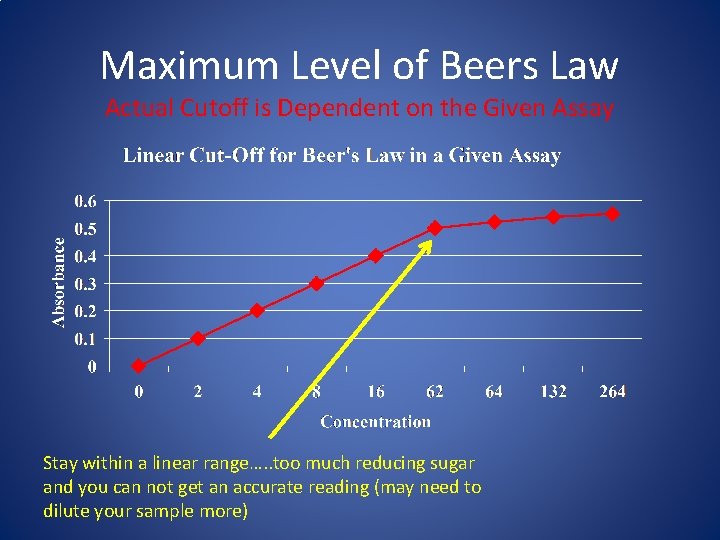
Maximum Level of Beers Law Actual Cutoff is Dependent on the Given Assay Stay within a linear range…. . too much reducing sugar and you can not get an accurate reading (may need to dilute your sample more)
Glucose Standard Curve • The slope of your standard curve is: 0. 00051 1. 4 R 2 = 0. 9982 1. 2 1 0. 8 Abs 0. 6 0. 4 0. 2 0 0 500 1000 1500 2000 2500 Concentration (mg/L or ppm) 3000
Case Study: Hydrolysis in Orange Juice • Sucrose hydrolysis occurs quite frequently in OJ. • Sucrose inverts or hydrolyzes to form 1 molecule of glucose and 1 of fructose from the heat of processing and natural organic acids. • Results in changes to sweetness and degradation • Fructose and glucose are then succeptable to degradation (HMF formation). • HMF results in brown color formation, a smelly aroma, and a bitter/medicinal taste. • Based on your lab group’s data, how easy/hard would it be for OJ to have inverted sucrose and/or reducing sugar degradation?
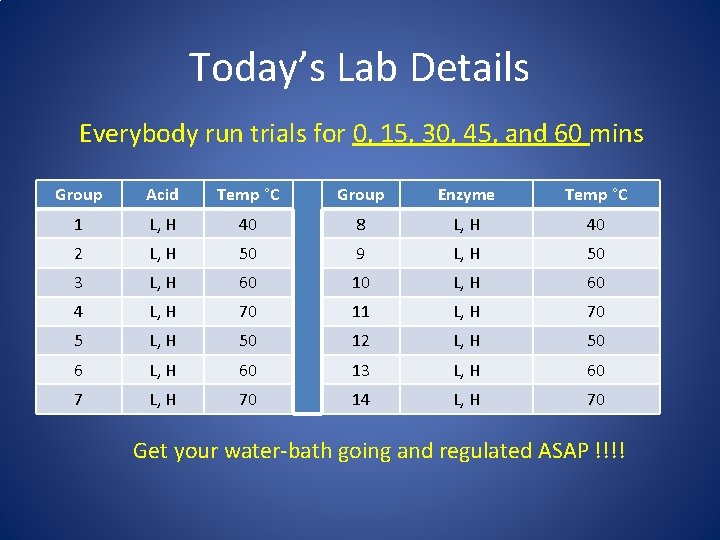
Today’s Lab Details Everybody run trials for 0, 15, 30, 45, and 60 mins Group Acid Temp °C Group Enzyme Temp °C 1 L, H 40 8 L, H 40 2 L, H 50 9 L, H 50 3 L, H 60 10 L, H 60 4 L, H 70 11 L, H 70 5 L, H 50 12 L, H 50 6 L, H 60 13 L, H 60 7 L, H 70 14 L, H 70 Get your water-bath going and regulated ASAP !!!!