
Succession Responses to disturbance 1 A community may
Succession
Responses to disturbance • 1. A community may resist change & remain stable (resistant) • 2. A community may change in response to the disturbance but later return to its original state (resilience) • 3. A community may be modified from the disturbance and never return to its original state
Natural Disturbances Man-Induced • • • • • Mortality Tree-fall Wildfire Volcano Flooding Hurricanes/tornadoes Insect/disease Tsunami Landslides Glaciers Sea-level rise or retreat Logging Plowing Mining Dam Removal Fire/Flooding Nuclear blast/warfare
WHAT HAPPENS WHEN A DISTURBANCE IS SEVERE ENOUGH IT ELIMINATES ALL OR MOST OF THE SPECIES IN A COMMUNITY?
Ecological Succession It will undergo a somewhat predictable series of changes called succession
Primary Succession • Follows a disturbance so severe that no vegetation or soil life remains from the community that once occupied the site • The biotic community has to rebuild from scratch • Can be caused by… • • Sides of volcanoes Landslides Glacier retreats Lakes dries up
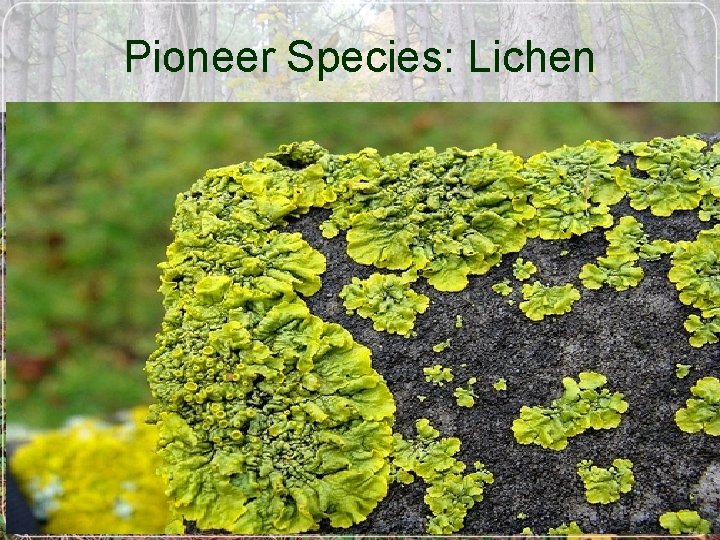
Pioneer Species: Lichen
Pioneer Species • Pioneer species have spores and seeds that can travel long distances • Lichens: secrete acids that break down rock, forming soil • Once soil is in place, small plants, insects & worms have suitable habitats
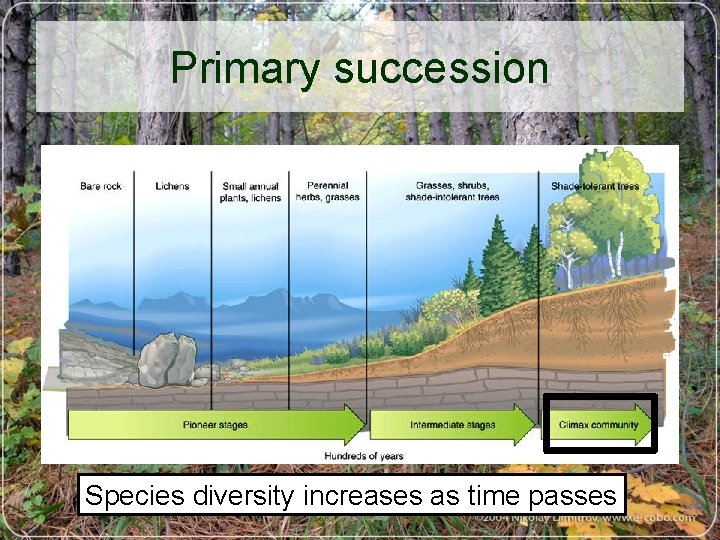
Primary succession Species diversity increases as time passes
Secondary Succession • Begins when a disturbance dramatically alters an existing community but does not destroy all living things or all organic matter in the soil. – Parts of the community remain, and become building blocks • Examples: – – – Abandoned farmlands Burned (fire) or cut forests (logging) Hurricane Flooding Heavily polluted streams
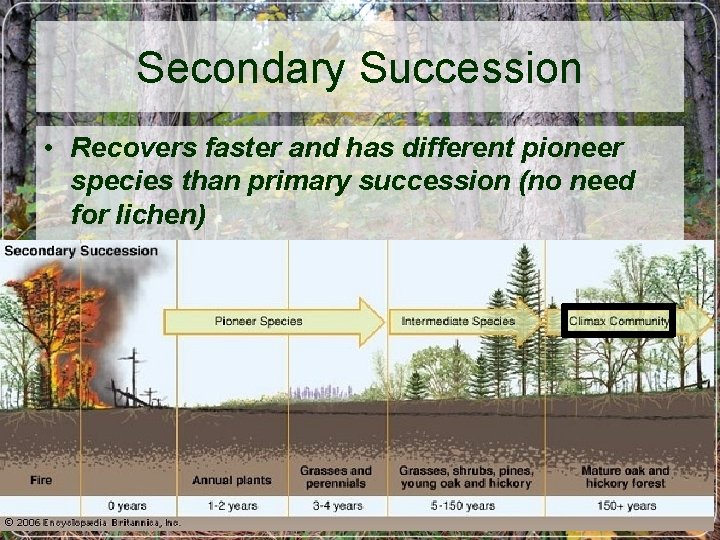
Secondary Succession • Recovers faster and has different pioneer species than primary succession (no need for lichen)
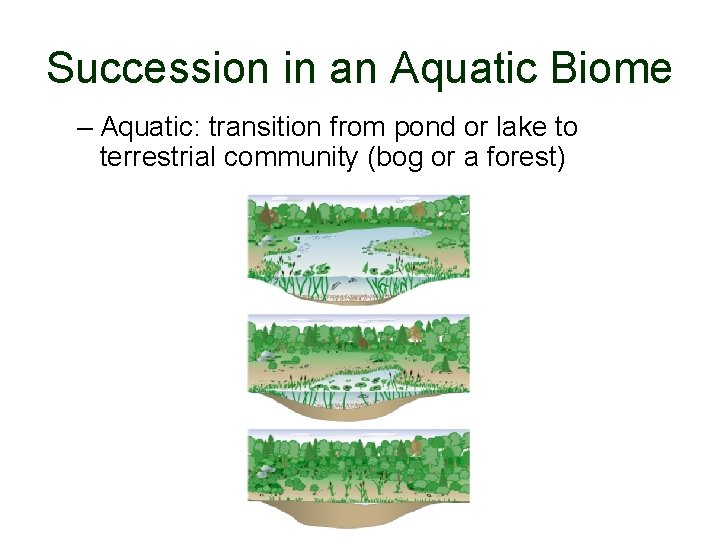
Succession in an Aquatic Biome – Aquatic: transition from pond or lake to terrestrial community (bog or a forest)
CLIMAX COMMUNITY • Will remain in place with little modification until some disturbance restarts succession
• Intermediate disturbance hypothesis: – Communities that experience fairly frequent, moderate disturbances have the greatest diversity of species • Removes organisms • Reduces populations • Creates opportunities for other species to colonize
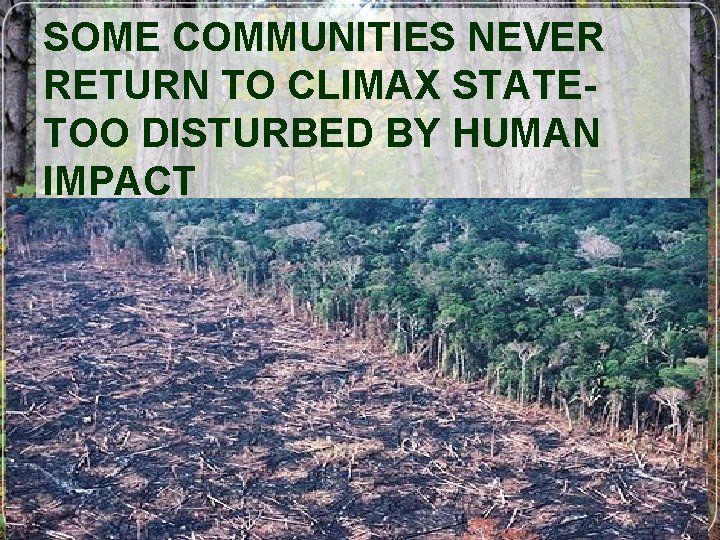
SOME COMMUNITIES NEVER RETURN TO CLIMAX STATETOO DISTURBED BY HUMAN IMPACT
Restoration Ecology • Restoration Ecology= restoring damaged areas to their pristine environment (what they once looked like) – Difficult – Time consuming – Expensive – Doesn’t always work *Best to protect natural systems from human degradation
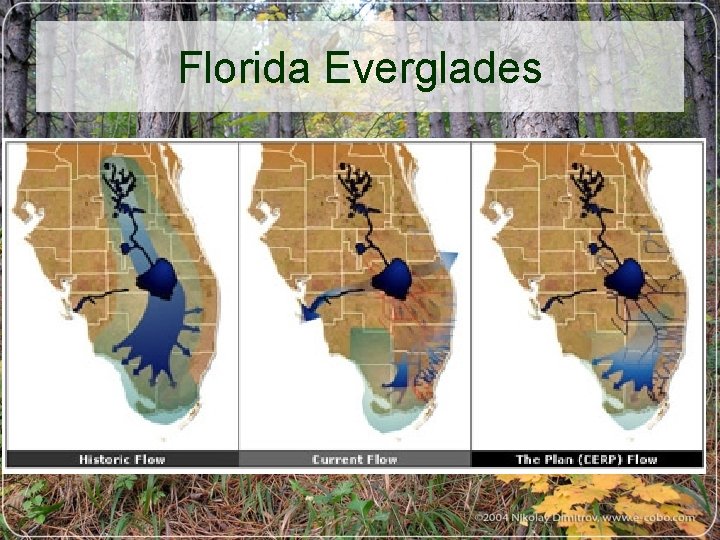
Florida Everglades
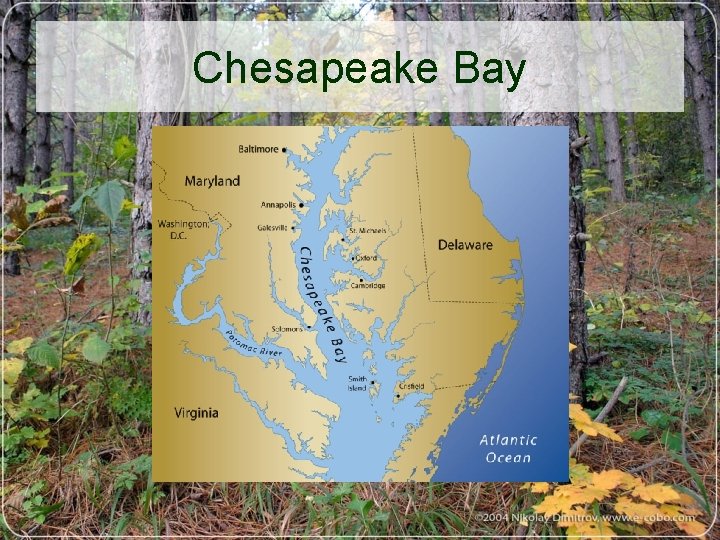
Chesapeake Bay
- Slides: 19