
Successful Slalom Edina Alpine Ski Team Jared Scribner
Successful Slalom Edina Alpine Ski Team Jared Scribner 21 Oct 2015
General Ski Racing Psychology � Ski racers and coaches almost unanimously agree the mental aspect of skiing has the greatest impact on how a skier performs � We don’t treat the mental game the way we treat the physical and technical aspects of the sport � Little to no time is devoted to the mental aspect � Racers, coaches, and especially parents seem to hold sports psychology to a different standard than the physical and technical aspects of ski racing
Mental Training Strategies � goal setting (S. M. A. R. T. goals) � positive-thinking skills � intensity-control techniques � focusing techniques � mental imagery � routines
Mental Training Settings � indoor � on group setting the snow
Obstacles to Skiing Our Best � habitual negativity � perfectionism � fear of failure
Unique SL Considerations � gates are encountered more quickly than other disciplines � many more gates in a course � often greater physical exertion � armor is worn � …we hit stuff!
Random photo of my dog because we’re 7 slides in and still have yet to see a picture!
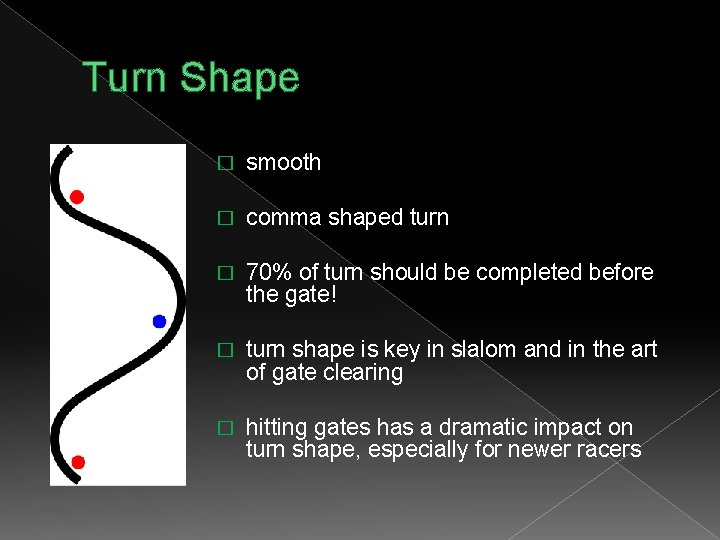
Turn Shape � smooth � comma shaped turn � 70% of turn should be completed before the gate! � turn shape is key in slalom and in the art of gate clearing � hitting gates has a dramatic impact on turn shape, especially for newer racers
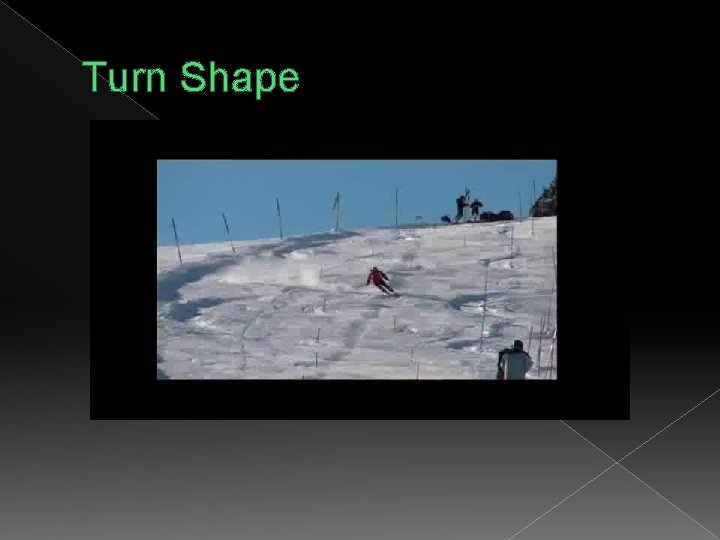
Turn Shape
Gates and Body Position � fear of speed; hill is too steep (especially for less experienced athletes on a big start ramp) combined with rapid encounter with gates often leads to poor body position � natural response is to distance yourself from the “threat”; i. e. lean back and narrow stance � “stay on top of skis”; athletic stance, skis positioned wide, neutral body position � Upper body “squared” to the hill and terrain; no twisting – quiet!
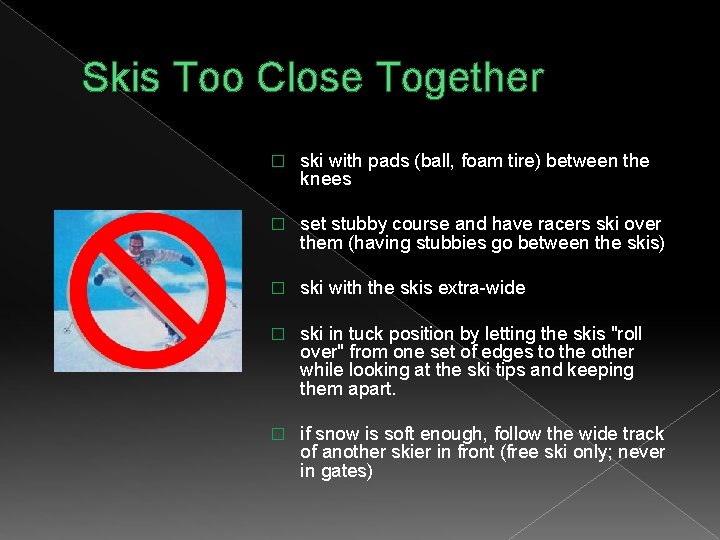
Skis Too Close Together � ski with pads (ball, foam tire) between the knees � set stubby course and have racers ski over them (having stubbies go between the skis) � ski with the skis extra-wide � ski in tuck position by letting the skis "roll over" from one set of edges to the other while looking at the ski tips and keeping them apart. � if snow is soft enough, follow the wide track of another skier in front (free ski only; never in gates)
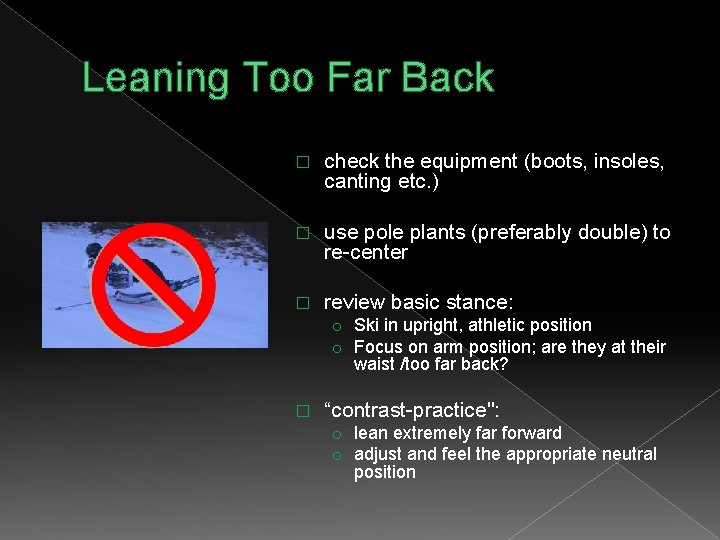
Leaning Too Far Back � check the equipment (boots, insoles, canting etc. ) � use pole plants (preferably double) to re-center � review basic stance: o Ski in upright, athletic position o Focus on arm position; are they at their waist /too far back? � “contrast-practice": o lean extremely far forward o adjust and feel the appropriate neutral position
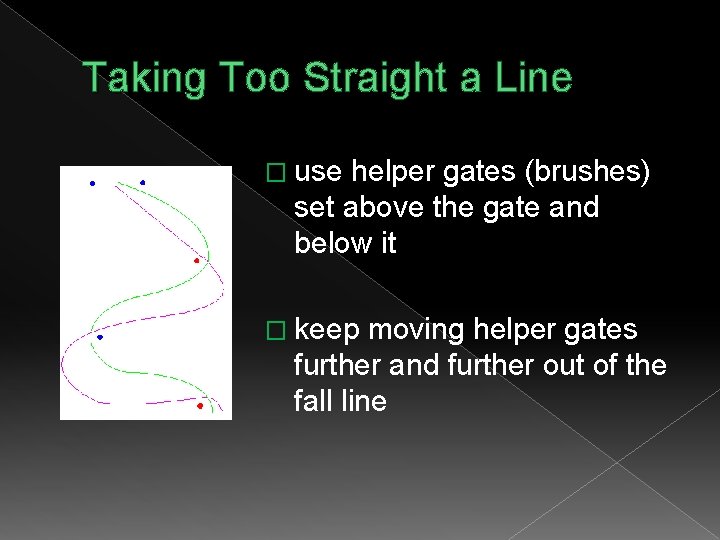
Taking Too Straight a Line � use helper gates (brushes) set above the gate and below it � keep moving helper gates further and further out of the fall line
Question: “Coach, when can I cross-block? ” Answer: “How about never!”
Clearing Technique � We teach “clearing” -- NOT cross-blocking! � Gate clearing is not about the hit, rather, it’s about the line! o Are they carving proper turns? o Do they have proper angulation to place their torso to the inside line of the gate?
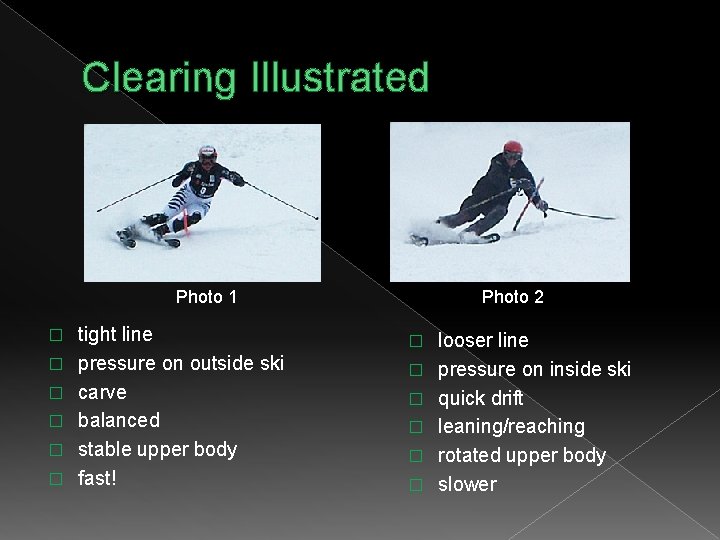
Clearing Illustrated Photo 1 � � � tight line pressure on outside ski carve balanced stable upper body fast! Photo 2 � � � looser line pressure on inside ski quick drift leaning/reaching rotated upper body slower
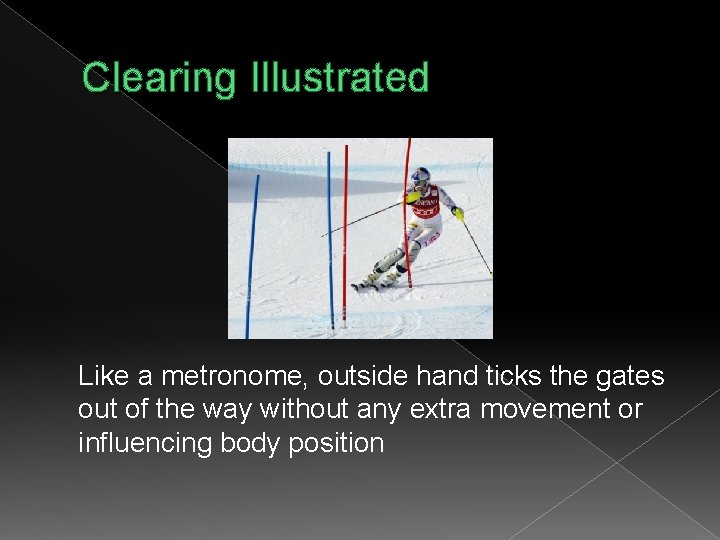
Clearing Illustrated Like a metronome, outside hand ticks the gates out of the way without any extra movement or influencing body position
Clearing Flushes
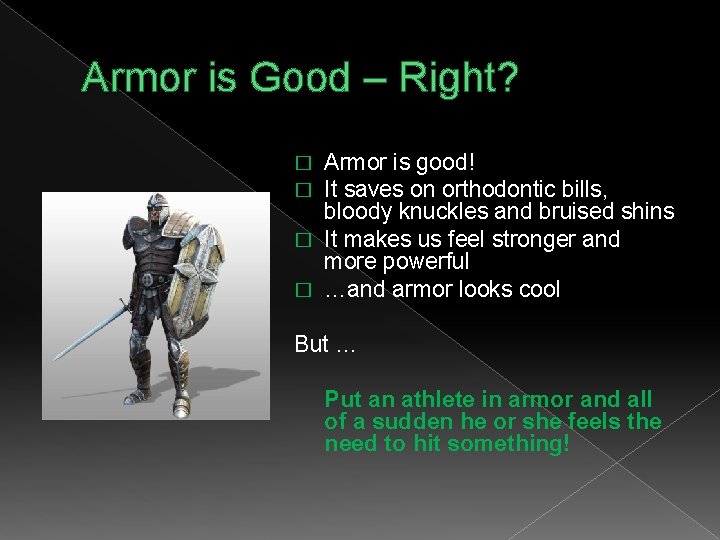
Armor is Good – Right? Armor is good! It saves on orthodontic bills, bloody knuckles and bruised shins � It makes us feel stronger and more powerful � …and armor looks cool � � But … Put an athlete in armor and all of a sudden he or she feels the need to hit something!
The Action and Result? Skier sees gate Skier goes straight at gate Skier blocks gate with outside hand Reaching over to the gate releases pressure from the edges before the turn is anywhere near completion. � Skier must complete turn after the gate by skidding skis around and is already too low to make a good turn on the next gate. � Pattern repeats until skier passes through finish and wonders, “Why am I so slow? I hit all the gates!” � �
What Do We Do? 1. accept that cross-blocking is a Faustian bargain 2. ditch the term “cross-blocking” altogether 3. refocus on the one core skill that will never fail pole plants 4. after 1 – 3 are mastered, use the armor! 5. give it time
Providing Corrective Feedback � First understand the cause of the problem, only then try to correct it � Don't point out several mistakes at once � Don't mention the same mistake over and over again � Include positive feedback into the criticism � It is very important to bring positive aspects into correction process � Give well defined tasks to correct mistakes
Sources � http: //skiracing. com/? q=node/9217 by Dr. Jim Taylor � http: //www. youtube. com/watch? v=RSd. MXslu. Gj 4 � www. youcanski. com by Greg Gurshman � http: //www. youtube. com/watch? v=a 0 Zb. Q 1 tj 4 Us&feature=fvwrel � www. racerex. com/clearing-up-the-issue-an-anti-cross-blockingmanifesto/ by Edie Thys Morgan and Racer. X � www. hvst. org/files/Gate_Clearing__Coaches_Ed_Dec_2005_WEB_. pdf by Coach Bors � Wayde “Kurv”-ida � Hot Dog…The Movie
- Slides: 23