
Successful Quote Integration A Simple Guide Things to
- Slides: 11
Successful Quote Integration A Simple Guide
Things to Remember: • Your essay is YOUR argument—too many quotations can overpower your voice • Use quotations sparingly • Quote only words, sentences, or passages that are POWERFUL • Never DROP a quotation into your paper—use your own words to introduce
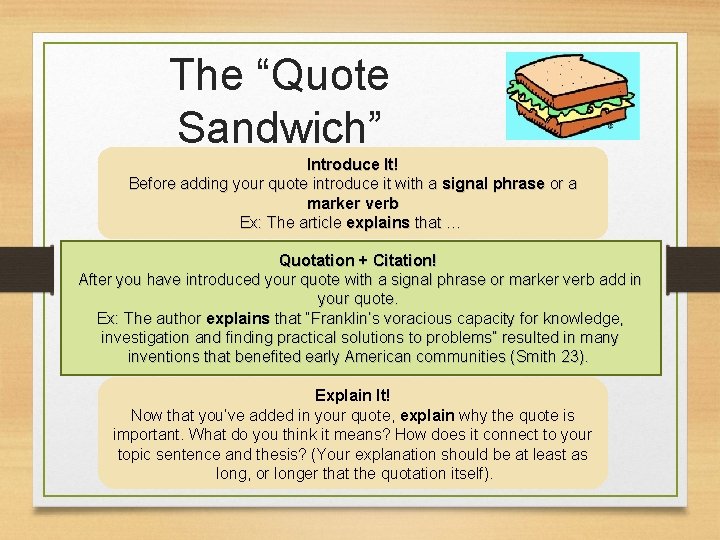
The “Quote Sandwich” Introduce It! Before adding your quote introduce it with a signal phrase or a marker verb Ex: The article explains that … Quotation + Citation! After you have introduced your quote with a signal phrase or marker verb add in your quote. Ex: The author explains that “Franklin’s voracious capacity for knowledge, investigation and finding practical solutions to problems” resulted in many inventions that benefited early American communities (Smith 23). Explain It! Now that you’ve added in your quote, explain why the quote is important. What do you think it means? How does it connect to your topic sentence and thesis? (Your explanation should be at least as long, or longer that the quotation itself).
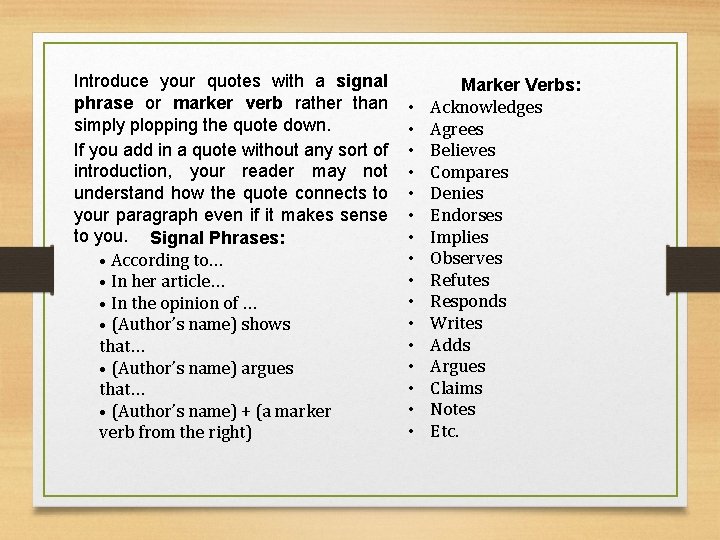
Introduce your quotes with a signal phrase or marker verb rather than simply plopping the quote down. If you add in a quote without any sort of introduction, your reader may not understand how the quote connects to your paragraph even if it makes sense to you. Signal Phrases: • According to… • In her article… • In the opinion of … • (Author’s name) shows that… • (Author’s name) argues that… • (Author’s name) + (a marker verb from the right) • • • • Marker Verbs: Acknowledges Agrees Believes Compares Denies Endorses Implies Observes Refutes Responds Writes Adds Argues Claims Notes Etc.
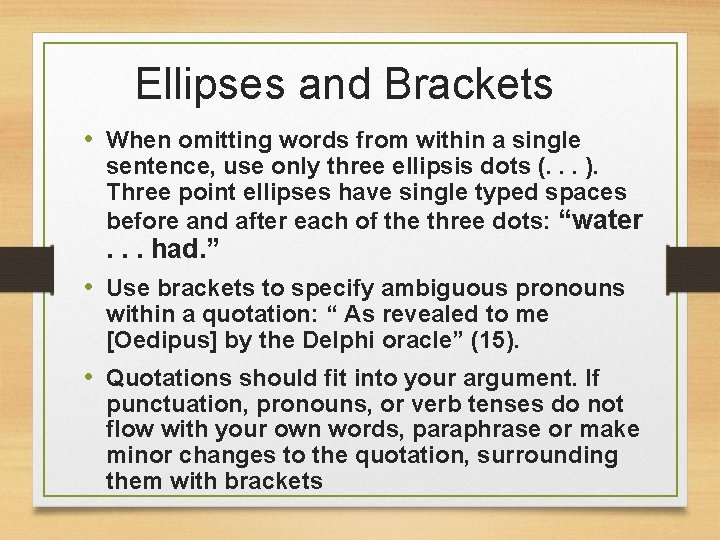
Ellipses and Brackets • When omitting words from within a single sentence, use only three ellipsis dots (. . . ). Three point ellipses have single typed spaces before and after each of the three dots: “water . . . had. ” • Use brackets to specify ambiguous pronouns within a quotation: “ As revealed to me [Oedipus] by the Delphi oracle” (15). • Quotations should fit into your argument. If punctuation, pronouns, or verb tenses do not flow with your own words, paraphrase or make minor changes to the quotation, surrounding them with brackets
You Do the Work • Do not rely on quotations to do the work for you. • You must always follow a quotation or paraphrase with commentary. • Never end a paragraph with a quotation.
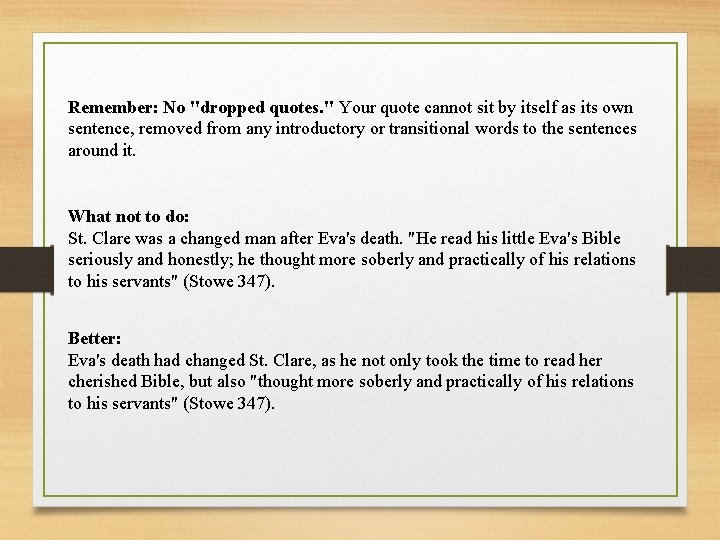
Remember: No "dropped quotes. " Your quote cannot sit by itself as its own sentence, removed from any introductory or transitional words to the sentences around it. What not to do: St. Clare was a changed man after Eva's death. "He read his little Eva's Bible seriously and honestly; he thought more soberly and practically of his relations to his servants" (Stowe 347). Better: Eva's death had changed St. Clare, as he not only took the time to read her cherished Bible, but also "thought more soberly and practically of his relations to his servants" (Stowe 347).
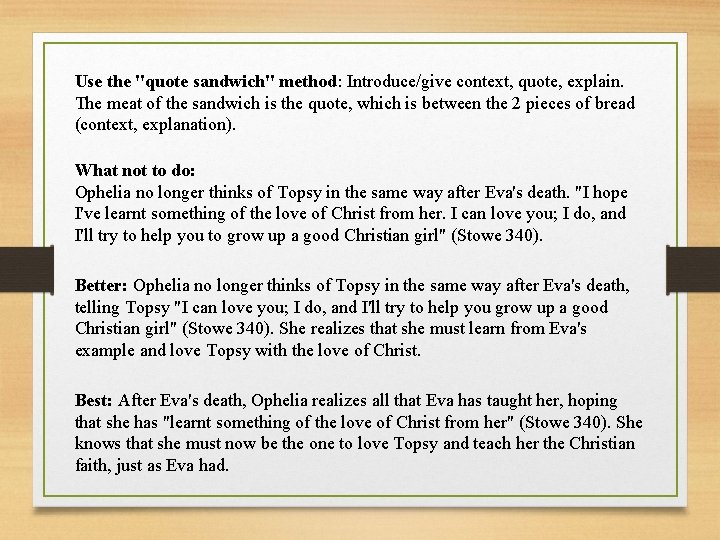
Use the "quote sandwich" method: Introduce/give context, quote, explain. The meat of the sandwich is the quote, which is between the 2 pieces of bread (context, explanation). What not to do: Ophelia no longer thinks of Topsy in the same way after Eva's death. "I hope I've learnt something of the love of Christ from her. I can love you; I do, and I'll try to help you to grow up a good Christian girl" (Stowe 340). Better: Ophelia no longer thinks of Topsy in the same way after Eva's death, telling Topsy "I can love you; I do, and I'll try to help you grow up a good Christian girl" (Stowe 340). She realizes that she must learn from Eva's example and love Topsy with the love of Christ. Best: After Eva's death, Ophelia realizes all that Eva has taught her, hoping that she has "learnt something of the love of Christ from her" (Stowe 340). She knows that she must now be the one to love Topsy and teach her the Christian faith, just as Eva had.
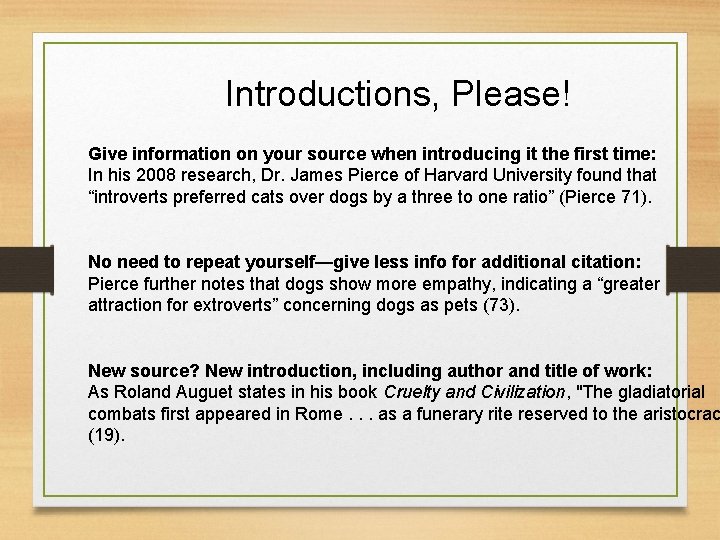
Introductions, Please! Give information on your source when introducing it the first time: In his 2008 research, Dr. James Pierce of Harvard University found that “introverts preferred cats over dogs by a three to one ratio” (Pierce 71). No need to repeat yourself—give less info for additional citation: Pierce further notes that dogs show more empathy, indicating a “greater attraction for extroverts” concerning dogs as pets (73). New source? New introduction, including author and title of work: As Roland Auguet states in his book Cruelty and Civilization, "The gladiatorial combats first appeared in Rome. . . as a funerary rite reserved to the aristocrac (19).
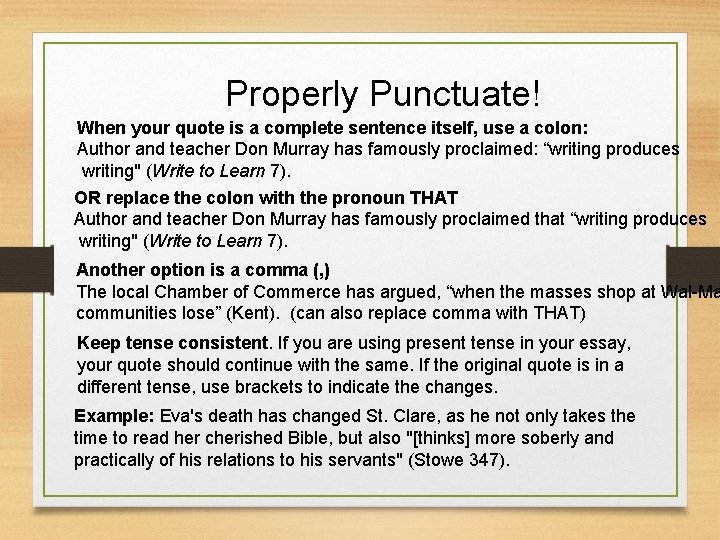
Properly Punctuate! When your quote is a complete sentence itself, use a colon: Author and teacher Don Murray has famously proclaimed: “writing produces writing" (Write to Learn 7). OR replace the colon with the pronoun THAT Author and teacher Don Murray has famously proclaimed that “writing produces writing" (Write to Learn 7). Another option is a comma (, ) The local Chamber of Commerce has argued, “when the masses shop at Wal-Ma communities lose” (Kent). (can also replace comma with THAT) Keep tense consistent. If you are using present tense in your essay, your quote should continue with the same. If the original quote is in a different tense, use brackets to indicate the changes. Example: Eva's death has changed St. Clare, as he not only takes the time to read her cherished Bible, but also "[thinks] more soberly and practically of his relations to his servants" (Stowe 347).
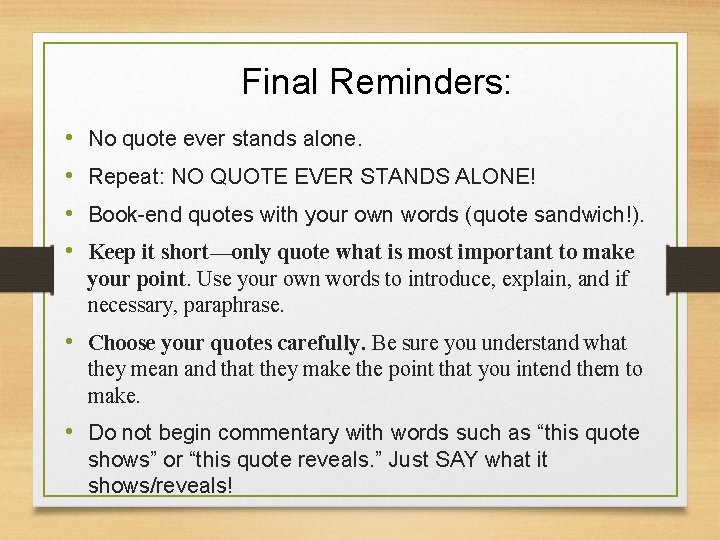
Final Reminders: • • No quote ever stands alone. Repeat: NO QUOTE EVER STANDS ALONE! Book-end quotes with your own words (quote sandwich!). Keep it short—only quote what is most important to make your point. Use your own words to introduce, explain, and if necessary, paraphrase. • Choose your quotes carefully. Be sure you understand what they mean and that they make the point that you intend them to make. • Do not begin commentary with words such as “this quote shows” or “this quote reveals. ” Just SAY what it shows/reveals!