
SUCCESSFUL INVENTORY PLANNING REQUIRES A NEW APPROACH Presentation


- Slides: 22
SUCCESSFUL INVENTORY PLANNING REQUIRES A NEW APPROACH Presentation at GSK October 15, 2002 CONFIDENTIAL
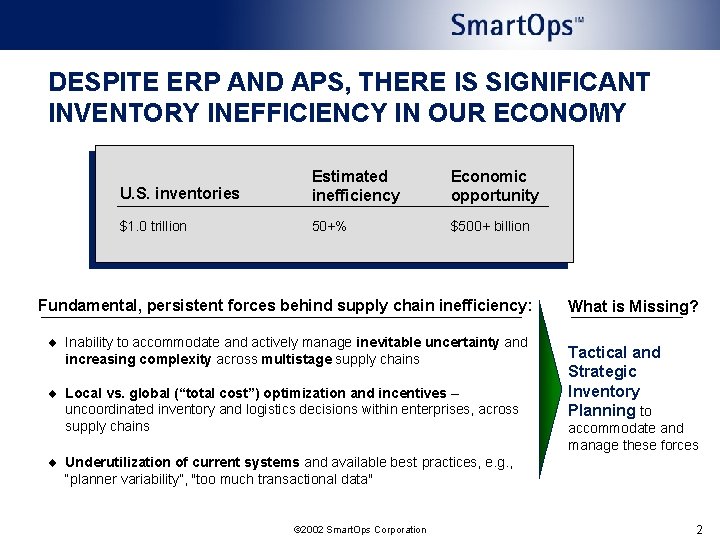
DESPITE ERP AND APS, THERE IS SIGNIFICANT INVENTORY INEFFICIENCY IN OUR ECONOMY U. S. inventories Estimated inefficiency Economic opportunity $1. 0 trillion 50+% $500+ billion Fundamental, persistent forces behind supply chain inefficiency: ¨ Inability to accommodate and actively manage inevitable uncertainty and increasing complexity across multistage supply chains ¨ Local vs. global (“total cost”) optimization and incentives – uncoordinated inventory and logistics decisions within enterprises, across supply chains ¨ Underutilization of current systems and available best practices, e. g. , “planner variability”, "too much transactional data" © 2002 Smart. Ops Corporation What is Missing? Tactical and Strategic What is missing? Inventory Planning to accommodate and manage these forces 2
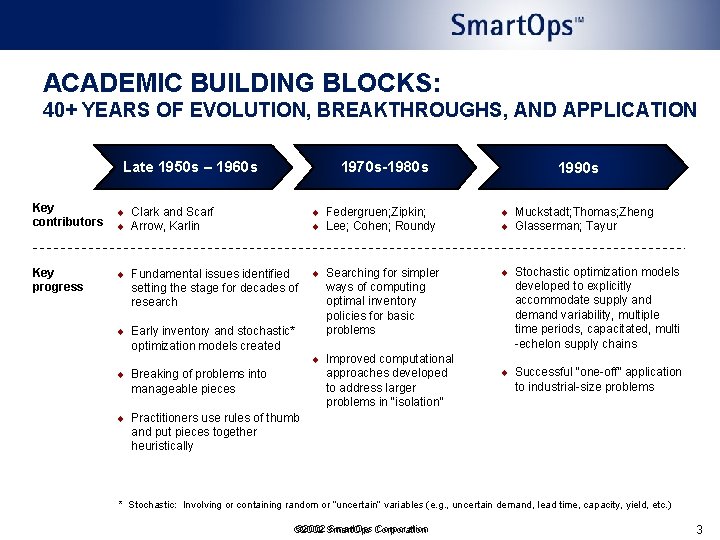
ACADEMIC BUILDING BLOCKS: 40+ YEARS OF EVOLUTION, BREAKTHROUGHS, AND APPLICATION Late 1950 s – 1960 s 1970 s-1980 s 1990 s Key contributors ¨ Clark and Scarf ¨ Arrow, Karlin ¨ Federgruen; Zipkin; ¨ Lee; Cohen; Roundy ¨ Muckstadt; Thomas; Zheng ¨ Glasserman; Tayur Key progress ¨ Fundamental issues identified ¨ Searching for simpler ¨ Stochastic optimization models setting the stage for decades of research ¨ Early inventory and stochastic* ways of computing optimal inventory policies for basic problems optimization models created developed to explicitly accommodate supply and demand variability, multiple time periods, capacitated, multi -echelon supply chains ¨ Improved computational approaches developed to address larger problems in “isolation” ¨ Breaking of problems into manageable pieces ¨ Successful “one-off” application to industrial-size problems ¨ Practitioners use rules of thumb and put pieces together heuristically * Stochastic: Involving or containing random or “uncertain” variables (e. g. , uncertain demand, lead time, capacity, yield, etc. ) © 2002 Smart. Ops Corporation © 2002 3
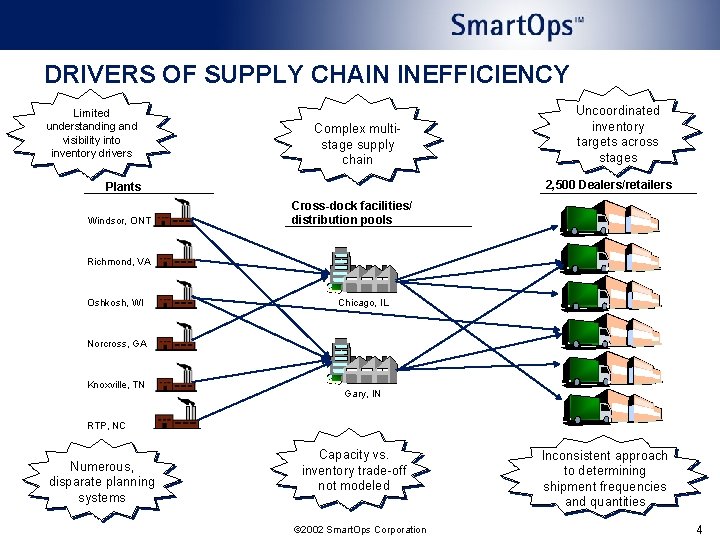
DRIVERS OF SUPPLY CHAIN INEFFICIENCY Limited understanding and visibility into inventory drivers Complex multistage supply chain 2, 500 Dealers/retailers Plants Windsor, ONT Uncoordinated inventory targets across stages Cross-dock facilities/ distribution pools Richmond, VA Oshkosh, WI Chicago, IL Norcross, GA Knoxville, TN Gary, IN RTP, NC Numerous, disparate planning systems Capacity vs. inventory trade-off not modeled © 2002 Smart. Ops Corporation Inconsistent approach to determining shipment frequencies and quantities 4
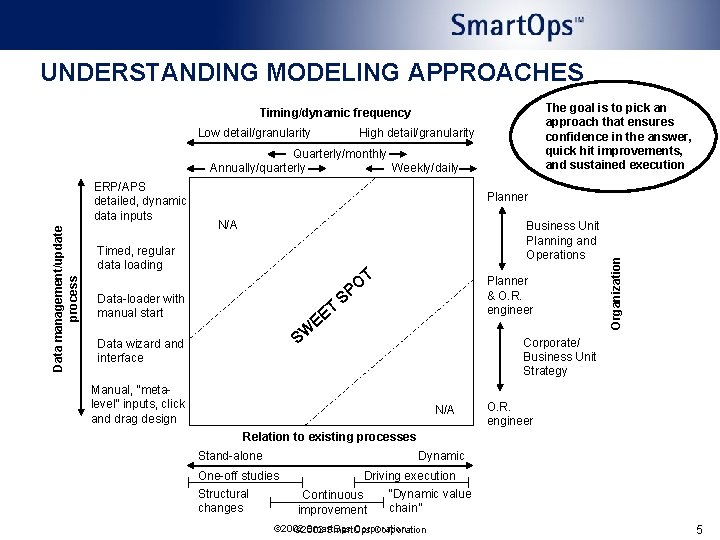
UNDERSTANDING MODELING APPROACHES The goal is to pick an approach that ensures confidence in the answer, quick hit improvements, and sustained execution Timing/dynamic frequency Low detail/granularity High detail/granularity Quarterly/monthly Annually/quarterly Weekly/daily Planner N/A Business Unit Planning and Operations Timed, regular data loading T Data-loader with manual start T E E Planner & O. R. engineer O P S SW Data wizard and interface Organization Data management/update process ERP/APS detailed, dynamic data inputs Corporate/ Business Unit Strategy Manual, “metalevel” inputs, click and drag design N/A O. R. engineer Relation to existing processes Stand-alone Dynamic One-off studies Structural changes Driving execution “Dynamic value Continuous chain” improvement © 2002 Smart. Ops Corporation 5
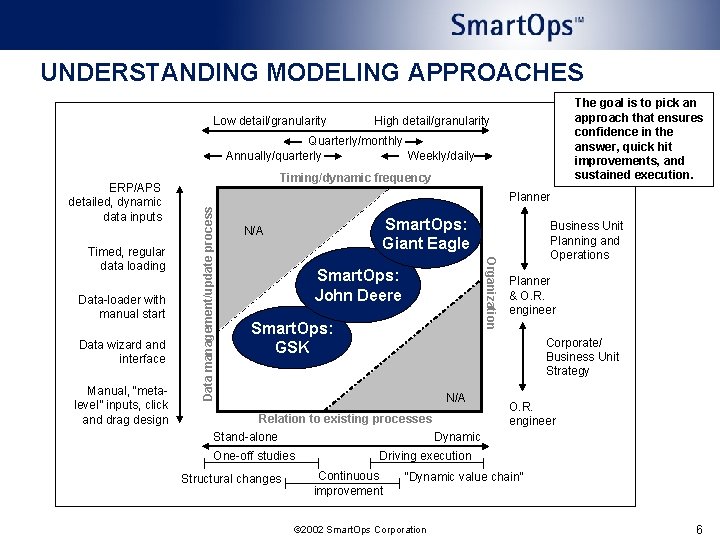
UNDERSTANDING MODELING APPROACHES Low detail/granularity The goal is to pick an approach that ensures confidence in the answer, quick hit improvements, and sustained execution. High detail/granularity Quarterly/monthly Annually/quarterly Weekly/daily Data-loader with manual start Data wizard and interface Manual, “metalevel” inputs, click and drag design Planner Smart. Ops: Giant Eagle N/A Organization Timed, regular data loading Timing/dynamic frequency Data management/update process ERP/APS detailed, dynamic data inputs Smart. Ops: John Deere Smart. Ops: GSK Relation to existing processes Stand-alone Dynamic Structural changes Planner & O. R. engineer Corporate/ Business Unit Strategy N/A One-off studies Business Unit Planning and Operations O. R. engineer Driving execution Continuous improvement “Dynamic value chain” © 2002 Smart. Ops Corporation 6
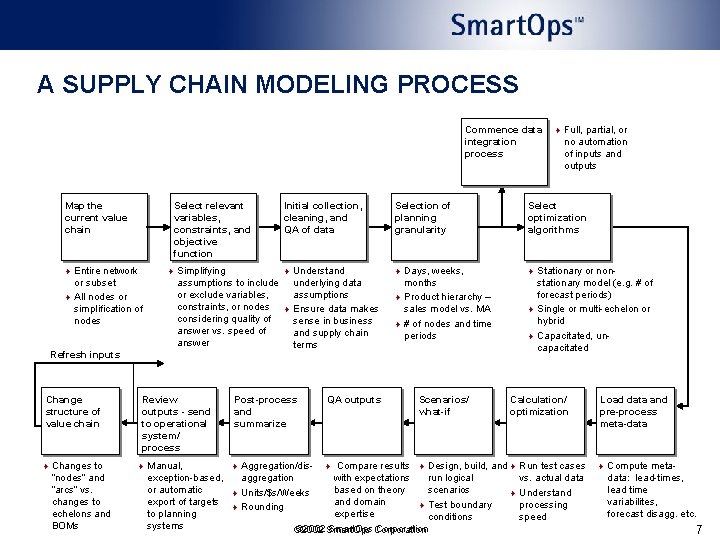
A SUPPLY CHAIN MODELING PROCESS Commence data integration process Map the current value chain Select relevant variables, constraints, and objective function ¨ Entire network ¨ Simplifying or subset ¨ All nodes or simplification of nodes Refresh inputs Change structure of value chain ¨ Changes to “nodes” and “arcs” vs. changes to echelons and BOMs Initial collection, cleaning, and QA of data ¨ Understand assumptions to include underlying data or exclude variables, assumptions constraints, or nodes ¨ Ensure data makes considering quality of sense in business answer vs. speed of and supply chain answer terms Review outputs - send to operational system/ process ¨ Manual, Post-process and summarize QA outputs ¨ Full, partial, or no automation of inputs and outputs Selection of planning granularity Select optimization algorithms ¨ Days, weeks, ¨ Stationary or non- months ¨ Product hierarchy – sales model vs. MA ¨ # of nodes and time periods stationary model (e. g. # of forecast periods) ¨ Single or multi-echelon or hybrid ¨ Capacitated, uncapacitated Scenarios/ what-if Calculation/ optimization ¨ Aggregation/dis- ¨ Compare results ¨ Design, build, and ¨ Run test cases exception-based, aggregation with expectations run logical vs. actual data or automatic based on theory scenarios ¨ Units/$s/Weeks ¨ Understand export of targets ¨ Rounding and domain ¨ Test boundary processing to planning expertise conditions speed systems © 2002 Smart. Ops Corporation Load data and pre-process meta-data ¨ Compute meta- data: lead-times, lead time variabilites, forecast disagg. etc. 7
© 2002 Smart. Ops Corporation 8
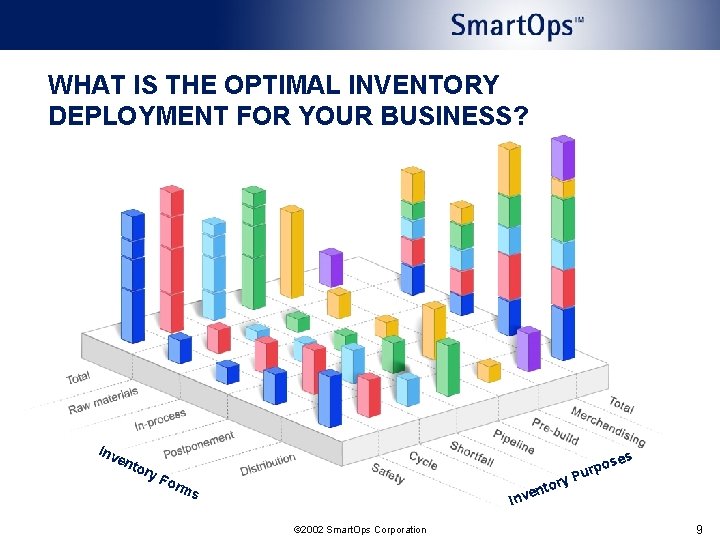
WHAT IS THE OPTIMAL INVENTORY DEPLOYMENT FOR YOUR BUSINESS? Inv ent ory Fo tory n e Inv rm s © 2002 Smart. Ops Corporation s ose p r Pu 9
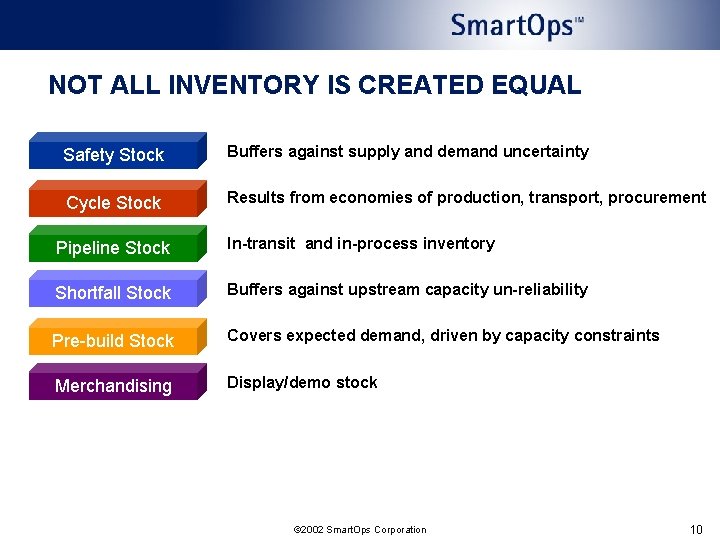
NOT ALL INVENTORY IS CREATED EQUAL Safety Stock Buffers against supply and demand uncertainty Cycle Stock Results from economies of production, transport, procurement Pipeline Stock In-transit and in-process inventory Shortfall Stock Buffers against upstream capacity un-reliability Pre-build Stock Covers expected demand, driven by capacity constraints Merchandising Display/demo stock © 2002 Smart. Ops Corporation 10
© 2002 Smart. Ops Corporation 11
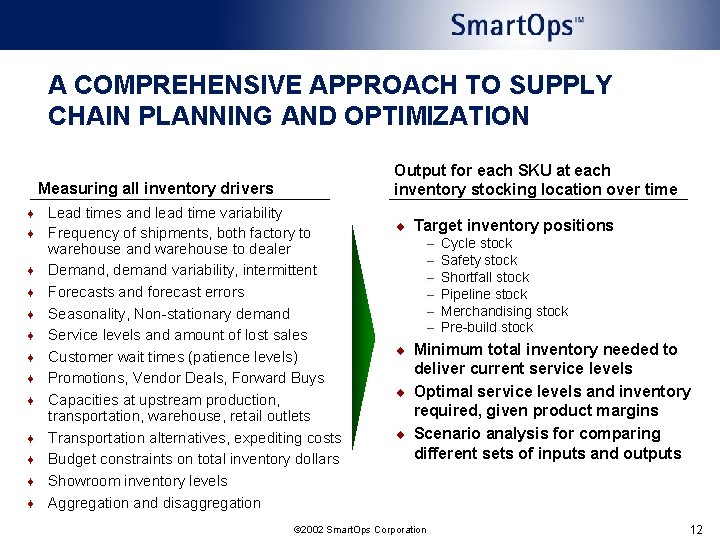
A COMPREHENSIVE APPROACH TO SUPPLY CHAIN PLANNING AND OPTIMIZATION Output for each SKU at each inventory stocking location over time Measuring all inventory drivers ¨ ¨ ¨ ¨ Lead times and lead time variability Frequency of shipments, both factory to warehouse and warehouse to dealer Demand, demand variability, intermittent Forecasts and forecast errors Seasonality, Non-stationary demand Service levels and amount of lost sales Customer wait times (patience levels) Promotions, Vendor Deals, Forward Buys Capacities at upstream production, transportation, warehouse, retail outlets Transportation alternatives, expediting costs Budget constraints on total inventory dollars Showroom inventory levels Aggregation and disaggregation ¨ Target inventory positions – – – Cycle stock Safety stock Shortfall stock Pipeline stock Merchandising stock Pre-build stock Minimum total inventory needed to deliver current service levels ¨ Optimal service levels and inventory required, given product margins ¨ Scenario analysis for comparing different sets of inputs and outputs ¨ © 2002 Smart. Ops Corporation 12
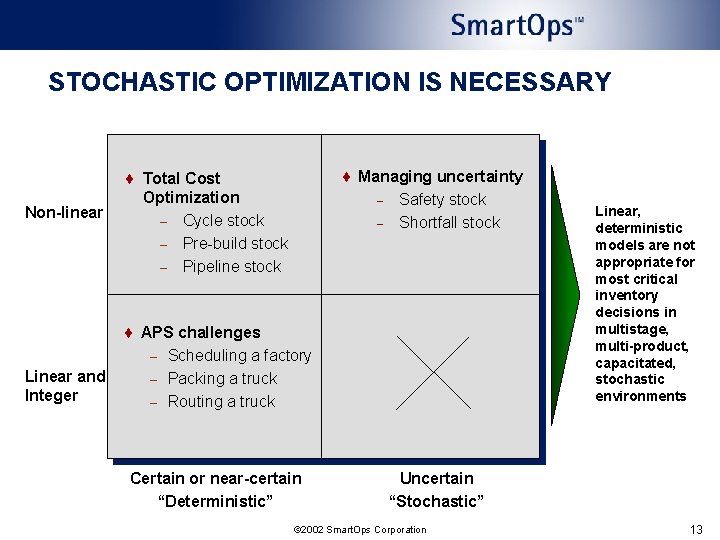
STOCHASTIC OPTIMIZATION IS NECESSARY Non-linear Linear and Integer ¨ Managing uncertainty - Safety stock - Shortfall stock ¨ Total Cost Optimization – Cycle stock – Pre-build stock – Pipeline stock ¨ APS challenges – Scheduling a factory – Packing a truck – Routing a truck Certain or near-certain “Deterministic” Linear, deterministic models are not appropriate for most critical inventory decisions in multistage, multi-product, capacitated, stochastic environments Uncertain “Stochastic” © 2002 Smart. Ops Corporation 13
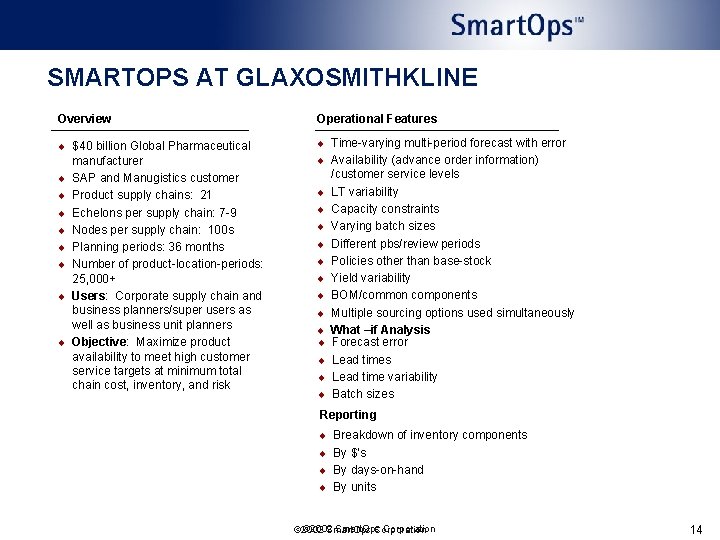
SMARTOPS AT GLAXOSMITHKLINE Overview Operational Features ¨ $40 billion Global Pharmaceutical ¨ Time-varying multi-period forecast with error ¨ ¨ ¨ ¨ manufacturer SAP and Manugistics customer Product supply chains: 21 Echelons per supply chain: 7 -9 Nodes per supply chain: 100 s Planning periods: 36 months Number of product-location-periods: 25, 000+ Users: Corporate supply chain and business planners/super users as well as business unit planners Objective: Maximize product availability to meet high customer service targets at minimum total chain cost, inventory, and risk ¨ Availability (advance order information) ¨ ¨ ¨ ¨ /customer service levels LT variability Capacity constraints Varying batch sizes Different pbs/review periods Policies other than base-stock Yield variability BOM/common components Multiple sourcing options used simultaneously What –if Analysis Forecast error Lead times Lead time variability Batch sizes Reporting ¨ Breakdown of inventory components ¨ By $’s ¨ By days-on-hand ¨ By units © 2002 Smart. Ops Corporation 14
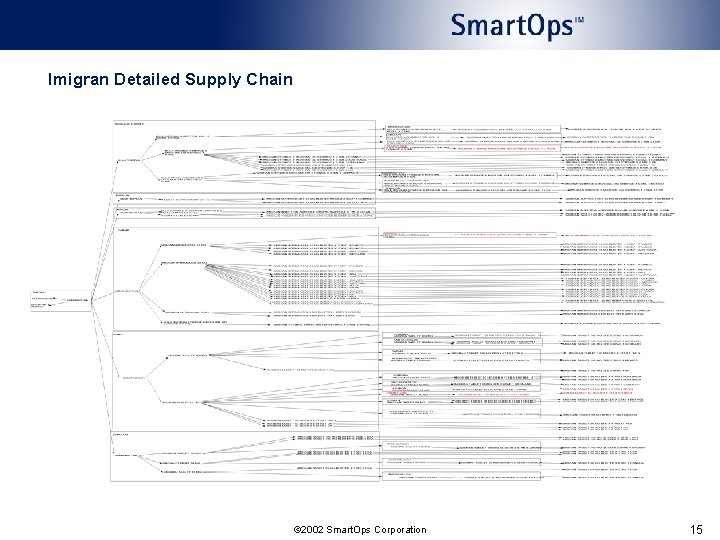
Imigran Detailed Supply Chain © 2002 Smart. Ops Corporation 15
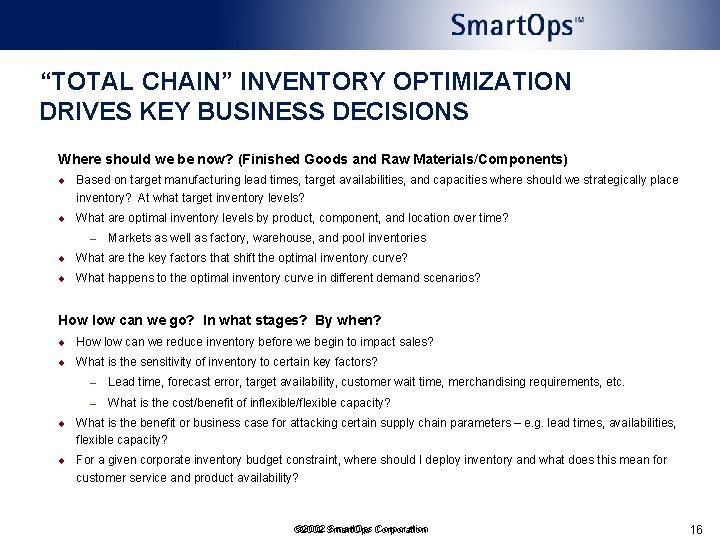
“TOTAL CHAIN” INVENTORY OPTIMIZATION DRIVES KEY BUSINESS DECISIONS Where should we be now? (Finished Goods and Raw Materials/Components) ¨ Based on target manufacturing lead times, target availabilities, and capacities where should we strategically place inventory? At what target inventory levels? ¨ What are optimal inventory levels by product, component, and location over time? – Markets as well as factory, warehouse, and pool inventories ¨ What are the key factors that shift the optimal inventory curve? ¨ What happens to the optimal inventory curve in different demand scenarios? How low can we go? In what stages? By when? ¨ How low can we reduce inventory before we begin to impact sales? ¨ What is the sensitivity of inventory to certain key factors? – Lead time, forecast error, target availability, customer wait time, merchandising requirements, etc. – What is the cost/benefit of inflexible/flexible capacity? ¨ What is the benefit or business case for attacking certain supply chain parameters – e. g. lead times, availabilities, flexible capacity? ¨ For a given corporate inventory budget constraint, where should I deploy inventory and what does this mean for customer service and product availability? © 2002 Smart. Ops Corporation © 2002 16
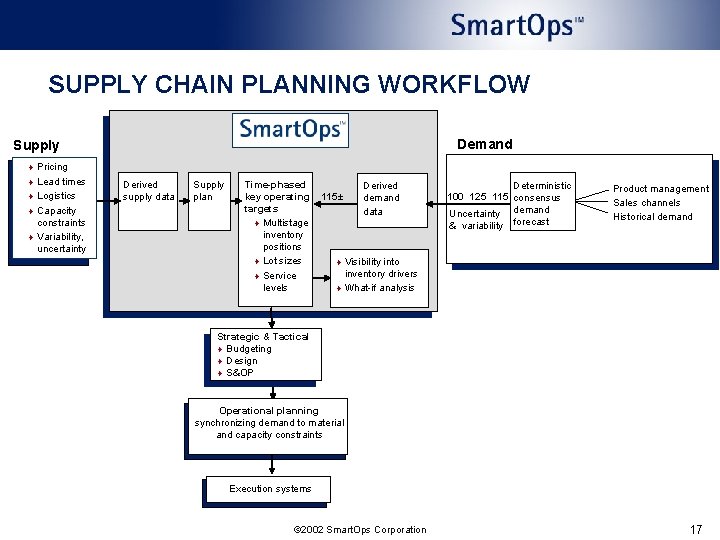
SUPPLY CHAIN PLANNING WORKFLOW Demand Supply ¨ Pricing ¨ Lead times ¨ Logistics ¨ Capacity constraints ¨ Variability, uncertainty Derived supply data Supply plan Time-phased key operating targets ¨ Multistage inventory positions ¨ Lot sizes ¨ Service levels 115± Derived demand data Deterministic 100 125 115 consensus Uncertainty demand & variability forecast Product management Sales channels Historical demand ¨ Visibility into inventory drivers ¨ What-if analysis Strategic & Tactical ¨ Budgeting ¨ Design ¨ S&OP Operational planning synchronizing demand to material and capacity constraints Execution systems © 2002 Smart. Ops Corporation 17
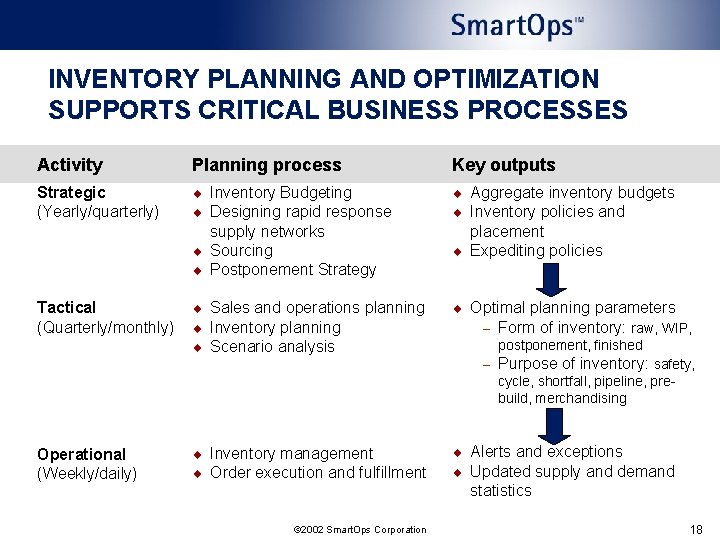
INVENTORY PLANNING AND OPTIMIZATION SUPPORTS CRITICAL BUSINESS PROCESSES Activity Planning process Key outputs Strategic (Yearly/quarterly) ¨ ¨ Inventory Budgeting Designing rapid response supply networks ¨ Sourcing ¨ Postponement Strategy ¨ ¨ Tactical (Quarterly/monthly) ¨ ¨ ¨ Sales and operations planning Inventory planning Scenario analysis Aggregate inventory budgets Inventory policies and placement ¨ Expediting policies ¨ Optimal planning parameters – Form of inventory: raw, WIP, postponement, finished – Purpose of inventory: safety, cycle, shortfall, pipeline, prebuild, merchandising Operational (Weekly/daily) ¨ ¨ Inventory management Order execution and fulfillment © 2002 Smart. Ops Corporation ¨ ¨ Alerts and exceptions Updated supply and demand statistics 18
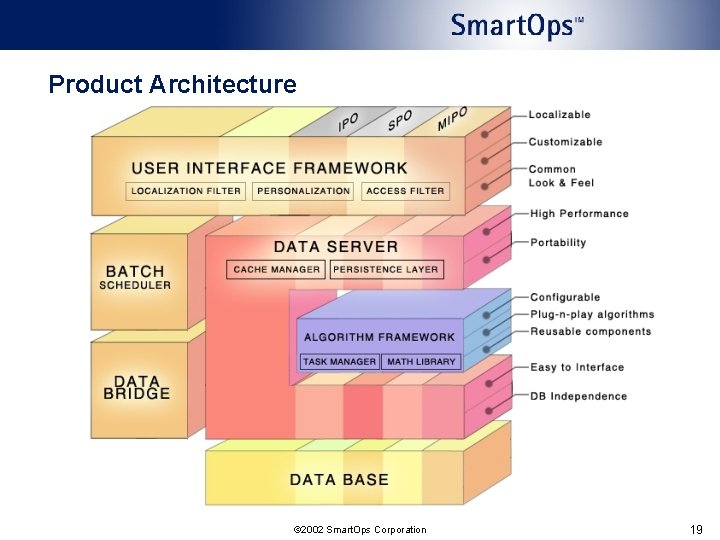
Product Architecture © 2002 Smart. Ops Corporation 19
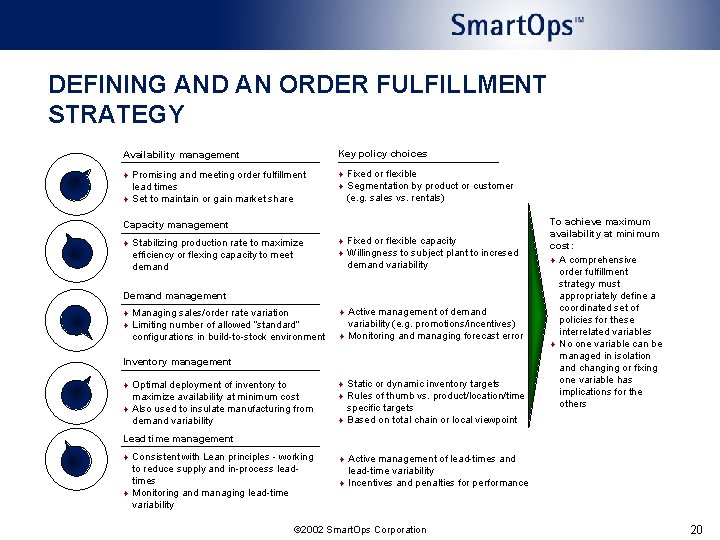
DEFINING AND AN ORDER FULFILLMENT STRATEGY Availability management Key policy choices ¨ Promising and meeting order fulfillment ¨ Fixed or flexible ¨ Segmentation by product or customer lead times ¨ Set to maintain or gain market share (e. g. sales vs. rentals) Capacity management ¨ Stabilizing production rate to maximize efficiency or flexing capacity to meet demand ¨ Fixed or flexible capacity ¨ Willingness to subject plant to incresed demand variability Demand management ¨ Managing sales/order rate variation ¨ Limiting number of allowed “standard” configurations in build-to-stock environment ¨ Active management of demand variability (e. g. promotions/incentives) ¨ Monitoring and managing forecast error Inventory management ¨ Optimal deployment of inventory to maximize availability at minimum cost ¨ Also used to insulate manufacturing from demand variability ¨ Static or dynamic inventory targets ¨ Rules of thumb vs. product/location/time specific targets To achieve maximum availability at minimum cost: ¨ A comprehensive order fulfillment strategy must appropriately define a coordinated set of policies for these interrelated variables ¨ No one variable can be managed in isolation and changing or fixing one variable has implications for the others ¨ Based on total chain or local viewpoint Lead time management ¨ Consistent with Lean principles - working to reduce supply and in-process leadtimes ¨ Monitoring and managing lead-time variability ¨ Active management of lead-times and lead-time variability ¨ Incentives and penalties for performance © 2002 Smart. Ops Corporation 20
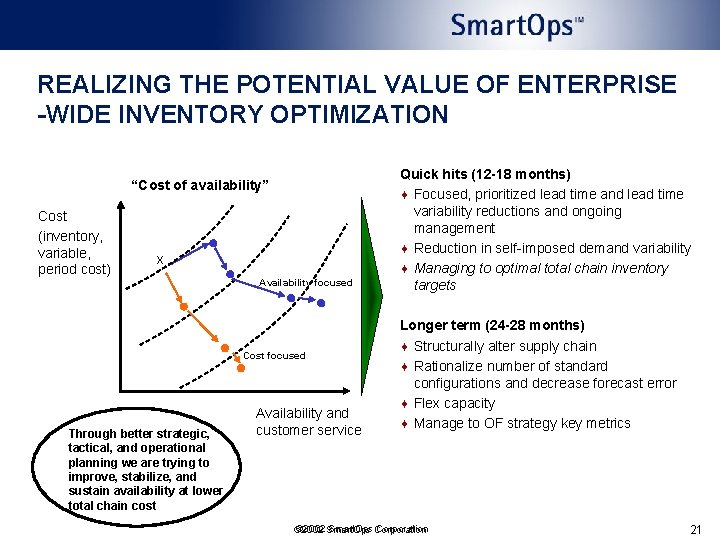
REALIZING THE POTENTIAL VALUE OF ENTERPRISE -WIDE INVENTORY OPTIMIZATION “Cost of availability” Cost (inventory, variable, period cost) x Availability focused Cost focused Through better strategic, tactical, and operational planning we are trying to improve, stabilize, and sustain availability at lower total chain cost Availability and customer service Quick hits (12 -18 months) ¨ Focused, prioritized lead time and lead time variability reductions and ongoing management ¨ Reduction in self-imposed demand variability ¨ Managing to optimal total chain inventory targets Longer term (24 -28 months) ¨ Structurally alter supply chain ¨ Rationalize number of standard configurations and decrease forecast error ¨ Flex capacity ¨ Manage to OF strategy key metrics © 2002 Smart. Ops Corporation © 2002 21
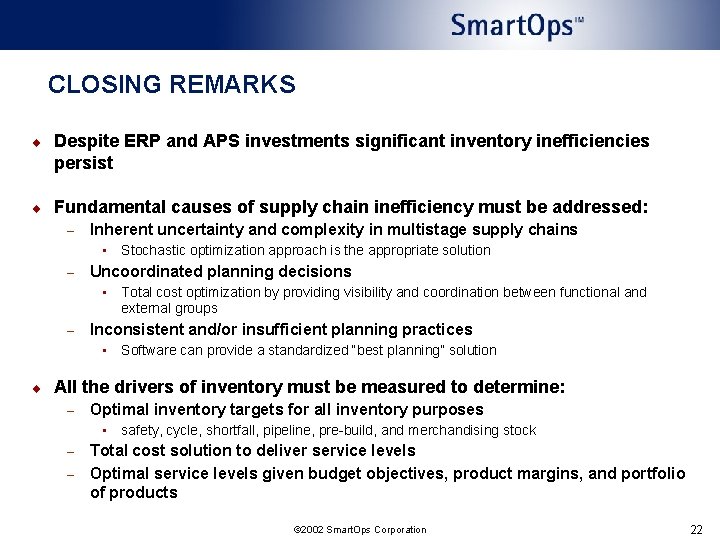
CLOSING REMARKS ¨ Despite ERP and APS investments significant inventory inefficiencies persist ¨ Fundamental causes of supply chain inefficiency must be addressed: – Inherent uncertainty and complexity in multistage supply chains • – Uncoordinated planning decisions • – Total cost optimization by providing visibility and coordination between functional and external groups Inconsistent and/or insufficient planning practices • ¨ Stochastic optimization approach is the appropriate solution Software can provide a standardized “best planning” solution All the drivers of inventory must be measured to determine: – Optimal inventory targets for all inventory purposes • safety, cycle, shortfall, pipeline, pre-build, and merchandising stock Total cost solution to deliver service levels – Optimal service levels given budget objectives, product margins, and portfolio of products – © 2002 Smart. Ops Corporation 22