
Successful Completion of CDSMP Workshops Can Session Zero

- Slides: 36
Successful Completion of CDSMP Workshops: Can Session Zero Make a Difference? November 23, 2015 Speakers: • Matthew Lee Smith, Ph. D, MPH, CHES, FAAHB, College of Public Health, The University of Georgia School of Public Health, Texas A&M Health Science Center • Christopher D. Lucero, BCH, CHES, New Mexico Department of Health • Laurie Pferr, MPA, New York State Office for the Aging • Megan Moulding Stadnisky, MA, Georgia Department of Human Services Improving the lives of 10 million older adults by 2020 © 2015 National Council on Aging 1
Successful Completion of CDSMP Workshops: Can Session Zero Make a Difference? Matthew Lee Smith, Ph. D, MPH, CHES Luohua Jiang, Ph. D Shuai Chen Sang. Nam Ahn, Ph. D, MPSA Kristie P. Kulinski, MSW Kate Lorig, Dr. PH Marcia G. Ory, Ph. D, MPH National Council on Aging
Recognition of Our Partners
Introduction to the Volume: Frontiers in Public Health http: //journal. frontiersin. org/researchtopic/2551/ evidence-based-programming-for-older-adults
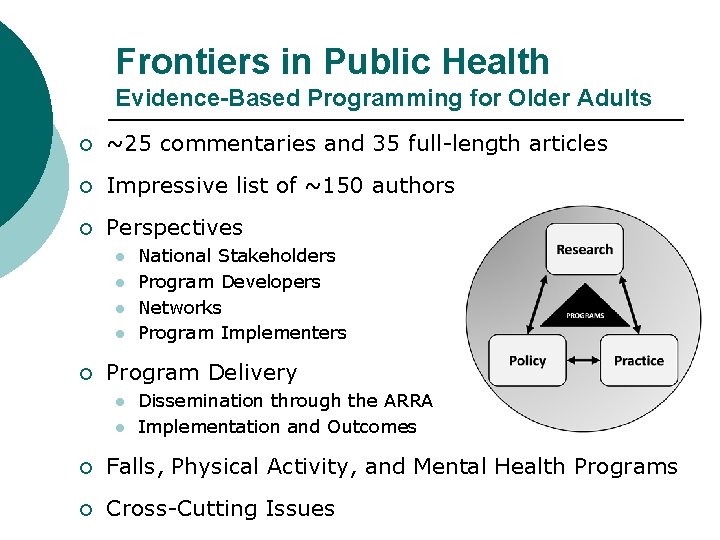
Frontiers in Public Health Evidence-Based Programming for Older Adults ¡ ~25 commentaries and 35 full-length articles ¡ Impressive list of ~150 authors ¡ Perspectives l l ¡ National Stakeholders Program Developers Networks Program Implementers Program Delivery l l Dissemination through the ARRA Implementation and Outcomes ¡ Falls, Physical Activity, and Mental Health Programs ¡ Cross-Cutting Issues
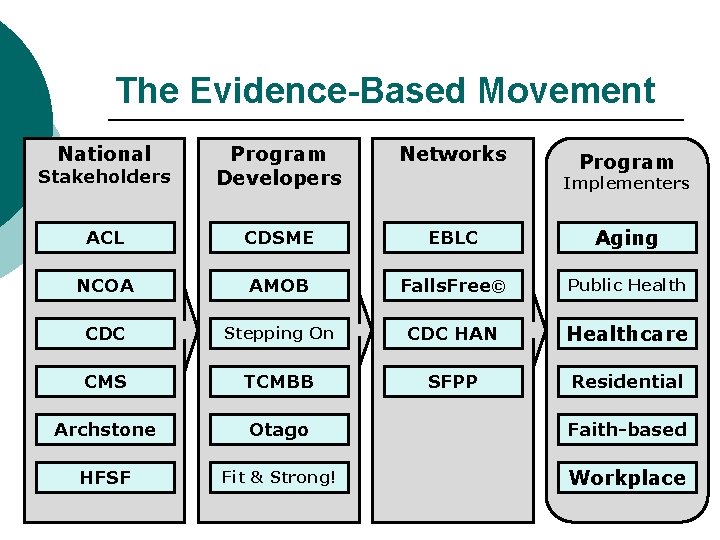
The Evidence-Based Movement National Stakeholders Program Developers Networks ACL CDSME EBLC Aging NCOA AMOB Falls. Free© Public Health CDC Stepping On CDC HAN Healthcare CMS TCMBB SFPP Residential Archstone Otago Faith-based HFSF Fit & Strong! Workplace Program Implementers
Successful Completion of CDSMP Workshops: Can Session Zero Make a Difference?
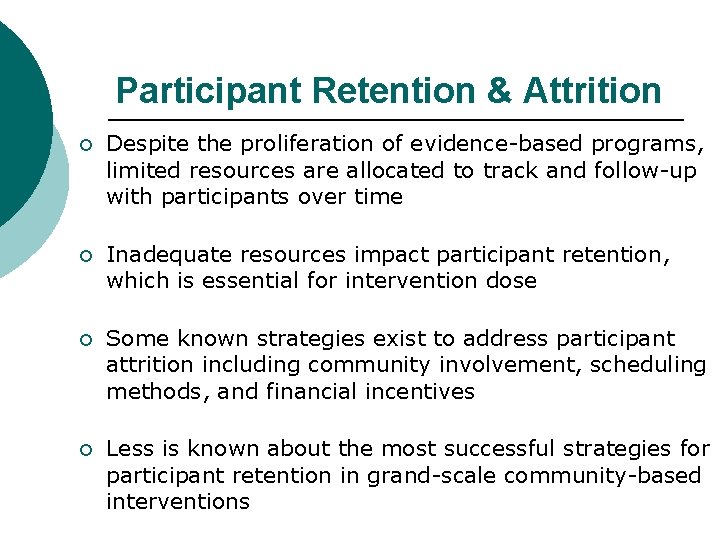
Participant Retention & Attrition ¡ Despite the proliferation of evidence-based programs, limited resources are allocated to track and follow-up with participants over time ¡ Inadequate resources impact participant retention, which is essential for intervention dose ¡ Some known strategies exist to address participant attrition including community involvement, scheduling methods, and financial incentives ¡ Less is known about the most successful strategies for participant retention in grand-scale community-based interventions
Session Zero ¡ Non-required, additional workshops ¡ An information session offered prior to Session One as a marketing tool (or recruitment event) ¡ Provides an overview of the workshop, explains expectations for workshop participation, and confirms commitment of those who are interested in or have already registered for a workshop ¡ Serves as an opportunity to collect baseline data from participants to alleviate administrative burden on workshop instructors ¡ Ensures time is not taken away from Session One of the workshop
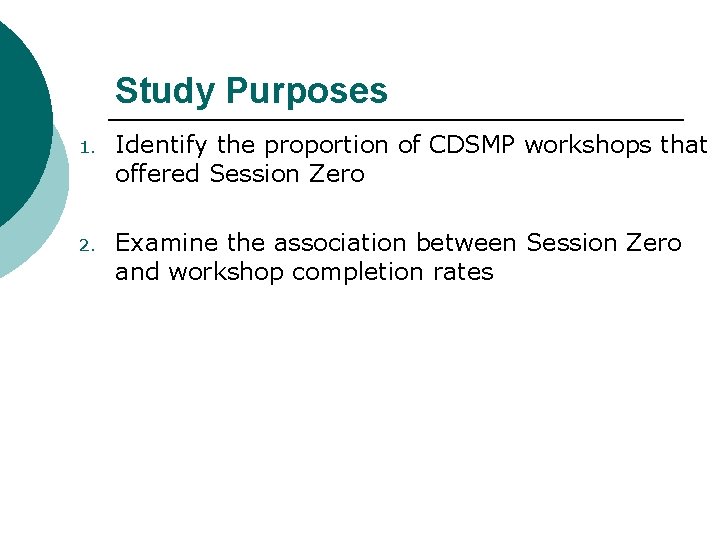
Study Purposes 1. Identify the proportion of CDSMP workshops that offered Session Zero 2. Examine the association between Session Zero and workshop completion rates
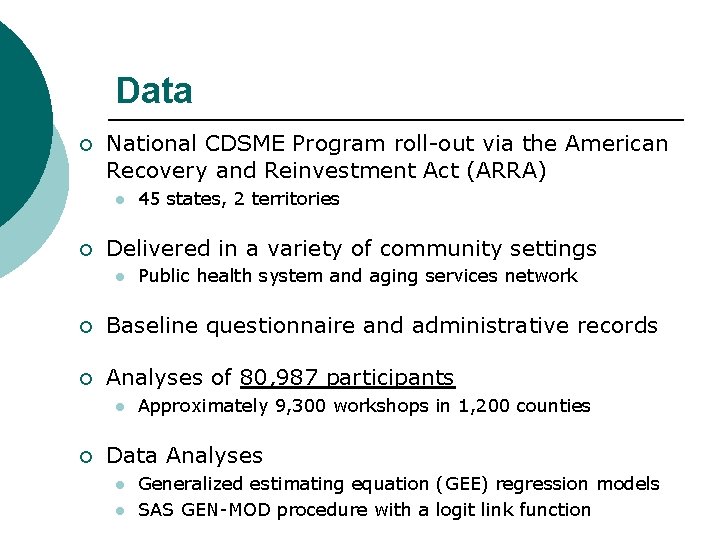
Data ¡ National CDSME Program roll-out via the American Recovery and Reinvestment Act (ARRA) l ¡ 45 states, 2 territories Delivered in a variety of community settings l Public health system and aging services network ¡ Baseline questionnaire and administrative records ¡ Analyses of 80, 987 participants l ¡ Approximately 9, 300 workshops in 1, 200 counties Data Analyses l l Generalized estimating equation (GEE) regression models SAS GEN-MOD procedure with a logit link function
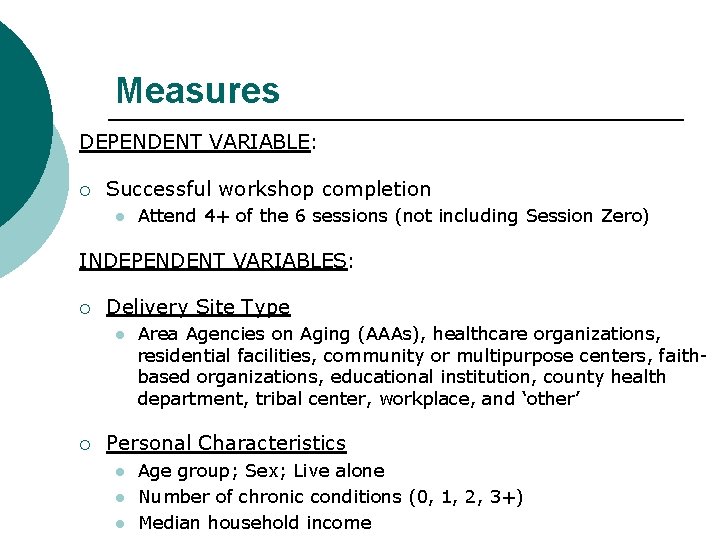
Measures DEPENDENT VARIABLE: ¡ Successful workshop completion l Attend 4+ of the 6 sessions (not including Session Zero) INDEPENDENT VARIABLES: ¡ Delivery Site Type l ¡ Area Agencies on Aging (AAAs), healthcare organizations, residential facilities, community or multipurpose centers, faithbased organizations, educational institution, county health department, tribal center, workplace, and ‘other’ Personal Characteristics l l l Age group; Sex; Live alone Number of chronic conditions (0, 1, 2, 3+) Median household income
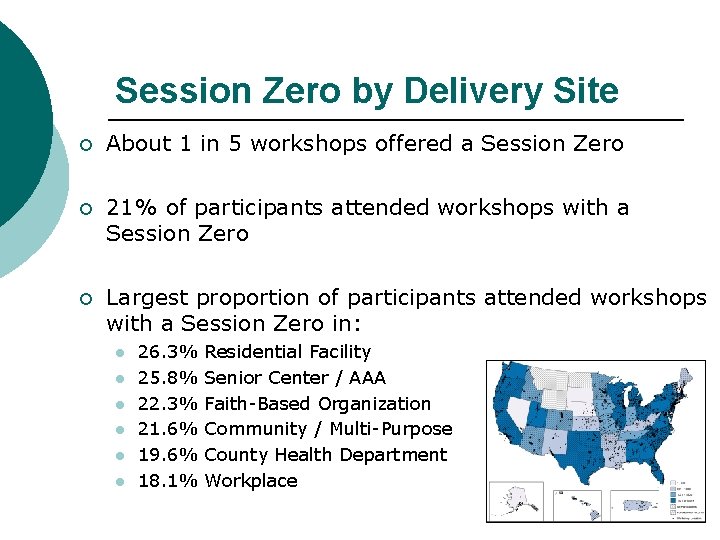
Session Zero by Delivery Site ¡ About 1 in 5 workshops offered a Session Zero ¡ 21% of participants attended workshops with a Session Zero ¡ Largest proportion of participants attended workshops with a Session Zero in: l l l 26. 3% 25. 8% 22. 3% 21. 6% 19. 6% 18. 1% Residential Facility Senior Center / AAA Faith-Based Organization Community / Multi-Purpose County Health Department Workplace
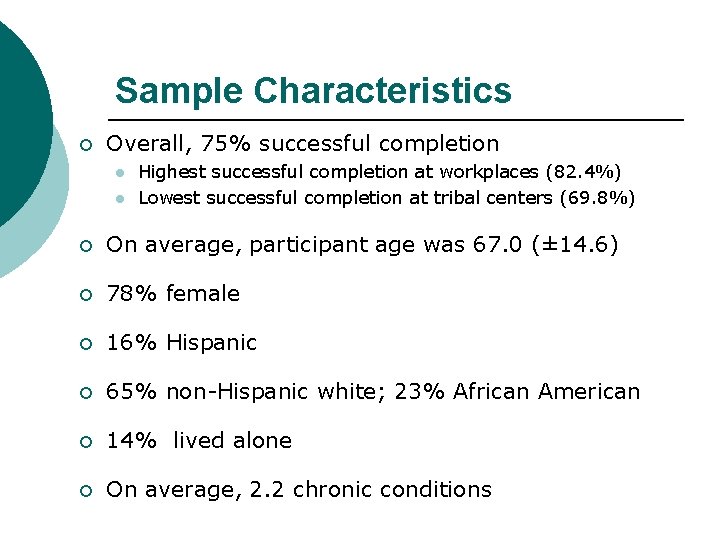
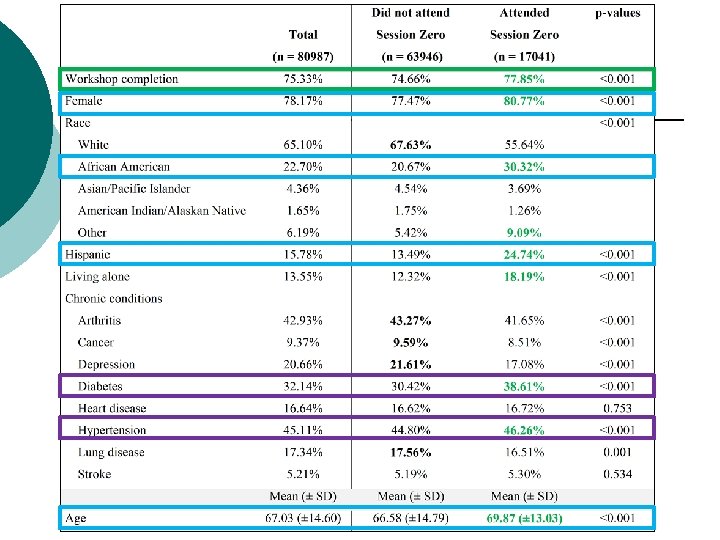
Sample Characteristics ¡ Overall, 75% successful completion l l Highest successful completion at workplaces (82. 4%) Lowest successful completion at tribal centers (69. 8%) ¡ On average, participant age was 67. 0 (± 14. 6) ¡ 78% female ¡ 16% Hispanic ¡ 65% non-Hispanic white; 23% African American ¡ 14% lived alone ¡ On average, 2. 2 chronic conditions
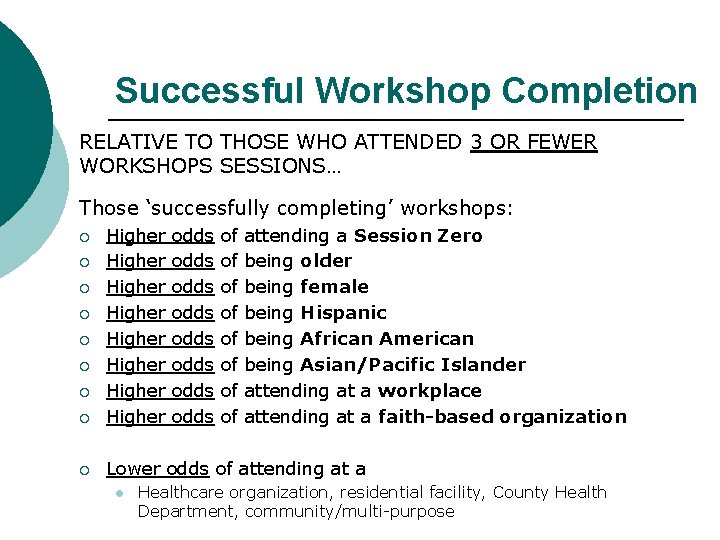
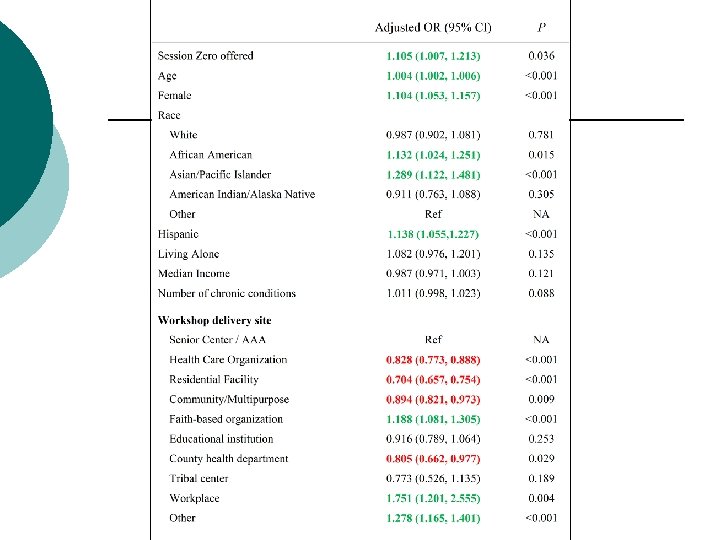
Successful Workshop Completion RELATIVE TO THOSE WHO ATTENDED 3 OR FEWER WORKSHOPS SESSIONS… Those ‘successfully completing’ workshops: ¡ Higher Higher ¡ Lower odds of attending at a ¡ ¡ ¡ ¡ l odds odds of of attending a Session Zero being older being female being Hispanic being African American being Asian/Pacific Islander attending at a workplace attending at a faith-based organization Healthcare organization, residential facility, County Health Department, community/multi-purpose
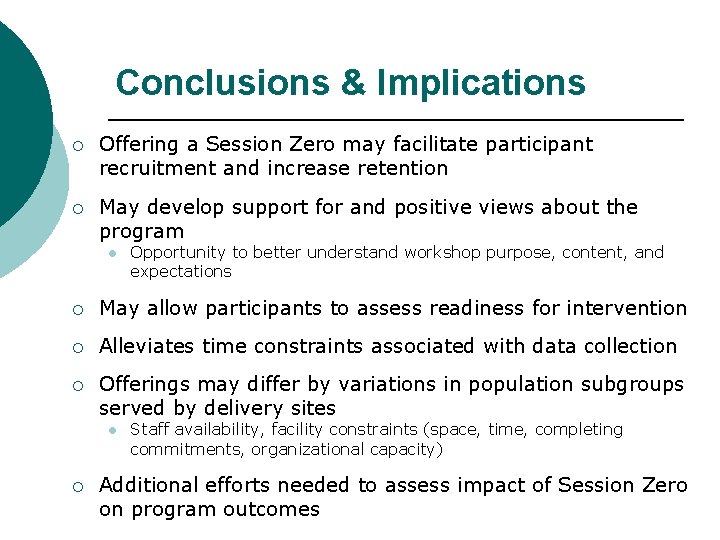
Conclusions & Implications ¡ Offering a Session Zero may facilitate participant recruitment and increase retention ¡ May develop support for and positive views about the program l Opportunity to better understand workshop purpose, content, and expectations ¡ May allow participants to assess readiness for intervention ¡ Alleviates time constraints associated with data collection ¡ Offerings may differ by variations in population subgroups served by delivery sites l ¡ Staff availability, facility constraints (space, time, completing commitments, organizational capacity) Additional efforts needed to assess impact of Session Zero on program outcomes
19 KEY DRIVERS TO SUCCESSFUL RETENTION IN NEW MEXICO Christopher D. Lucero, BCH, CHES Diabetes Prevention and Control Program National Council on Aging Webinar Monday, November 23, 2015
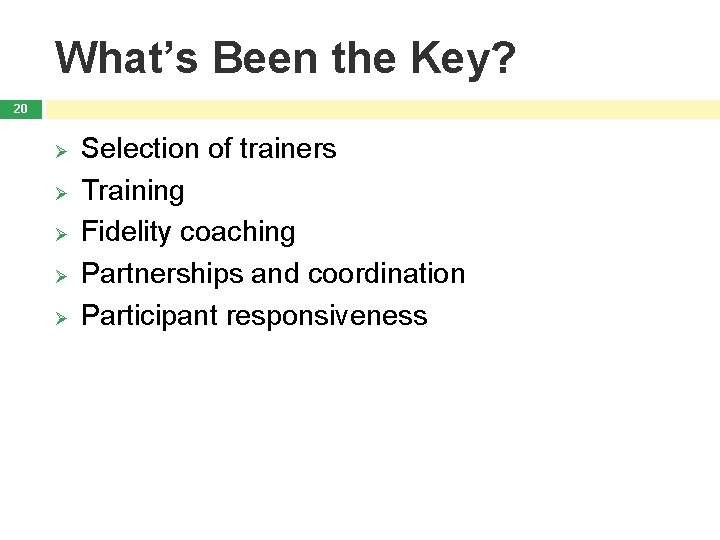
What’s Been the Key? 20 Ø Ø Ø Selection of trainers Training Fidelity coaching Partnerships and coordination Participant responsiveness
Improving Recruitment, Retention and Completion Rates - New York State Laurie Pferr, MPA, Deputy Director Policy, Planning, Program & Outcomes Division NYS Office for the Aging December 19, 2021
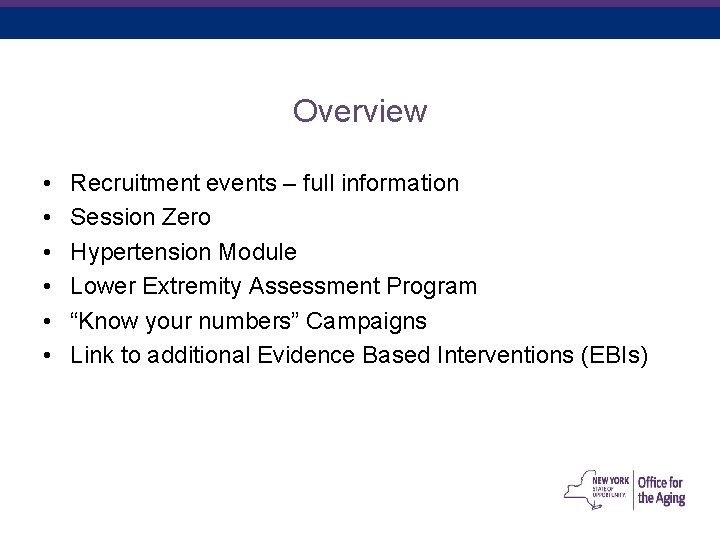
December 19, 2021 22 Overview • • • Recruitment events – full information Session Zero Hypertension Module Lower Extremity Assessment Program “Know your numbers” Campaigns Link to additional Evidence Based Interventions (EBIs)
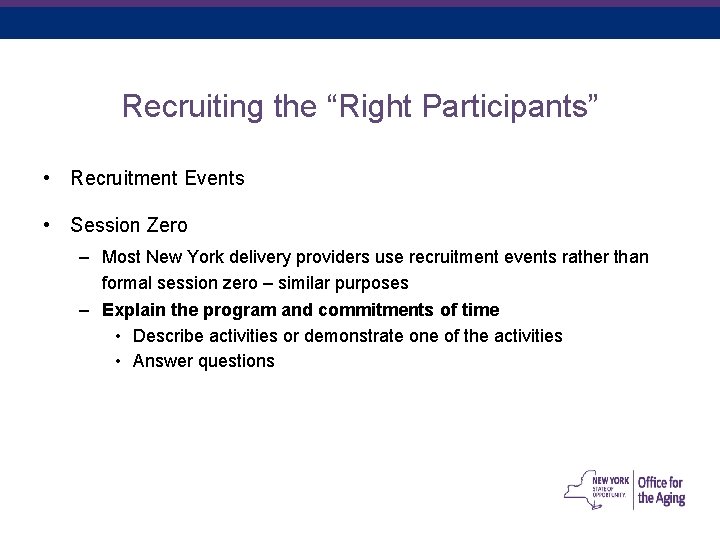
December 19, 2021 Recruiting the “Right Participants” • Recruitment Events • Session Zero – Most New York delivery providers use recruitment events rather than formal session zero – similar purposes – Explain the program and commitments of time • Describe activities or demonstrate one of the activities • Answer questions 23
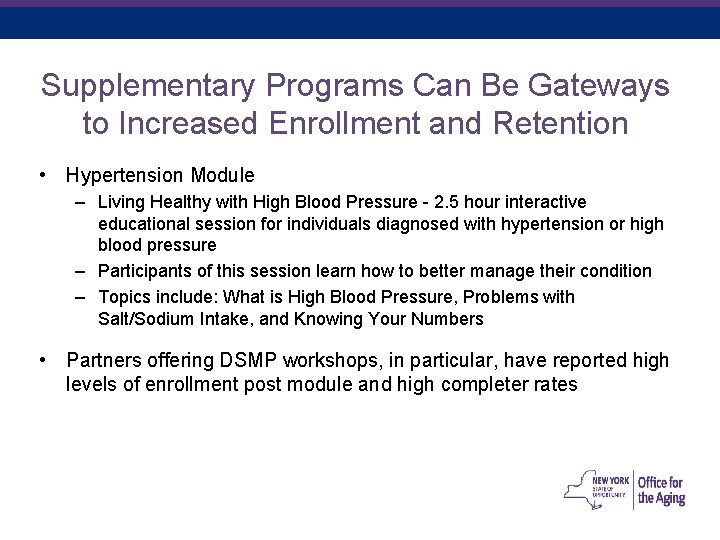
December 19, 2021 24 Supplementary Programs Can Be Gateways to Increased Enrollment and Retention • Hypertension Module – Living Healthy with High Blood Pressure - 2. 5 hour interactive educational session for individuals diagnosed with hypertension or high blood pressure – Participants of this session learn how to better manage their condition – Topics include: What is High Blood Pressure, Problems with Salt/Sodium Intake, and Knowing Your Numbers • Partners offering DSMP workshops, in particular, have reported high levels of enrollment post module and high completer rates
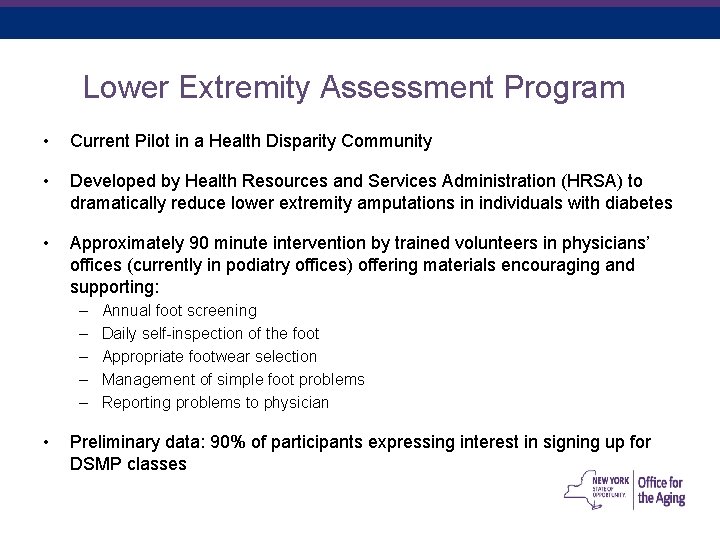
December 19, 2021 25 Lower Extremity Assessment Program • Current Pilot in a Health Disparity Community • Developed by Health Resources and Services Administration (HRSA) to dramatically reduce lower extremity amputations in individuals with diabetes • Approximately 90 minute intervention by trained volunteers in physicians’ offices (currently in podiatry offices) offering materials encouraging and supporting: – – – • Annual foot screening Daily self-inspection of the foot Appropriate footwear selection Management of simple foot problems Reporting problems to physician Preliminary data: 90% of participants expressing interest in signing up for DSMP classes
December 19, 2021 26 Linkages • “Know your numbers” Campaigns – Working with employer groups to provide opportunities to sign up for CDSME/EBIs as part of health benefits package when conducting screening campaigns for employees • Link to additional EBIs • Encouraging providers to offer multiple EBIs and to cross market additional EBIs to “completers”
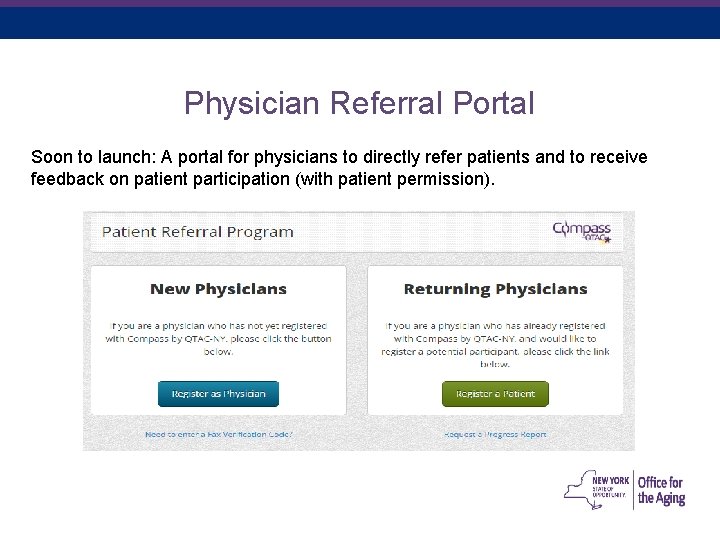
December 19, 2021 27 Physician Referral Portal Soon to launch: A portal for physicians to directly refer patients and to receive feedback on patient participation (with patient permission).
CDSME Completer Rates in Georgia Presenter: Megan Moulding Stadnisky, MA Presentation: NCOA webinar Date: November 23, 2015 Georgia Department of Human Services
Vision, Mission and Core Values Vision Stronger Families for a Stronger Georgia. Mission Strengthen Georgia by providing Individuals and Families access to services that promote self-sufficiency, independence, and protect Georgia's vulnerable children and adults. Core Values • Provide access to resources that offer support and empower Georgians and their families. • Deliver services professionally and treat all clients with dignity and respect. Manage business operations effectively and efficiently by aligning resources across the agency. • Promote accountability, transparency and quality in all services we deliver and programs we administer. • Develop our employees at all levels of the agency.
Steps to success Selling the program to host site staff Selling the program to participants Recruiting/training the right people Using Ambassadors
Selling the program to host site sta Understanding the program • All pieces They have a role in workshop success • Even as a participant Buy-in and commitment
Selling the program to participants Session Zero/recruitment session First step to self-management is choosing to attend Getting on the spot commitment – registration sheets Make contact prior to the workshop If you have a great first class, word of mouth will help it spread.
Recruiting & training the right people • If your leaders are awesome, the participants will stay • Spend more time recruiting the right people • Host an orientation prior to a training • Manage expectations
Using ambassadors • Individuals or teams who know the community • Individuals or teams who are known by the community • “I only went to the class because she asked me to”
Q&A www. ncoa. org Improving the lives of 10 million older adults by 2020 © 2015 National Council on Aging 35
Contact Information November 23, 2015 • Matthew Lee Smith College of Public Health, The University of Georgia School of Public Health, Texas A&M Health Science Center health@uga. edu • Christopher D. Lucero, New Mexico Department of Health christopher. lucero@state. nm. us • Laurie Pferr, New York State Office for the Aging laurie. pferr@aging. ny. gov • Megan Moulding Stadnisky, Georgia Department of Human Services megan. stadnisky@dhs. ga. gov Improving the lives of 10 million older adults by 2020 © 2015 National Council on Aging 36