
Successful aging and its discontents Marty Martinson Dr
- Slides: 4
Successful aging and its discontents Marty Martinson, Dr. PH Assistant Professor Dept. of Health Education
Successful aging and its discontents Successful aging as a distinction (Rowe & Kahn, 1987): Distinction between pathologic aging, normal aging, and successful aging Successful aging defined (Rowe & Kahn, 1997): 1) Avoidance of disease and disability 2) High physical and cognitive function 3) Engagement with life Successful aging critiqued (Riley, 1999) The model is “seriously incomplete. ”
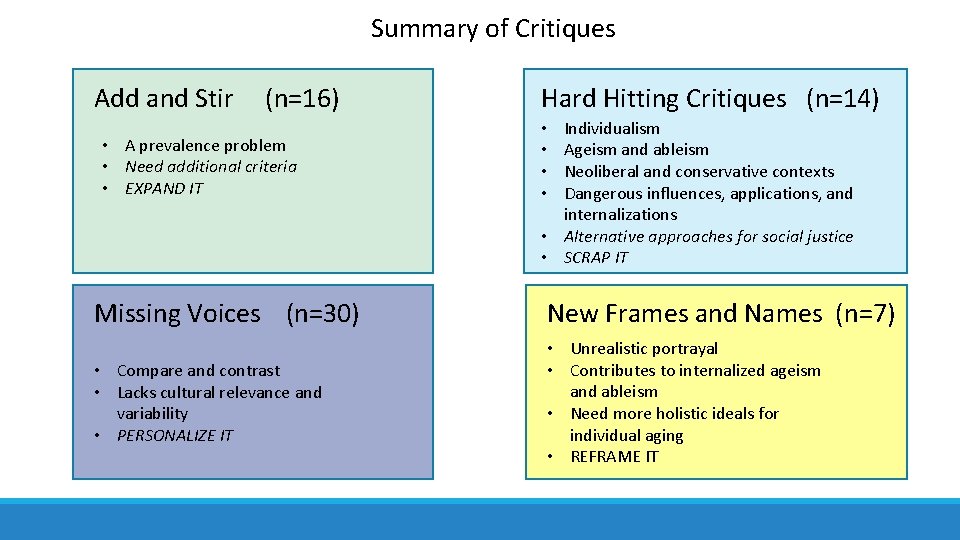
Summary of Critiques Add and Stir (n=16) • A prevalence problem • Need additional criteria • EXPAND IT Hard Hitting Critiques (n=14) Individualism Ageism and ableism Neoliberal and conservative contexts Dangerous influences, applications, and internalizations • Alternative approaches for social justice • SCRAP IT • • Missing Voices (n=30) New Frames and Names (n=7) • Compare and contrast • Lacks cultural relevance and variability • PERSONALIZE IT • Unrealistic portrayal • Contributes to internalized ageism and ableism • Need more holistic ideals for individual aging • REFRAME IT
What’s the problem? • • Unrealistic Successful vs. unsuccessful Incompatible with diverse understandings of life and aging Destructive Why are holding on to a such a problematic concept? • Funding • Neoliberal and cultural contexts Where do we go from here? “The growth of an intellectually rich social gerontology depends on the continued willingness to foster greater interactions between empirical research, interpretation, critical evaluation, and reflexive knowledge. ” 1995) (Cole,