
Successful Acquisitions Insurance Policy for Getting Required ROI
- Slides: 30
Successful Acquisitions Insurance Policy for Getting Required ROI on Acquisitions Client XYZ Date
Table of Contents I. The Track Record for Mergers & Acquisitions II. The Key to Successful Acquisitions III. Next Steps 2 8 19 Appendix: M&A Mayhem 22 generic. M&Adiscdoc. ppt 1
The Track Record for Successful Mergers and Acquisitions generic. M&Adiscdoc. ppt 2
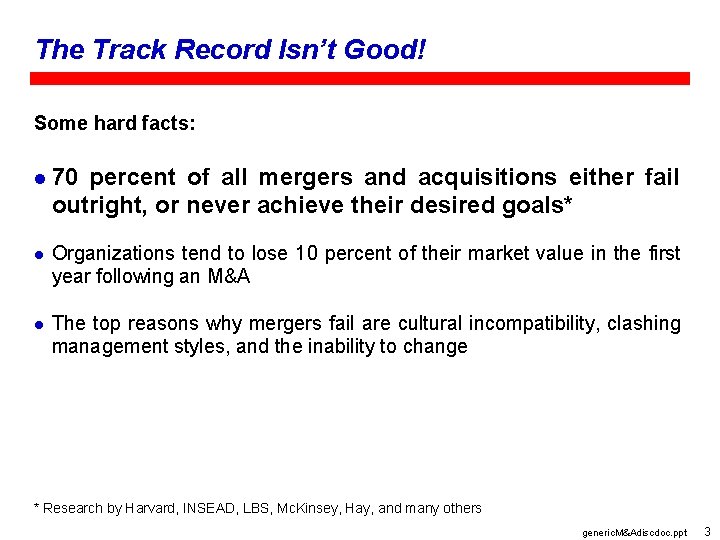
Section I Congratulations and Challenge The Track Record Isn’t Good! Some hard facts: l 70 percent of all mergers and acquisitions either fail outright, or never achieve their desired goals* l Organizations tend to lose 10 percent of their market value in the first year following an M&A l The top reasons why mergers fail are cultural incompatibility, clashing management styles, and the inability to change * Research by Harvard, INSEAD, LBS, Mc. Kinsey, Hay, and many others generic. M&Adiscdoc. ppt 3
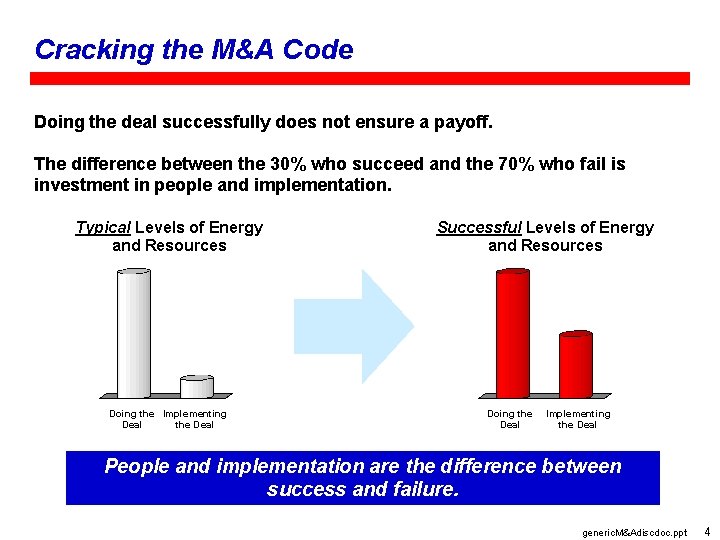
Cracking the M&A Code Doing the deal successfully does not ensure a payoff. The difference between the 30% who succeed and the 70% who fail is investment in people and implementation. Typical Levels of Energy and Resources Doing the Implementing Deal the Deal Successful Levels of Energy and Resources Doing the Deal Implementing the Deal People and implementation are the difference between success and failure. generic. M&Adiscdoc. ppt 4
Section I Congratulations and Challenge Why Do Mergers and Acquisitions Keep Failing? By now, almost everybody knows that most studies continue to show a 70% failure rate for M&As. The same studies also identify the primary reason for the failures. It is not poor planning, or a flawed strategy, or decision-making. The primary reason for failure is caused by underestimating the significance of the impact on people. Acquisition activity that focuses mainly on doing the deal and not on implementing and integrating the newly acquired company are highly predictive of failure. Successful acquisitions are achieved by a real investment in an integrated implementation with focus on the people factors. generic. M&Adiscdoc. ppt 5
The Challenge for Client XYZ l Cracking the M&A code is an essential requirement for Client XYZ—failure is not an option. l Rapid and effective assimilation of acquisitions is essential to our strategy: servicing customer base, growth, and productivity. l This is urgent: the competition has a 5 -year head start! l This is challenging: the most difficult acquisitions are those that are in the same industry or business. Each side thinks that their way of operating is the best, or they are emotionally attached to their way of doing things, such as: n n n Work processes Roles Culture Values Rewards generic. M&Adiscdoc. ppt 6
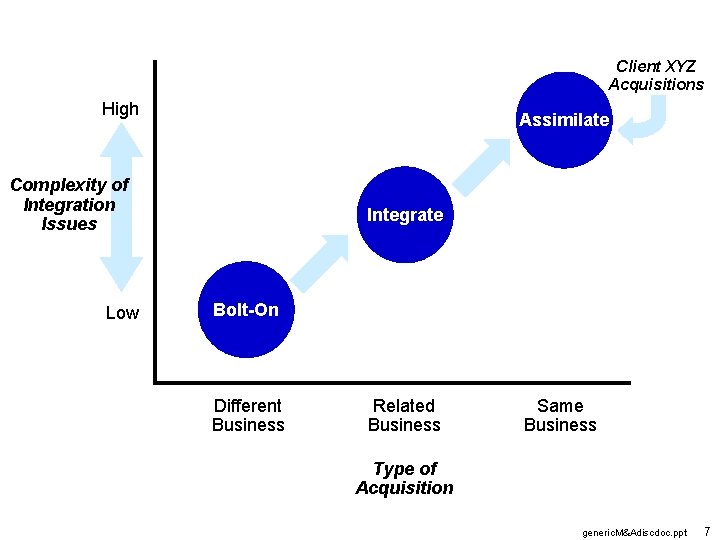
Client XYZ Acquisitions High Assimilate Complexity of Integration Issues Low Integrate Bolt-On Different Business Related Business Same Business Type of Acquisition generic. M&Adiscdoc. ppt 7
The Key to Successful Acquisitions generic. M&Adiscdoc. ppt 8
Successful M&As: Recent Research A recent survey asked some of the giants of industry— companies such as Microsoft, America Online, and Sun Microsystems—to identify critical performance gaps before, during, and after mergers and acquisitions. It also asked them to talk about their best practices—what they did differently that helped them achieve a smooth transition and rapid growth. Even experienced organizations sometimes get it wrong, and when it does go wrong, it’s always on the people side of implementation, versus the deal itself. generic. M&Adiscdoc. ppt 9
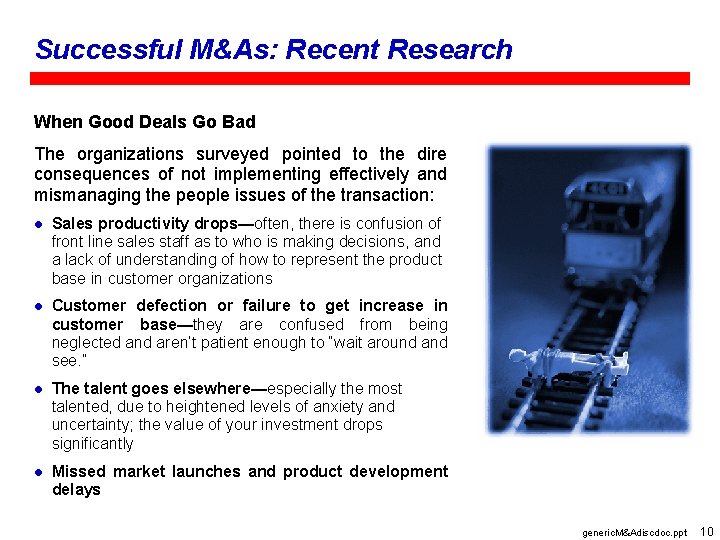
Successful M&As: Recent Research When Good Deals Go Bad The organizations surveyed pointed to the dire consequences of not implementing effectively and mismanaging the people issues of the transaction: l Sales productivity drops—often, there is confusion of front line sales staff as to who is making decisions, and a lack of understanding of how to represent the product base in customer organizations l Customer defection or failure to get increase in customer base—they are confused from being neglected and aren’t patient enough to “wait around and see. ” l The talent goes elsewhere—especially the most talented, due to heightened levels of anxiety and uncertainty; the value of your investment drops significantly l Missed market launches and product development delays generic. M&Adiscdoc. ppt 10
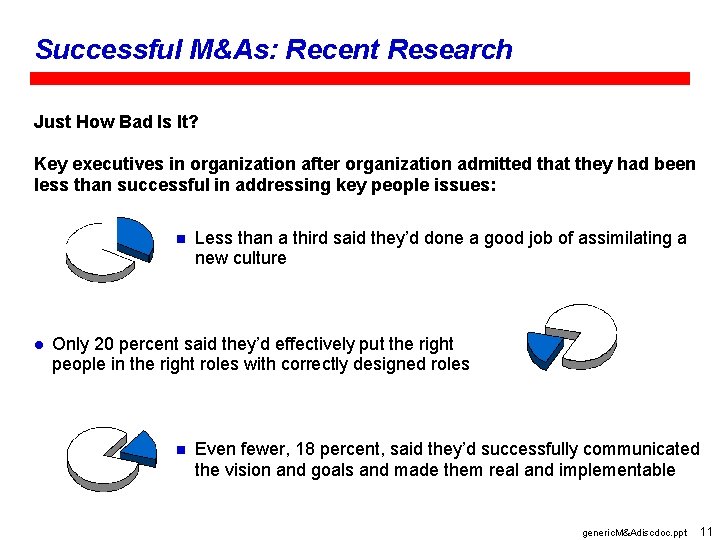
Successful M&As: Recent Research Just How Bad Is It? Key executives in organization after organization admitted that they had been less than successful in addressing key people issues: n l Less than a third said they’d done a good job of assimilating a new culture Only 20 percent said they’d effectively put the right people in the right roles with correctly designed roles n Even fewer, 18 percent, said they’d successfully communicated the vision and goals and made them real and implementable generic. M&Adiscdoc. ppt 11
It Isn’t Rocket Science! The key to successful acquisitions isn’t rocket science. Organizations know they need to deal with culture, work processes, roles, structure and reward. The issues is, they don’t know how to do it in an integrated way, with enough depth to get real and sustainable changes, or to do it quickly enough to get rapid ROI. generic. M&Adiscdoc. ppt 12
Best Practices for Successful Acquisitions The organizations that have been most successful all took a similar approach. 1. They created transitional implementation teams with the clearly defined objective of effectively guiding the organization through the change. They also used an integrated approach to change. 2. They undertook a carefully planned culture and climate due diligence in order to identify gaps between the organizations, strengths and weaknesses of each, and potential “synergy points” where the two might not only connect, but also generate rapid growth. 3. They developed a specific strategy and a variety of approaches and methodologies to deal with key people and HR issues, including assessment, selection, reward, performance management, and communication. 4. They understood that, while no two mergers or acquisitions are alike, certain general cultural and human dynamics are at work depending on the size of the partners and the objectives of the deal. 5. They realized they had a very small window of opportunity— typically a year or less—in which to make the deal work successfully. generic. M&Adiscdoc. ppt 13
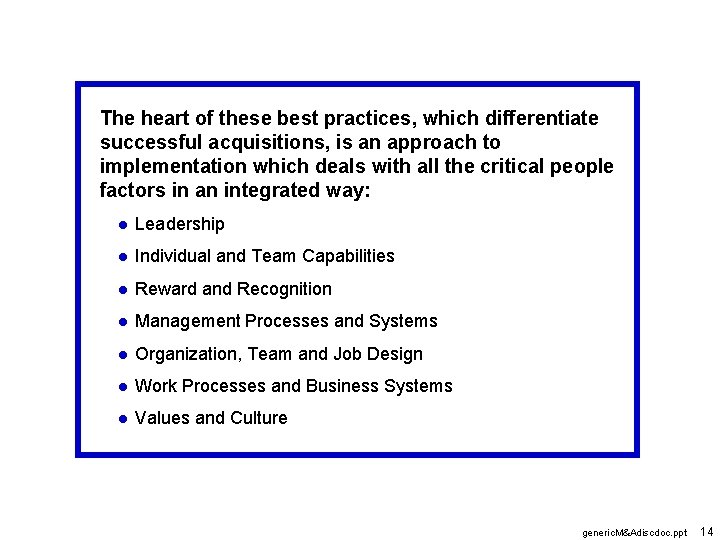
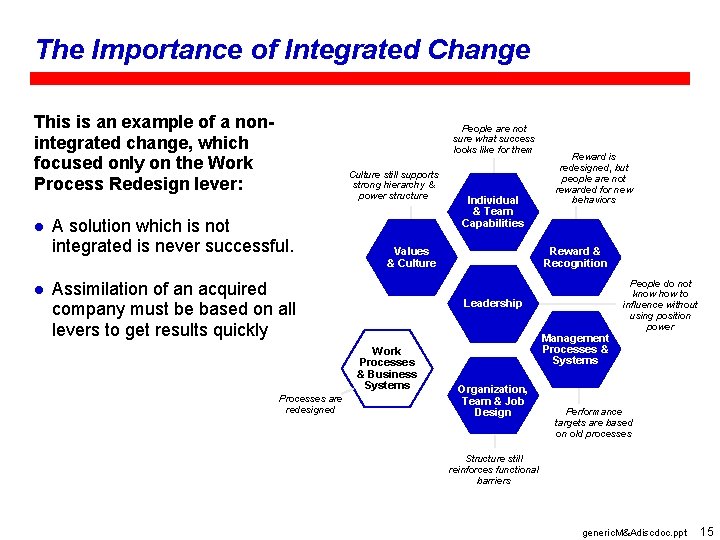
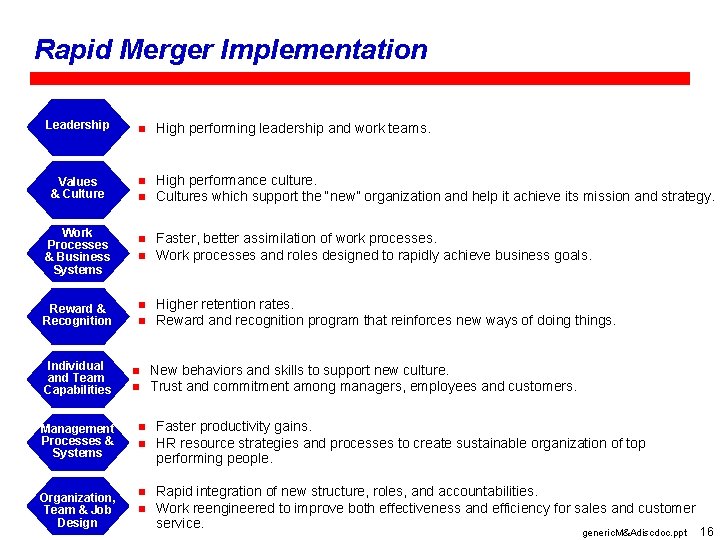
The heart of these best practices, which differentiate successful acquisitions, is an approach to implementation which deals with all the critical people factors in an integrated way: l Leadership l Individual and Team Capabilities l Reward and Recognition l Management Processes and Systems l Organization, Team and Job Design l Work Processes and Business Systems l Values and Culture generic. M&Adiscdoc. ppt 14
The Importance of Integrated Change This is an example of a nonintegrated change, which focused only on the Work Process Redesign lever: l l People are not sure what success looks like for them Culture still supports strong hierarchy & power structure A solution which is not integrated is never successful. Values & Culture Assimilation of an acquired company must be based on all levers to get results quickly Reward & Recognition Leadership Work Processes & Business Systems Processes are redesigned Individual & Team Capabilities Reward is redesigned, but people are not rewarded for new behaviors Management Processes & Systems Organization, Team & Job Design People do not know how to influence without using position power Performance targets are based on old processes Structure still reinforces functional barriers generic. M&Adiscdoc. ppt 15
Rapid Merger Implementation Leadership n High performing leadership and work teams. Values & Culture n High performance culture. Cultures which support the “new” organization and help it achieve its mission and strategy. Work Processes & Business Systems Reward & Recognition Individual and Team Capabilities n n n n Management Processes & Systems n Organization, Team & Job Design n Faster, better assimilation of work processes. Work processes and roles designed to rapidly achieve business goals. Higher retention rates. Reward and recognition program that reinforces new ways of doing things. New behaviors and skills to support new culture. Trust and commitment among managers, employees and customers. Faster productivity gains. HR resource strategies and processes to create sustainable organization of top performing people. Rapid integration of new structure, roles, and accountabilities. Work reengineered to improve both effectiveness and efficiency for sales and customer service. generic. M&Adiscdoc. ppt 16
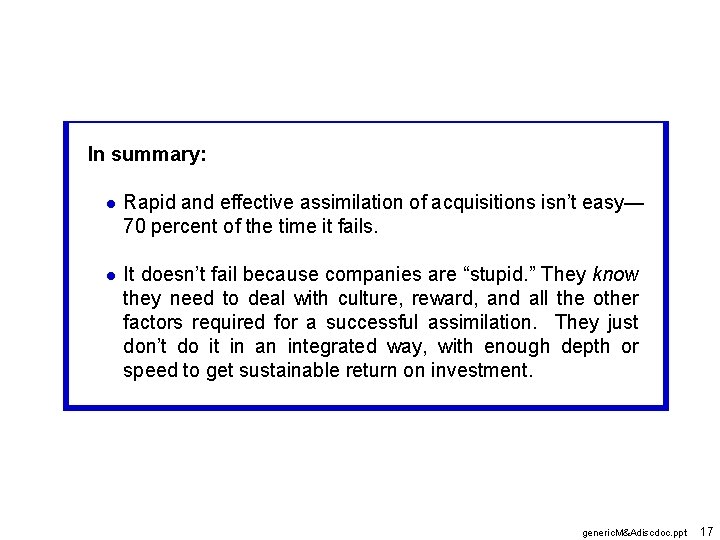
In summary: l Rapid and effective assimilation of acquisitions isn’t easy— 70 percent of the time it fails. l It doesn’t fail because companies are “stupid. ” They know they need to deal with culture, reward, and all the other factors required for a successful assimilation. They just don’t do it in an integrated way, with enough depth or speed to get sustainable return on investment. generic. M&Adiscdoc. ppt 17
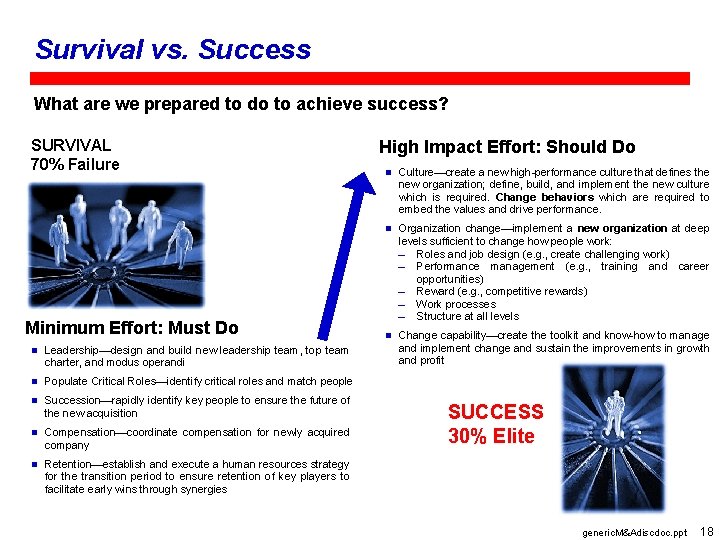
Survival vs. Success What are we prepared to do to achieve success? SURVIVAL 70% Failure Minimum Effort: Must Do n Leadership—design and build new leadership team, top team charter, and modus operandi n Populate Critical Roles—identify critical roles and match people n Succession—rapidly identify key people to ensure the future of the new acquisition n Compensation—coordinate compensation for newly acquired company n Retention—establish and execute a human resources strategy for the transition period to ensure retention of key players to facilitate early wins through synergies High Impact Effort: Should Do n Culture—create a new high-performance culture that defines the new organization; define, build, and implement the new culture which is required. Change behaviors which are required to embed the values and drive performance. n Organization change—implement a new organization at deep levels sufficient to change how people work: – Roles and job design (e. g. , create challenging work) – Performance management (e. g. , training and career opportunities) – Reward (e. g. , competitive rewards) – Work processes – Structure at all levels n Change capability—create the toolkit and know-how to manage and implement change and sustain the improvements in growth and profit SUCCESS 30% Elite generic. M&Adiscdoc. ppt 18
Next Steps generic. M&Adiscdoc. ppt 19
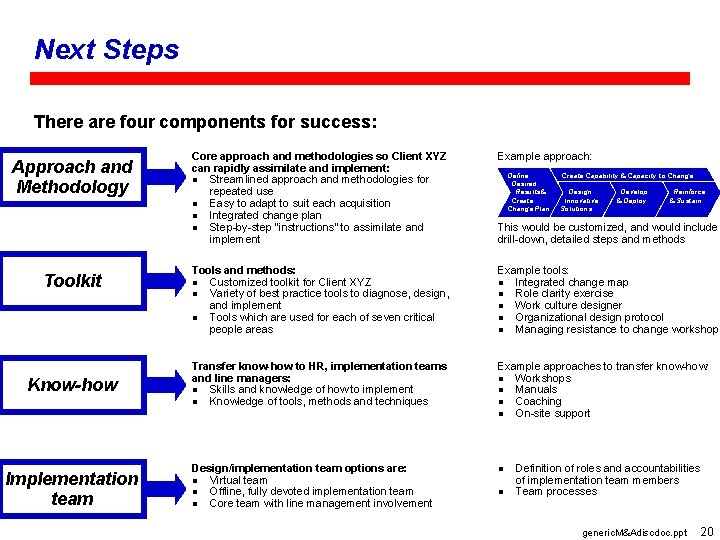
Next Steps There are four components for success: Approach and Methodology Toolkit Know-how Implementation team Core approach and methodologies so Client XYZ can rapidly assimilate and implement: n Streamlined approach and methodologies for repeated use n Easy to adapt to suit each acquisition n Integrated change plan n Step-by-step “instructions” to assimilate and implement Example approach: Tools and methods: n Customized toolkit for Client XYZ n Variety of best practice tools to diagnose, design, and implement n Tools which are used for each of seven critical people areas Example tools: n Integrated change map n Role clarity exercise n Work culture designer n Organizational design protocol n Managing resistance to change workshop Transfer know-how to HR, implementation teams and line managers: n Skills and knowledge of how to implement n Knowledge of tools, methods and techniques Example approaches to transfer know-how: n Workshops n Manuals n Coaching n On-site support Design/implementation team options are: n Virtual team n Offline, fully devoted implementation team n Core team with line management involvement Define Desired Results& Create Change Plan Create Capability & Capacity to Change Design Innovative Solutions Develop & Deploy Reinforce & Sustain This would be customized, and would include drill-down, detailed steps and methods n n Definition of roles and accountabilities of implementation team members Team processes generic. M&Adiscdoc. ppt 20
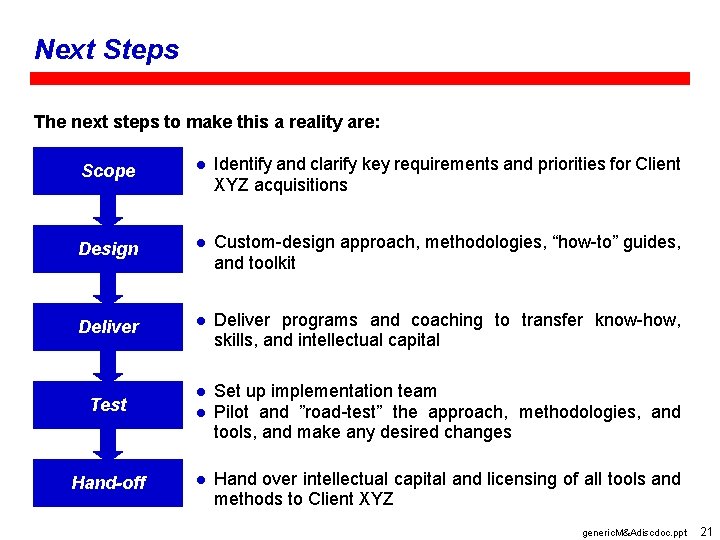
Next Steps The next steps to make this a reality are: Scope l Identify and clarify key requirements and priorities for Client XYZ acquisitions Design l Custom-design approach, methodologies, “how-to” guides, and toolkit Deliver l Deliver programs and coaching to transfer know-how, skills, and intellectual capital l Set up implementation team Pilot and ”road-test” the approach, methodologies, and tools, and make any desired changes Test Hand-off l l Hand over intellectual capital and licensing of all tools and methods to Client XYZ generic. M&Adiscdoc. ppt 21
Appendix: M&A Mayhem generic. M&Adiscdoc. ppt 22
Here’s what happens when the people levers are not addressed. . . Stories of the Good and the Bad generic. M&Adiscdoc. ppt 23
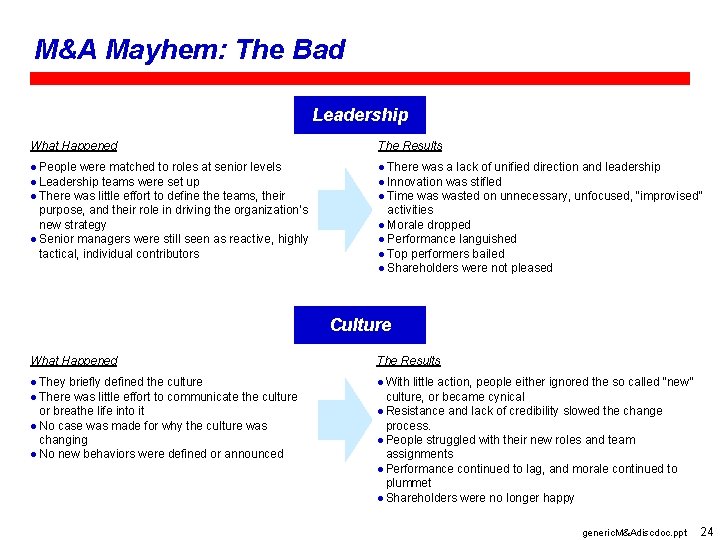
M&A Mayhem: The Bad Leadership What Happened The Results People were matched to roles at senior levels l Leadership teams were set up l There was little effort to define the teams, their purpose, and their role in driving the organization’s new strategy l Senior managers were still seen as reactive, highly tactical, individual contributors l l There was a lack of unified direction and leadership l Innovation was stifled l Time wasted on unnecessary, unfocused, “improvised” activities l Morale dropped l Performance languished l Top performers bailed l Shareholders were not pleased Culture What Happened The Results They briefly defined the culture l There was little effort to communicate the culture or breathe life into it l No case was made for why the culture was changing l No new behaviors were defined or announced l l With little action, people either ignored the so called “new” culture, or became cynical l Resistance and lack of credibility slowed the change process. l People struggled with their new roles and team assignments l Performance continued to lag, and morale continued to plummet l Shareholders were no longer happy generic. M&Adiscdoc. ppt 24
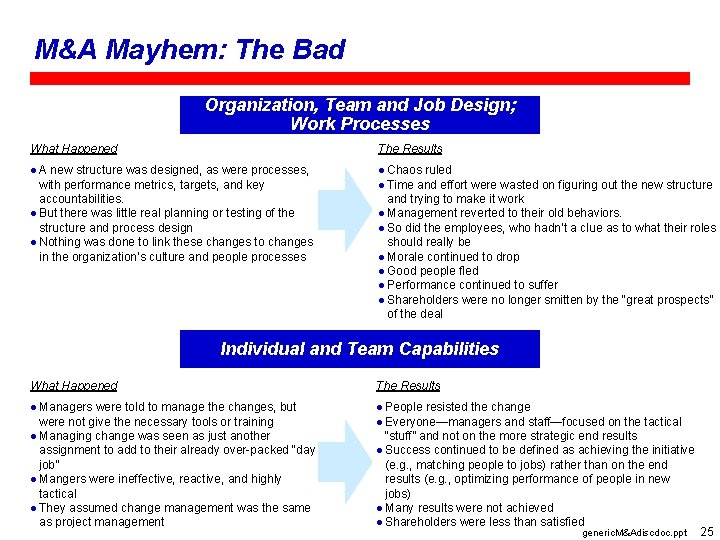
M&A Mayhem: The Bad Organization, Team and Job Design; Work Processes What Happened The Results A new structure was designed, as were processes, with performance metrics, targets, and key accountabilities. l But there was little real planning or testing of the structure and process design l Nothing was done to link these changes to changes in the organization’s culture and people processes l l Chaos ruled l Time and effort were wasted on figuring out the new structure and trying to make it work l Management reverted to their old behaviors. l So did the employees, who hadn’t a clue as to what their roles should really be l Morale continued to drop l Good people fled l Performance continued to suffer l Shareholders were no longer smitten by the “great prospects” of the deal Individual and Team Capabilities What Happened The Results Managers were told to manage the changes, but were not give the necessary tools or training l Managing change was seen as just another assignment to add to their already over-packed “day job” l Mangers were ineffective, reactive, and highly tactical l They assumed change management was the same as project management l l People resisted the change l Everyone—managers and staff—focused on the tactical “stuff” and not on the more strategic end results l Success continued to be defined as achieving the initiative (e. g. , matching people to jobs) rather than on the end results (e. g. , optimizing performance of people in new jobs) l Many results were not achieved l Shareholders were less than satisfied generic. M&Adiscdoc. ppt 25
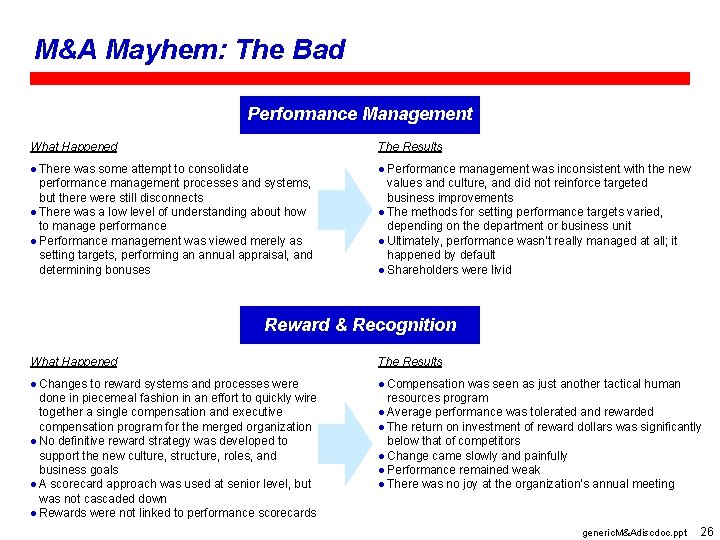
M&A Mayhem: The Bad Performance Management What Happened The Results There was some attempt to consolidate performance management processes and systems, but there were still disconnects l There was a low level of understanding about how to manage performance l Performance management was viewed merely as setting targets, performing an annual appraisal, and determining bonuses l l Performance management was inconsistent with the new values and culture, and did not reinforce targeted business improvements l The methods for setting performance targets varied, depending on the department or business unit l Ultimately, performance wasn’t really managed at all; it happened by default l Shareholders were livid Reward & Recognition What Happened The Results Changes to reward systems and processes were done in piecemeal fashion in an effort to quickly wire together a single compensation and executive compensation program for the merged organization l No definitive reward strategy was developed to support the new culture, structure, roles, and business goals l A scorecard approach was used at senior level, but was not cascaded down l Rewards were not linked to performance scorecards l l Compensation was seen as just another tactical human resources program l Average performance was tolerated and rewarded l The return on investment of reward dollars was significantly below that of competitors l Change came slowly and painfully l Performance remained weak l There was no joy at the organization’s annual meeting generic. M&Adiscdoc. ppt 26
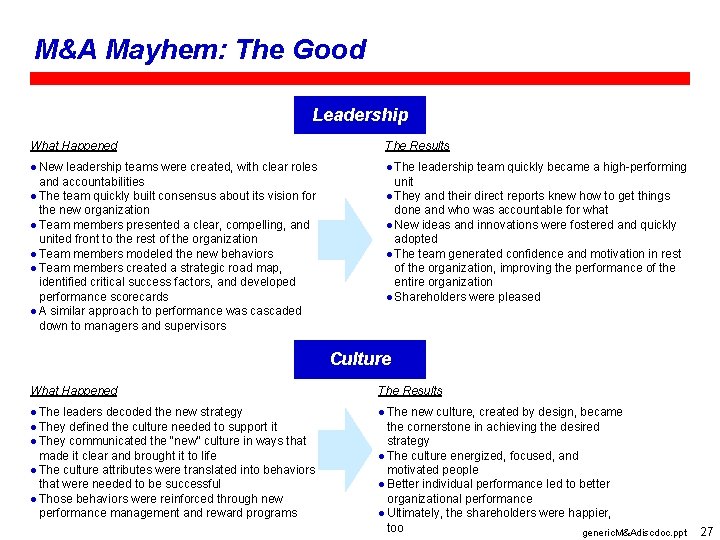
M&A Mayhem: The Good Leadership What Happened The Results New leadership teams were created, with clear roles and accountabilities l The team quickly built consensus about its vision for the new organization l Team members presented a clear, compelling, and united front to the rest of the organization l Team members modeled the new behaviors l Team members created a strategic road map, identified critical success factors, and developed performance scorecards l A similar approach to performance was cascaded down to managers and supervisors l The leadership team quickly became a high-performing unit l They and their direct reports knew how to get things done and who was accountable for what l New ideas and innovations were fostered and quickly adopted l The team generated confidence and motivation in rest of the organization, improving the performance of the entire organization l Shareholders were pleased l Culture What Happened The Results The leaders decoded the new strategy They defined the culture needed to support it l They communicated the “new” culture in ways that made it clear and brought it to life l The culture attributes were translated into behaviors that were needed to be successful l Those behaviors were reinforced through new performance management and reward programs l l l The new culture, created by design, became the cornerstone in achieving the desired strategy l The culture energized, focused, and motivated people l Better individual performance led to better organizational performance l Ultimately, the shareholders were happier, too generic. M&Adiscdoc. ppt 27
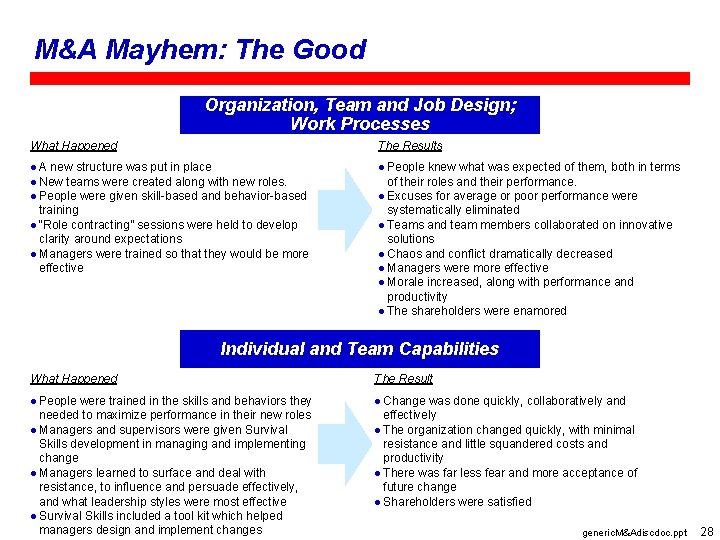
M&A Mayhem: The Good Organization, Team and Job Design; Work Processes What Happened The Results A new structure was put in place l New teams were created along with new roles. l People were given skill-based and behavior-based training l “Role contracting” sessions were held to develop clarity around expectations l Managers were trained so that they would be more effective l l People knew what was expected of them, both in terms of their roles and their performance. l Excuses for average or poor performance were systematically eliminated l Teams and team members collaborated on innovative solutions l Chaos and conflict dramatically decreased l Managers were more effective l Morale increased, along with performance and productivity l The shareholders were enamored Individual and Team Capabilities What Happened The Result People were trained in the skills and behaviors they needed to maximize performance in their new roles l Managers and supervisors were given Survival Skills development in managing and implementing change l Managers learned to surface and deal with resistance, to influence and persuade effectively, and what leadership styles were most effective l Survival Skills included a tool kit which helped managers design and implement changes l l Change was done quickly, collaboratively and effectively l The organization changed quickly, with minimal resistance and little squandered costs and productivity l There was far less fear and more acceptance of future change l Shareholders were satisfied generic. M&Adiscdoc. ppt 28
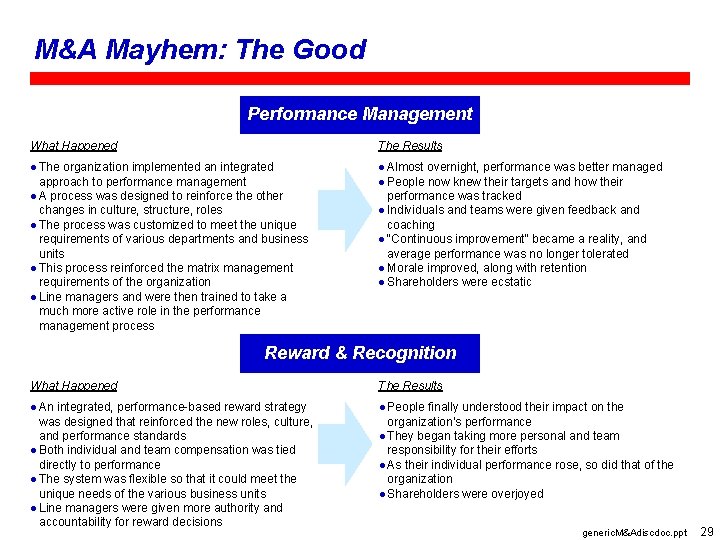
M&A Mayhem: The Good Performance Management What Happened The Results The organization implemented an integrated approach to performance management l A process was designed to reinforce the other changes in culture, structure, roles l The process was customized to meet the unique requirements of various departments and business units l This process reinforced the matrix management requirements of the organization l Line managers and were then trained to take a much more active role in the performance management process l l Almost overnight, performance was better managed l People now knew their targets and how their performance was tracked l Individuals and teams were given feedback and coaching l "Continuous improvement" became a reality, and average performance was no longer tolerated l Morale improved, along with retention l Shareholders were ecstatic Reward & Recognition What Happened The Results An integrated, performance-based reward strategy was designed that reinforced the new roles, culture, and performance standards l Both individual and team compensation was tied directly to performance l The system was flexible so that it could meet the unique needs of the various business units l Line managers were given more authority and accountability for reward decisions l l People finally understood their impact on the organization’s performance l They began taking more personal and team responsibility for their efforts l As their individual performance rose, so did that of the organization l Shareholders were overjoyed generic. M&Adiscdoc. ppt 29