
Success of TIER Net Rollout Monitoring in Broad
Success of TIER. Net Rollout Monitoring in Broad. Reach supported Department of Health Facilities Health Informatics South Africa Conference 2013 Port Elizabeth 3 rd to 5 th July 2013 Linda Mc. Intosh Broad. Reach Healthcare (Pty)Ltd Park Lane Office Park Block B, Lobby 1, First Floor cnr Alexandra Road & Park Lane Pinelands, 7405 Cape Town, South Africa Phone: +27 21 514 8300 Fax: +27 21 511 5292
The Team Broad. Reach Healthcare: • Linda Mc. Intosh - Project Lead & Senior Manager: Strategic Information • Marlien Prins – Team Leader KZN • Vivian Burger – Team Leader EC • Donald Jacobs – Senior TAO EC • Nkosi Tshabalala – Team Leader MPU/GAU © 2013 Broad. Reach Healthcare (Pty)Ltd 2
Broad. Reach Healthcare • Broad. Reach Healthcare is a global healthcare solutions company that broadens access to health in emerging economies and underserved populations. • Funded by USAID/South Africa to provide technical assistance to the South African government and support the strategic directions and goals outlined in the National Strategic Plan (NSP) on HIV, STIs and TB (2012 -2016) and other key national policies • Focus of our Health Systems Strengthening programme is to provide technical assistance and capacity building at the national, provincial, district, sub-district, facility and community levels. © 2013 Broad. Reach Healthcare (Pty)Ltd 3
Background • 2004 – March 2011 – Provinces, districts and health facilities used various paper forms and electronic data systems to monitor ART services, making it impossible to understand how many people were receiving ART services across South Africa • Dec 2010 - NHC (National Health Council) adopted the three TIER strategy and in March 2011 – National Department of Health (NDo. H) released the ART monitoring strategy to standardize ART data collection and reporting across all public health facilities • The 3 TIER’s cover all Do. H ART service points: – TIER 1: a paper based manual system aimed at small facilities with less than 500 patients or which do not meet other criteria for TIER 2 or 3. – TIER 2: TIER. Net, which covers the majority of facilities, and is aimed at facilities with 500 to 2000 patients, is a standalone MS Access database system with one or more internally linked computers. (latest release: now also SQL version) – TIER 3: The ‘SMARTER’ system for large facilities with a stable external network – Aug / Sep 2011 - NDo. H master TIER training and start of the national rollout © 2013 Broad. Reach Healthcare (Pty)Ltd 4
Introduction • The problem at facilities before the implementation of TIER was the lack of validated ART data with 40+ non-standard monitoring systems - producing an unmanageable number of data elements without standardised definitions • The master TIER training introduced the TIER. Net system and the standardised rollout process , and provided trainees with the tools required to implement the TIER. Net system at all qualifying facilities using a national 12 step implementation plan. • January 2012 - BRHC (Broad. Reach Healthcare) trainers started cascading the training to Do. H district management teams and assisted with the establishment of District Implementation Teams (DIT). • BRHC teams worked with the DITs to follow the Do. H 12 step implementation process. This involved assessing facilities for readiness and deciding on a rollout plan for the District © 2013 Broad. Reach Healthcare (Pty)Ltd 5
Challenges Some challenges became evident as the project started rolling out at scale: • Large numbers of patient records requiring back capture (some of which were already in other electronic systems). • Lack of skills and resources available to assist with requirement for networking of computers at larger facilities. • Inability to monitor progress of rollout across multiple facilities simultaneously. • Implementation terminology not clear, which led to confused monitoring of rollout • Lack of progress during back-capturing phase © 2013 Broad. Reach Healthcare (Pty)Ltd 6
Solutions to challenges • Data conversion: Following the mapping guidelines supplied, a procedure was developed which allowed different formats of existing electronic patient records to be converted to an XML format, which was easily imported into the TIER. Net system. • Linking computers: BRHC staff investigated and mastered the complexity of linking the individual computers, information which was then shared with Do. H resources to assist with networking computers in different districts. • Monitoring rollout and definition of terminology: Development of BRHC ‘PHASES’ and definition of various terms used in the rollout process between the assessment phase to point of audit (rollout completed) © 2013 Broad. Reach Healthcare (Pty)Ltd 7
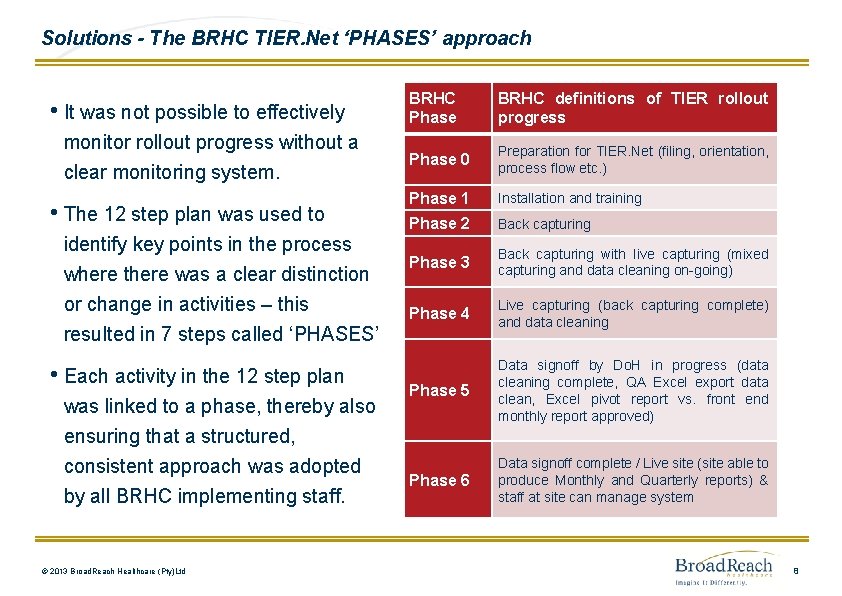
Solutions - The BRHC TIER. Net ‘PHASES’ approach • It was not possible to effectively monitor rollout progress without a clear monitoring system. • The 12 step plan was used to identify key points in the process where there was a clear distinction or change in activities – this resulted in 7 steps called ‘PHASES’ • Each activity in the 12 step plan was linked to a phase, thereby also ensuring that a structured, consistent approach was adopted by all BRHC implementing staff. BRHC Phase BRHC definitions of TIER rollout progress Phase 0 Preparation for TIER. Net (filing, orientation, process flow etc. ) Phase 1 Installation and training Phase 2 Back capturing Phase 3 Back capturing with live capturing (mixed capturing and data cleaning on-going) Phase 4 Live capturing (back capturing complete) and data cleaning Phase 5 Data signoff by Do. H in progress (data cleaning complete, QA Excel export data clean, Excel pivot report vs. front end monthly report approved) Phase 6 Data signoff complete / Live site (site able to produce Monthly and Quarterly reports) & staff at site can manage system © 2013 Broad. Reach Healthcare (Pty)Ltd 8
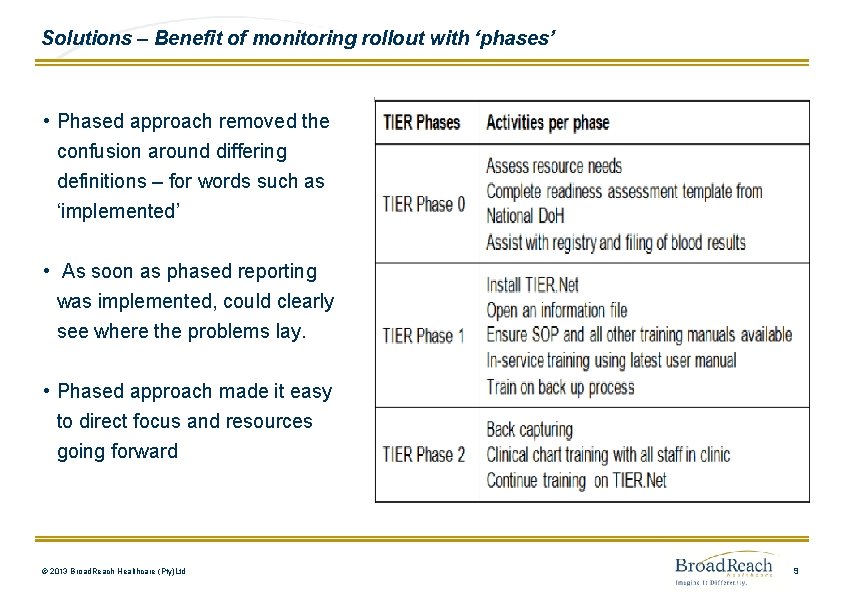
Solutions – Benefit of monitoring rollout with ‘phases’ • Phased approach removed the confusion around differing definitions – for words such as ‘implemented’ • As soon as phased reporting was implemented, could clearly see where the problems lay. • Phased approach made it easy to direct focus and resources going forward © 2013 Broad. Reach Healthcare (Pty)Ltd 9
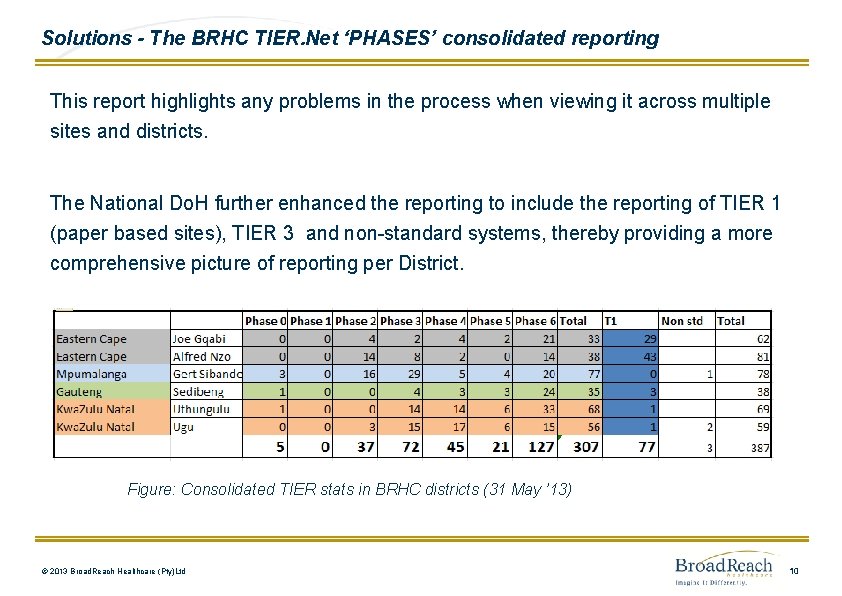
Solutions - The BRHC TIER. Net ‘PHASES’ consolidated reporting This report highlights any problems in the process when viewing it across multiple sites and districts. The National Do. H further enhanced the reporting to include the reporting of TIER 1 (paper based sites), TIER 3 and non-standard systems, thereby providing a more comprehensive picture of reporting per District. Figure: Consolidated TIER stats in BRHC districts (31 May ’ 13) © 2013 Broad. Reach Healthcare (Pty)Ltd 10
Solutions – Graphs to monitor progress • Later in the implementation process it became clear that back capturing was not being carefully monitored. The BRHC team developed a set of graphs to assist the manager responsible for monitoring facility rollout. • A back capture target was agreed with the capturing staff (and facility manager) and progress was monitored against this target, giving a visual representation over a specified time frame. • A second graph was also developed to assist with ART monitoring and use of data in facilities. © 2013 Broad. Reach Healthcare (Pty)Ltd 11
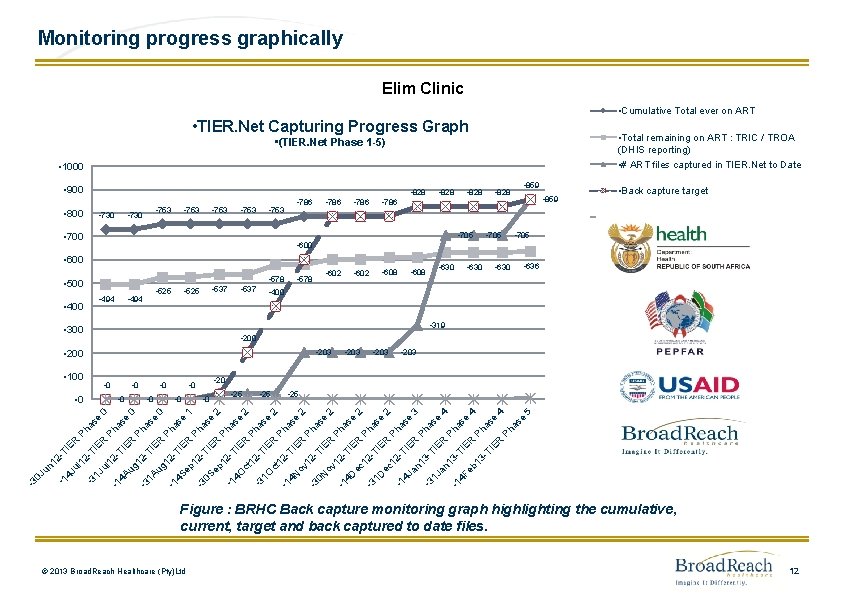
Monitoring progress graphically Elim Clinic • Cumulative Total ever on ART • TIER. Net Capturing Progress Graph • Total remaining on ART : TRIC / TROA (DHIS reporting) • # ART files captured in TIER. Net to Date • (TIER. Net Phase 1 -5) • 1000 • 900 • 800 • 828 • 730 • 753 • 753 • 786 • 859 • Back capture target • Defaulter > 90 days • 705 • 600 • 578 • 500 • 494 • 525 • 494 • 537 • 525 • 537 • 578 • 602 • 608 • 630 • 636 • 400 • 319 • 300 • 200 • 203 • 0 • 0 • 0 • 203 • 20 • 203 • 0 • 25 • 3 0 J un 12 -T • 1 IE 4 J R ul P 12 ha -T • 3 se IE 1 J 0 R ul P 12 h • 1 -T as 4 A IE e ug R 0 P 12 ha • 3 TI 1 A ER se ug 0 P 12 ha • 1 TI 4 S ER se ep 1 P 12 ha • 3 TI 0 S ER se ep 2 P 12 ha • 1 -T se 4 O IE 2 R ct P 12 ha • 3 -T se 1 O IE 2 R ct Ph 12 • 1 -T as 4 N IE e ov R 2 P 12 h • 3 -T as 0 N IE e ov R 2 P 12 h • 1 -T as 4 D IE e ec R 2 P 12 h • 3 -T as 1 D IE e ec R 2 P 12 h • 1 -T as 4 J IE e an R 3 P 13 h • 3 -T as 1 J IE e an R 4 P 13 h • 1 -T as 4 F IE e eb R 4 P 13 h -T as IE e R 4 P ha se 5 • 0 • 828 • 786 • 600 • 100 • 828 • 705 • 700 • 400 • 828 Figure : BRHC Back capture monitoring graph highlighting the cumulative, current, target and back captured to date files. © 2013 Broad. Reach Healthcare (Pty)Ltd 12
Results • The BRHC plan of action adopted for TIER. Net rollout has led to a consistent approach to rollout across all BRHC supported districts ensuring good quality, accurate reporting of rollout statistics. • The standardised data conversion of large datasets on existing electronic systems dramatically reduced the resources required for back capturing in large facilities where electronic records already existed. • The BRHC phased reporting solution produced an accurate, effective reporting methodology which was adopted nationally by Do. H in December 2012. • Monitoring back capture in TIER. Net using graphs presents a visual progress of back capturing, increasing the level of accountability of facility managers as well as improving the use of data. © 2013 Broad. Reach Healthcare (Pty)Ltd 13
Conclusion • A consistent, structured approach with clear definitions is essential when rolling out and monitoring a system at scale across the country. • The adoption of the BRHC phases used in TIER reporting by NDo. H has allowed the Department to accurately understand the progress of the TIER. Net system rollout nationally, as well as identify which facilities are now reporting validated data monthly and quarterly. This is critical information required to understand the quality of the reported ART data in the country. © 2013 Broad. Reach Healthcare (Pty)Ltd 14
Acknowledgements Broad. Reach Healthcare would like to acknowledge: – USAID for funding this work – The National Do. H for making this work possible – Other partners supporting the National Do. H © 2013 Broad. Reach Healthcare (Pty)Ltd 15
USAID Disclaimer The creation of this material was made possible by the support of the American People through the U. S. Agency for International Development (USAID) under the Cooperative Agreement No. AID-674 -A-12 -00016. The contents are the responsibility of Broad. Reach Healthcare and do not necessarily reflect the views of USAID or the United States Government. Broad. Reach Healthcare is a global healthcare solutions company dedicated to developing and implementing large scale solutions to expand access to healthcare services across the globe. We apply our expertise in global health across five core service areas: distribution networks; health systems strengthening; patient education and community mobilisation; public-private partnerships; and strategic consulting. Across each of these service areas, our work combines best practices from the public sector with business efficiency and private sector discipline to address international health challenges and opportunities. Our hybrid public/private approach has helped Broad. Reach create a portfolio of innovative health projects for a diverse client base including multinational corporations, small and medium enterprises, bilateral donor agencies, multilateral development banks, and other civil society organisations. Broad. Reach Healthcare has offices in Washington, DC; Cape Town and Johannesburg, South Africa; Nairobi, Kenya; Shanghai, China; and Zurich, Switzerland. Visit www. brhc. com for further information. Broad. Reach Healthcare (Pty) Ltd Cape Town Telephone: (021) 514 8300 Johannesburg Telephone: (011) 727 9500 © 2013 Broad. Reach Healthcare (Pty)Ltd 16
- Slides: 16