
Suburban Railways Metro Networks Signalling Convergence of needs
Suburban Railways / Metro Networks Signalling: Convergence of needs © Siemens AG 2015 – All rights reserved.

Characteristics of metro and mainline are different, but requirements are increasingly convergent Metro Mainline Passenger services • Typically single service • Consistent service pattern • Mixed speeds and traffic types • Wide variation in route and pattern Journeys • Short • Long Trains • Single fleet • High acceleration • Door layout optimised for boarding and alighting • Interior designed for carrying capacity (standing and seating) • Mixed fleet • Low acceleration • Door layout and interior designed for maximum seating capacity Operations • Turn up and go • Focus on headway (service frequency) • Timetable • Focus on timetable adherence Capacity demand • Very high • Variable across route and region Track • No/limited branch lines • Lines separate, interconnection via station • Many branch lines • No line separation, interconnection via platform Platform • Passenger/dwell time management • Seconds count • Minutes count © Siemens AG 2015 – All rights reserved. Page 2 August 2015 Mobility Division / Mobility Management
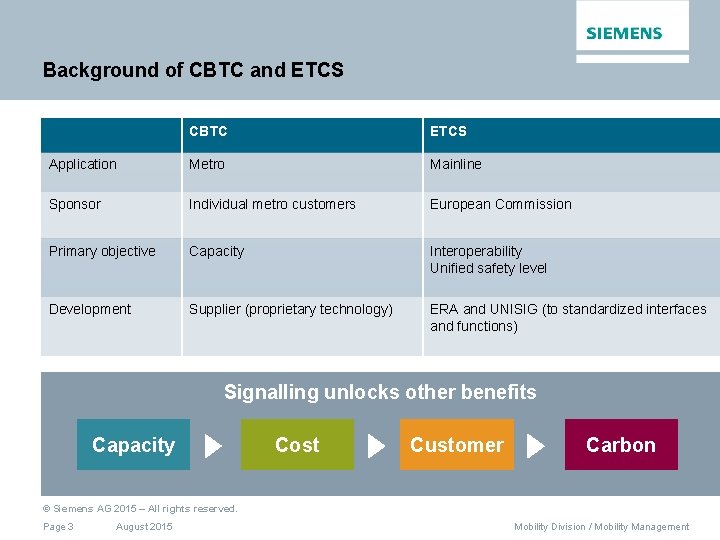
Background of CBTC and ETCS CBTC ETCS Application Metro Mainline Sponsor Individual metro customers European Commission Primary objective Capacity Interoperability Unified safety level Development Supplier (proprietary technology) ERA and UNISIG (to standardized interfaces and functions) Signalling unlocks other benefits Customer Cost Capacity Carbon © Siemens AG 2015 – All rights reserved. Page 3 August 2015 Mobility Division / Mobility Management
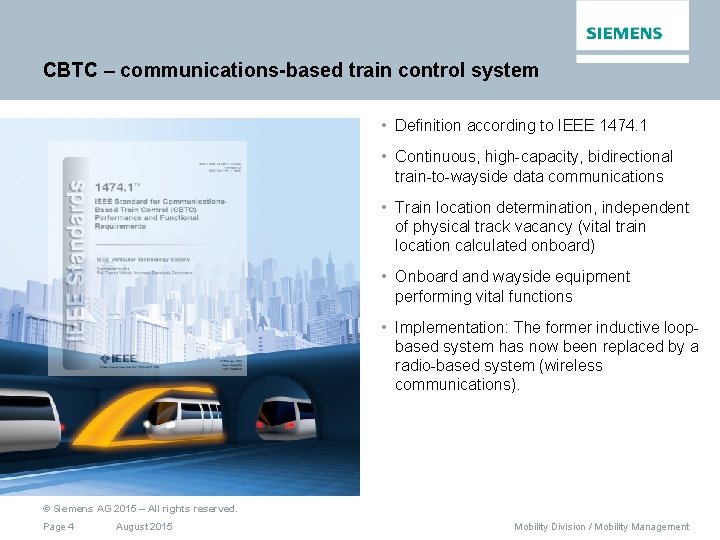
CBTC – communications-based train control system • Definition according to IEEE 1474. 1 • Continuous, high-capacity, bidirectional train-to-wayside data communications • Train location determination, independent of physical track vacancy (vital train location calculated onboard) • Onboard and wayside equipment performing vital functions • Implementation: The former inductive loopbased system has now been replaced by a radio-based system (wireless communications). © Siemens AG 2015 – All rights reserved. Page 4 August 2015 Mobility Division / Mobility Management
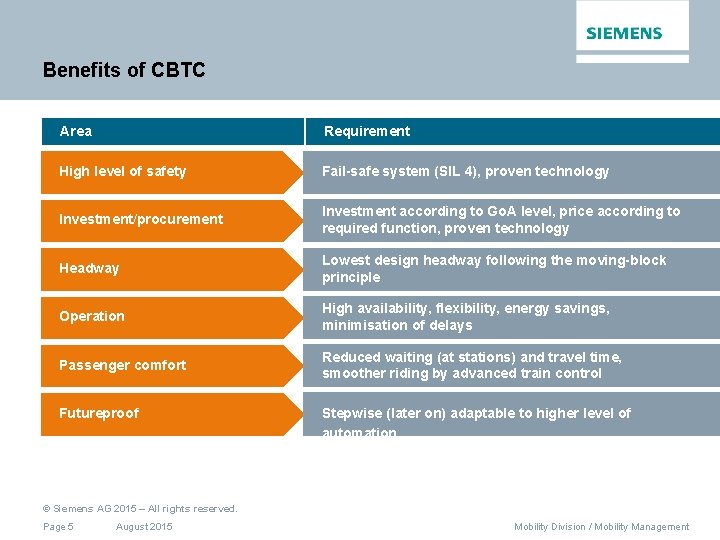
Benefits of CBTC Area Requirement High level of safety Fail-safe system (SIL 4), proven technology Investment/procurement Investment according to Go. A level, price according to required function, proven technology Headway Lowest design headway following the moving-block principle Operation High availability, flexibility, energy savings, minimisation of delays Passenger comfort Reduced waiting (at stations) and travel time, smoother riding by advanced train control Futureproof Stepwise (later on) adaptable to higher level of automation © Siemens AG 2015 – All rights reserved. Page 5 August 2015 Mobility Division / Mobility Management
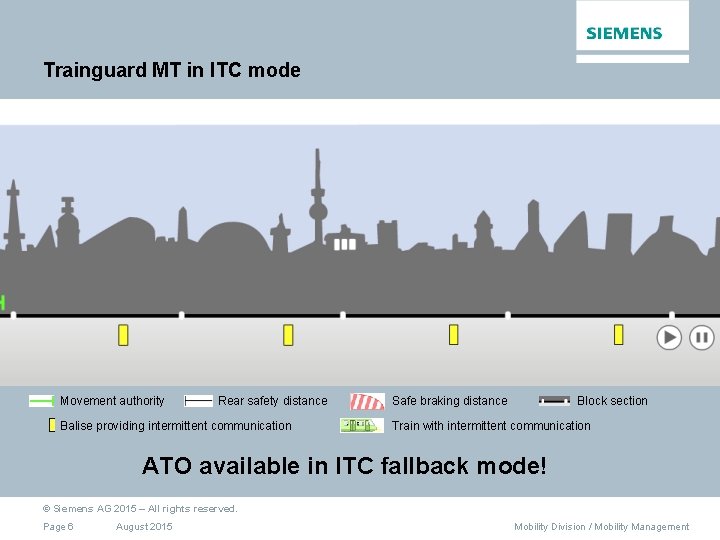
Trainguard MT in ITC mode Movement authority Rear safety distance Balise providing intermittent communication Safe braking distance Block section Train with intermittent communication ATO available in ITC fallback mode! © Siemens AG 2015 – All rights reserved. Page 6 August 2015 Mobility Division / Mobility Management

ITC wayside equipment Signalling point Lineside electronic unit (LEU) Transparent balise Fixed balise © Siemens AG 2015 – All rights reserved. Page 7 August 2015 Mobility Division / Mobility Management
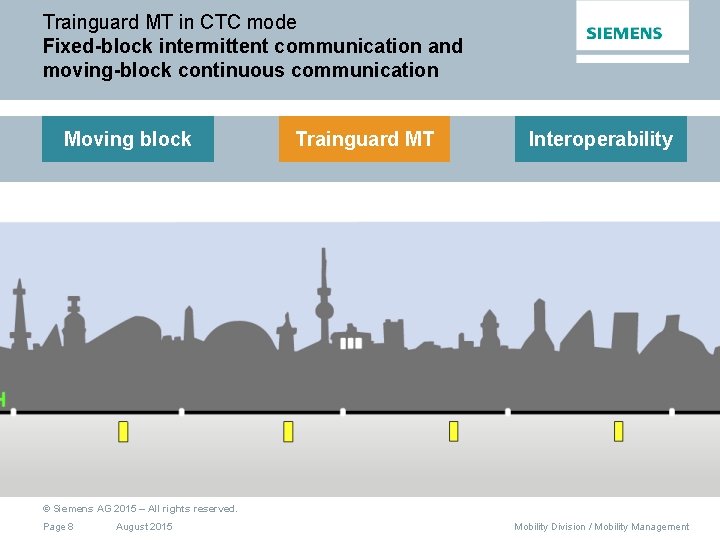
Trainguard MT in CTC mode Fixed-block intermittent communication and moving-block continuous communication Moving block Trainguard MT Interoperability © Siemens AG 2015 – All rights reserved. Page 8 August 2015 Mobility Division / Mobility Management

Trainguard MT – ITC system architecture © Siemens AG 2015 – All rights reserved. Page 9 August 2015 Mobility Division / Mobility Management
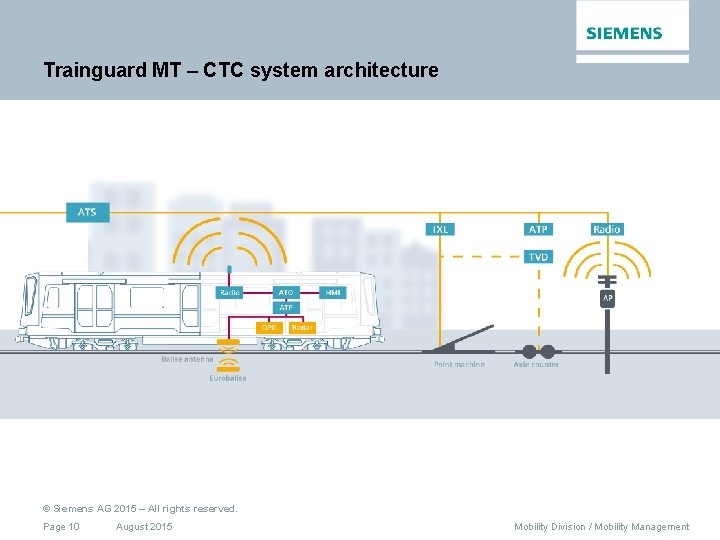
Trainguard MT – CTC system architecture © Siemens AG 2015 – All rights reserved. Page 10 August 2015 Mobility Division / Mobility Management
Benefits of ETCS platform usage for Metro • Sustainable/future-proof solution as ETCS is becoming a global standard • Reduction of the risk of obsolescence • Possible pooling of spare parts for maintenance • Easy Migration: • Wayside compatibility with TPWS suburban trains • No dual equipment of balise, odometry, etc. • Siemens recommends to make use of ETCS components for the Indian CBTC platform. © Siemens AG 2015 – All rights reserved. Page 11 August 2015 Mobility Division / Mobility Management
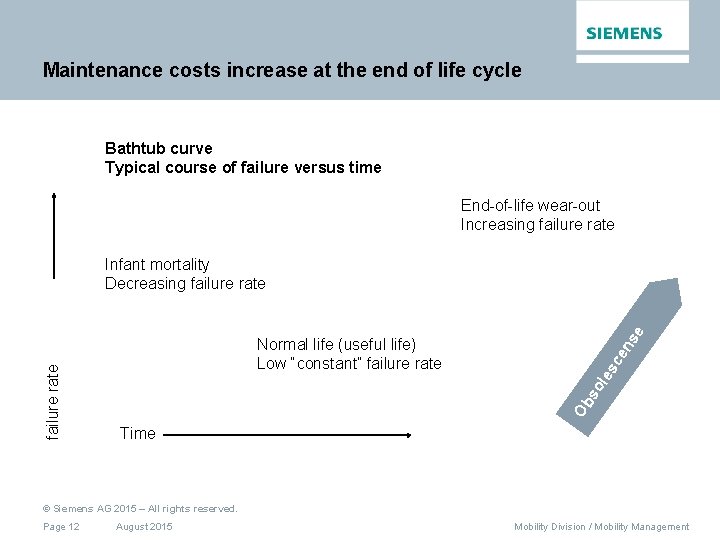
Maintenance costs increase at the end of life cycle Bathtub curve Typical course of failure versus time End-of-life wear-out Increasing failure rate e ns ce Normal life (useful life) Low “constant” failure rate Ob so les failure rate Infant mortality Decreasing failure rate Time © Siemens AG 2015 – All rights reserved. Page 12 August 2015 Mobility Division / Mobility Management
Example projects Mass transit meets mainline © Siemens AG 2015 – All rights reserved.
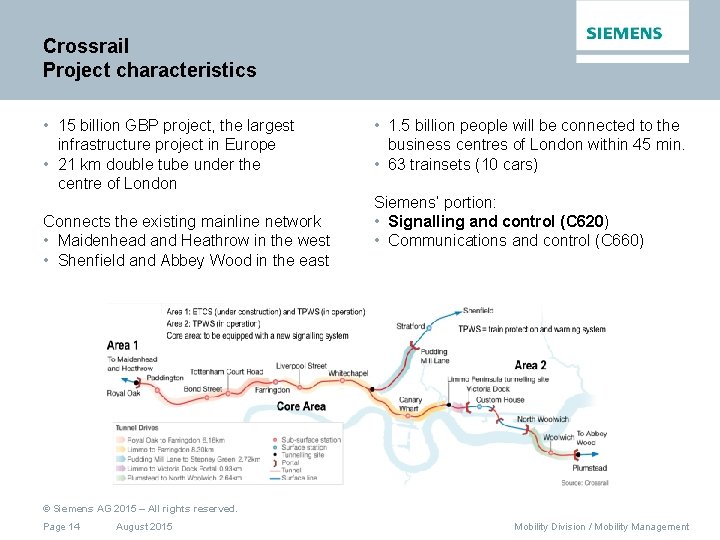
Crossrail Project characteristics • 15 billion GBP project, the largest infrastructure project in Europe • 21 km double tube under the centre of London Connects the existing mainline network • Maidenhead and Heathrow in the west • Shenfield and Abbey Wood in the east • 1. 5 billion people will be connected to the business centres of London within 45 min. • 63 trainsets (10 cars) Siemens’ portion: • Signalling and control (C 620) • Communications and control (C 660) © Siemens AG 2015 – All rights reserved. Page 14 August 2015 Mobility Division / Mobility Management

Crossrail Transition from ETCS to CBTC • ETCS reads the LTA CBTC BG. • Driver to acknowledge the LTA. • ETCS activates the CBTC OBU. • Establishment of the communication link to the CBTC trackside unit • The CBTC OBU reads the CBTC BG to locate the train and send the position report. • The CBTC OBU receives the MA and is now ready to control the train. • ETCS reads the LT CBTC BG. • Driver to acknowledge the LT. • Following acknowledgment, ETCS transfers control of the train to the CBTC OBU. • CBTC now controls the train. MA – Movement authority LT – Level transition LTA – Level transition announcement BG – Balise group © Siemens AG 2015 – All rights reserved. Page 15 August 2015 Mobility Division / Mobility Management
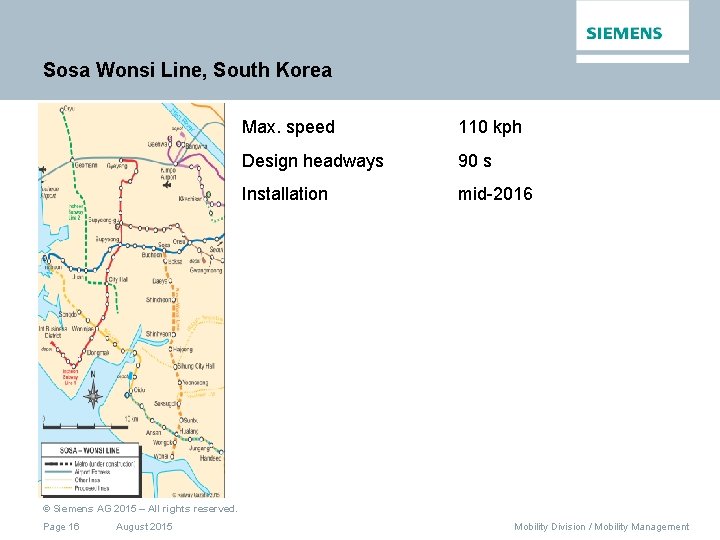
Sosa Wonsi Line, South Korea Max. speed 110 kph Design headways 90 s Installation mid-2016 © Siemens AG 2015 – All rights reserved. Page 16 August 2015 Mobility Division / Mobility Management
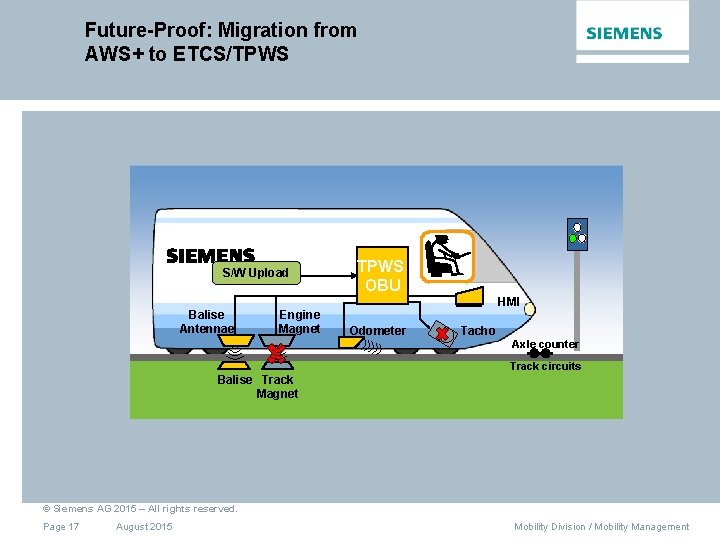
Future-Proof: Migration from AWS+ to ETCS/TPWS S/W Upload Balise Antennae Engine Magnet TPWS AWS+ OBU HMI Odometer Tacho Axle counter Track circuits Balise Track Magnet © Siemens AG 2015 – All rights reserved. Page 17 August 2015 Mobility Division / Mobility Management
Thank you for your attention! Danyavad! © Siemens AG 2015 – All rights reserved. Page 18 August 2015 Mobility Division / Mobility Management
- Slides: 18