
Subthalamic GAD Gene Therapy in a Parkinsons Disease
Subthalamic GAD Gene Therapy in a Parkinson’s Disease Rat Model Jia Luo, Michael G. Kaplitt, Helen L. Fitzsimons, David S. Zuzga, Yuhong Liu, Michael L. Oshinsky, Matthew J. During
Parkinson’s Disease �Degenerate disease of the nervous system that affects movement �Affects over 50, 000 Americans each year �Symptoms: tremors, muscle rigidity, speech change, bradykinesia (limited movement), gait and balance disturbance, decreased dexterity and coordination, digestion and urinary problems, increased sweating, low blood pressure, muscle and joint cramps
�Onset: 50 -60 years old �Treatment: no known treatment �Medications are used to relieve symptoms � Levadopa, MAO B inhibitors, COMT inhibitors �Surgery is sometimes affective � Deep brain stimulation � Pallidotomy � thalamotomy �Lifestyle adjustments � Physical, occupational, speech and language therapy
What we know about Parkinson’s Disease • Caused by death of dopaminergic neurons in the Substantia Nigra pars Compacta • Thalamic activation of upper motor neurons in the motor cortex is less likely to occur • The inhibitory outflow of the Basal Ganglia is significantly higher • Basal Ganglia is required for the normal course of voluntary movement
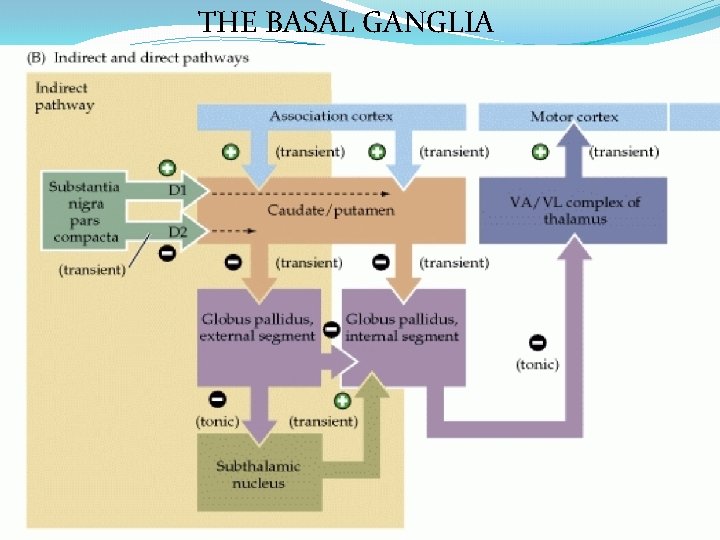
THE BASAL GANGLIA Indirect pathway – modulates the disinhibition actions of the direct Direct pathway activated reduces inhibition SNPR Inputs provided by SNC are diminished in PD making it more difficult to generate the inhibition from the caudate and putamen. PD: The disinhibited STN is overactive now and sending excitatory signals to the SNr and Gpi.
Previous studies �Deep brain stimulation of the STN or GPi is associated with significant improvement of motor complications in patients with Parkinson's disease given about a year of treatment. �Triple transduction expressing tyrosine hydroxylase, lamino acid decarboxylase, and GTP cyclohydrolase I for gene therapy �Injected vector encoding neurotrophic factor (GDNF) that supports growth and survival of dopaminergic(DA) neurons, into a rats substantia nigra
Hypothesis of the Study �“Glutamatergic neurons of the STN ( subthalamic nucleus) can be induced to express GAD, and thereby change from an excitatory nucleus to a predominantly inhibitory system that releases GABA at its terminal region in the substantia nigra (SN), leading to the suppression of firing activity of these SN neurons. ” �Glutamate = excitatory neurotransmitter �GABA = inhibitory neurotransmitter
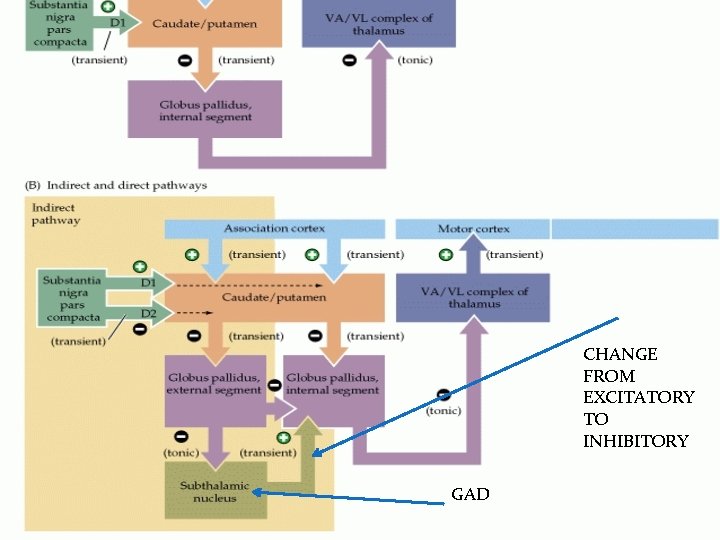
CHANGE FROM EXCITATORY TO INHIBITORY GAD
The study also showed…. . �This intervention also resulted in protectionresistance to 6 -hydroxydopamine ( 6 -OHDA). � 6 -OHDA �A neurotoxin that scientists commonly use �Induces degeneration of dopaminergic neurons
How were the STN neurons induced to express GAD?
�r. AAV ( recombinant adeno-associated virus) to transduce the neurons �Why this vector? �stable gene transfer �Highly efficient �Minimal inflammatory and immunological responses �GABA can be generated by two isoforms of GAD, GAD 65 and GAD 67. �Generated multiple vectors containing GAD 65 and GAD 67 c. DNA �Used the CBA promoter and a woodchuck hepatitits virus postregulatory element
Functional expression of transgene confirmed �Mouse neural cells (C 17. 2) were transduced with both of the isoforms of GAD �Expression confirmed by immunocytochemistry �Antibodies were specific to GAD 65, GAD 67, GABA �Remember : GAD converts glutamate to GABA so an excitatory neurotransmitter to an inhibitory neurotransmitter �HPLC (high-performance liquid chromatography) used to measure GABA release
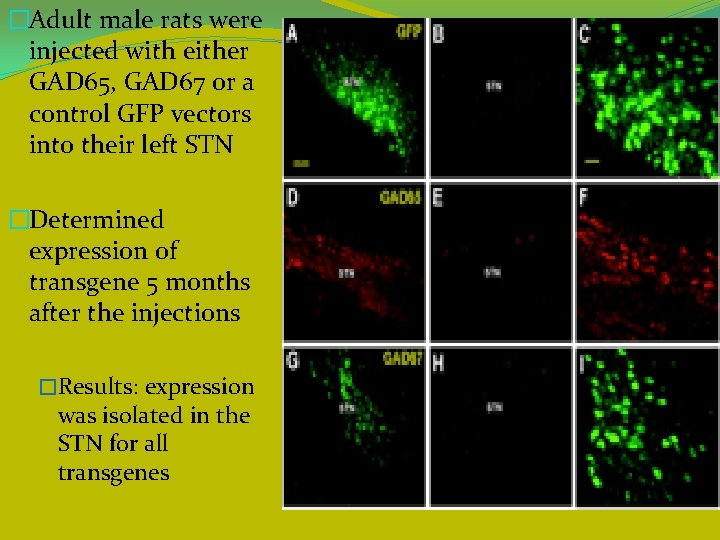
�Adult male rats were injected with either GAD 65, GAD 67 or a control GFP vectors into their left STN �Determined expression of transgene 5 months after the injections �Results: expression was isolated in the STN for all transgenes
Testing the hypothesis �Control – unlesioned rats � 6 -OHDA-lesioned parkinsonian rats received �GAD 65, GAD 67, GFP, or saline �Used Microdialysis and electorphysiology -- electrode STN, probes SNr (Substantia Nigra pars reticulata) �Remember: the STN neurons has its’ excitatory dendrite terminals on the SNr �Measured GABA and glutamate concentrations
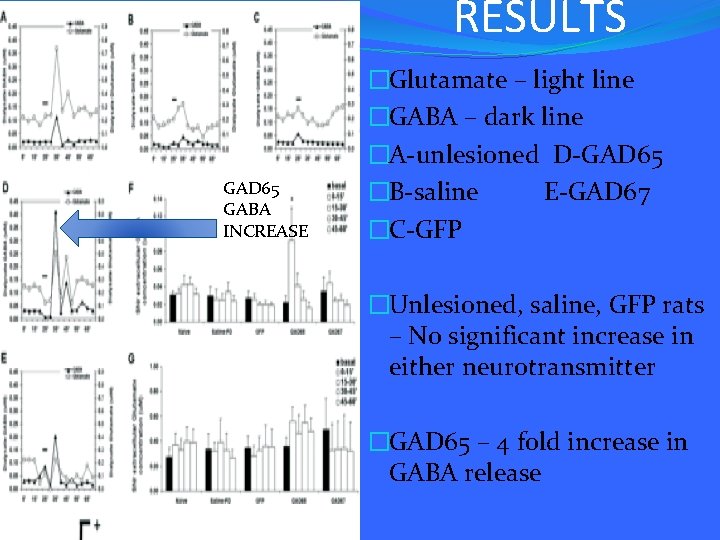
RESULTS GAD 65 GABA INCREASE �Glutamate – light line �GABA – dark line �A-unlesioned D-GAD 65 �B-saline E-GAD 67 �C-GFP �Unlesioned, saline, GFP rats – No significant increase in either neurotransmitter �GAD 65 – 4 fold increase in GABA release

Further Testing of the Hypothesis….
• Took a subgroup of rats and placed recording electrodes in the STN AND the SNr �STN was stimulated then the SNr cells were recorded �RESULTS: �Unlesioned rats – excitatory responses in 74% of SNr cells, 5% inhibitory �GFP and saline parkinsonian rats – 83% excitatory, 6%, 10% inhibitory respectively �GAD 65 – 17% excitatory, 78% inhibitory �GAD 67 – 62% excitatory, 33% inhibitory
Examined other effects of GAD expression �Carried out a similar experiment with surgery for rats to receive GFP, saline, or GAD isoforms � 6 -OHDA was injected 3 weeks after surgery the medial forebrain bundle �Fluorogold was injected as well to show neuronal degeneration �RESULTS: GAD 65 – 35+/- 14% dopmainergic neurons survived in SNc and 80+/-11% survived in VTA ( ventral tegmental area- origin of dopaminergic cell bodies) �GAD 67 - less than 1% survival
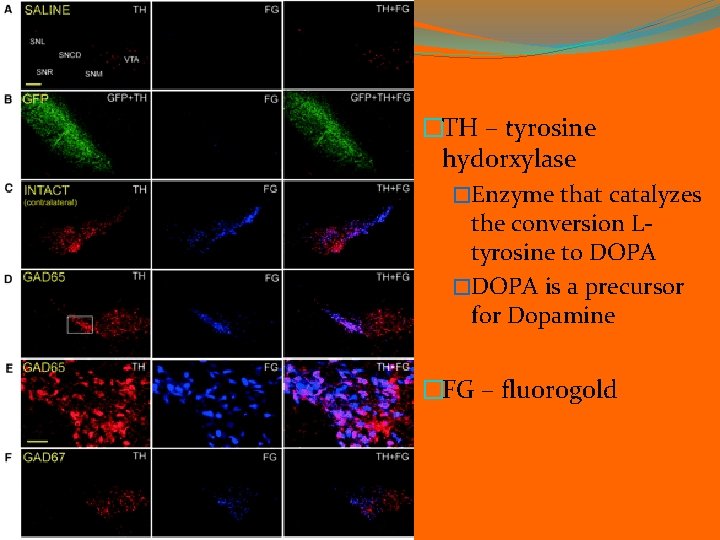
�TH – tyrosine hydorxylase �Enzyme that catalyzes the conversion Ltyrosine to DOPA �DOPA is a precursor for Dopamine �FG – fluorogold

CONCLUSIONS �Transfer of the gene GAD into cells in the STN resulted in a phenotype change from excitatory to inhibitory transmission. �GAD 65 is the more effective isoform �GAD 67 expressed an intermediate phenotype �GAD 65 offers nigral neuroprotection
Future Application �The coupling of GAD gene transfer resulting in an inhibitory network and neuroprotection can potentially treat Parkinson’s Disease as well as many other neurological conditions that are characterized of having over expressed excitatory synapses.
- Slides: 21