
SUBTEST I REVIEW Presented by Dr Kurt Lowry
SUBTEST I REVIEW Presented by: Dr. Kurt Lowry Questions: Call BTPS Testing (800) 426 -2769 To access class files: www. btpstesting. com Password: CSET 1234
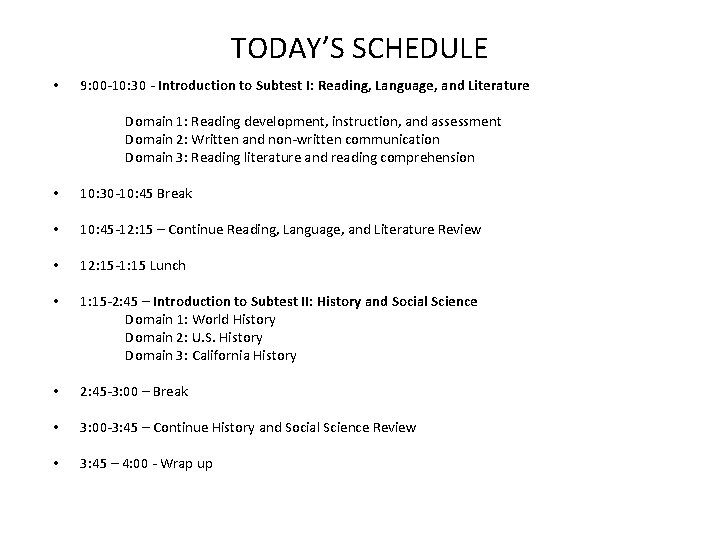
TODAY’S SCHEDULE • 9: 00 -10: 30 - Introduction to Subtest I: Reading, Language, and Literature Domain 1: Reading development, instruction, and assessment Domain 2: Written and non-written communication Domain 3: Reading literature and reading comprehension • 10: 30 -10: 45 Break • 10: 45 -12: 15 – Continue Reading, Language, and Literature Review • 12: 15 -1: 15 Lunch • 1: 15 -2: 45 – Introduction to Subtest II: History and Social Science Domain 1: World History Domain 2: U. S. History Domain 3: California History • 2: 45 -3: 00 – Break • 3: 00 -3: 45 – Continue History and Social Science Review • 3: 45 – 4: 00 - Wrap up
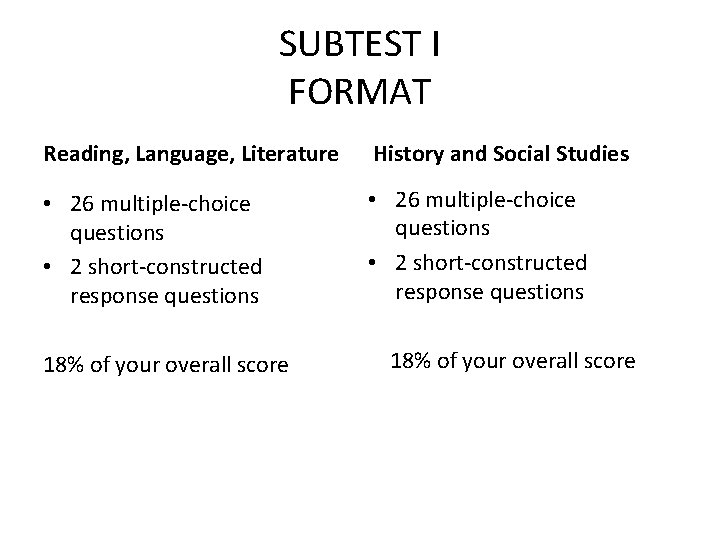
SUBTEST I FORMAT Reading, Language, Literature History and Social Studies • 26 multiple-choice questions • 2 short-constructed response questions 18% of your overall score
Be test wise! BECOME FAMILIAR WITH THE CONTENT SPECIFICATIONS! The CSET Content Specifications are the well from which ALL questions are drawn. Available online at www. ctcexams. nesinc. com and Available in your book, Cliffs. Notes CSET: Multiple Subjects • Reading, Language, and Literature (pages 14 -33) • History and Social Science (pages 85 -101)
Now, let’s review important concepts in each domain for Reading, Language, and Literature Reading Resource “Put Reading First” available at www. btpstesting. com (Go to “class files” – Password “CSET 1234”
Reading, Language, and Literature DOMAIN 1 FOCUSES ON LANGUAGE: WHAT YOU WILL NEED TO KNOW TO BE ABLE TO TEACH ELEMENTARY SCHOOL CHILDREN TO READ. The main topics in Domain 1 are: • Language and Linguistics • Language Development and Acquisition • Literacy • Assessment
Domain I: Language Development The two main topics that we will focus on for CSET are: • Language Development • Assessment Take your time to study Domain 1 because approximately 9 -10 questions focus on this section (and there is usually one essay question that emphasizes reading instruction).
Language Development CONCEPTS YOU SHOULD KNOW q. Important language development theories q. The importance of Second Language Learning q. Instructional strategies for primary (pp. 46 -47) and second language learning (pp. 44 -45).
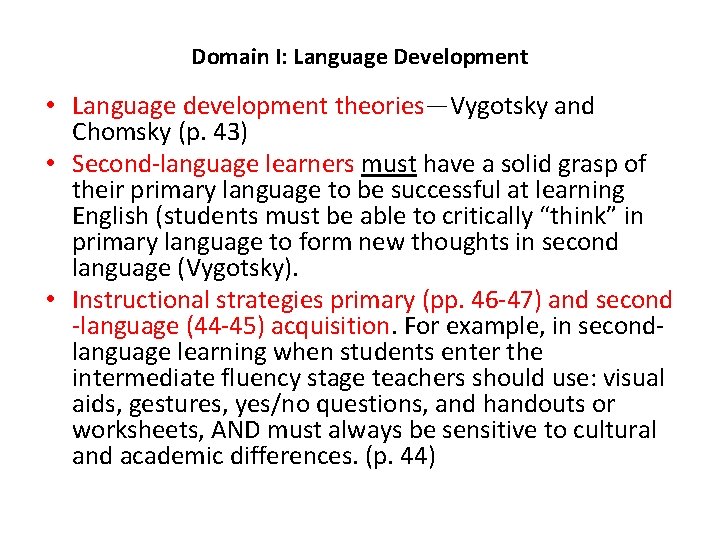
Domain I: Language Development • Language development theories—Vygotsky and Chomsky (p. 43) • Second-language learners must have a solid grasp of their primary language to be successful at learning English (students must be able to critically “think” in primary language to form new thoughts in second language (Vygotsky). • Instructional strategies primary (pp. 46 -47) and second -language (44 -45) acquisition. For example, in secondlanguage learning when students enter the intermediate fluency stage teachers should use: visual aids, gestures, yes/no questions, and handouts or worksheets, AND must always be sensitive to cultural and academic differences. (p. 44)
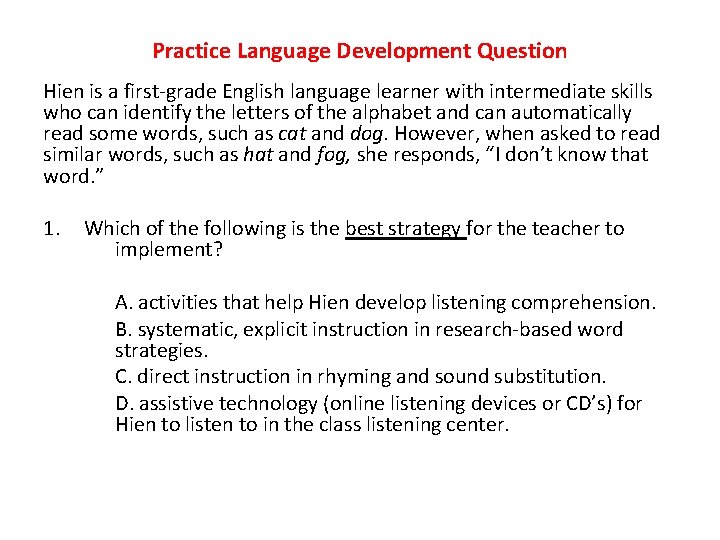
Practice Language Development Question Hien is a first-grade English language learner with intermediate skills who can identify the letters of the alphabet and can automatically read some words, such as cat and dog. However, when asked to read similar words, such as hat and fog, she responds, “I don’t know that word. ” 1. Which of the following is the best strategy for the teacher to implement? A. activities that help Hien develop listening comprehension. B. systematic, explicit instruction in research-based word strategies. C. direct instruction in rhyming and sound substitution. D. assistive technology (online listening devices or CD’s) for Hien to listen to in the class listening center.
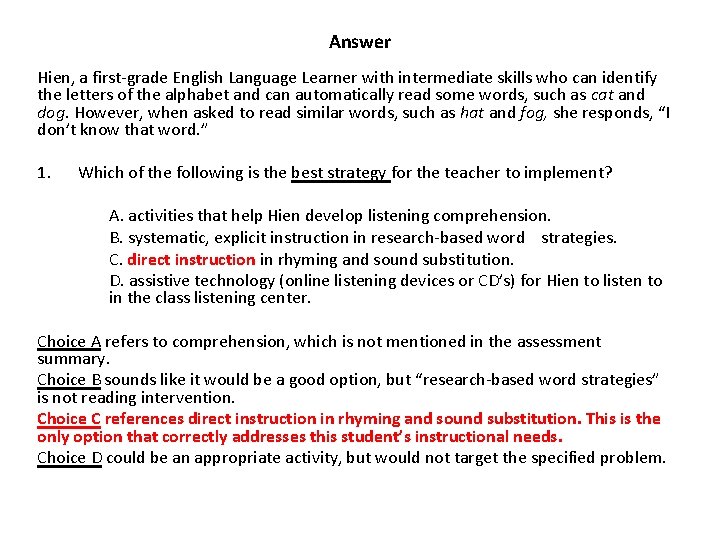
Answer Hien, a first-grade English Language Learner with intermediate skills who can identify the letters of the alphabet and can automatically read some words, such as cat and dog. However, when asked to read similar words, such as hat and fog, she responds, “I don’t know that word. ” 1. Which of the following is the best strategy for the teacher to implement? A. activities that help Hien develop listening comprehension. B. systematic, explicit instruction in research-based word strategies. C. direct instruction in rhyming and sound substitution. D. assistive technology (online listening devices or CD’s) for Hien to listen to in the class listening center. Choice A refers to comprehension, which is not mentioned in the assessment summary. Choice B sounds like it would be a good option, but “research-based word strategies” is not reading intervention. Choice C references direct instruction in rhyming and sound substitution. This is the only option that correctly addresses this student’s instructional needs. Choice D could be an appropriate activity, but would not target the specified problem.
…Speaking of important “buzzword” terms like direct instruction… When taking the CSET, especially when answering essay questions, you should memorize important “buzzwords. ” Some of the terms (direct, systematic, and explicit instruction) are often used interchangeably when referring to “reading instruction. ”
Some reading instruction buzzwords that you should use in your essay responses q. Direct instruction q. Systematic instruction q. Explicit instruction q. Differentiated instruction q. Developmentally appropriate q. Specificity
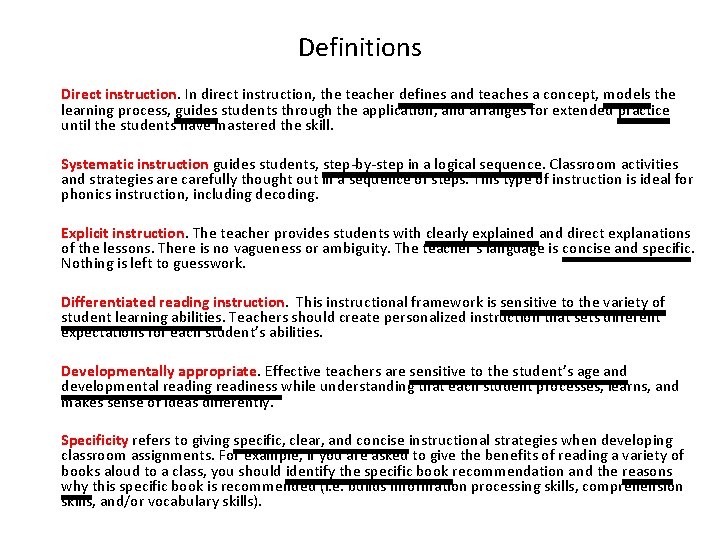
Definitions Direct instruction. In direct instruction, the teacher defines and teaches a concept, models the learning process, guides students through the application, and arranges for extended practice until the students have mastered the skill. Systematic instruction guides students, step-by-step in a logical sequence. Classroom activities and strategies are carefully thought out in a sequence of steps. This type of instruction is ideal for phonics instruction, including decoding. Explicit instruction. The teacher provides students with clearly explained and direct explanations of the lessons. There is no vagueness or ambiguity. The teacher’s language is concise and specific. Nothing is left to guesswork. Differentiated reading instruction. This instructional framework is sensitive to the variety of student learning abilities. Teachers should create personalized instruction that sets different expectations for each student’s abilities. Developmentally appropriate. Effective teachers are sensitive to the student’s age and developmental reading readiness while understanding that each student processes, learns, and makes sense of ideas differently. Specificity refers to giving specific, clear, and concise instructional strategies when developing classroom assignments. For example, if you are asked to give the benefits of reading a variety of books aloud to a class, you should identify the specific book recommendation and the reasons why this specific book is recommended (i. e. builds information processing skills, comprehension skills, and/or vocabulary skills).
Other reading terms to include in your essay responses. • Marilyn Jager Adams and her book “Beginning to Read. ” Reading instruction scholar and expert. • No Child Left Behind Act (2001). A federal law that authorizes “standards-based educational reform programs. ” The goal is to close the student achievement gaps by providing fair and equal opportunities. • Language acquisition theory: Lev Vygotsky’s “second language acquisition theory” (p. 43) shows that children must have a solid understanding of their primary language in order to “think” about learning a new language. • Metacognition: (p. 52) “Thinking about thinking. ” Metacognition is a good example of Vygotsky’s theory.
Domain I: Overview of Things You Should Know • Have an overall understanding of how to teach reading in the classroom. • Have an overall understanding of grade-level expectations and milestones (pp. 46 -47). • Identify key reading and literacy terms (i. e. alphabetic principle, phonemic awareness, phonics, phonological awareness, decoding, segmenting, concepts about print, metacognition, fluency, prosody (pp. 39 -40). • Provide a few examples of how to teach vocabulary development. • Know the difference between phonemic awareness and phonics (pp. 4649). • Provide a few examples of how to teach phonemic awareness (rhyming, segmenting, and blending), p. 48. • Know how to interpret reading fluency (accuracy, rate, prosody), p. 51 and how to calculate reading fluency (p. 57) • Know a few important reading assessments to use in the classroom. (i. e. The Yopp-Singer Test, Shefelbine’s Phonics Skills Test, Fry’s Oral Reading Assessment, see pp. 56 -58).
Constructed-Response Essay Question We’ve covered a lot, so let’s practice an constructed-response essay. Before we practice, let’s review some essay writing strategies.
Constructed-Response Essays ESSENTIAL COMPUTER INFORMATION – WHAT IS AVAILABLE • BASIC WORD PROCESSOR FUNCTIONS • DELETE, CUT, PASTE, UNDO BUTTONS (RIGHT SIDE OF SCREEN) • ENTER KEY (USE FOR PARAGRAPH BREAKS)

ESSENTIAL COMPUTER INFORMATION WHAT THE SCREEN LOOKS LIKE
STRATEGIES TO WRITE YOUR ESSAY • • • 8 to 10 minutes in length Pre-write: clustering, outlining Write about those you know first Write clear, complete, and concise sentences Responses are “short” between 100 to 200 words. No need to write an intro, body, conclusion. Answer “all parts” of the question! Use specific supporting examples, details, and facts Don’t leave any essays blank (1 point is better than no points) Use “buzzwords” - key words and phrases from authoritative sources (if possible).
ESSAY SCORING RUBRIC • TO SCORE 3 POINTS: – STAY FOCUSED ON THE QUESTION (TRY PARAPHRAING THE QUESTION IN YOUR OWN WORDS TO CHECK YOUR UNDERSTANDING). – SHOW A COMMAND OF KNOWLEDGE OF SUBJECT -MATTER FROM THE DOMAINS. – PROVIDE RELEVANT SUPPORTING EXAMPLES AND FACTS. – BE ORGANIZED
Let’s Practice Writing a CSET Essay DIRECTIONS: Use lined paper to write your response. TIME: 10 Minutes TASK: Complete the exercise that follows: A second-grade teacher notices that a student is struggling with reading grade-level text. The student is decoding slowly, sound by sound, and is unable to accurately retell what she has read. • Describe how the teacher might identify the specific need of the student. • Discuss at least one effective strategy that the teacher should implement, and • Identify why this strategy or activity would be effective in addressing the problem.
Sample Response The teacher can identify the specific need because the student cannot accurately retell what she is reading and cannot effectively demonstrate prosody. This demonstrates a weakness in comprehension skills. Reading comprehension becomes increasingly difficult if the student does not have a command of reading fluency. Because the student is decoding sound by sound, the teacher should begin by assessing the student’s fluency. By the second grade, students should be able to read with about 95% accuracy when matched to appropriate grade-level texts. To assess fluency, the teacher should first give the student a timed oral reading test (such as Fry’s Oral Reading Assessment) and calculate how many correct words per minute the student reads. The next step would be to plan fluency lessons and activities that would help the student improve reading fluency. The student can be assigned to read easy materials first (missing no more than 1 in 20 words), such as decodable books, several times over and over because repeated readings help improve fluency. This strategy is effective for increasing fluency because, when practicing reading for fluency, the text needs to be at the student’s independent reading level whereby text is comprehended 90 to 100 percent of the time. This way the student has few unknown words to decode and can work just on speed and phrasing.
Essay Evaluation Evaluating the Essay • The essay addresses all three parts of the task. It starts by identifying the “comprehension” and “fluency. • Next, the writer tells how he or she would identify the specific need of the student by explaining how to assess the student’s fluency. • Then the writer describes an instructional strategy for working on fluency, which is repeated readings of easy, familiar text. She provides a detail by giving an example of a specific type of material that contains this type of text—decodable books. • The writer concludes by explaining why repeated readings of text that is easy and familiar helps to improve fluency and provides a description of “independent reading level. ” Note: Use the Constructed-Response Handout to help you evaluate your essays.
Domain 2 Non-Written and Written Communication Domain 2 focuses on the conventions of standard written English in written and spoken language—grammar and sentence structure.
Domain 2: Grammar and Sentence Structure Things You Should Know • Parts of speech (noun, verb, adjective, adverb) • Sentence components (phrases, clauses); sentence types (simple, compound, and complex) • Punctuation and capitalization Note: Only a couple of questions on the CSET will focus on grammar and sentence structure.
Domain 2: Written Communication Things You Should Know • The stages of the writing process (prewriting, revising/editing, and proofreading), p. 64. • How to write a good essay (i. e. organization, logical development of ideas, vocabulary usage, transitions, style, purpose, and audience). • What are the principles of composition (p. 69 -70)? • How to conduct research to produce a writing project. • The differences between an argumentative essay versus an informative/explanatory essay (pp. 70 -71).
Domain 2: Non-Written Communication and Research Things You Should Know • Identify nonverbal components of speech (i. e. eye contact, volume/tone, pacing, visual aids, bias/stereotyping, etc. ), p. 73. • Understand how to analyze speech (i. e. volume, fluency, and pronunciation). • Identify strategies for collaborative discussions (i. e. one-onone, groups, teacher-led). • Identify research strategies (i. e. data collecting, documenting, references, etc. ), pp. 73 -76. • Understand how to cite and paraphrase research sources with plagiarizing. • Understand how to integrate technology, multimedia, and visual displays into presentations.
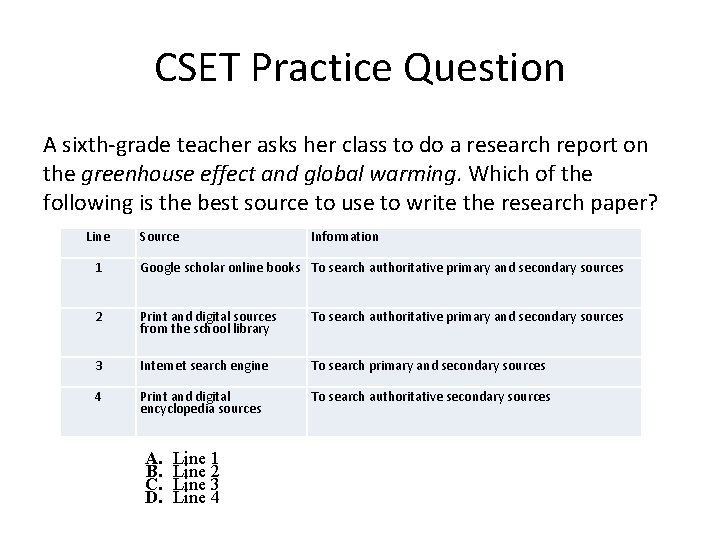
CSET Practice Question A sixth-grade teacher asks her class to do a research report on the greenhouse effect and global warming. Which of the following is the best source to use to write the research paper? Line Source Information 1 Google scholar online books To search authoritative primary and secondary sources 2 Print and digital sources from the school library To search authoritative primary and secondary sources 3 Internet search engine To search primary and secondary sources 4 Print and digital encyclopedia sources To search authoritative secondary sources A. B. C. D. Line 1 Line 2 Line 3 Line 4
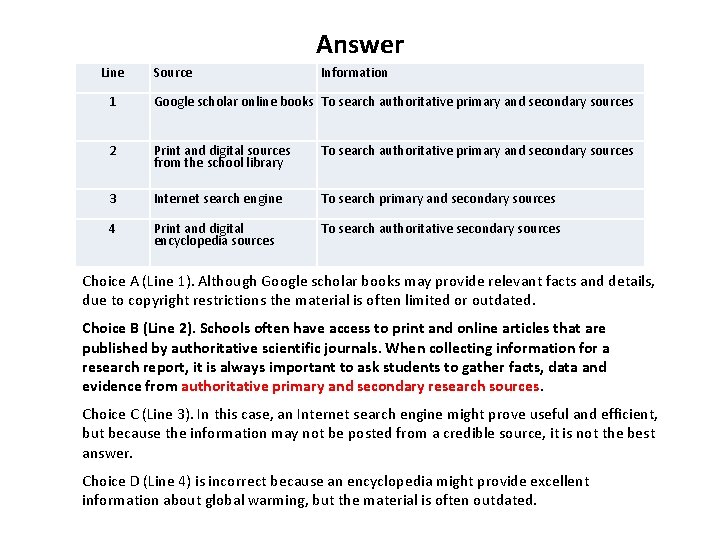
Answer Line Source Information 1 Google scholar online books To search authoritative primary and secondary sources 2 Print and digital sources from the school library To search authoritative primary and secondary sources 3 Internet search engine To search primary and secondary sources 4 Print and digital encyclopedia sources To search authoritative secondary sources Choice A (Line 1). Although Google scholar books may provide relevant facts and details, due to copyright restrictions the material is often limited or outdated. Choice B (Line 2). Schools often have access to print and online articles that are published by authoritative scientific journals. When collecting information for a research report, it is always important to ask students to gather facts, data and evidence from authoritative primary and secondary research sources. Choice C (Line 3). In this case, an Internet search engine might prove useful and efficient, but because the information may not be posted from a credible source, it is not the best answer. Choice D (Line 4) is incorrect because an encyclopedia might provide excellent information about global warming, but the material is often outdated.
Domain 3 Reading Comprehension and Analysis Domain 3 focuses on reading comprehension in literature, informational text, and text complexity.
Domain 3: Reading Literature Things You Should Know • How to analyze prose, especially in children’s literature (novels, short stories, folktales, fairy tales, and poems). • What is the structure of children’s literature (plot, setting, theme, characterization, conflict, point of view, patterns, allegory), p. 77.
Domain 3: Informational Text Things you Should Know • What are informational texts? • Understand how to analyze explicit versus implicit meanings of informational texts. • Analyze the use of text features (graphics, illustrations, data, maps, headers, captions). • Understand how to analyze multiple sources of information in text, media, and other formats.
Domain 3: Text Complexity Things You Should Know • Understand how to evaluate text complexity (p. 81). • Know the difference between quantitative and qualitative measures. • *What are the guidelines for text comprehension? (frustrated level, instructional level, and independent level of reading), p. 83.
Domain 3 CSET Practice Question Advanced students, as well as those with learning difficulties in language arts, often require systematically planned differentiation to ensure that core reading curriculum and instruction are appropriately challenging and steadily increasing in complexity. To increase students’ independent and proficient reading abilities in successive years, a sixth-grade teacher should consider which of the following when measuring text complexity? A. B. C. D. match the reader to the text and task match the reader to a broad range of the texts match the reader to specific context clues in the text match the reader to speed reading strategies
Answer Advanced students as well as those with learning difficulties in language arts often require systematically planned differentiation to ensure that core reading curriculum and instruction are appropriately challenging and steadily increasing in complexity. To increase students’ independent and proficient reading abilities in successive years, a sixth-grade teacher should consider which of the following when measuring text complexity? A. match the reader to the text and task B. match the reader to a broad range of the texts C. match the reader to specific context clues in the text D. match the reader to speed reading strategies Students in grade six are expected to comprehend literary and informational texts of increasing length and complexity to prepare them for future college, career and civic life. Literature texts are stories, dramas, and poetry. Informational texts are nonfiction, historical/scientific, and technical texts. Choice A. According to the Standards, instruction and measurement in text complexity should consist of three “equally important” factors: (1) qualitative factors; (2) quantitative factors; and (3) matching the reader to the text and task. Complexity for advanced students means that enriched instruction encourages students to address the meaning and purpose of the topics, text length, and variables specific to each reader and task (i. e. motivation, knowledge and experiences). Always keep in mind that a student’s ability to read complex texts may not follow in a linear fashion. Text complexity for struggling students means the teacher should focus on the key concepts within the standards and eliminate confusing activities.
SUBTEST I HISTORY AND SOCIAL STUDIES Domain 1: World History Domain 2: U. S. History Domain 3: California History
History and Social Studies Overview 26 multiple-choice questions 2 short-constructed response questions 18% of your overall score Excellent History Resources A History of Us by Joy Hakin Don’t Know Much about History by Kenneth Davis
History and Social Studies TEST-TAKING TIPS q STICK TO THE CONTENT SPECIFICATIONS! q THINK ABOUT HISTORY AS A “STORY” q LOOK FOR THE CONTEXT (WHAT WAS GOING ON IN THE REGION OR WORLD AT THE TIME? ) q LOOK FOR THE CAUSES, OUTCOMES, AND CONSEQUENCES. q KNOW THE MAJOR WARS (e. g. American Revolution, Civil War).
History and Social Science Domain 1: World History Ancient Civilizations Medieval and Early Modern Times Note: About 9 questions on the CSET will focus on World History.
Domain 1: World History Ancient Civilizations • Early humans depended on food and shelter so geography was important to early civilizations (agriculture, irrigation systems, climate, environment). • Migration and the desire for land resources created the need for trade, social organization, and innovation. • Early empires began forming in China, India, Greek city-states, and Rome.
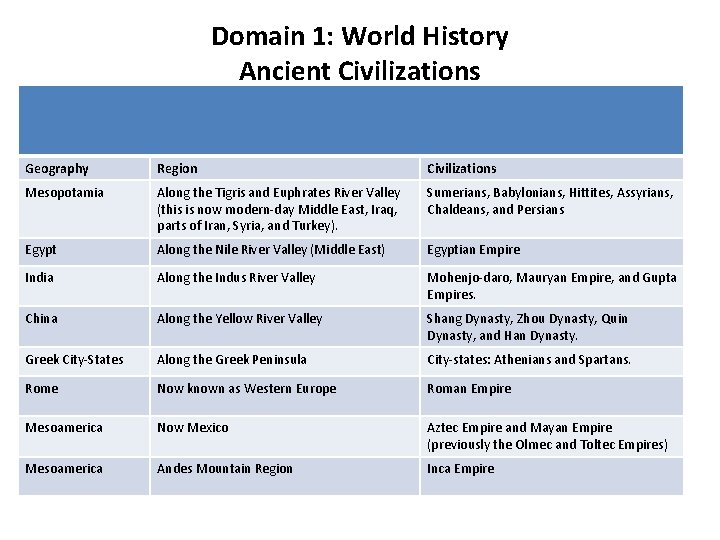
Domain 1: World History Ancient Civilizations Geography Region Civilizations Mesopotamia Along the Tigris and Euphrates River Valley (this is now modern-day Middle East, Iraq, parts of Iran, Syria, and Turkey). Sumerians, Babylonians, Hittites, Assyrians, Chaldeans, and Persians Egypt Along the Nile River Valley (Middle East) Egyptian Empire India Along the Indus River Valley Mohenjo-daro, Mauryan Empire, and Gupta Empires. China Along the Yellow River Valley Shang Dynasty, Zhou Dynasty, Quin Dynasty, and Han Dynasty. Greek City-States Along the Greek Peninsula City-states: Athenians and Spartans. Rome Now known as Western Europe Roman Empire Mesoamerica Now Mexico Aztec Empire and Mayan Empire (previously the Olmec and Toltec Empires) Mesoamerica Andes Mountain Region Inca Empire
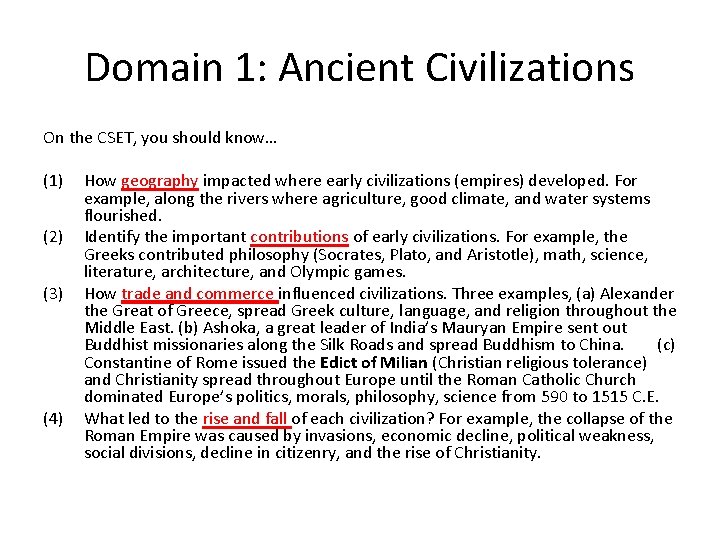
Domain 1: Ancient Civilizations On the CSET, you should know… (1) (2) (3) (4) How geography impacted where early civilizations (empires) developed. For example, along the rivers where agriculture, good climate, and water systems flourished. Identify the important contributions of early civilizations. For example, the Greeks contributed philosophy (Socrates, Plato, and Aristotle), math, science, literature, architecture, and Olympic games. How trade and commerce influenced civilizations. Three examples, (a) Alexander the Great of Greece, spread Greek culture, language, and religion throughout the Middle East. (b) Ashoka, a great leader of India’s Mauryan Empire sent out Buddhist missionaries along the Silk Roads and spread Buddhism to China. (c) Constantine of Rome issued the Edict of Milian (Christian religious tolerance) and Christianity spread throughout Europe until the Roman Catholic Church dominated Europe’s politics, morals, philosophy, science from 590 to 1515 C. E. What led to the rise and fall of each civilization? For example, the collapse of the Roman Empire was caused by invasions, economic decline, political weakness, social divisions, decline in citizenry, and the rise of Christianity.
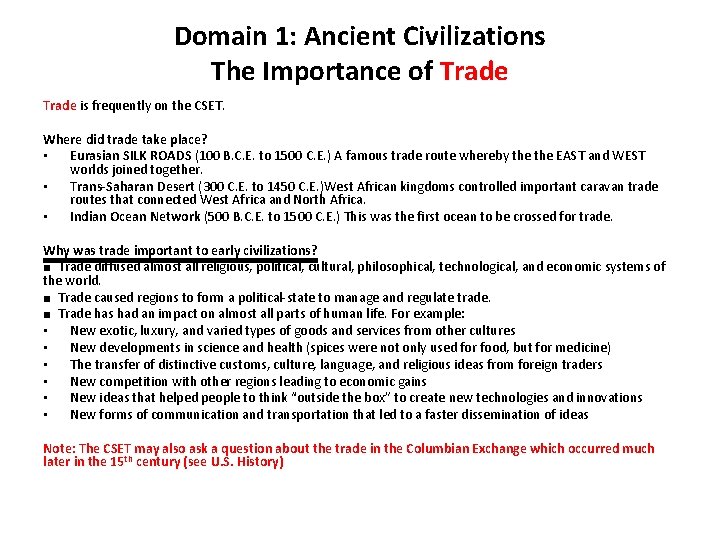
Domain 1: Ancient Civilizations The Importance of Trade is frequently on the CSET. Where did trade take place? • Eurasian SILK ROADS (100 B. C. E. to 1500 C. E. ) A famous trade route whereby the EAST and WEST worlds joined together. • Trans-Saharan Desert (300 C. E. to 1450 C. E. )West African kingdoms controlled important caravan trade routes that connected West Africa and North Africa. • Indian Ocean Network (500 B. C. E. to 1500 C. E. ) This was the first ocean to be crossed for trade. Why was trade important to early civilizations? ■ Trade diffused almost all religious, political, cultural, philosophical, technological, and economic systems of the world. ■ Trade caused regions to form a political-state to manage and regulate trade. ■ Trade has had an impact on almost all parts of human life. For example: • New exotic, luxury, and varied types of goods and services from other cultures • New developments in science and health (spices were not only used for food, but for medicine) • The transfer of distinctive customs, culture, language, and religious ideas from foreign traders • New competition with other regions leading to economic gains • New ideas that helped people to think “outside the box” to create new technologies and innovations • New forms of communication and transportation that led to a faster dissemination of ideas Note: The CSET may also ask a question about the trade in the Columbian Exchange which occurred much later in the 15 th century (see U. S. History)
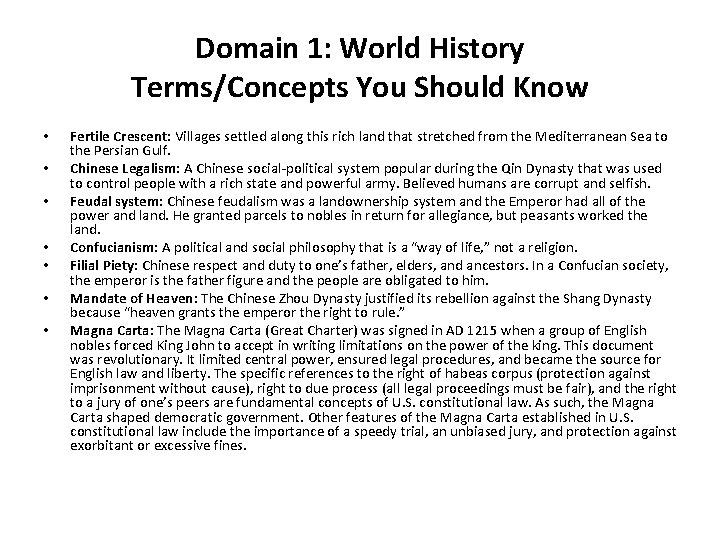
Domain 1: World History Terms/Concepts You Should Know • • Fertile Crescent: Villages settled along this rich land that stretched from the Mediterranean Sea to the Persian Gulf. Chinese Legalism: A Chinese social-political system popular during the Qin Dynasty that was used to control people with a rich state and powerful army. Believed humans are corrupt and selfish. Feudal system: Chinese feudalism was a landownership system and the Emperor had all of the power and land. He granted parcels to nobles in return for allegiance, but peasants worked the land. Confucianism: A political and social philosophy that is a “way of life, ” not a religion. Filial Piety: Chinese respect and duty to one’s father, elders, and ancestors. In a Confucian society, the emperor is the father figure and the people are obligated to him. Mandate of Heaven: The Chinese Zhou Dynasty justified its rebellion against the Shang Dynasty because “heaven grants the emperor the right to rule. ” Magna Carta: The Magna Carta (Great Charter) was signed in AD 1215 when a group of English nobles forced King John to accept in writing limitations on the power of the king. This document was revolutionary. It limited central power, ensured legal procedures, and became the source for English law and liberty. The specific references to the right of habeas corpus (protection against imprisonment without cause), right to due process (all legal proceedings must be fair), and the right to a jury of one’s peers are fundamental concepts of U. S. constitutional law. As such, the Magna Carta shaped democratic government. Other features of the Magna Carta established in U. S. constitutional law include the importance of a speedy trial, an unbiased jury, and protection against exorbitant or excessive fines.
Domain 1: World History Medieval and Early Modern Times On the CSET, you should be familiar with different periods that changed the face of Europe (and these ideas changed the world). • • Middle Ages (medieval period in Europe) (c. 5 th to the 15 centuries). Europe plunged into a dark period with famine and plague (The Black Death killed about 75 million people). European Renaissance (c. 1400 – 1550). A “renewal” of Greek and Roman classics in art, literature, philosophy, and science in Europe. It was a turning point for cultural, religious, and social attitudes. Niccolo Machiavelli (1469 – 1527). Depicted a ruler’s ruthless conduct in his essay outlines “The Prince. ” Believed that the prince must be merciless to secure power. Now, the term Machiavellian has become synonymous with describing a ruthless ruler who is immoral and deceitful. For centuries many statesmen and politicians have acted based on Machiavellian’s realism, without the toxic label, but this has become oversimplified and perverted over time. The Protestant Reformation (c. 1515 – 1650). The Reformation, led by Martin Luther, was a movement from the Roman Catholic authority to a new way of thinking about Christianity— Protestantism. The Printing Press (invented by Johannes Gutenberg) was one of the most significant inventions known to mankind. News could be published more rapidly to everyday people, not just the elite, and Luther’s ideas of questioning the Church spread quickly. The Scientific Revolution (1543 – 1700). The Rise of scientific achievements. Scientists began to reevaluate blindly accepted theories and challenged Church doctrine. For example, Galileo’s heliocentric theory (sun-centered universe) challenged the existing earth-centered theory). The Age of Enlightenment (1685 – 1789). New political philosophies with revolutionary ideas of great writers radically changed the face of Europe. Reason, logic, and knowledge changed the world. These ideas were brought to America. (e. g. separation of church and state, government should be separated into branches, citizens deserve legal rights). Spain’s dominance in the Americas Imperialism
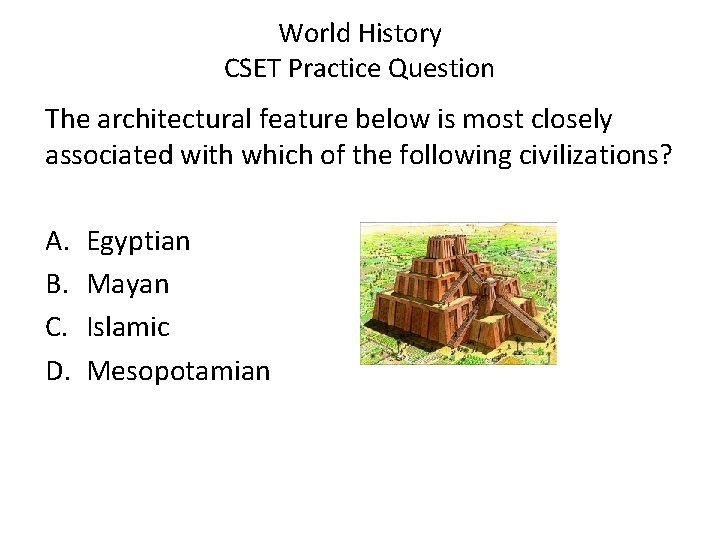
World History CSET Practice Question The architectural feature below is most closely associated with which of the following civilizations? A. B. C. D. Egyptian Mayan Islamic Mesopotamian
Answer Choice A. The massive granite pyramids of Egypt, unlike the other choices, were not used for priestly worship, but solely as the resting place of the pharaoh. Choice B. The Mayans in pre-Columbian Central America also built massive stone temples that generally had four stairways leading to the top platform where priests performed rituals and placated the gods. Choice C. The religious architectural structure of Islam was the mosque and accompanying minarets. The massive granite pyramids of Egypt, unlike the other choices, were not used for priestly worship, but solely as the resting place of the pharaoh. Choice D. The ziggurat of Ur in Mesopotamia (present-day Iraq) is depicted. A ziggurat is a monumental religious temple built from hundreds of thousands of sun-dried bricks and stone. The word ziggurat means “mountain of God. ” A ziggurat was a temple for priests to honor and pacify their gods. Massive stairways led to the top of the ziggurat. Note that the biblical Tower of Babel was a ziggurat.
Domain 2: U. S. History • Early America Exploration (1492 – 1600) Colonial Era (1607 – 1754) American Revolution (1775 – 1783) • The Formation of a New Nation (1783 – 1791) The U. S. Constitution and the Early Republic • The Civil War (1861 – 1865) and Reconstruction Era (1865 – 1877) • The Rise of Industrial America (1870 – 19104)
APPROACHING U. S. HISTORY QUESTIONS q CSET EMPHASIZES U. S. HISTORY TO 1900. q ONLY STUDY U. S. HISTORY TO ~ 1910. THE CSET WILL NOT HAVE QUESTIONS ABOUT U. S. HISTORY ABOUT WORLD WAR I (1914) AND BEYOND. q ABOUT 10 QUESTIONS WILL FOCUS ON U. S. HISTORY q USE REASONING TO ANSWER QUESTIONS USE EX/CED/RIN FOR U. S. HISTORY EX = EXPLORATION AND CONQUEST CED = COLONIZATION AND DEVELOPMENT RIN = REVOLUTION AND INDEPENDENCE
Early Exploration (c. 1492 to c. 1600) Why did Europeans explore new trade routes to the Americas? q Pursuit of power (imperialism). As political power centralized and feudalism declined in Europe, monarchs had a desire to fund voyages to the NEW WORLD for political and religious world power. q Trade. Europeans needed valuable goods to trade to correct the imbalance with China along the Silk Roads. Keep in mind that around 1492, Muslim powers encircled almost all of Christian Europe preventing trade. Spanish and Portuguese explorers searched westward to North America. q The Renaissance and Reformation. Europeans were inspired by the Renaissance and Reformation. Exploration was often stimulated by religious motives, particularly the desire to freely practice or spread either Protestantism or Catholicism. Some sought out new converts amongst the Native Americans to replace the lost Catholic populations of Northern Europe.
Who Explored North America First? • Portugal was the first to explore and discovered the Atlantic Trade Route. • Spain started exploring in the 15 th century and began conquests in the Caribbean. In 1492, Columbus discovered the West Indies, and America. Spain established the *Encomienda System (feudal land labor grants that enslaved Natives). • Spain (Hernan Cortes in 1519) also conquered the Aztec Empire (now Mexico), and Francisco Pizarro in 1532 conquered the Inca Empire (now Peru). *Remember this term on the CSET.
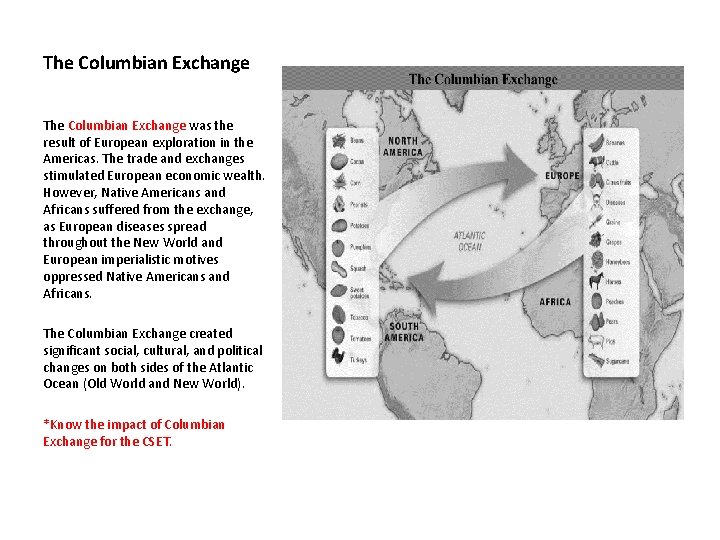
The Columbian Exchange was the result of European exploration in the Americas. The trade and exchanges stimulated European economic wealth. However, Native Americans and Africans suffered from the exchange, as European diseases spread throughout the New World and European imperialistic motives oppressed Native Americans and Africans. The Columbian Exchange created significant social, cultural, and political changes on both sides of the Atlantic Ocean (Old World and New World). *Know the impact of Columbian Exchange for the CSET.
Domain 2: Colonial Era (1607 to 1754) In Colonial America, there were various motivations for European colonization and vast differences between colonial regions. On the CSET, you should know some of the reasons that European people wanted to settle in America. 1. Economic competitiveness, which motivated European nations to seek economic wealth through business ventures and mercantilism. 2. Europe’s poor economic conditions including a decline in wages. Many landowners were converting farming fields into livestock pastures, and workers lost their jobs. America offered new job and economic opportunities. 3. Europe’s overpopulated cities. 4. Europe’s growing religious intolerances. Catholics and Protestants continually battled for control in the New World, just as they did in Europe.
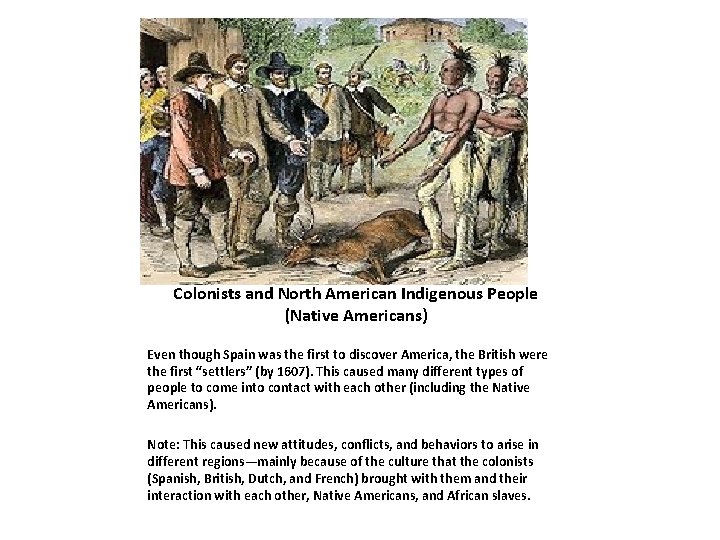
Colonists and North American Indigenous People (Native Americans) Even though Spain was the first to discover America, the British were the first “settlers” (by 1607). This caused many different types of people to come into contact with each other (including the Native Americans). Note: This caused new attitudes, conflicts, and behaviors to arise in different regions—mainly because of the culture that the colonists (Spanish, British, Dutch, and French) brought with them and their interaction with each other, Native Americans, and African slaves.
Domain 2: Colonial America Colony Present-Day States Economy Geography Southern Jamestown (Virginia) Virginia, Maryland, North Carolina, South Carolina, Georgia Cash-crop farming (tobacco, cotton, and rice) and slavery Fertile coastal plains, warm winters, and long hot summers New England Plymouth Colony Massachusetts Bay Colony Massachusetts, New Hampshire, Rhode Island, Connecticut Fisheries, shipbuilding, lumbering, and commerce. Ports on the Atlantic Ocean, mountains, rolling hills, rocky soil, cold winters Middle Colonies Pennsylvania, New Large-scale York, Delaware, farming New Jersey (corn/grain), manufacturing, and commerce Ports on the Atlantic Ocean, open fertile plains, mild to cold winters, long summers Note: For the CSET, just get an overall picture of the Early Colonies and how their geography and economy might have impacted social and political views later in America.
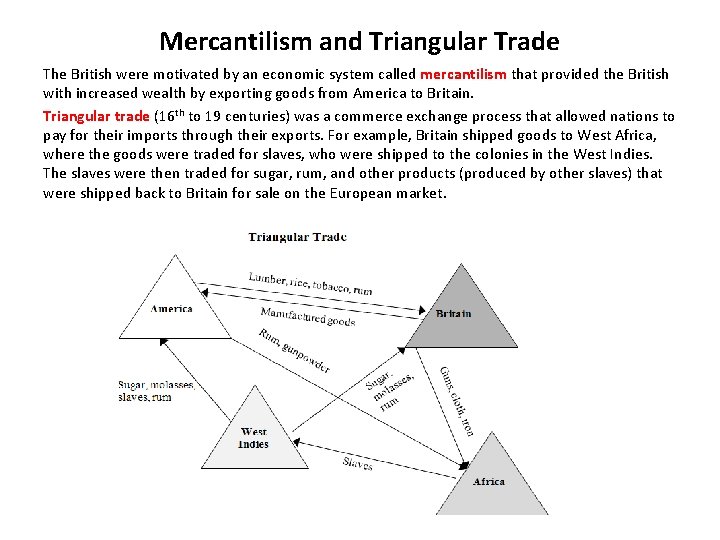
Mercantilism and Triangular Trade The British were motivated by an economic system called mercantilism that provided the British with increased wealth by exporting goods from America to Britain. Triangular trade (16 th to 19 centuries) was a commerce exchange process that allowed nations to pay for their imports through their exports. For example, Britain shipped goods to West Africa, where the goods were traded for slaves, who were shipped to the colonies in the West Indies. The slaves were then traded for sugar, rum, and other products (produced by other slaves) that were shipped back to Britain for sale on the European market.
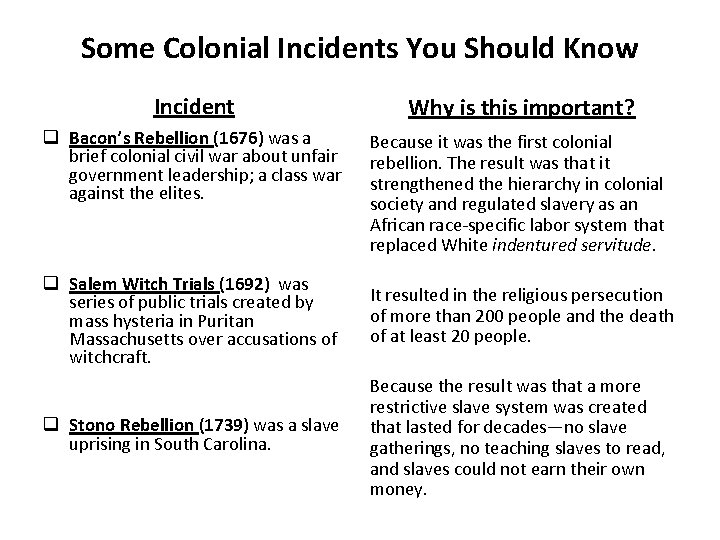
Some Colonial Incidents You Should Know Incident Why is this important? q Bacon’s Rebellion (1676) was a brief colonial civil war about unfair government leadership; a class war against the elites. Because it was the first colonial rebellion. The result was that it strengthened the hierarchy in colonial society and regulated slavery as an African race-specific labor system that replaced White indentured servitude. q Salem Witch Trials (1692) was series of public trials created by mass hysteria in Puritan Massachusetts over accusations of witchcraft. It resulted in the religious persecution of more than 200 people and the death of at least 20 people. q Stono Rebellion (1739) was a slave uprising in South Carolina. Because the result was that a more restrictive slave system was created that lasted for decades—no slave gatherings, no teaching slaves to read, and slaves could not earn their own money.
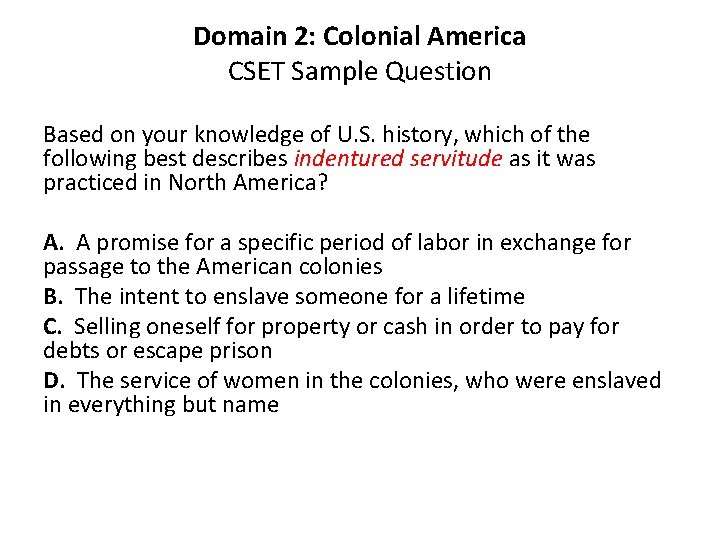
Domain 2: Colonial America CSET Sample Question Based on your knowledge of U. S. history, which of the following best describes indentured servitude as it was practiced in North America? A. A promise for a specific period of labor in exchange for passage to the American colonies B. The intent to enslave someone for a lifetime C. Selling oneself for property or cash in order to pay for debts or escape prison D. The service of women in the colonies, who were enslaved in everything but name

Answer Based on your knowledge of U. S. history, which of the following best describes indentured servitude as it was practiced in North America? A. A promise for a specific period of labor in exchange for passage to the American colonies B. The intent to enslave someone for a lifetime C. Selling oneself for property or cash in order to pay for debts or escape prison D. The service of women in the colonies, who were enslaved in everything but name Choice A. Based on history, colonists practiced indentured servitude. Passage to the New World was given to persons in exchange for approximately 4 to 7 years of labor. Choice B describes slavery. Choices C and D were not labor systems that existed among the colonies.
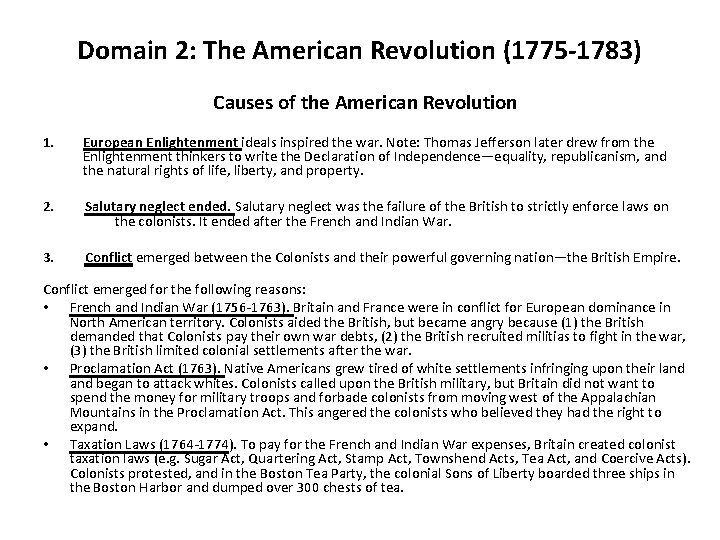
Domain 2: The American Revolution (1775 -1783) Causes of the American Revolution 1. European Enlightenment ideals inspired the war. Note: Thomas Jefferson later drew from the Enlightenment thinkers to write the Declaration of Independence—equality, republicanism, and the natural rights of life, liberty, and property. 2. Salutary neglect ended. Salutary neglect was the failure of the British to strictly enforce laws on the colonists. It ended after the French and Indian War. 3. Conflict emerged between the Colonists and their powerful governing nation—the British Empire. Conflict emerged for the following reasons: • French and Indian War (1756 -1763). Britain and France were in conflict for European dominance in North American territory. Colonists aided the British, but became angry because (1) the British demanded that Colonists pay their own war debts, (2) the British recruited militias to fight in the war, (3) the British limited colonial settlements after the war. • Proclamation Act (1763). Native Americans grew tired of white settlements infringing upon their land began to attack whites. Colonists called upon the British military, but Britain did not want to spend the money for military troops and forbade colonists from moving west of the Appalachian Mountains in the Proclamation Act. This angered the colonists who believed they had the right to expand. • Taxation Laws (1764 -1774). To pay for the French and Indian War expenses, Britain created colonist taxation laws (e. g. Sugar Act, Quartering Act, Stamp Act, Townshend Acts, Tea Act, and Coercive Acts). Colonists protested, and in the Boston Tea Party, the colonial Sons of Liberty boarded three ships in the Boston Harbor and dumped over 300 chests of tea.
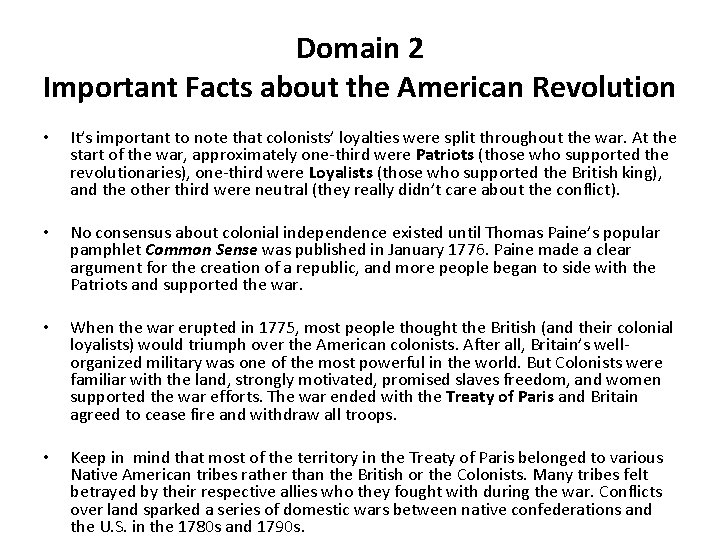
Domain 2 Important Facts about the American Revolution • It’s important to note that colonists’ loyalties were split throughout the war. At the start of the war, approximately one-third were Patriots (those who supported the revolutionaries), one-third were Loyalists (those who supported the British king), and the other third were neutral (they really didn’t care about the conflict). • No consensus about colonial independence existed until Thomas Paine’s popular pamphlet Common Sense was published in January 1776. Paine made a clear argument for the creation of a republic, and more people began to side with the Patriots and supported the war. • When the war erupted in 1775, most people thought the British (and their colonial loyalists) would triumph over the American colonists. After all, Britain’s wellorganized military was one of the most powerful in the world. But Colonists were familiar with the land, strongly motivated, promised slaves freedom, and women supported the war efforts. The war ended with the Treaty of Paris and Britain agreed to cease fire and withdraw all troops. • Keep in mind that most of the territory in the Treaty of Paris belonged to various Native American tribes rather than the British or the Colonists. Many tribes felt betrayed by their respective allies who they fought with during the war. Conflicts over land sparked a series of domestic wars between native confederations and the U. S. in the 1780 s and 1790 s.
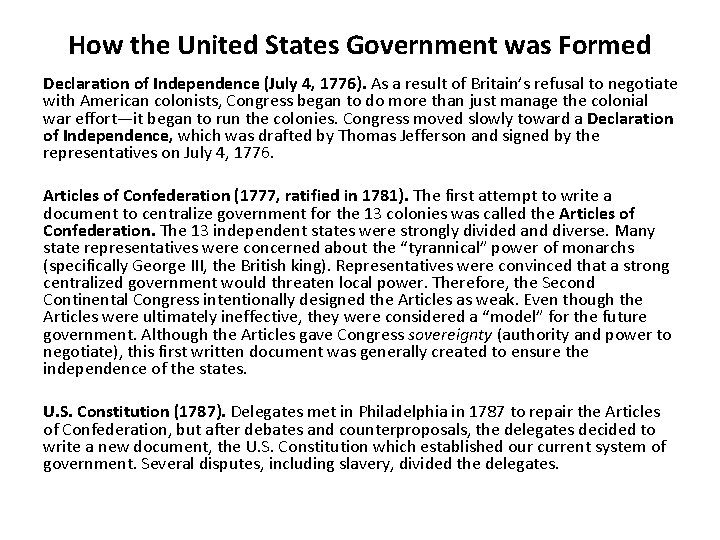
How the United States Government was Formed Declaration of Independence (July 4, 1776). As a result of Britain’s refusal to negotiate with American colonists, Congress began to do more than just manage the colonial war effort—it began to run the colonies. Congress moved slowly toward a Declaration of Independence, which was drafted by Thomas Jefferson and signed by the representatives on July 4, 1776. Articles of Confederation (1777, ratified in 1781). The first attempt to write a document to centralize government for the 13 colonies was called the Articles of Confederation. The 13 independent states were strongly divided and diverse. Many state representatives were concerned about the “tyrannical” power of monarchs (specifically George III, the British king). Representatives were convinced that a strong centralized government would threaten local power. Therefore, the Second Continental Congress intentionally designed the Articles as weak. Even though the Articles were ultimately ineffective, they were considered a “model” for the future government. Although the Articles gave Congress sovereignty (authority and power to negotiate), this first written document was generally created to ensure the independence of the states. U. S. Constitution (1787). Delegates met in Philadelphia in 1787 to repair the Articles of Confederation, but after debates and counterproposals, the delegates decided to write a new document, the U. S. Constitution which established our current system of government. Several disputes, including slavery, divided the delegates.
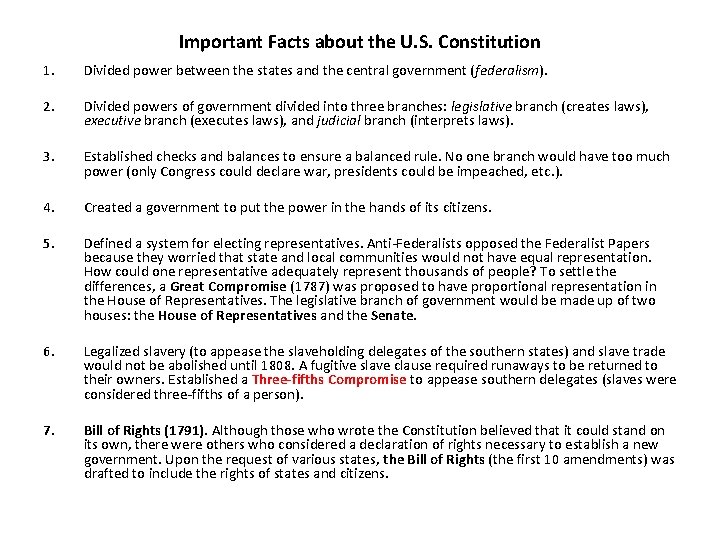
Important Facts about the U. S. Constitution 1. Divided power between the states and the central government (federalism). 2. Divided powers of government divided into three branches: legislative branch (creates laws), executive branch (executes laws), and judicial branch (interprets laws). 3. Established checks and balances to ensure a balanced rule. No one branch would have too much power (only Congress could declare war, presidents could be impeached, etc. ). 4. Created a government to put the power in the hands of its citizens. 5. Defined a system for electing representatives. Anti-Federalists opposed the Federalist Papers because they worried that state and local communities would not have equal representation. How could one representative adequately represent thousands of people? To settle the differences, a Great Compromise (1787) was proposed to have proportional representation in the House of Representatives. The legislative branch of government would be made up of two houses: the House of Representatives and the Senate. 6. Legalized slavery (to appease the slaveholding delegates of the southern states) and slave trade would not be abolished until 1808. A fugitive slave clause required runaways to be returned to their owners. Established a Three-fifths Compromise to appease southern delegates (slaves were considered three-fifths of a person). 7. Bill of Rights (1791). Although those who wrote the Constitution believed that it could stand on its own, there were others who considered a declaration of rights necessary to establish a new government. Upon the request of various states, the Bill of Rights (the first 10 amendments) was drafted to include the rights of states and citizens.
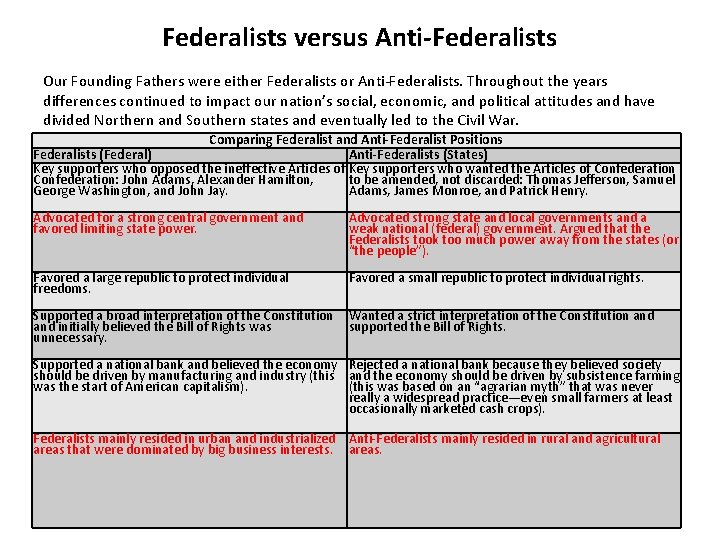
Federalists versus Anti-Federalists Our Founding Fathers were either Federalists or Anti-Federalists. Throughout the years differences continued to impact our nation’s social, economic, and political attitudes and have divided Northern and Southern states and eventually led to the Civil War. Comparing Federalist and Anti-Federalist Positions Federalists (Federal) Anti-Federalists (States) Key supporters who opposed the ineffective Articles of Key supporters who wanted the Articles of Confederation: John Adams, Alexander Hamilton, to be amended, not discarded: Thomas Jefferson, Samuel George Washington, and John Jay. Adams, James Monroe, and Patrick Henry. Advocated for a strong central government and favored limiting state power. Advocated strong state and local governments and a weak national (federal) government. Argued that the Federalists took too much power away from the states (or “the people”). Favored a large republic to protect individual freedoms. Favored a small republic to protect individual rights. Supported a broad interpretation of the Constitution Wanted a strict interpretation of the Constitution and initially believed the Bill of Rights was supported the Bill of Rights. unnecessary. Supported a national bank and believed the economy Rejected a national bank because they believed society should be driven by manufacturing and industry (this and the economy should be driven by subsistence farming was the start of American capitalism). (this was based on an “agrarian myth” that was never really a widespread practice—even small farmers at least occasionally marketed cash crops). Federalists mainly resided in urban and industrialized Anti-Federalists mainly resided in rural and agricultural areas that were dominated by big business interests. areas.
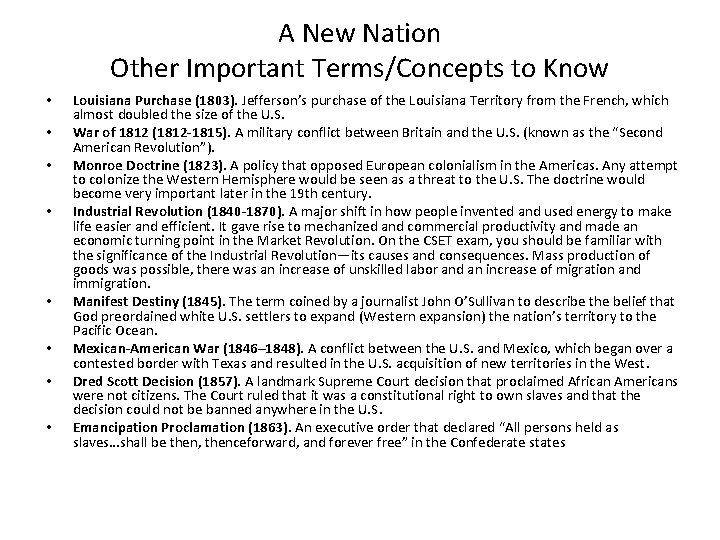
A New Nation Other Important Terms/Concepts to Know • • Louisiana Purchase (1803). Jefferson’s purchase of the Louisiana Territory from the French, which almost doubled the size of the U. S. War of 1812 (1812 -1815). A military conflict between Britain and the U. S. (known as the “Second American Revolution”). Monroe Doctrine (1823). A policy that opposed European colonialism in the Americas. Any attempt to colonize the Western Hemisphere would be seen as a threat to the U. S. The doctrine would become very important later in the 19 th century. Industrial Revolution (1840 -1870). A major shift in how people invented and used energy to make life easier and efficient. It gave rise to mechanized and commercial productivity and made an economic turning point in the Market Revolution. On the CSET exam, you should be familiar with the significance of the Industrial Revolution—its causes and consequences. Mass production of goods was possible, there was an increase of unskilled labor and an increase of migration and immigration. Manifest Destiny (1845). The term coined by a journalist John O’Sullivan to describe the belief that God preordained white U. S. settlers to expand (Western expansion) the nation’s territory to the Pacific Ocean. Mexican-American War (1846– 1848). A conflict between the U. S. and Mexico, which began over a contested border with Texas and resulted in the U. S. acquisition of new territories in the West. Dred Scott Decision (1857). A landmark Supreme Court decision that proclaimed African Americans were not citizens. The Court ruled that it was a constitutional right to own slaves and that the decision could not be banned anywhere in the U. S. Emancipation Proclamation (1863). An executive order that declared “All persons held as slaves…shall be then, thenceforward, and forever free” in the Confederate states
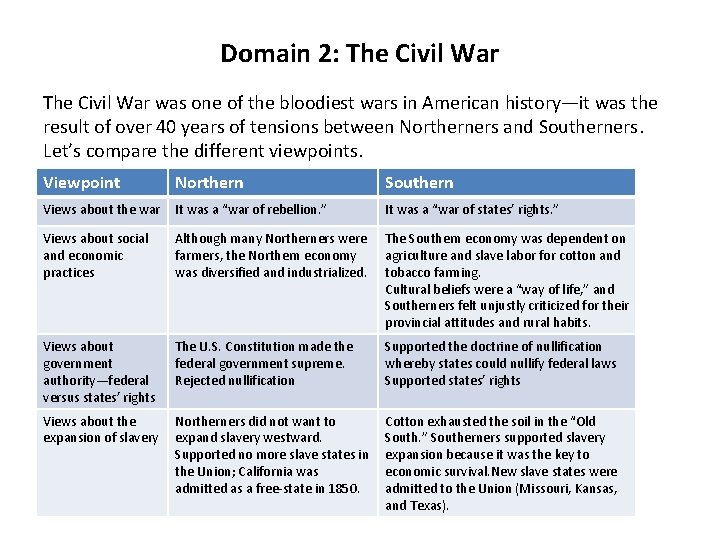
Domain 2: The Civil War was one of the bloodiest wars in American history—it was the result of over 40 years of tensions between Northerners and Southerners. Let’s compare the different viewpoints. Viewpoint Northern Southern Views about the war It was a “war of rebellion. ” It was a “war of states’ rights. ” Views about social and economic practices Although many Northerners were farmers, the Northern economy was diversified and industrialized. The Southern economy was dependent on agriculture and slave labor for cotton and tobacco farming. Cultural beliefs were a “way of life, ” and Southerners felt unjustly criticized for their provincial attitudes and rural habits. Views about government authority—federal versus states’ rights The U. S. Constitution made the federal government supreme. Rejected nullification Supported the doctrine of nullification whereby states could nullify federal laws Supported states’ rights Views about the expansion of slavery Northerners did not want to expand slavery westward. Supported no more slave states in the Union; California was admitted as a free-state in 1850. Cotton exhausted the soil in the “Old South. ” Southerners supported slavery expansion because it was the key to economic survival. New slave states were admitted to the Union (Missouri, Kansas, and Texas).
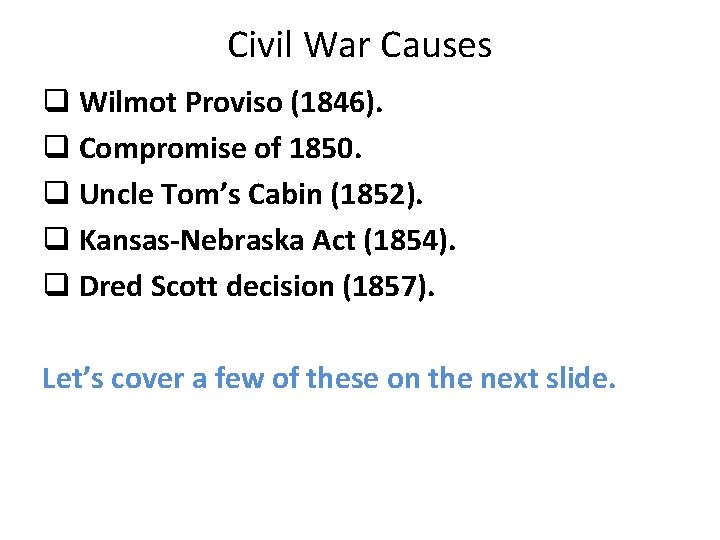
Civil War Causes q Wilmot Proviso (1846). q Compromise of 1850. q Uncle Tom’s Cabin (1852). q Kansas-Nebraska Act (1854). q Dred Scott decision (1857). Let’s cover a few of these on the next slide.
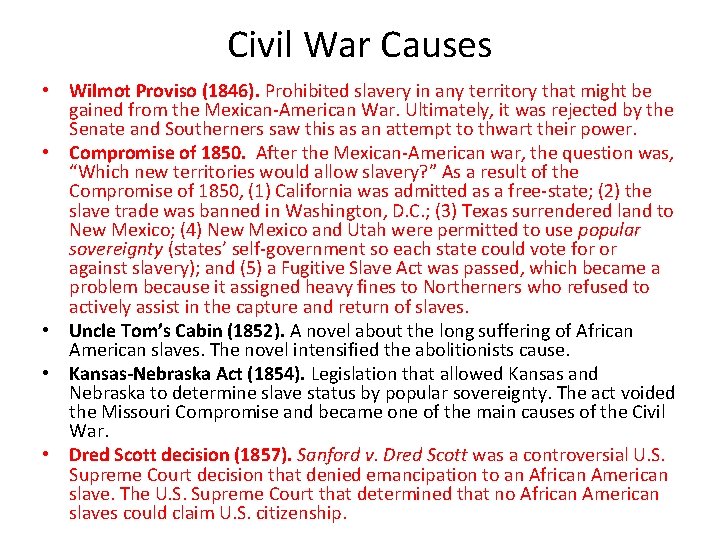
Civil War Causes • Wilmot Proviso (1846). Prohibited slavery in any territory that might be gained from the Mexican-American War. Ultimately, it was rejected by the Senate and Southerners saw this as an attempt to thwart their power. • Compromise of 1850. After the Mexican-American war, the question was, “Which new territories would allow slavery? ” As a result of the Compromise of 1850, (1) California was admitted as a free-state; (2) the slave trade was banned in Washington, D. C. ; (3) Texas surrendered land to New Mexico; (4) New Mexico and Utah were permitted to use popular sovereignty (states’ self-government so each state could vote for or against slavery); and (5) a Fugitive Slave Act was passed, which became a problem because it assigned heavy fines to Northerners who refused to actively assist in the capture and return of slaves. • Uncle Tom’s Cabin (1852). A novel about the long suffering of African American slaves. The novel intensified the abolitionists cause. • Kansas-Nebraska Act (1854). Legislation that allowed Kansas and Nebraska to determine slave status by popular sovereignty. The act voided the Missouri Compromise and became one of the main causes of the Civil War. • Dred Scott decision (1857). Sanford v. Dred Scott was a controversial U. S. Supreme Court decision that denied emancipation to an African American slave. The U. S. Supreme Court that determined that no African American slaves could claim U. S. citizenship.
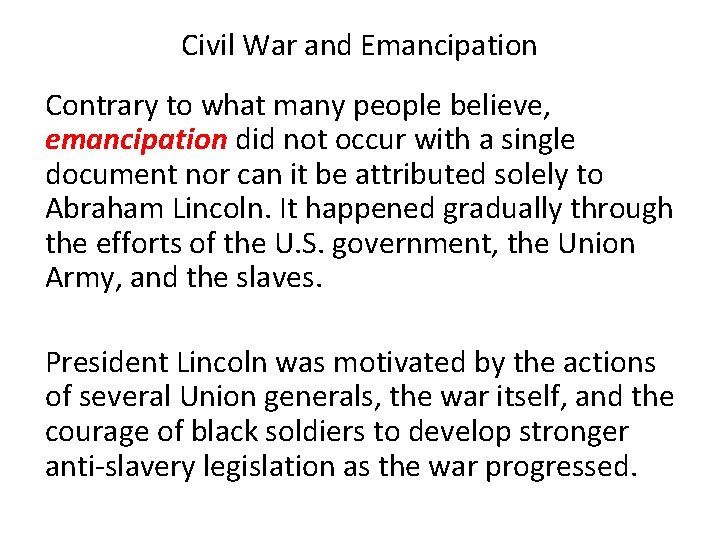
Civil War and Emancipation Contrary to what many people believe, emancipation did not occur with a single document nor can it be attributed solely to Abraham Lincoln. It happened gradually through the efforts of the U. S. government, the Union Army, and the slaves. President Lincoln was motivated by the actions of several Union generals, the war itself, and the courage of black soldiers to develop stronger anti-slavery legislation as the war progressed.
Reconstruction • Lincoln’s assassination (April 14, 1965). • Reconstruction was implemented by President Johnson. • Legislation lacked enforcement and soon Southerners took control of state governments. • Paramilitary groups formed (Ku Klux Klan) • Despite gaining freedom, 4 million African Americans faced conflicts and struggles for almost 100 years after the Civil War. • African Americans couldn’t vote, testify in court, serve in state militias, or own property. Vagrancy laws—which were applied to people who appeared jobless or homeless—even forced Black men and children to work for whites without pay. Through the Black Codes, Southern states found a new scheme to suppress emancipation.
Domain 2: A New Nation CSET Practice Question #1 “ By referring the matter from argument to arms, a new arena for politics is struck; a new method of thinking hath arisen. . . I have heard it asserted by some, that as America hath flourished under her former connection with Great Britain, that the same connection is necessary towards her future happiness, and will always have the same effect. …I answer roundly, that America would have flourished as much, and probably much more, had no European power had anything to do with her. The commerce, by which she hath enriched herself are the necessaries of life, and will always have a market while eating is the custom of Europe. ” —Source: Thomas Paine, Common Sense, 1776. 1. Which of the following best describes the colonial conflict that Paine is addressing in the excerpt from Common Sense? A. The frustration of the colonists with the British trade policies B. The tensions between different colonists, especially those arguing for either reconciliation or separation C. The British Parliament’s concern that the Continental Army had already begun a military engagement D. The jealousy between British colonists in North America and those in other parts of the world

Answer 1. Which of the following best describes the colonial conflict that Paine is addressing in the excerpt from Common Sense? A. The frustration of the colonists with the British trade policies B. The tensions between different colonists, especially those arguing for either reconciliation or separation C. The British Parliament’s concern that the Continental Army had already begun a military engagement D. The jealousy between British colonists in North America and those in other parts of the world Answer choice B is correct. Choice A. Although you may have been tempted to select choice A (the frustration of the colonists with the British trade policies), it is incorrect. Choice B. Paine’s passage addresses more than one reason for separation from the Mother Country. On the CSET exam, you should be familiar with Paine’s work, because he is one of the Founding Fathers of the U. S. Paine’s argument must relate to more than just trade. The passage specifically responds to those colonists who argue for reconciliation. Choices C and D are incorrect because Paine is reflecting an American perspective, not a British one.
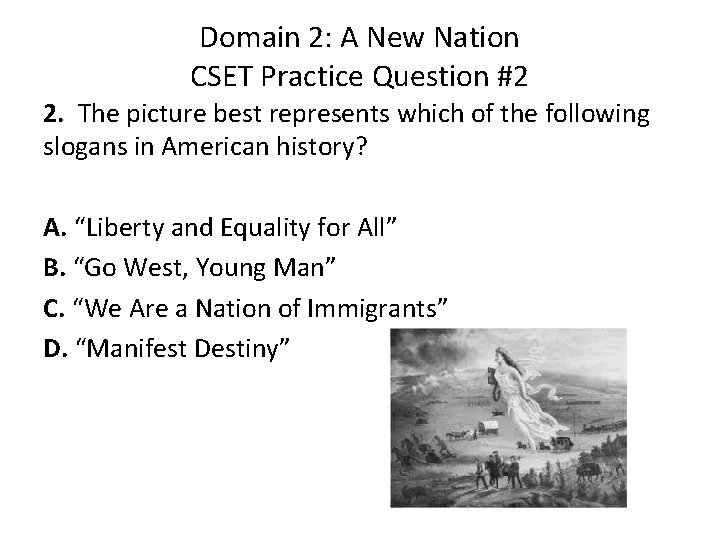
Domain 2: A New Nation CSET Practice Question #2 2. The picture best represents which of the following slogans in American history? A. “Liberty and Equality for All” B. “Go West, Young Man” C. “We Are a Nation of Immigrants” D. “Manifest Destiny”
Answer 2. Choice D. Manifest Destiny was the belief that the United States was ordained by God as a great nation and therefore was justified in expanding territorially from the Atlantic Ocean to the Pacific Ocean. The slogan gained popularity in 1845 in support of the annexation of the Oregon Territory and was used to justify subjugating Native Americans and Mexicans who lived in the American West. The concept of Manifest Destiny was also used to support war with Mexico (1846) and the subsequent territorial expansion of the United States. In the painting “American Progress, ” the artist Gast consciously advocated for Manifest Destiny. Gast used the female figure of Columbia (Greek goddess) as an allegorical icon symbolizing the United States. As Columbia moves across the West, Native Americans are no match for the progress and modernization she brings (railroads, telegraph, settlement) and flee before her. .
History and Social Science Domain 3: California History • California’s Pre-Columbian Period to the Gold Rush (1848) • California’s Economic, Political, and Cultural Developments (1850 s to 2000) Note: About 8 questions on the CSET will focus on California History.
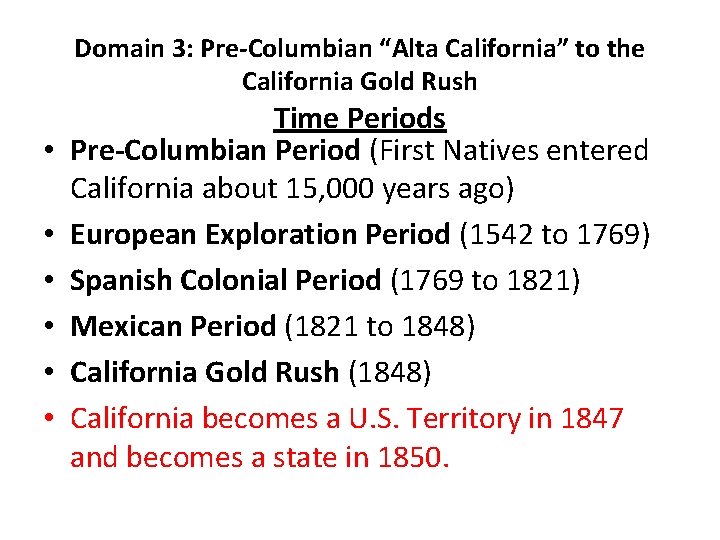
Domain 3: Pre-Columbian “Alta California” to the California Gold Rush • • • Time Periods Pre-Columbian Period (First Natives entered California about 15, 000 years ago) European Exploration Period (1542 to 1769) Spanish Colonial Period (1769 to 1821) Mexican Period (1821 to 1848) California Gold Rush (1848) California becomes a U. S. Territory in 1847 and becomes a state in 1850.
Spanish Colonial Period in California • Spaniards conquered regions from Mexico in today’s California, New Mexico, Arizona, Florida, and Texas in the 1500 s. • Spaniards wanted to expand world dominance, gain wealth, and spread religion. • Russian excursions along Northern California motivated the Spaniards to colonize. • The Spaniards (Franciscan friars headed by Father Serra) established 21 missions to claim their territory along the El Camino Real. By 1836, when Mexico ruled California, missions were privately owned. • Natives were often enslaved by the Spaniards by “sword” and “cross. ”
Mexican Colonial Period in California (1821 -1846) • Mexico gained independence from Spain in 1822 and California became a territory of Mexico. • When Mexico ruled in California it was called Alta California and Californians wanted control of local political matters. • The sale of Spanish mission lands in land grants gave power to landowners. Some Californians sought help from Europeans to be free from Mexico’s rule. • American trappers opened California to settlement. • The Mexican-American War in the Treaty of Guadalupe Hidalgo (1848) granted Mexican cession of Alta California to the United States. • California was admitted to the U. S. Union in 1850.
What was the Mexican-American War about? • The war between the U. S. and Mexico started because of the U. S. annexation of Texas (Texas became independent from Mexico and joined the U. S. in 1845). • Tensions rose again in 1846 over a border dispute because the U. S. wanted to expand territory, “Manifest Destiny, ” across the entire U. S. to the Pacific Ocean. • Mexico lost one-third of its territory to the U. S. (California, Utah, Nevada, Arizona, and New Mexico).
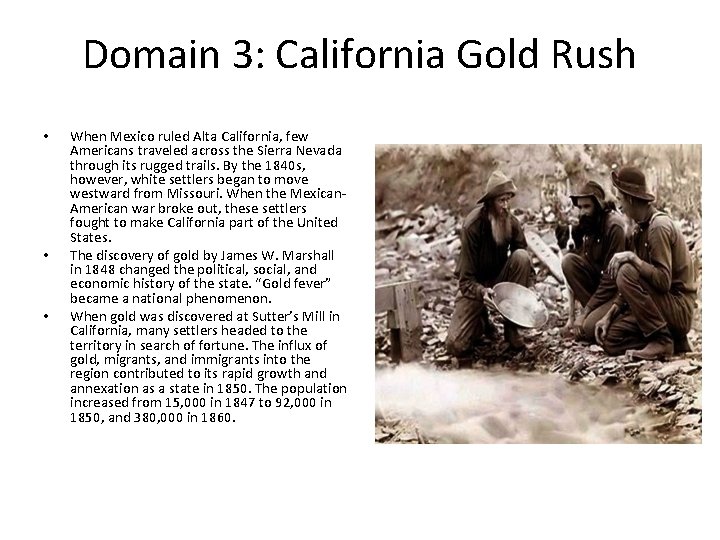
Domain 3: California Gold Rush • • • When Mexico ruled Alta California, few Americans traveled across the Sierra Nevada through its rugged trails. By the 1840 s, however, white settlers began to move westward from Missouri. When the Mexican. American war broke out, these settlers fought to make California part of the United States. The discovery of gold by James W. Marshall in 1848 changed the political, social, and economic history of the state. “Gold fever” became a national phenomenon. When gold was discovered at Sutter’s Mill in California, many settlers headed to the territory in search of fortune. The influx of gold, migrants, and immigrants into the region contributed to its rapid growth and annexation as a state in 1850. The population increased from 15, 000 in 1847 to 92, 000 in 1850, and 380, 000 in 1860.
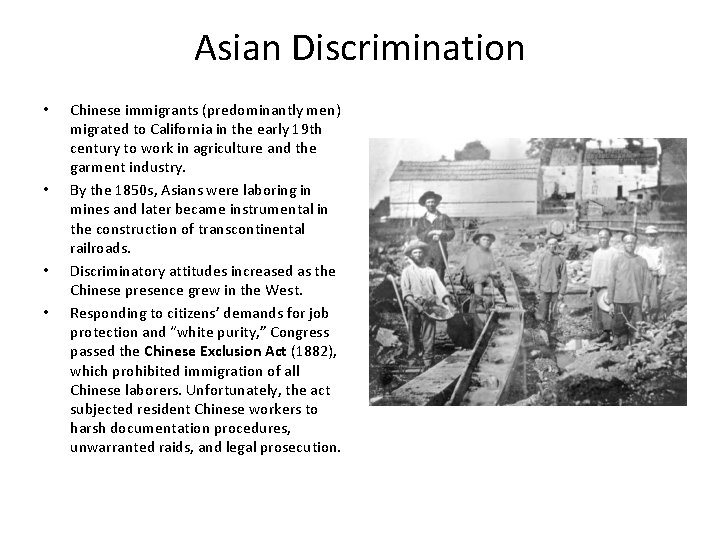
Asian Discrimination • • Chinese immigrants (predominantly men) migrated to California in the early 19 th century to work in agriculture and the garment industry. By the 1850 s, Asians were laboring in mines and later became instrumental in the construction of transcontinental railroads. Discriminatory attitudes increased as the Chinese presence grew in the West. Responding to citizens’ demands for job protection and “white purity, ” Congress passed the Chinese Exclusion Act (1882), which prohibited immigration of all Chinese laborers. Unfortunately, the act subjected resident Chinese workers to harsh documentation procedures, unwarranted raids, and legal prosecution.
Modern Day California • By the 20 th century, immigration caused the population to swell in California. • The oil industry, movie industry, and agriculture caused an economic and real estate boom in California. • The Panama Canal (1914) opened exports and imports. • The Great Depression hit California and the Dust Bowl migrants. Competition for agricultural jobs made Mexican workers a target. • After World War II, California had an economic revitalization. However, Japanese Americans were forced into detention campus (1942). • Defense contracts fueled economic prosperity in California. • California now has some of the strictest environmental laws in the United States.
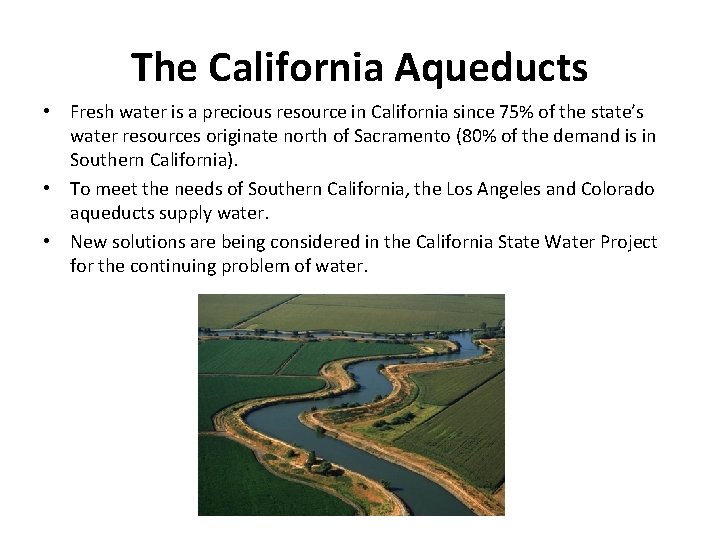
The California Aqueducts • Fresh water is a precious resource in California since 75% of the state’s water resources originate north of Sacramento (80% of the demand is in Southern California). • To meet the needs of Southern California, the Los Angeles and Colorado aqueducts supply water. • New solutions are being considered in the California State Water Project for the continuing problem of water.
Domain 3 CSET Sample Question #1 1. The primary reason that Spain sent explorers to Alta California in the sixteenth century was to A. prevent other European powers from claiming California. B. establish commercial treaties with the native population. C. discover a water passage that connected the Atlantic and Pacific Oceans. D. establish missions to convert the Indians.
Answer Choice C. Starting with Cortez in 1553, Spanish explorers were sent by the Spanish king to discover a short water route that connected the Atlantic and Pacific Oceans. The waterway was called by the Spanish the Strait of Anian. Such a discovery would enable Spain to sail to Asia from the New World without sailing around South America. Spain could bypass European middlemen to obtain for themselves the valuable spices and silks of Asia. Cortez and Cabrillo failed to find the Strait of Anian (geographically such a strait does not exist), but their explorations led to the discovery of Baja California by Cortez and the exploration of Alta (upper) California by Cabrillo in 1542– 43. Cabrillo is credited with the discovery of California.
Domain 3: Sample Question #2 2. Cinco de Mayo (the 5 th of May) is observed in many California schools with celebrations of Mexican culture, food, music, and customs. Which of the following is a correct statement regarding what Cinco de Mayo actually stands for? A. The victory of Mexican rebels over Spain in 1821 and the independence of Mexico from Spain B. The victory of the Mexican militia in 1862 over the occupying French army in Mexico. C. The independence movement of Mexican nationals against the Americans during the Mexican-American War in 1846. D. The importance of Mexican victories during the Bear Flag Revolt in 1846.
Answer #2 Choice B. Cinco de Mayo commemorates the victory of the poorly equipped Mexican militia over the occupying French army in 1862. It is popularly misunderstood as Mexican Independence Day, choice A. Mexico had incurred a large debt to France and other European nations following the Mexican-American War (1846). France used the debt crisis in an attempt to expand its empire and invade Mexico. After initial success at Veracruz, the French army was defeated at the Battle of Puebla (1862). Today, Cinco de Mayo is celebrated in California and other areas that have a high percentage of people with Mexican heritage. The celebrations recognize the role of Mexican culture in California.
Practice a History Constructed Response Essay (if time permits) Let’s review some of the strategies for a constructed-response essay. • • PRE-WRITE USING CLUSTERING, OUTLINING, ETC. WRITE COMPLETE, CLEAR, AND CONCISE SENTENCES. INCLUDE SUPPORTING FACTS, DETAILS, AND BUZZWORDS. IF YOU GET STUCK, THINK OF THE ACRONYM SPRITE FOR HISTORY ESSAYS. SOCIAL POLITICAL RELIGIOUS IDEOLOGCAL TECHNOLOGICAL ECONOMIC
When thinking about “SPRITE, ” ask yourself, what are some of the causes or reasons for a historical event? For example, what were the causes of the fall of the Roman Empire: • Social/political: The rapid growth of the Roman Empire made it necessary for the Roman army to protect its borders from invaders. They needed a larger army to control society and outside attacks from the Barbarians and German tribes. • Political: The leadership was comprised of aristocrats and the military. The military became corrupt and disloyal to the government. Eventually, rulers were unable to manage the large geographic area without help of the military leaders. Problems with political corruption and betrayals ensued. • Religious: Christian values conflicted with the empire’s authoritarian values. This later changed when Constantine tried to united Rome by adopting Christianity as the empire’s main religious identity. • Ideological: Decline in citizenry. The civic morale declined because there was a strict class system. Patriotism declined and diseases killed about a third of the people. • Economic: The economy declined due to high taxes to support the army. An economic warfare between the rich and the poor ensued. There were problems with food production and the slaves/peasants (the labor force) was fleeing the empire. Rome became dependent on foreign trade. Remember receiving at least 1 point on an essay question is better than receiving zero points!
CSET History Practice Essay Question Complete the exercise that follows. Political actions often result in political reactions. The Tea Act was passed in 1773 to protect British commercial interests. Using your knowledge of U. S. history, prepare a response in which you • Explain how the response to this tax was an evolution in the colonial reaction to British policy; and • Explain two specific British Parliamentary reactions passed in 1774 that restricted the rights of the colonists.
History Sample Essay The event in question was the 1773 Boston Tea Party. The British government passed the Tea Act in 1773. This gave a legal monopoly to the nearly bankrupt British East Company to ship tea directly to America. The Tea Act also kept a tax on imported tea and allowed the British East India Company to select the merchants to sell the tea. The colonists were outraged at yet another British attempt to restrict the colonies. Boston colonial leaders refused to allow the tea to be unloaded. As frustrations mounted, colonists disguised as Indians took matters into their own hands and dumped 230 barrels of tea into Boston Harbor. The colonial reaction was a direct escalation of American attempts to resist English taxation. Prior to the Tea Act, colonial protests to repeal British taxes included boycotts, embargoes, and nonimportation agreements. However, with the “Boston Tea Party, ” for the first time British property on a large scale was destroyed. This new style of defiance against British policy became a turning point in colonial resistance to British rule. The British government was outraged over what they saw as a wide-ranging colonial criminal activity. The British Parliament responded by passing the Coercive Acts in 1774 designed to directly punish the colonists in Boston. Two of these acts were (1) the port of Boston was closed until the tea was paid for. This caused unprecedented economic chaos in Boston since the livelihood of Boston was based on trade; and (2) the Quartering Act was passed that allowed British soldiers to occupy colonial buildings and homes at the expense of the colonials. The colonials considered this action a direct violation of their “Rights of Englishmen. ” The Coercive Acts did not break the will of colonial America; rather, it became a major factor in mobilizing public opinion against the British. The Coercive Acts were referred to as the “Intolerable Acts” by the colonists.
CSET FINAL ADVICE • Don’t leave any questions blank! • If you have moments of self-doubt, it is normal. Take a deep breath, you have already increased your odds for success by taking this prep class. • Practice, practice. Practice makes perfect. • If you feel overwhelmed, remember that you can take one Subtest at a time. GOOD LUCK!
- Slides: 93