
SUBSTITUTION TREATMENT IN THREE PORTUGUESE PRISONS M J
SUBSTITUTION TREATMENT IN THREE PORTUGUESE PRISONS M. J. Campos*; L. Fernandes**; J. Almeida*; L. Mendão*; R. Freitas* GAT – Grupo Português de Activistas sobre Tratamentos de VIH/SIDA* Faculdade de Psicologia e Ciências de Educação – Oporto University** Portugal Sponsored by DG JLS European Commission
Aims and objectives Reduction of drug-related crime in prisons – the impact of opioid substitution treatment (OST) on the manageability of opioid-dependent prisoners - Austria, England, Germany, Italy, Portugal, Slovenia, Spain • Extensive literature review on opioid substitution treatment in Europe • Qualitative interviews with key persons • Standardized questionnaires with inmates (one to one) • Standardized questionnaires with prison staff (health workers and guards)
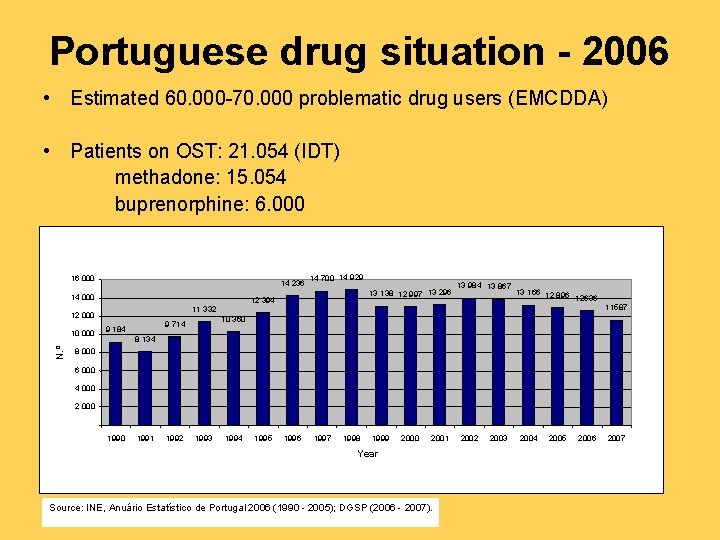
Portuguese drug situation - 2006 • Estimated 60. 000 -70. 000 problematic drug users (EMCDDA) • Patients on OST: 21. 054 (IDT) methadone: 15. 054 buprenorphine: 6. 000 16 000 14 236 14 000 N. º 13 138 12 997 13 296 12 394 13 984 13 867 13 166 12 896 12636 11587 11 332 12 000 10 000 14 700 14 929 10 360 9 714 9 184 8 134 8 000 6 000 4 000 2 000 1991 1992 1993 1994 1995 1996 1997 1998 1999 2000 2001 Year Source: INE, Anuário Estatístico de Portugal 2006 (1990 - 2005); DGSP (2006 - 2007). 2002 2003 2004 2005 2006 2007
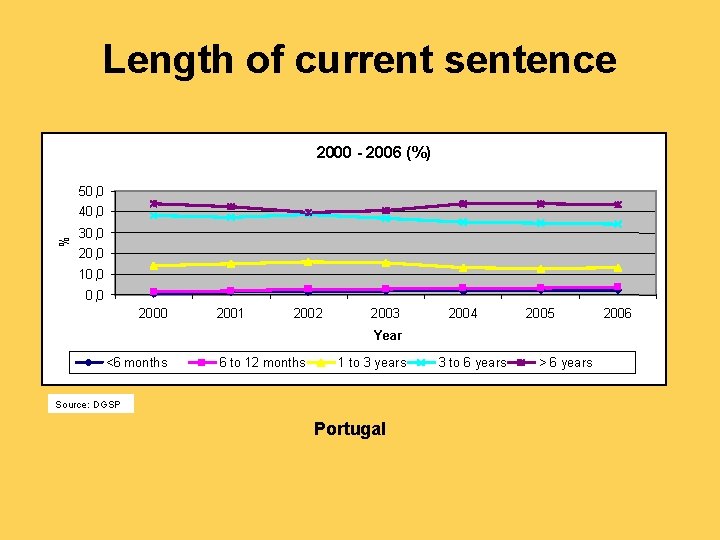
Length of current sentence 2000 - 2006 (%) 50, 0 % 40, 0 30, 0 20, 0 10, 0 2000 2001 2002 2003 2004 2005 Year <6 months 6 to 12 months 1 to 3 years Source: DGSP Portugal 3 to 6 years > 6 years 2006
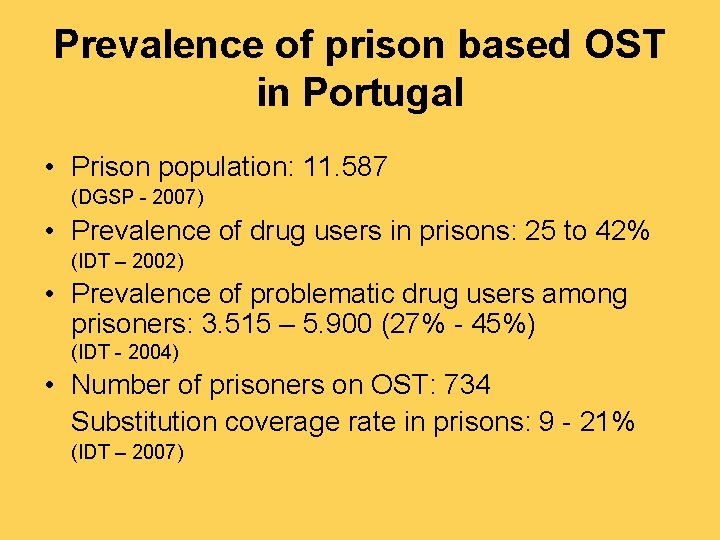
Prevalence of prison based OST in Portugal • Prison population: 11. 587 (DGSP - 2007) • Prevalence of drug users in prisons: 25 to 42% (IDT – 2002) • Prevalence of problematic drug users among prisoners: 3. 515 – 5. 900 (27% - 45%) (IDT - 2004) • Number of prisoners on OST: 734 Substitution coverage rate in prisons: 9 - 21% (IDT – 2007)
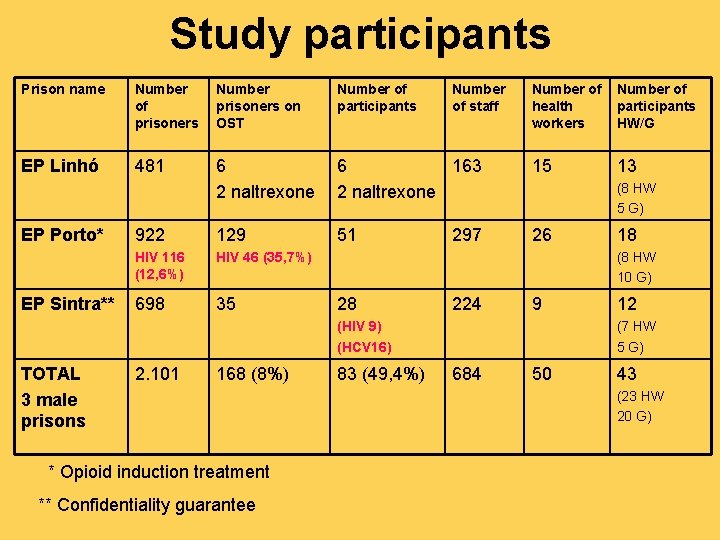
Study participants Prison name Number of prisoners Number prisoners on OST Number of participants EP Linhó 481 6 2 naltrexone 922 129 HIV 116 (12, 6%) HIV 46 (35, 7%) 698 35 EP Porto* EP Sintra** Number of staff Number of health workers Number of participants HW/G 6 163 2 naltrexone 15 13 51 26 297 (8 HW 5 G) (8 HW 10 G) 28 224 9 (HIV 9) (HCV 16) TOTAL 3 male prisons 2. 101 168 (8%) * Opioid induction treatment ** Confidentiality guarantee 18 83 (49, 4%) 12 (7 HW 5 G) 684 50 43 (23 HW 20 G)
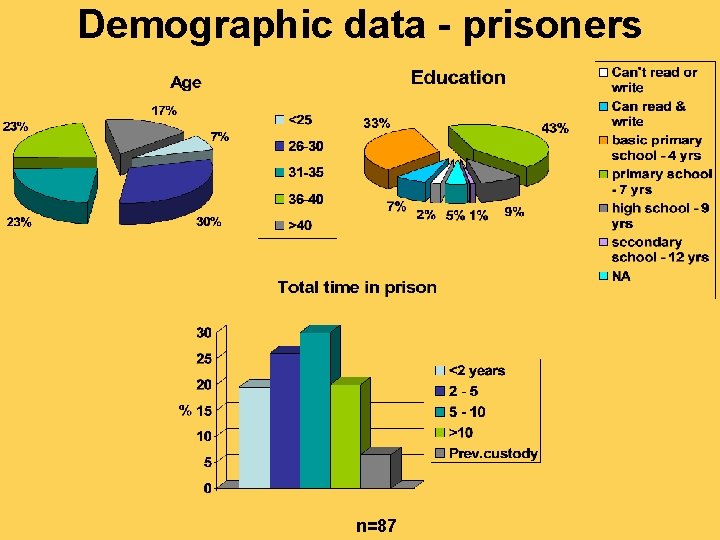
Demographic data - prisoners n=87
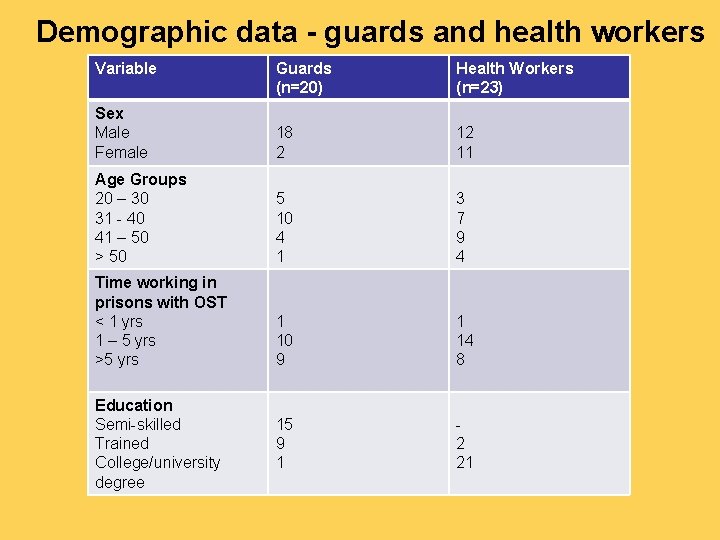
Demographic data - guards and health workers Variable Guards (n=20) Health Workers (n=23) Sex Male Female 18 2 12 11 Age Groups 20 – 30 31 - 40 41 – 50 > 50 5 10 4 1 3 7 9 4 Time working in prisons with OST < 1 yrs 1 – 5 yrs >5 yrs 1 10 9 1 14 8 15 9 1 2 21 Education Semi-skilled Trained College/university degree
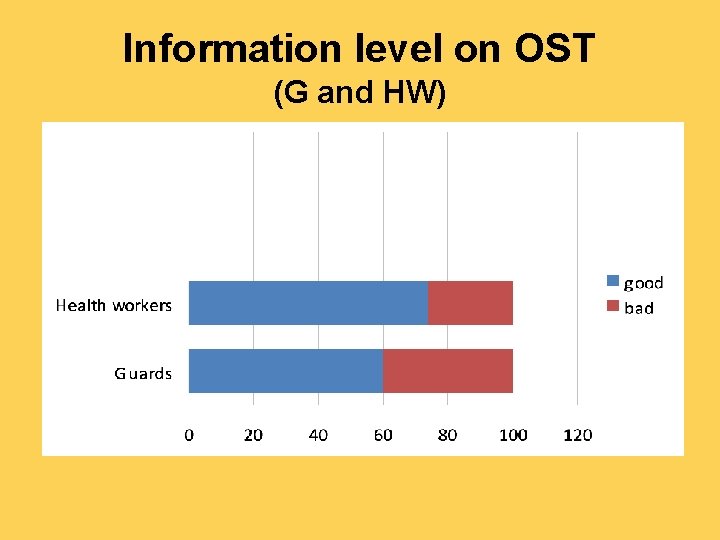
Information level on OST (G and HW)
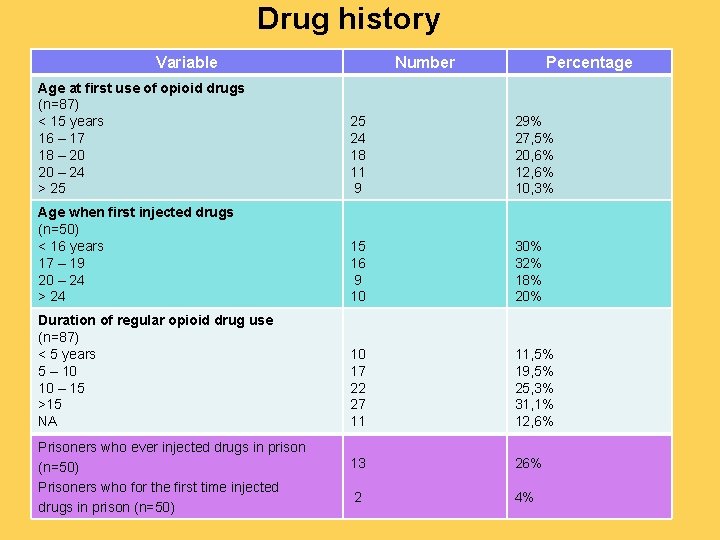
Drug history Variable Number Percentage Age at first use of opioid drugs (n=87) < 15 years 16 – 17 18 – 20 20 – 24 > 25 25 24 18 11 9 29% 27, 5% 20, 6% 12, 6% 10, 3% Age when first injected drugs (n=50) < 16 years 17 – 19 20 – 24 > 24 15 16 9 10 30% 32% 18% 20% Duration of regular opioid drug use (n=87) < 5 years 5 – 10 10 – 15 >15 NA 10 17 22 27 11 11, 5% 19, 5% 25, 3% 31, 1% 12, 6% 13 26% 2 4% Prisoners who ever injected drugs in prison (n=50) Prisoners who for the first time injected drugs in prison (n=50)
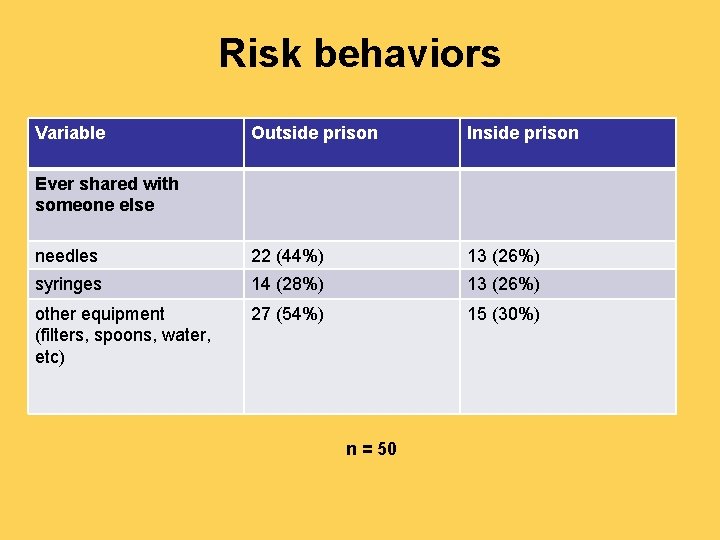
Risk behaviors Variable Outside prison Inside prison needles 22 (44%) 13 (26%) syringes 14 (28%) 13 (26%) other equipment (filters, spoons, water, etc) 27 (54%) 15 (30%) Ever shared with someone else n = 50
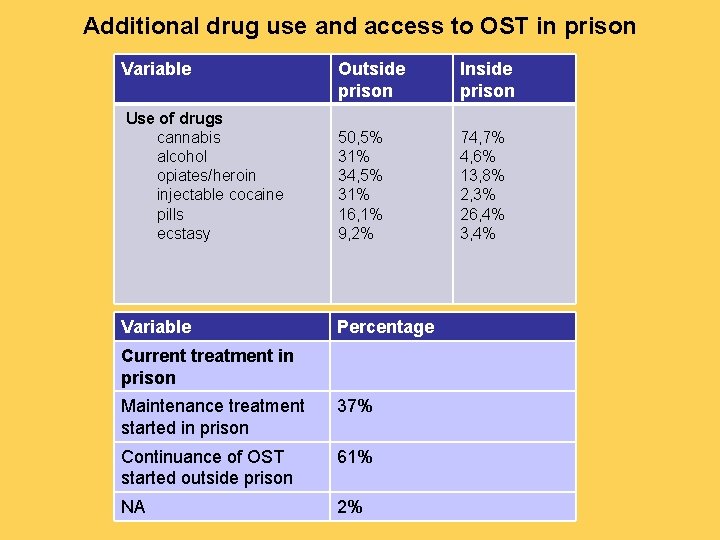
Additional drug use and access to OST in prison Variable Outside prison Inside prison Use of drugs cannabis alcohol opiates/heroin injectable cocaine pills ecstasy 50, 5% 31% 34, 5% 31% 16, 1% 9, 2% 74, 7% 4, 6% 13, 8% 2, 3% 26, 4% 3, 4% Variable Percentage Current treatment in prison Maintenance treatment started in prison 37% Continuance of OST started outside prison 61% NA 2%
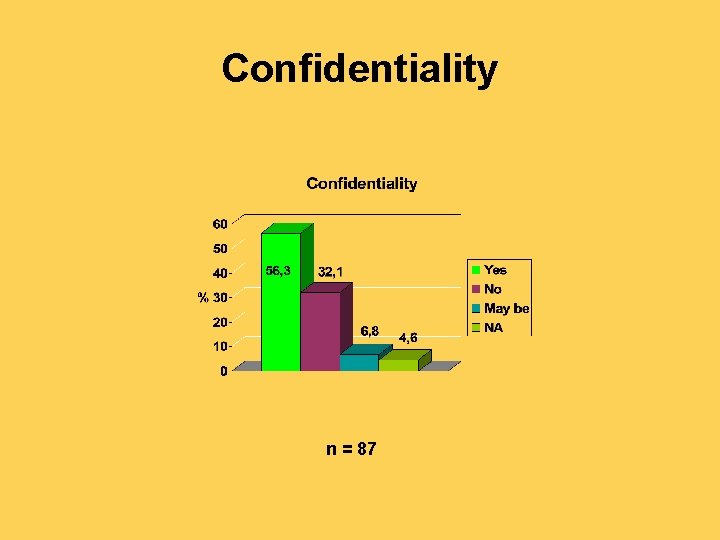
Confidentiality n = 87
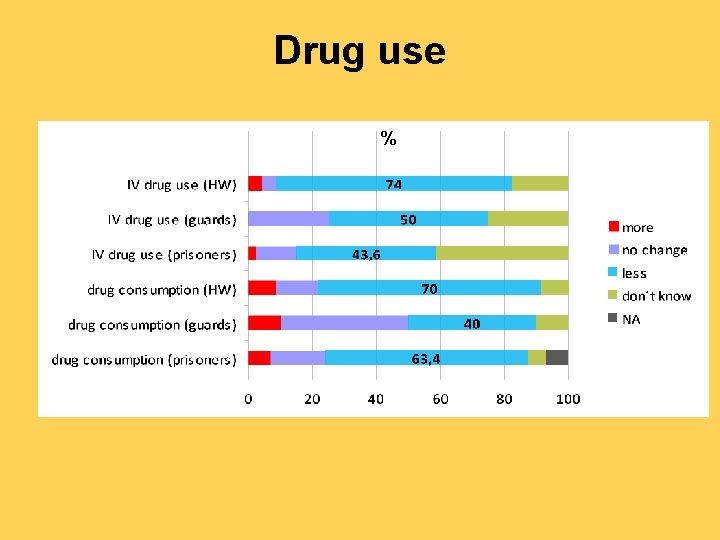
Drug use %
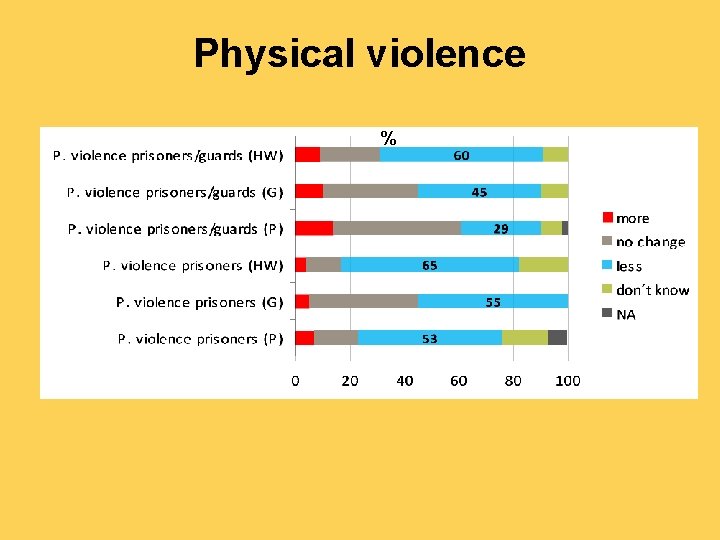
Physical violence %
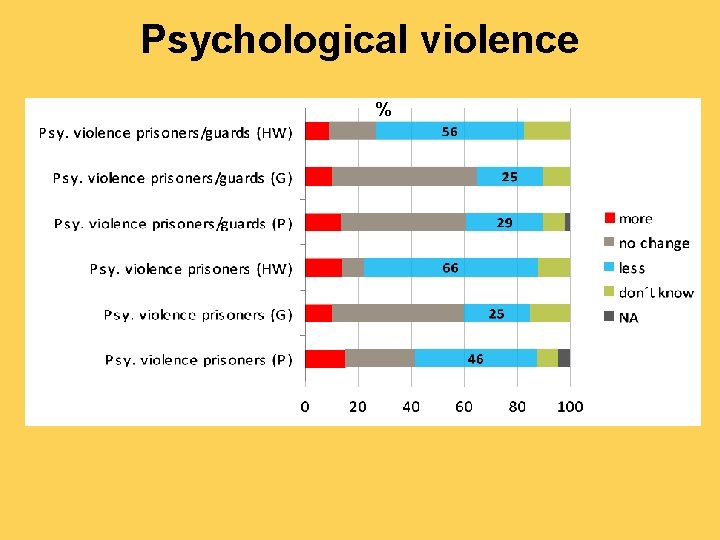
Psychological violence %
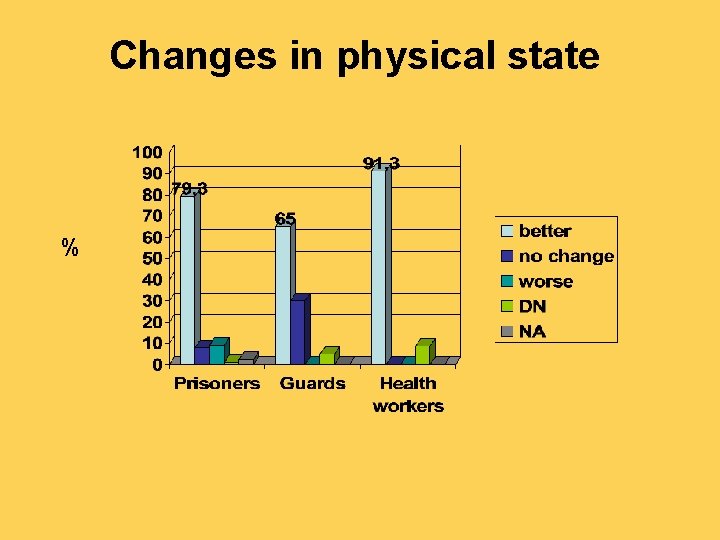
Changes in physical state %
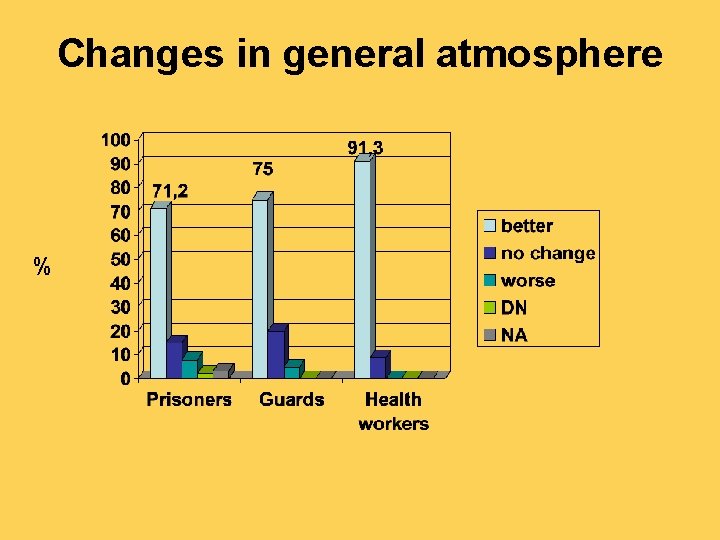
Changes in general atmosphere %
Study problems Bias in the study sample • The three prisons were chosen by DGSSP • Only one prison – Oporto – is actively inducing OST • Many guards refuse to participate • Unsafe environment - some prisoners admitted to lie during the interviews due to the fact they didn’t believe in the confidentiality
Findings When and where OST is available there is: • Improvement of the general prison atmosphere recognized both by prisoners and prison staff • Decrease of violence and conflicts between prisoners and guards • Reduction of illicit drug use and IV drug use • Improvement in prisoners physical, psychological and overall well-being
Study results Prisoners: – extreme long length of incarceration – 50% with > 5 yrs – increase of cannabis (50%) and pills (60%) consumers – 26% IVDU kept injecting in prison – syringe exchange programs, with severe limitations and without participants, only exists in two prisons (one covered by the study) – almost 50% of the responders considered access to OST difficult or very difficult Prison staff (health workers - guards): – poor information and training (25 - 40%) OST coverage – below official numbers 8% vs 9 - 21%
Recommendations I OST is a proven and effective strategy to successfully prevent HIV, AIDS and hepatitis among incarcerated injecting drug users. To be effective, OST should be: Based on the individual conditions and needs, taking into account their experiences and knowledge Organized as a multidisciplinary team Provided for the right period of time and at the right dosages Provided with the same substitution/maintenance drugs as in the community Provided with continuity, upon imprisonment and also following release and Have clear protocols and guidelines, with understandable rules Include psycho-social care, self-help groups and the support of NGOs
Recommendations II Education, information and training should be provided on treatment options as well as on the general impact of OST in prisons; OST should be integrated into existing drug and/or infectious disease prevention, treatment, care and support strategies; OST should become an understandable and transparent treatment option. Misconceptions and myths should be addressed; OST should be scaled up to cover all in need. Syringe exchange programs should urgently become effective and broadly accessible in Portuguese prisons

Acknowledgements • staff and prisoners who agreed to provide such wealth of information • the Portuguese study team and BISDRO – Bremem Institute for Drug Research, University of Bremen WIAD – Scientific Institute of the German Medical Association, Bonn Pedro Silvério Marques Ana Pisco Wim Vandevelde GAT – Grupo Português de Activistas sobre Tratamentos de VIH/SIDA WWW. GATPORTUGAL. ORG gatcontactos@gmail. com Faculdade de Psicologia e Ciências de Educação – Oporto University http: //sigarra. up. pt/fpceup/web_page. inicial
- Slides: 24