
Substitute Teacher Training and Protocols Ashford School 440
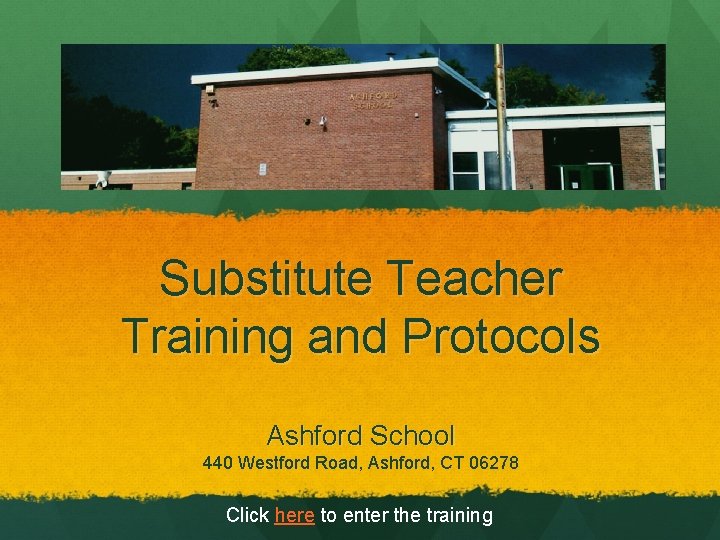
Substitute Teacher Training and Protocols Ashford School 440 Westford Road, Ashford, CT 06278 Click here to enter the training
Training Overview Click on each individual icon below to enter the specific training sequence: Classroom Management and Student Behavior School Policies and Procedures
Overview: Classroom Management and Student Behavior The purpose of this training session is to provide all substitute teachers with: • Strategies for establishing and maintaining student motivation • Approaches for constructively handling student discipline issues • A step-by-step protocol for the student removal and referral process Click to return to training overview Click to continue
Get to Know the Class Begin each day in the classroom familiarizing yourself with the information left by the classroom teacher. This will often include important information about: Students who have specific behavior plans Accommodations for special education students If applicable, seating charts Often, you can avoid many smaller behavioral issues by sticking to the routine that the students are familiar with. Click to Continue
Be Sure You Understand the Lesson Plans Read the lesson plans thoroughly. Be sure to identify any pieces of the lesson that you need to differentiate for specific students Each teacher should have identified a substitute partner teacher. If you have any confusion about sub plans or have any specific questions, seek this person out before the school day begins Follow the lesson plans as closely as possible. If a situation arises where certain tasks were not accomplished, make sure you leave a general explanation with feedback for the classroom teacher so they know where to pick up instruction upon their return Click to Continue
Strategies for Behavior Management When dealing with minor behavioral infractions (inappropriate clothing, disrupting the learning of others, horse-play, throwing objects, teasing, not listening, etc. ), use the following strategies to redirect the students involved: Proximity- Often your presence when standing near a student who is off task will be enough to redirect them Peer Role-Model- Acknowledging examples of positive behavior works well to reinforce expectations and redirect off-task behavior Seat Change- If behavior persists, move a student’s seat to an area of the classroom where they will be less likely to distract others or to be distracted Private Conversation- Have a private discussion with the student in the hallway, where you can address their behavior without their peers hearing the conversation Use the Sub Partner- If a student is finding it difficult to stay on task, or if their behavioral plan allows it, have them complete their work in the Sub Partners classroom Click to Continue
Major Behavior Infractions All students who has a major behavioral infraction should immediately be sent to the main school office However… Please consider a student’s behavior plan, prior to making any decisions in regards to removal from the classroom. Examples of major behavioral infractions include but are not limited to: - Verbal Threats (“I will kill you!”) For younger students this should be handled with discretion. - Causing physical harm to others or to themselves - Obscene language. For younger students this should be handled with discretion. - Breaking or damaging property - Threat to the teacher/major classroom disruption - Misuse of computers (visiting inappropriate sites) Click to continue
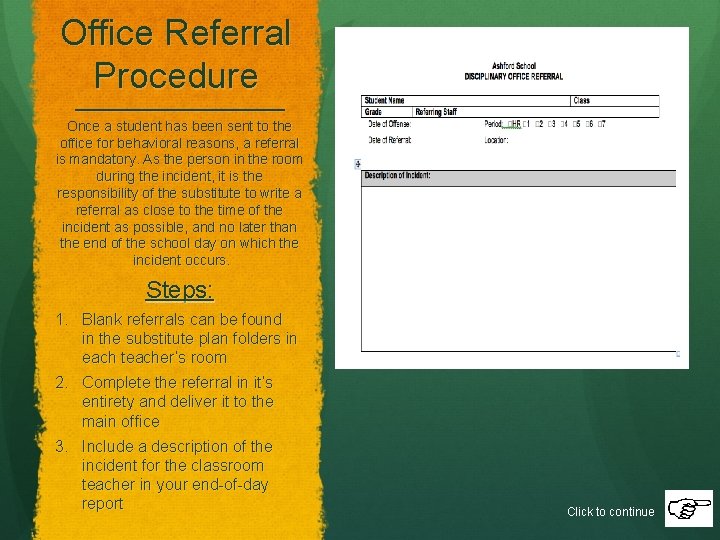
Office Referral Procedure _____________________ Once a student has been sent to the office for behavioral reasons, a referral is mandatory. As the person in the room during the incident, it is the responsibility of the substitute to write a referral as close to the time of the incident as possible, and no later than the end of the school day on which the incident occurs. Steps: 1. Blank referrals can be found in the substitute plan folders in each teacher’s room 2. Complete the referral in it’s entirety and deliver it to the main office 3. Include a description of the incident for the classroom teacher in your end-of-day report Click to continue
Remember… They are just kids… For more information on managing student motivation and behavior, visit the following helpful site: http: //www. livesinthebalance. org/walking-tour-educators Like adults, kids aren’t perfect. They make mistakes in their pursuit of learning about themselves and the world. If a student is not doing the right thing, don’t be afraid to talk to them. Showing that you genuinely care about their thoughts and opinions will go a long way with most of our students and will earn you more respect and buy-in than force or anger will. To receive credit for completing this part of the training, please complete the “Reflection on Behavior Management Strategies” located on the school website. Click here to visit the reflection now Click here to return to Training Overview
Overview: School Policies and Procedures The purpose of this training session is to provide all substitute teachers with: • An understanding of emergency procedures at Ashford School • Direction on attendance and other procedures • Clarification of responsibilities beyond the classroom • Clear explanation of important rules and policies Click to return to training overview Click to continue
Be Prepared! It is the responsibility of the substitute to locate the room copy of the “School Safety and Emergency Guide” binder at the beginning of any day as a substitute. There is critical information and paperwork in this binder that is necessary in the case of a fire drill or other emergency. The substitute should also take the time to study the Ashford School evacuation map, located within the “School Safety and Emergency Guide” binder to understand where you need to bring your class in the case of an evacuation or drill. Click to Continue
Substitute Responsibilities During a Fire Drill 1. Remain calm and collected. Remember, your students are looking to you for guidance and protection. 2. Remove the class roster and evacuation slip from the “School Safety and Emergency Guide” binder. 3. Escort students out to their designated fire drill area. (See school evacuation map) 4. Fill out your evacuation slip, complete with the names of all students present (which may include students who ARE NOT ON YOUR ROSTER) as well as the names of students who are missing. 5. Hand your evacuation slip, once completed, to the “Captain” at your designated area. This person will be holding a walkie-talkie and will be collecting slips from all groups in your designated area. 6. Maintain student silence. 7. Return to the building only when the “All Clear” signal has been given. Click to continue
Substitute Responsibilities During a School Lockdown The code for a lockdown is “AT THIS TIME IT IS NECESSARY FOR THE SCHOOL TO GO INTO A LOCKDOWN, ” which will be repeated over the intercom system. During a lockdown, follow these steps: 1. Pull any students in the hallway that are near to your classroom into the room, then shut the door. (It should already be locked. If not, lock the door. ) 2. Close the shades and blinds on the windows as much as possible. 3. Turn off the lights and have the students sit on the floor against a wall where they are not visible from the door window, or from the exterior windows. 4. Use the evacuation form to take attendance. 5. ONLY CALL THE OFFICE if you: have a student elsewhere (at the nurse, etc. ), have a student who is not assigned to you, or have an adult in the room not assigned to your location. If your attendance is complete and normal, do not call the office. 6. The office will do an “all call” once the lockdown is complete. Click to continue
Daily Responsibilities 1. At the beginning of the day (for PK- grade 4) or at the beginning of each period (grades 5 -8 or specials) take attendance on the class roster. Call the office with the names of any absent students. 2. Be sure to follow all sub plans as closely as possible. Teachers spend a lot of time and effort creating lessons that minimize the impact of their absence on their students an as such it is critical that their plans are followed. If plans are confusing, seek out the substitute partner teacher for assistance or clarification. 3. At the end of the school day, fill out a Substitute Teacher Reflection, found on the school website. Click to continue
Other Substitute Responsibilities Cell Phone/i. Pad Usage The use of cell phones is allowed in the classroom at the discretion of the teacher. Please check the lesson plans for guidance on whether or not phones are allowed in the classroom. Otherwise, cell phone use is at your discretion and based on your comfort level. Treat cell phone use as a minor discipline issue (unless the use is in direct violation of any major behavioral rules…) and respond accordingly. Hallway Monitoring Between class periods, please be standing in the hallway monitoring students during their passing times. Students should be walking on the right side of the hallway, maintaining quiet, and not running. Vigilance in the hallway helps to reduce problems and injuries. Click to continue
Remember! In following school policies and procedures, you are going a long way towards providing students with the consistency they need to be successful. Familiarize yourself with evacuation routes, with your sub plans, and with the schedule for the school day. The more time you spend preparing, the easier your time here with us will be. Thanks for volunteering to substitute in Ashford School! To receive credit for completing this part of the training, please complete the “Reflection on School Policies and Procedures” located on the school website. Click here to visit the reflection now Click to return to training overview
- Slides: 16