
Substance misuse services Lancashire Chris Lee Public Health
Substance misuse services: Lancashire Chris Lee Public Health Lancashire County Council
History of substance misuse in Lancashire • Difficult history, under spends, poor services • Lacked design, no clear system, inequitable provision, unacceptable waiting times • Difficult commissioner/provider relationships • Varied performance • Lack of political support • Block contracts (substance misuse tied up with mental health) • Alcohol: Historically little funding, Long waiting lists, Very little performance data
Modernisation of adult treatment system • • 2008 – North Lancs – Integrated substance misuse services 2009 – East Lancs follows North and adds CJ 2009 – Central follows East adds IDTS 2011 -13 – further redesign in North and Central – Integrated prison and community – Recovery orientated, asset based, 5 Ways to Health and Wellbeing – Includes prison based therapeutic communities (2 of 4 nationally)
Present day • Alcohol fully embedded in substance misuse services • Use all budgets as substance misuse • System designed to meet the needs of the population – not just opiate/alcohol (cannabis/stimulants/NPS) • Applied drug targets where alcohol target missing eg waiting times • Significantly improved performance: Successful completions growing, waiting times very low, improvement in wider outcomes – housing, employment, reducing injecting, growth in detox etc
• Alcohol now equates to approx 2/3 of all referrals • Case loads still opiate dominated • Shorter ‘in treatment’ period for alcohol 89% of alcohol users in treatment 12 months or less (opiates – 34. 4% 2 years or less; 28. 8% 6 years plus) • Majority of community and inpatient detox = alcohol • Almost half of alcohol users living with children (less than 10% for opiate users)
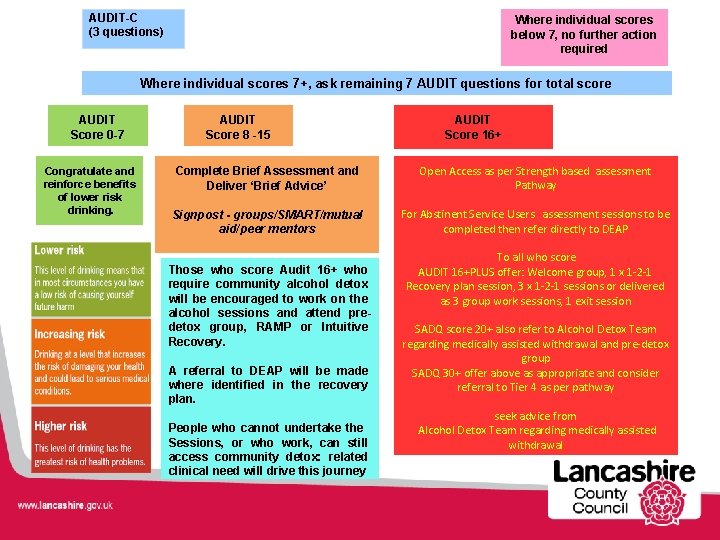
AUDIT-C (3 questions) Where individual scores below 7, no further action required Where individual scores 7+, ask remaining 7 AUDIT questions for total score AUDIT Score 0 -7 Congratulate and reinforce benefits of lower risk drinking. AUDIT Score 8 -15 AUDIT Score 16+ Complete Brief Assessment and Deliver ‘Brief Advice’ Open Access as per Strength based assessment Pathway Signpost - groups/SMART/mutual aid/peer mentors For Abstinent Service Users assessment sessions to be completed then refer directly to DEAP Those who score Audit 16+ who require community alcohol detox will be encouraged to work on the alcohol sessions and attend predetox group, RAMP or Intuitive Recovery. A referral to DEAP will be made where identified in the recovery plan. People who cannot undertake the Sessions, or who work, can still access community detox: related clinical need will drive this journey To all who score AUDIT 16+PLUS offer: Welcome group, 1 x 1 -2 -1 Recovery plan session, 3 x 1 -2 -1 sessions or delivered as 3 group work sessions, 1 exit session SADQ score 20+ also refer to Alcohol Detox Team regarding medically assisted withdrawal and pre-detox group SADQ 30+ offer above as appropriate and consider referral to Tier 4 as per pathway seek advice from Alcohol Detox Team regarding medically assisted withdrawal
Issues • Professional resistance to joining drug and alcohol together (not from service users) • Dual diagnosis: – DD is the norm, not a rare event – Often present as • • • CJ issues Homeless/housing need History of service disengagement Alcohol and cannabis (largest cohort) MH issues – What appears to be a fragmented service response from MH
• Thank you - Any questions?
- Slides: 8