
Substance dualism can mind and body interact Michael
Substance dualism: can mind and body interact? Michael Lacewing enquiries@alevelphilosophy. co. uk © Michael Lacewing
Substance dualism • Substance dualism: minds are not bodies, not parts of bodies, nor properties of bodies, but distinct substances • Cartesian dualism: Minds can exist independent of bodies – Mental properties are properties of a mental substance – The mind is just thought, not in space; matter is just extension, in space © Michael Lacewing
Mental causation • Mental causation: thoughts, desires and other psychological states cause both other mental states and changes in the body (e. g. movement) • The problem: could the mind/mental states causally affect the body, and vice-versa, and if so, how? © Michael Lacewing
The conceptual interaction problem • Given that the mind is not in space and has no physical force, how is it possible that it could affect the body, which is in space and is moved by physical forces? • Princess Elisabeth – Physical things only move if they are pushed. – Only something that is extended and can touch the thing that is moved can exert such a force. – But the mind has no extension, so it can’t touch the body. – Therefore, the mind cannot move the body. © Michael Lacewing
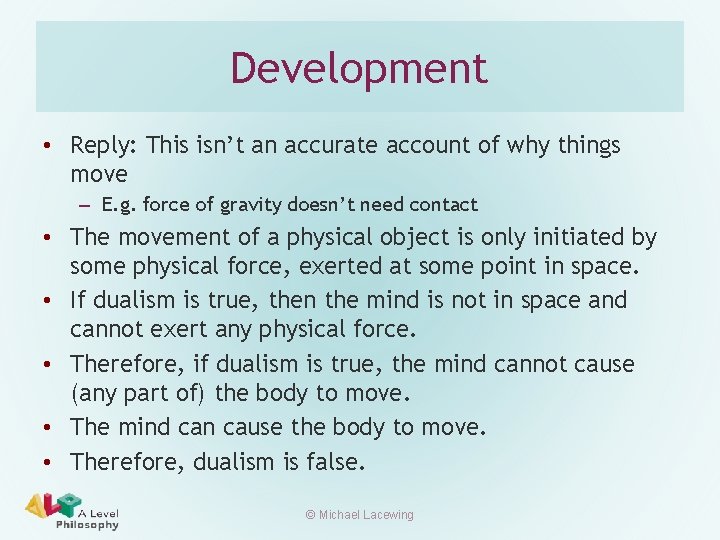
Development • Reply: This isn’t an accurate account of why things move – E. g. force of gravity doesn’t need contact • The movement of a physical object is only initiated by some physical force, exerted at some point in space. • If dualism is true, then the mind is not in space and cannot exert any physical force. • Therefore, if dualism is true, the mind cannot cause (any part of) the body to move. • The mind can cause the body to move. • Therefore, dualism is false. © Michael Lacewing
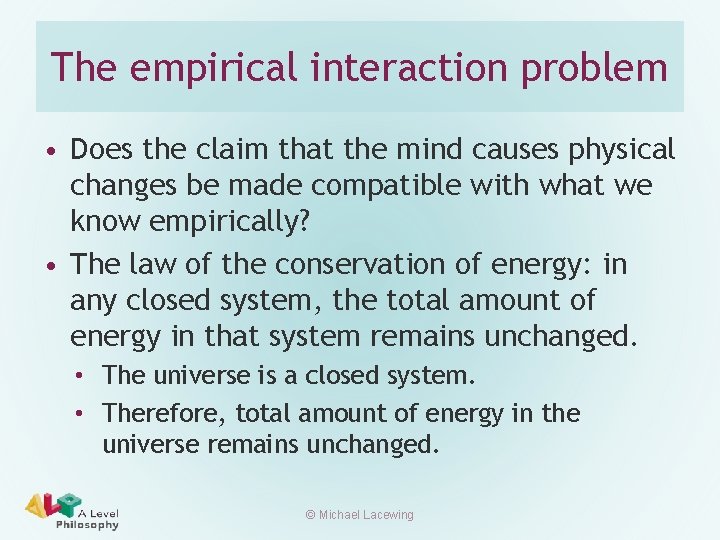
The empirical interaction problem • Does the claim that the mind causes physical changes be made compatible with what we know empirically? • The law of the conservation of energy: in any closed system, the total amount of energy in that system remains unchanged. • The universe is a closed system. • Therefore, total amount of energy in the universe remains unchanged. © Michael Lacewing
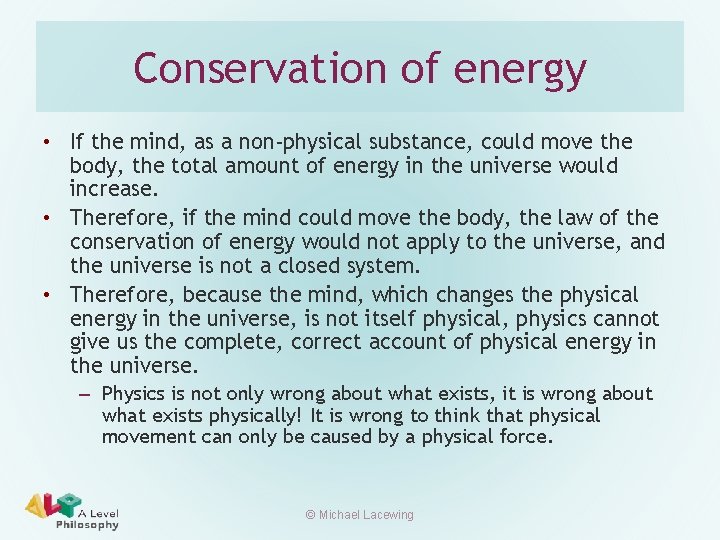
Conservation of energy • If the mind, as a non-physical substance, could move the body, the total amount of energy in the universe would increase. • Therefore, if the mind could move the body, the law of the conservation of energy would not apply to the universe, and the universe is not a closed system. • Therefore, because the mind, which changes the physical energy in the universe, is not itself physical, physics cannot give us the complete, correct account of physical energy in the universe. – Physics is not only wrong about what exists, it is wrong about what exists physically! It is wrong to think that physical movement can only be caused by a physical force. © Michael Lacewing

Neuroscience • Objection: Movements of the body are caused by physical events in the brain. – We have no evidence of the mind changing what happens in the brain. • Reply: we have no evidence that the mind does not change what happens in the brain – If dualism is true, then some brain events have no physical cause • The empirical evidence is not against dualism © Michael Lacewing
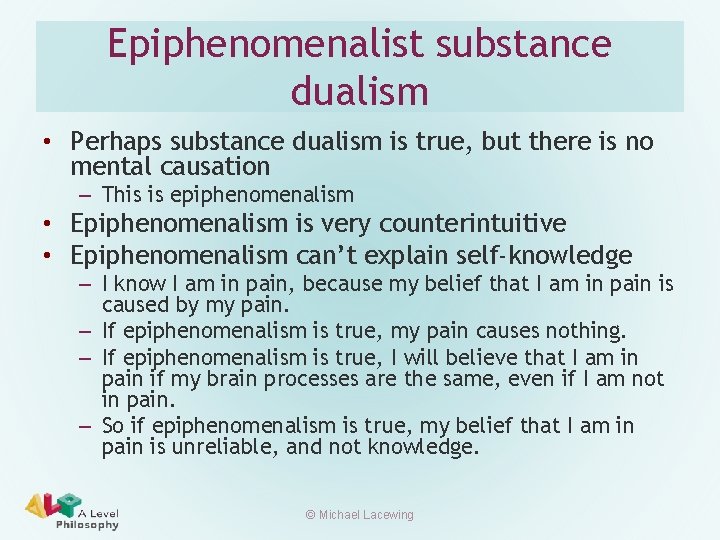
Epiphenomenalist substance dualism • Perhaps substance dualism is true, but there is no mental causation – This is epiphenomenalism • Epiphenomenalism is very counterintuitive • Epiphenomenalism can’t explain self-knowledge – I know I am in pain, because my belief that I am in pain is caused by my pain. – If epiphenomenalism is true, my pain causes nothing. – If epiphenomenalism is true, I will believe that I am in pain if my brain processes are the same, even if I am not in pain. – So if epiphenomenalism is true, my belief that I am in pain is unreliable, and not knowledge. © Michael Lacewing
- Slides: 9