
Substance Abuse Mental Health National Prevention Week SAMHS
Substance Abuse & Mental Health National Prevention Week SAMHS

What is SAMHS? ► SAMHS - Substance Abuse and Mental Health Service ► National Prevention Week is an annual health observance dedicated to increasing public awareness of, and action around, substance abuse and mental health issues. ► 14 th-19 th May 2018 -National Prevention Week Question ► Did you know adolescents more likely to use substances for the first time in the summer months, before returning to school in September? Why do you think this is? Watch this video: https: //www. youtube. com/watch? v=KHw. NW 2 o. Zw. TU#action=share
Mental Health & Substance Misuse What is Mental Health? What is Substance Misuse? Mental health includes our emotional, psychological, and social well-being. It affects how we think, feel, and act. It also helps determine how we handle stress, relate to others, and make choices. Substance use is the use of alcohol or drugs occasionally without being addicted however comes with the risk that it can lead to addiction. Positive mental health allows people to: ► Realize their full potential ► Cope with the stresses of life ► Work productively ► Make meaningful contributions to their communities People with good mental health usually: ► Have better physical health ► Work harder ► Have better relationships with family and friends ► Avoid crime ► Live longer and happier lives Substance misuse is the regular use of alcohol or drugs which may be causing issues in their life that may affect their job, personal life, or even their safety. People who misuse drugs and alcohol do it regardless of the consequences. Typical signs of substance misuse or addiction include: ► Neglecting responsibilities and activities you used to enjoy ► Participating in dangerous or risky behaviours ► Criminal problems ► Relationship problems ► Physical tolerance ► Losing control of your substance use ► Substance use takes over your life
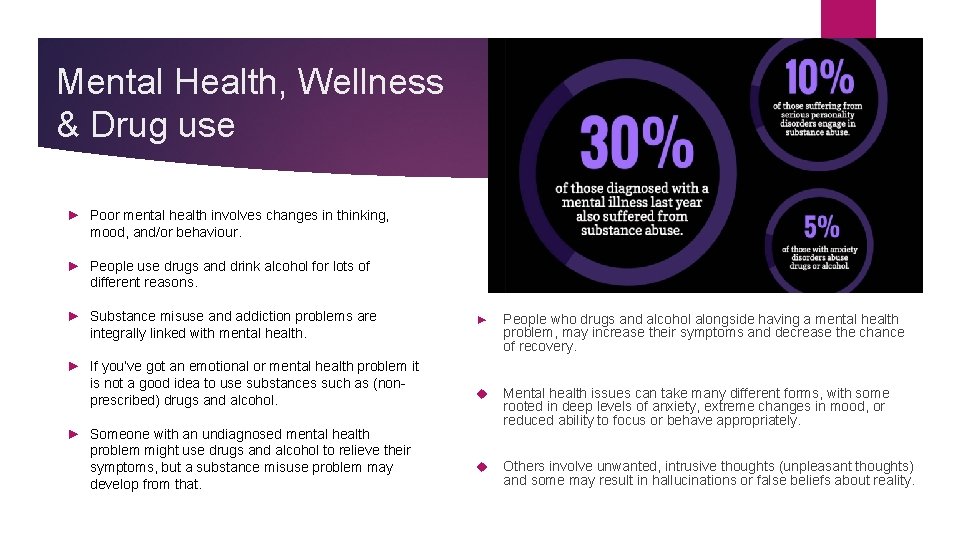
Mental Health, Wellness & Drug use ► Poor mental health involves changes in thinking, mood, and/or behaviour. ► People use drugs and drink alcohol for lots of different reasons. ► Substance misuse and addiction problems are integrally linked with mental health. ► If you’ve got an emotional or mental health problem it is not a good idea to use substances such as (nonprescribed) drugs and alcohol. ► Someone with an undiagnosed mental health problem might use drugs and alcohol to relieve their symptoms, but a substance misuse problem may develop from that. ► People who drugs and alcohol alongside having a mental health problem, may increase their symptoms and decrease the chance of recovery. Mental health issues can take many different forms, with some rooted in deep levels of anxiety, extreme changes in mood, or reduced ability to focus or behave appropriately. Others involve unwanted, intrusive thoughts (unpleasant thoughts) and some may result in hallucinations or false beliefs about reality.
Alcohol Misuse ►Alcohol is a drug. ►It is classed as a depressant, meaning that it slows down vital functions—resulting in slurred speech, unsteady movement, disturbed perceptions and an inability to react quickly. ►A young person’s body cannot cope with alcohol the same way an adult’s can. ►Alcohol is a psychoactive substance with intoxicating effects – it poisons you! ►Drinking is more harmful to teens than adults because their brains are still developing throughout adolescence and well into young adulthood. ►It can alter a users’ mental state, increasing impulsivity, impairing judgement, and affecting balance and movement. ►Drinking too much alcohol, can lead to alcohol poisoning. ►Repeated exposure to alcohol is toxic to human cells and tissue. ►Alcohol has the potential to affect nearly every organ and system of the body negatively. ►Drinking during this critical growth period can lead to lifelong damage in brain function, particularly as it relates to memory, motor skills (ability to move) and coordination. Question ►Did you know, on an average day in June, July, or December, more than 11, 000 youths used alcohol for the first time; in other months, the daily average ranged from about 5, 000 to 8, 000 new users per day (NSDUH Report, 2012)
How will underage drinking impact my Mental Health? ►Drinking often starts in adolescence, a time of significant emotional and biological change, alcohol use in adolescence may have a critical impact on mental well-being ►Underage drinking and alcohol misuse has links with: ► Depression ► Anxiety ► personality disorders ► Psychosis ► Risk taking behaviour ►Alcohol abuse can cause or mask emotional problems such as anxiety or depression. It can also increase the severity of these emotional problems. ► Studies show teenage girls aged 12 -16 who drink are four times more likely than their non-drinking peers to suffer from depression. ► Alcohol use has been identified as a risk factor for self- harming during the transition from late adolescence to adulthood. Studies show that girls aged 14 -15 who drink heavily are three times more likely to attempt suicide than girls the same age who don’t drink Adolescents who drink whilst feeling sad or depressed have an increased risk of attempting suicide. Question: ► Did you know that drinking alcohol in adolescence weakens coping skills; lessens concentration; and causes sadness, isolation and hopelessness?
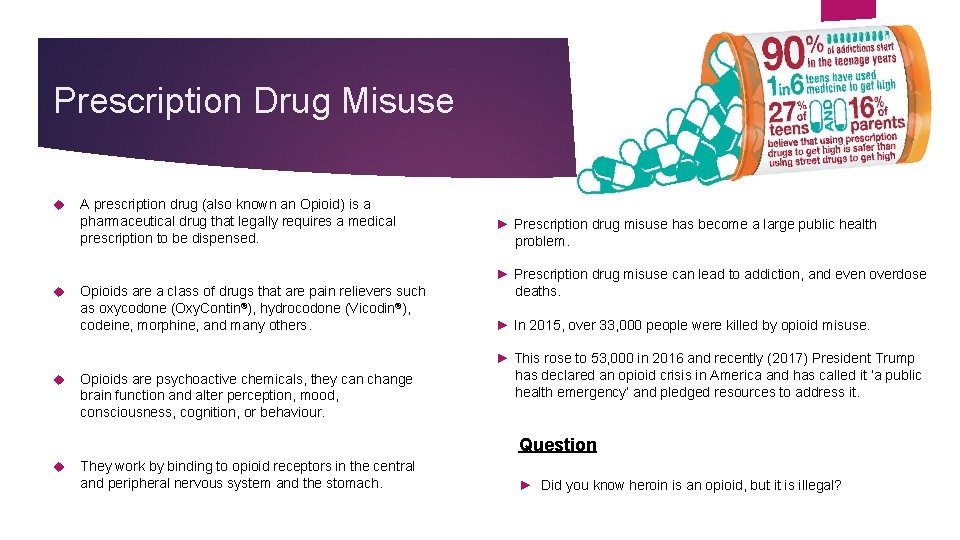
Prescription Drug Misuse A prescription drug (also known an Opioid) is a pharmaceutical drug that legally requires a medical prescription to be dispensed. Opioids are a class of drugs that are pain relievers such as oxycodone (Oxy. Contin®), hydrocodone (Vicodin®), codeine, morphine, and many others. Opioids are psychoactive chemicals, they can change brain function and alter perception, mood, consciousness, cognition, or behaviour. ► Prescription drug misuse has become a large public health problem. ► Prescription drug misuse can lead to addiction, and even overdose deaths. ► In 2015, over 33, 000 people were killed by opioid misuse. ► This rose to 53, 000 in 2016 and recently (2017) President Trump has declared an opioid crisis in America and has called it ‘a public health emergency’ and pledged resources to address it. Question They work by binding to opioid receptors in the central and peripheral nervous system and the stomach. ► Did you know heroin is an opioid, but it is illegal?
Opioid Misuse: The Risks Common health risks associated with opioid misuse include: Sedation Insomnia Dizziness Agitation Nausea Tremors Vomiting Diarrhoea Constipation Hallucinations Tolerance ► Depression Sweating ► Anxiety Muscle Aches ► Physical Dependence ► Using opioids, especially in a way not prescribed by a doctor, can cause addiction. ► Opioids are highly addictive, so even infrequent use can lead to physical dependence. ► Habitual opioid use causes changes in the brain, specifically in the pain centre, which can bring on addiction. ► Opioid use is a choice, but some factors may increase a risk of addiction. ► People who abuse alcohol or other drugs, or who have a mental illness, have an increased risk of opioid dependence.
Prescription Drugs & Opioid Misuse ►After marijuana and alcohol, prescription drugs are the most commonly misused substances by teens aged 14 and older. ►Teens misuse prescription drugs for a number of reasons, such as to get high, to stop pain, or because they think it will help them with school work. ►Many teens get prescription drugs they misuse from friends and relatives, sometimes without the person knowing. ►Boys and girls tend to misuse some types of prescription drugs for different reasons. For example, boys are more likely to misuse prescription stimulants to get high, while girls tend to misuse them to stay alert or to lose weight ► 7/ 10 teen users are more likely to use other substances along side opioids. ►Teens who take opioids are 8 times more likely to abuse marijuana and 4 times more likely to misuse alcohol Question: Did you know prescription drugs can be just as addictive and dangerous as other drugs?
How will opioid use impact my mental health? The relationship between opioid abuse and depression is bi-directional, meaning that suffering from one increases the risk of the other. Opioid abuse is defined as using a prescription opioid for non-medical reasons or using it longer or in greater amounts than what was prescribed by a doctor. Opioid abuse has been linked to higher rates of depression, anxiety, and bipolar disorders. Increase risk of depression, signs of can include: Signs of Opioid Addiction can include: ► Taking opioids for longer or in larger amounts than your ►Lack of interest in activities ►Depressed mood or irritability prescription. ► In ability to use less/ stop taking opioids. ► experiencing withdrawal ►Changes in sleep patterns ►Changes in appetite ►Feelings of guilt or despair ►Lack of energy ►Trouble concentrating ►Suicidal thoughts ► Experiencing cravings. ► Desire to keep using even though health being compromised ► The drug beginning to interfere with work, school, or home life. ► Problems in/ with relationships. ► Spending excess time and money on drugs ► Using more of the drug to get the same effect. ► Excessive sleeping/ weight loss or weight gain ► Turning to crime to fund opiates
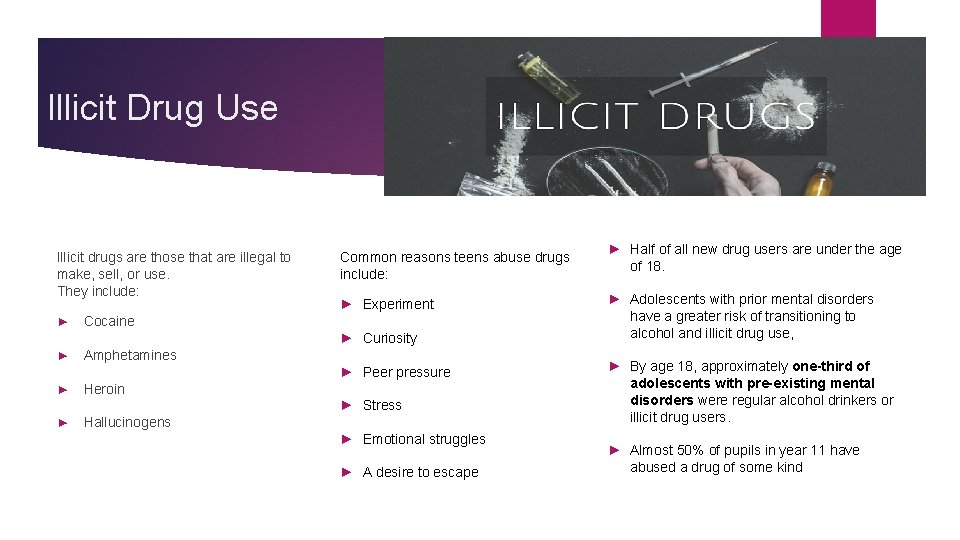
Illicit Drug Use Illicit drugs are those that are illegal to make, sell, or use. They include: ► Common reasons teens abuse drugs include: ► Experiment Cocaine ► Curiosity ► Amphetamines ► Peer pressure ► Heroin ► Stress ► Hallucinogens ► Emotional struggles ► A desire to escape ► Half of all new drug users are under the age of 18. ► Adolescents with prior mental disorders have a greater risk of transitioning to alcohol and illicit drug use, ► By age 18, approximately one-third of adolescents with pre-existing mental disorders were regular alcohol drinkers or illicit drug users. ► Almost 50% of pupils in year 11 have abused a drug of some kind
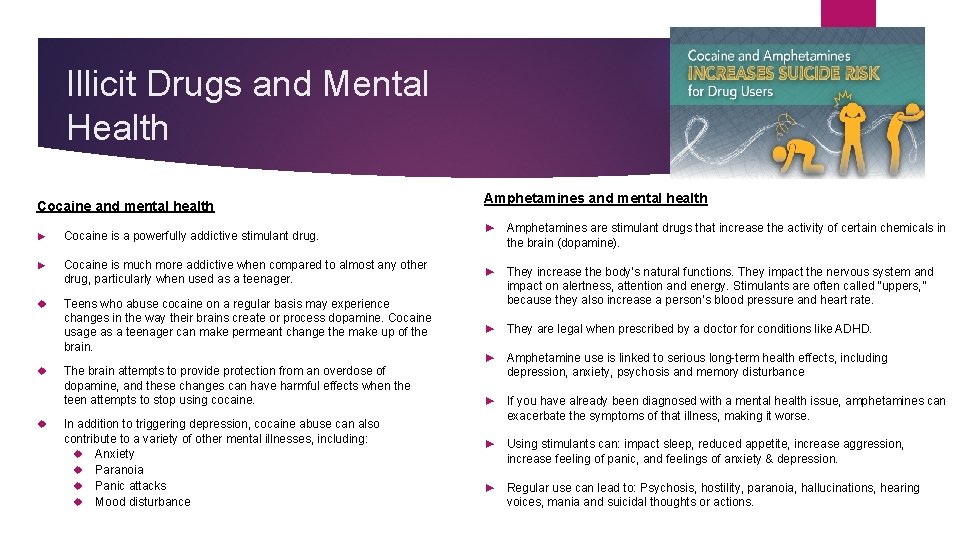
Illicit Drugs and Mental Health Cocaine and mental health ► Cocaine is a powerfully addictive stimulant drug. ► Cocaine is much more addictive when compared to almost any other drug, particularly when used as a teenager. Teens who abuse cocaine on a regular basis may experience changes in the way their brains create or process dopamine. Cocaine usage as a teenager can make permeant change the make up of the brain. The brain attempts to provide protection from an overdose of dopamine, and these changes can have harmful effects when the teen attempts to stop using cocaine. In addition to triggering depression, cocaine abuse can also contribute to a variety of other mental illnesses, including: Anxiety Paranoia Panic attacks Mood disturbance Amphetamines and mental health ► Amphetamines are stimulant drugs that increase the activity of certain chemicals in the brain (dopamine). ► They increase the body’s natural functions. They impact the nervous system and impact on alertness, attention and energy. Stimulants are often called “uppers, ” because they also increase a person’s blood pressure and heart rate. ► They are legal when prescribed by a doctor for conditions like ADHD. ► Amphetamine use is linked to serious long-term health effects, including depression, anxiety, psychosis and memory disturbance ► If you have already been diagnosed with a mental health issue, amphetamines can exacerbate the symptoms of that illness, making it worse. ► Using stimulants can: impact sleep, reduced appetite, increase aggression, increase feeling of panic, and feelings of anxiety & depression. ► Regular use can lead to: Psychosis, hostility, paranoia, hallucinations, hearing voices, mania and suicidal thoughts or actions.
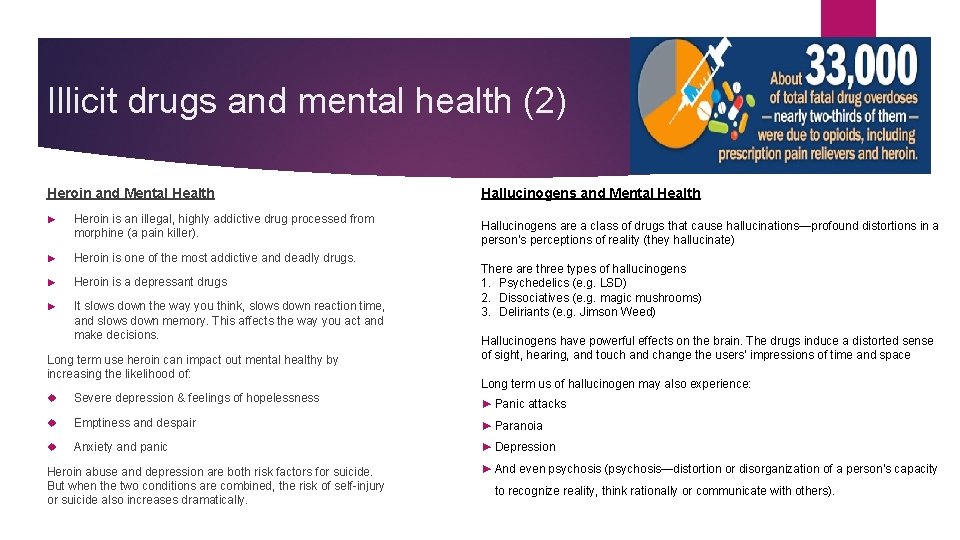
Illicit drugs and mental health (2) Heroin and Mental Health ► Heroin is an illegal, highly addictive drug processed from morphine (a pain killer). ► Heroin is one of the most addictive and deadly drugs. ► Heroin is a depressant drugs ► It slows down the way you think, slows down reaction time, and slows down memory. This affects the way you act and make decisions. Long term use heroin can impact out mental healthy by increasing the likelihood of: Hallucinogens and Mental Health Hallucinogens are a class of drugs that cause hallucinations—profound distortions in a person’s perceptions of reality (they hallucinate) There are three types of hallucinogens 1. Psychedelics (e. g. LSD) 2. Dissociatives (e. g. magic mushrooms) 3. Deliriants (e. g. Jimson Weed) Hallucinogens have powerful effects on the brain. The drugs induce a distorted sense of sight, hearing, and touch and change the users' impressions of time and space Long term us of hallucinogen may also experience: Severe depression & feelings of hopelessness ► Panic attacks Emptiness and despair ► Paranoia Anxiety and panic ► Depression Heroin abuse and depression are both risk factors for suicide. But when the two conditions are combined, the risk of self-injury or suicide also increases dramatically. ► And even psychosis (psychosis—distortion or disorganization of a person's capacity to recognize reality, think rationally or communicate with others).
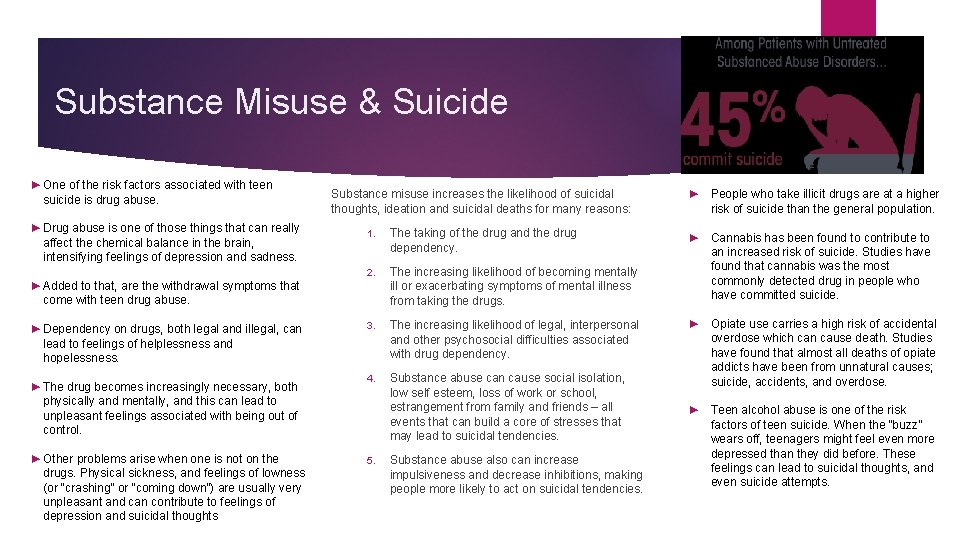
Substance Misuse & Suicide ► One of the risk factors associated with teen suicide is drug abuse. ► Drug abuse is one of those things that can really affect the chemical balance in the brain, intensifying feelings of depression and sadness. Substance misuse increases the likelihood of suicidal thoughts, ideation and suicidal deaths for many reasons: 1. The taking of the drug and the drug dependency. 2. The increasing likelihood of becoming mentally ill or exacerbating symptoms of mental illness from taking the drugs. 3. The increasing likelihood of legal, interpersonal and other psychosocial difficulties associated with drug dependency. 4. Substance abuse can cause social isolation, low self esteem, loss of work or school, estrangement from family and friends – all events that can build a core of stresses that may lead to suicidal tendencies. ► Added to that, are the withdrawal symptoms that come with teen drug abuse. ► Dependency on drugs, both legal and illegal, can lead to feelings of helplessness and hopelessness. ► The drug becomes increasingly necessary, both physically and mentally, and this can lead to unpleasant feelings associated with being out of control. ► Other problems arise when one is not on the drugs. Physical sickness, and feelings of lowness (or “crashing” or “coming down”) are usually very unpleasant and can contribute to feelings of depression and suicidal thoughts 5. Substance abuse also can increase impulsiveness and decrease inhibitions, making people more likely to act on suicidal tendencies. ► People who take illicit drugs are at a higher risk of suicide than the general population. ► Cannabis has been found to contribute to an increased risk of suicide. Studies have found that cannabis was the most commonly detected drug in people who have committed suicide. ► Opiate use carries a high risk of accidental overdose which can cause death. Studies have found that almost all deaths of opiate addicts have been from unnatural causes; suicide, accidents, and overdose. ► Teen alcohol abuse is one of the risk factors of teen suicide. When the “buzz” wears off, teenagers might feel even more depressed than they did before. These feelings can lead to suicidal thoughts, and even suicide attempts.
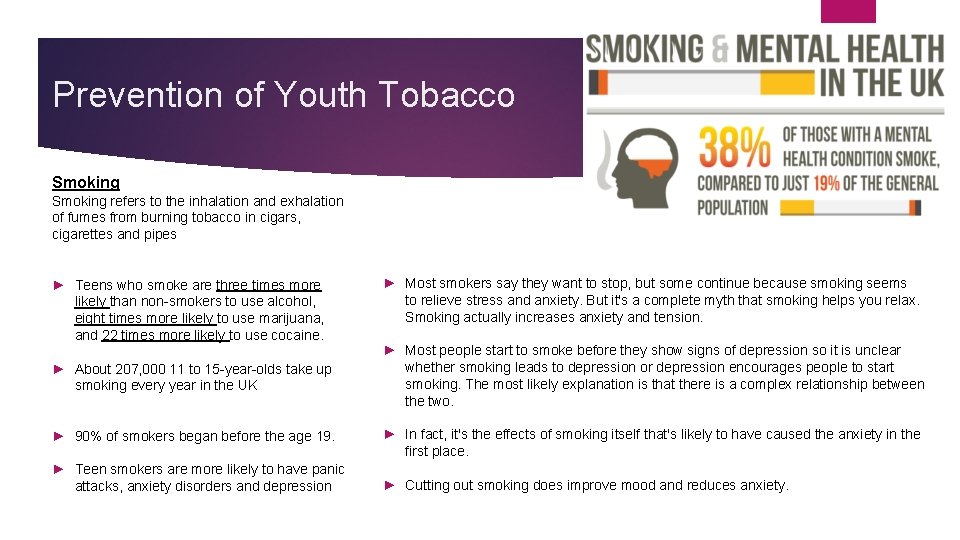
Prevention of Youth Tobacco Smoking refers to the inhalation and exhalation of fumes from burning tobacco in cigars, cigarettes and pipes ► Teens who smoke are three times more likely than non-smokers to use alcohol, eight times more likely to use marijuana, and 22 times more likely to use cocaine. ► Most smokers say they want to stop, but some continue because smoking seems to relieve stress and anxiety. But it's a complete myth that smoking helps you relax. Smoking actually increases anxiety and tension. ► About 207, 000 11 to 15 -year-olds take up smoking every year in the UK ► Most people start to smoke before they show signs of depression so it is unclear whether smoking leads to depression or depression encourages people to start smoking. The most likely explanation is that there is a complex relationship between the two. ► 90% of smokers began before the age 19. ► In fact, it's the effects of smoking itself that's likely to have caused the anxiety in the first place. ► Teen smokers are more likely to have panic attacks, anxiety disorders and depression ► Cutting out smoking does improve mood and reduces anxiety.
Need More Information, Help & Support?
- Slides: 16