
Subsidies Lower 6 th Micro How Markets Work
Subsidies Lower 6 th Micro How Markets Work
Intro to Subsidies Mr O’Grady
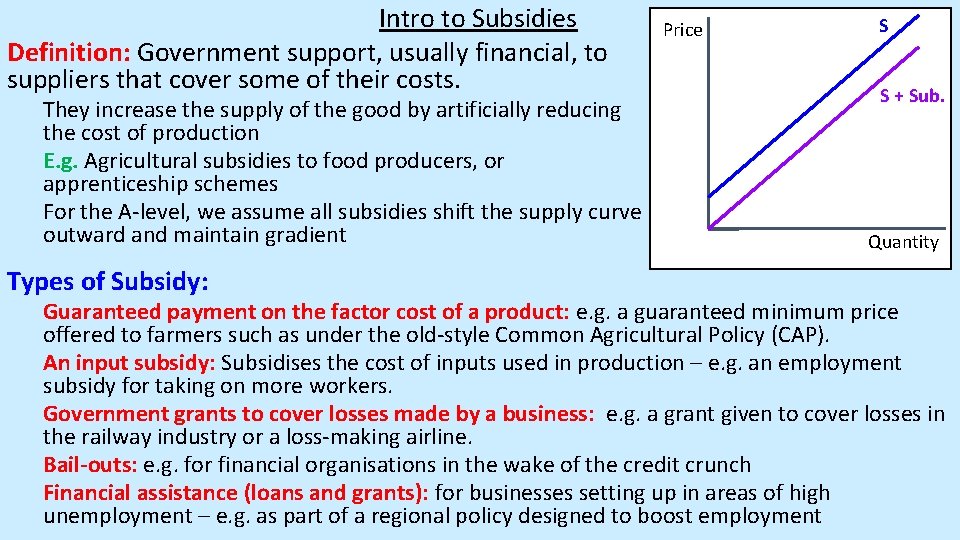
Intro to Subsidies Definition: Government support, usually financial, to suppliers that cover some of their costs. They increase the supply of the good by artificially reducing the cost of production E. g. Agricultural subsidies to food producers, or apprenticeship schemes For the A-level, we assume all subsidies shift the supply curve outward and maintain gradient Types of Subsidy: Price S S + Sub. Quantity Guaranteed payment on the factor cost of a product: e. g. a guaranteed minimum price offered to farmers such as under the old-style Common Agricultural Policy (CAP). An input subsidy: Subsidises the cost of inputs used in production – e. g. an employment subsidy for taking on more workers. Government grants to cover losses made by a business: e. g. a grant given to cover losses in the railway industry or a loss-making airline. Bail-outs: e. g. for financial organisations in the wake of the credit crunch Financial assistance (loans and grants): for businesses setting up in areas of high unemployment – e. g. as part of a regional policy designed to boost employment
Reasons for Subsidies Mr O’Grady
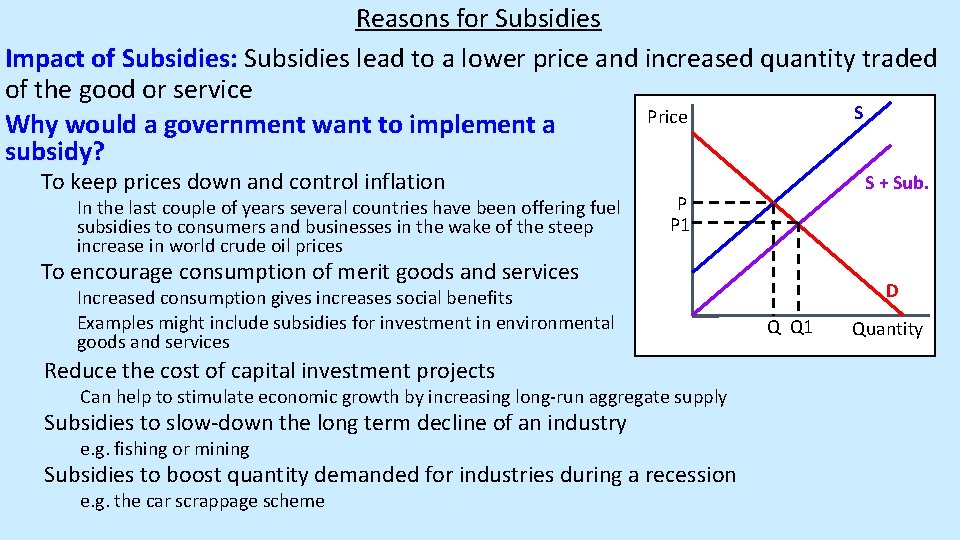
Reasons for Subsidies Impact of Subsidies: Subsidies lead to a lower price and increased quantity traded of the good or service S Price Why would a government want to implement a subsidy? To keep prices down and control inflation In the last couple of years several countries have been offering fuel subsidies to consumers and businesses in the wake of the steep increase in world crude oil prices S + Sub. P P 1 To encourage consumption of merit goods and services Increased consumption gives increases social benefits Examples might include subsidies for investment in environmental goods and services Reduce the cost of capital investment projects Can help to stimulate economic growth by increasing long-run aggregate supply Subsidies to slow-down the long term decline of an industry e. g. fishing or mining Subsidies to boost quantity demanded for industries during a recession e. g. the car scrappage scheme D Q Q 1 Quantity
Costs and Benefits of Subsidies Mr O’Grady
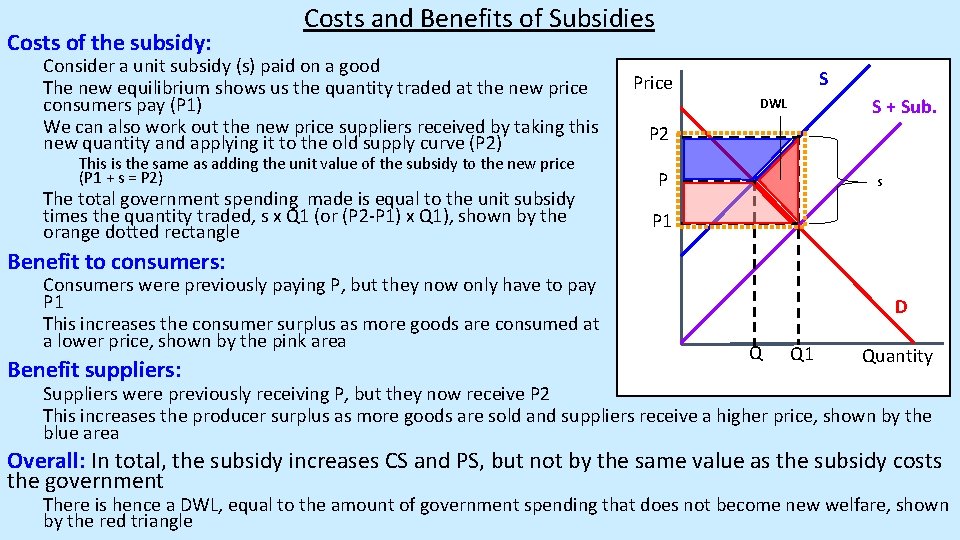
Costs of the subsidy: Costs and Benefits of Subsidies Consider a unit subsidy (s) paid on a good The new equilibrium shows us the quantity traded at the new price consumers pay (P 1) We can also work out the new price suppliers received by taking this new quantity and applying it to the old supply curve (P 2) This is the same as adding the unit value of the subsidy to the new price (P 1 + s = P 2) The total government spending made is equal to the unit subsidy times the quantity traded, s x Q 1 (or (P 2 -P 1) x Q 1), shown by the orange dotted rectangle S Price S + Sub. DWL P 2 P s P 1 Benefit to consumers: Consumers were previously paying P, but they now only have to pay P 1 This increases the consumer surplus as more goods are consumed at a lower price, shown by the pink area Benefit suppliers: D Q Q 1 Quantity Suppliers were previously receiving P, but they now receive P 2 This increases the producer surplus as more goods are sold and suppliers receive a higher price, shown by the blue area Overall: In total, the subsidy increases CS and PS, but not by the same value as the subsidy costs the government There is hence a DWL, equal to the amount of government spending that does not become new welfare, shown by the red triangle
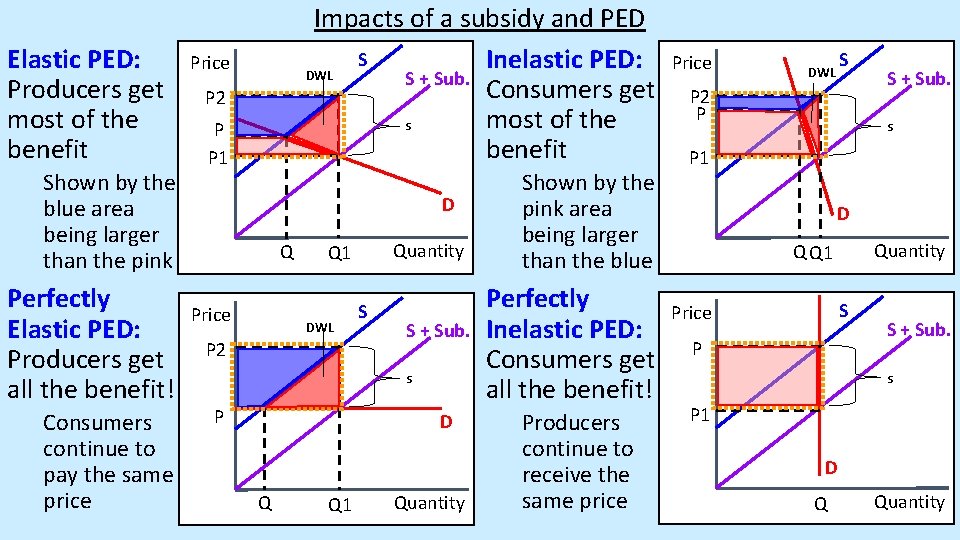
Elastic PED: Producers get most of the benefit Shown by the blue area being larger than the pink Perfectly Elastic PED: Producers get all the benefit! Consumers continue to pay the same price Impacts of a subsidy and PED S Inelastic PED: DWL S + Sub. Consumers get most of the s benefit Price P 2 P P 1 D Q Price Quantity Q 1 DWL P 2 S S + Sub. s P D Q Q 1 Quantity Shown by the pink area being larger than the blue Perfectly Inelastic PED: Consumers get all the benefit! Producers continue to receive the same price Price S DWL P 2 P S + Sub. s P 1 D Quantity Q Q 1 S Price P S + Sub. s P 1 D Q Quantity
Limitations of Subsidies Mr O’Grady
Limitations of Subsidies Productivity effects: If the subsidy is too generous, it can lead firms to become over reliant on government support Inefficient and high cost ‘zombie’ businesses can persist into the long run when their resources could have been better used elsewhere The operation of the free market is distorted Can be ineffective: If demand is inelastic, subsidies have little effect on the amount consumed The subsidy represents a large opportunity cost to the government with limited gains for producers Funding: Sometimes a subsidy can be self funding, if the improved revenue for businesses can generate more tax revenue for the government However, this won’t always be the case, particularly for struggling industries A subsidy could hence create an expensive extra burden for taxpayers Risk of Fraud: Ever-present risk of fraud when allocating subsidy payments E. g. the system of CAP farm subsidies have been heavily criticised for the level of fraud involved Limits the extent to which CS and PS are both increased

Where next? Don’t forget to SUBSCRIBE! Visit our website: www. smootheconomics. co. uk Find more resources, extension materials, details of courses, competitions, and more! Follow our socials: Instagram: @smootheconomics Twitter: @Smooth. Economics Facebook: @Smooth. Economics
- Slides: 11