
SubNuclear Matter in Neutron Stars and Supernovae Nuclear
Sub-Nuclear Matter in Neutron Stars and Supernovae Nuclear Pasta and Complex Fluids W. G. Newton 1, J. R. Stone 1, 2 1 University of Oxford, UK 2 Physics Division, ORNL, Oak Ridge, TN, USA
Outline n Overview of NS, SN Matter n n n The Transition to Uniform Matter n n n QMD Hartree-Fock A new Hartree-Fock study of nuclear pasta n n n Astrophysical consequences Frustration and Complex Fluids Nuclear Pasta Self-consistent models n n Anatomy of Supernovae (SNe) and Neutron Stars (NSs) Superfluidity in NSs Computational Method Preliminary Results Conclusions
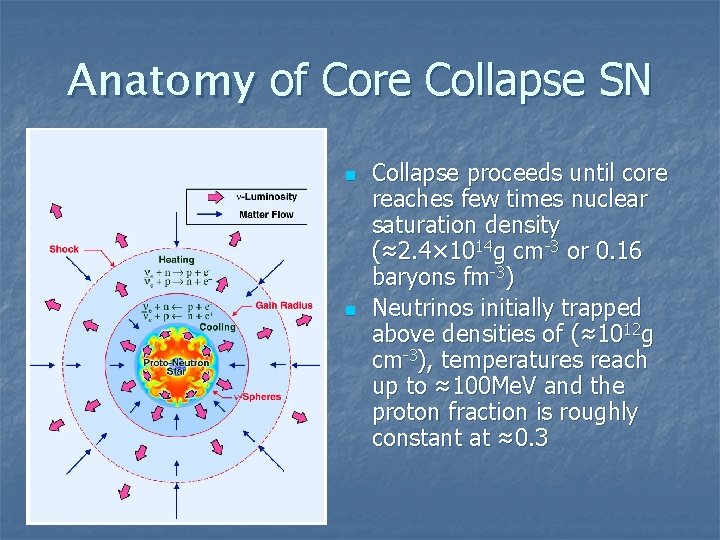
Anatomy of Core Collapse SN n n Collapse proceeds until core reaches few times nuclear saturation density (≈2. 4× 10¹⁴ g cm-3 or 0. 16 baryons fm-3) Neutrinos initially trapped above densities of (≈1012 g cm-3), temperatures reach up to ≈100 Me. V and the proton fraction is roughly constant at ≈0. 3
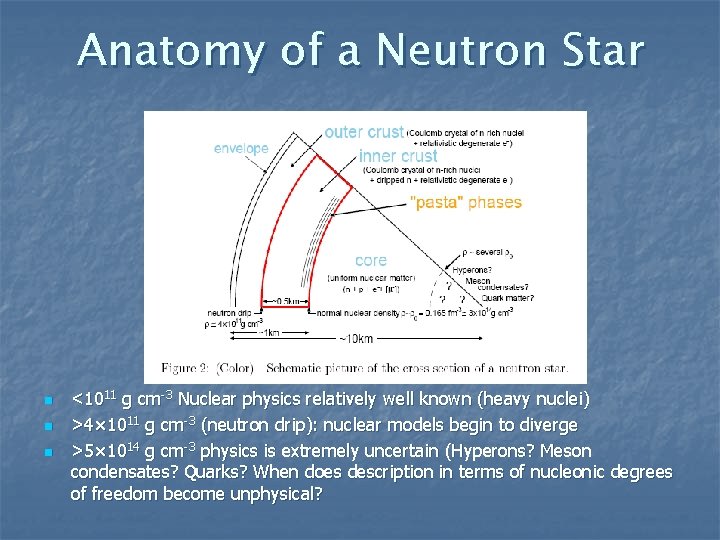
Anatomy of a Neutron Star n n n <1011 g cm-3 Nuclear physics relatively well known (heavy nuclei) >4× 10¹¹ g cm-3 (neutron drip): nuclear models begin to diverge >5× 10¹⁴ g cm-3 physics is extremely uncertain (Hyperons? Meson condensates? Quarks? When does description in terms of nucleonic degrees of freedom become unphysical?

Superfluids in Neutron Stars n n n At temperatures below a critical temperature of ≈ 109 K 1010 K, neutrons in the inner crust and core are expected to become superfluid (and, in the core, protons superconducting). Superfluids have zero viscosity, and so cannot support bulk rotation. If a fluid, rotating with period P(s), is cooled below the critical temperature, it arranges itself into quantized vortices of spin, density 104 /P cm-2
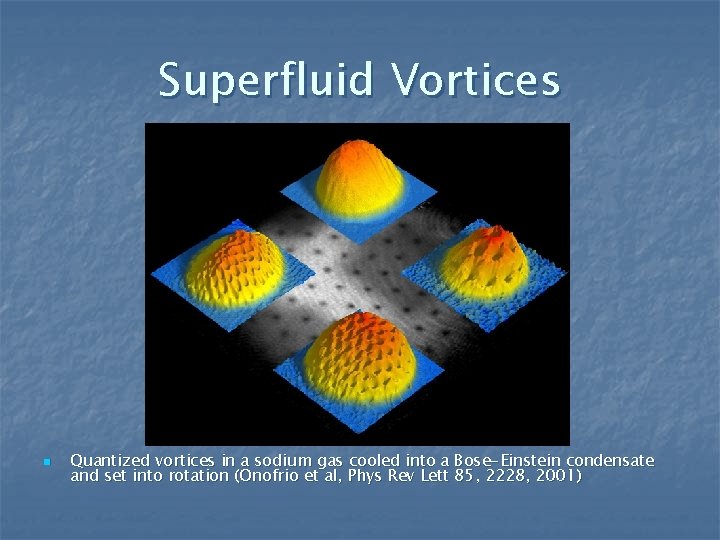
Superfluid Vortices n Quantized vortices in a sodium gas cooled into a Bose-Einstein condensate and set into rotation (Onofrio et al, Phys Rev Lett 85, 2228, 2001)
Transition to Uniform Matter n n The density regime 1013 < ρ < 2× 10¹⁴ g/cm 3 is important It marks the transition from the outer crystalline crust of a NS, or the gas of nuclei, neutrons and leptons in a core collapse, to the liquid, homogeneous phase above nuclear saturation density
The Transition to Uniform Matter: Astrophysical Consequences n n Neutrino opacities and emission mechanisms n during core collapse n neutron star cooling Pulsar Glitches n star-quakes n superfluid vortex dynamics n n n Pinned vortices? Change in crustal composition and reheating during accretion NS Oscillation n GWs
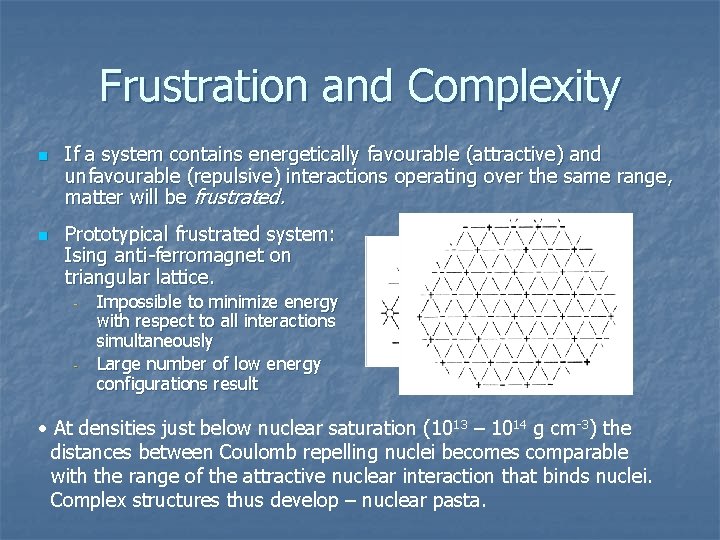
Frustration and Complexity n n If a system contains energetically favourable (attractive) and unfavourable (repulsive) interactions operating over the same range, matter will be frustrated. Prototypical frustrated system: Ising anti-ferromagnet on triangular lattice. - - Impossible to minimize energy with respect to all interactions simultaneously Large number of low energy configurations result • At densities just below nuclear saturation (1013 – 1014 g cm-3) the distances between Coulomb repelling nuclei becomes comparable with the range of the attractive nuclear interaction that binds nuclei. Complex structures thus develop – nuclear pasta.

Nuclear Pasta • Competition between surface tension and Coulomb repulsion of closely spaced heavy nuclei results in a series of shape transitions from the inner crust to the core (Ravenhall et al Phys. Rev. Lett. 50, 2066, 1983 and Hashimoto et al, Progress of Th. Physics, 71, 2, 320, 1984). • The basic sequence is (a) spherical (meatball/gnocchi) → (b) rod (spaghetti) → (c) slab (lasagna) → (d) tube (penne) → (e) bubble (swiss cheese? ) → uniform matter
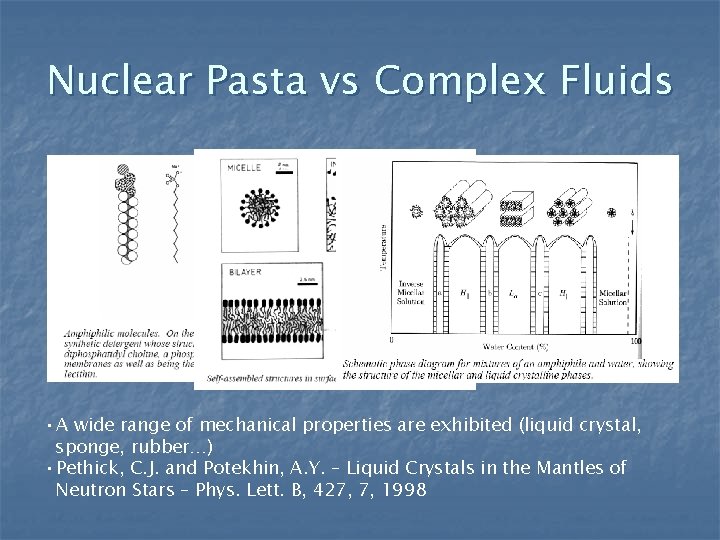
Nuclear Pasta vs Complex Fluids • A wide range of mechanical properties are exhibited (liquid crystal, sponge, rubber…) • Pethick, C. J. and Potekhin, A. Y. – Liquid Crystals in the Mantles of Neutron Stars – Phys. Lett. B, 427, 7, 1998
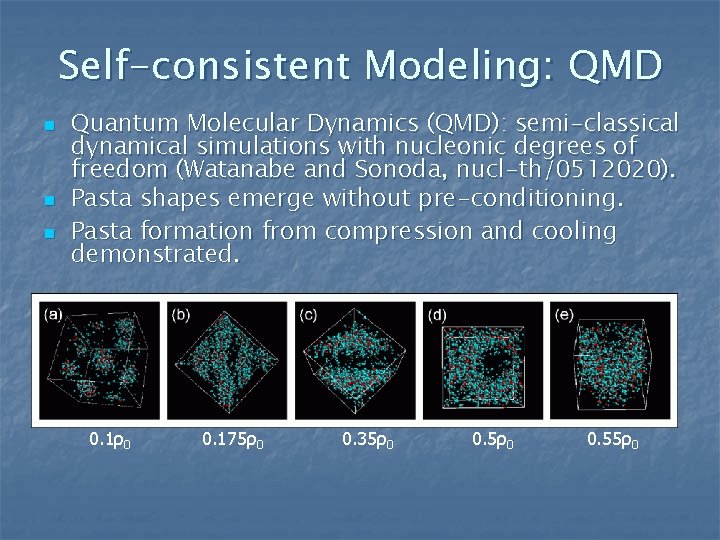
Self-consistent Modeling: QMD n n n Quantum Molecular Dynamics (QMD): semi-classical dynamical simulations with nucleonic degrees of freedom (Watanabe and Sonoda, nucl-th/0512020). Pasta shapes emerge without pre-conditioning. Pasta formation from compression and cooling demonstrated. 0. 1ρ0 0. 175ρ0 0. 35ρ0 0. 55ρ0
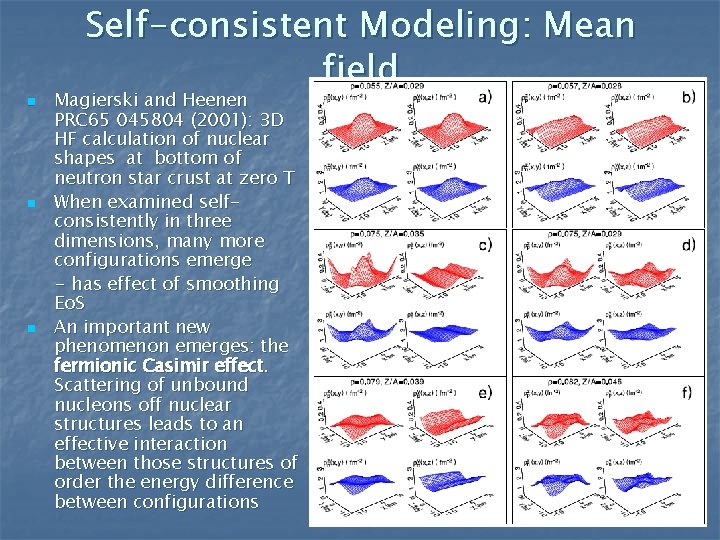
n n n Self-consistent Modeling: Mean field Magierski and Heenen PRC 65 045804 (2001): 3 D HF calculation of nuclear shapes at bottom of neutron star crust at zero T When examined selfconsistently in three dimensions, many more configurations emerge - has effect of smoothing Eo. S An important new phenomenon emerges: the fermionic Casimir effect. Scattering of unbound nucleons off nuclear structures leads to an effective interaction between those structures of order the energy difference between configurations
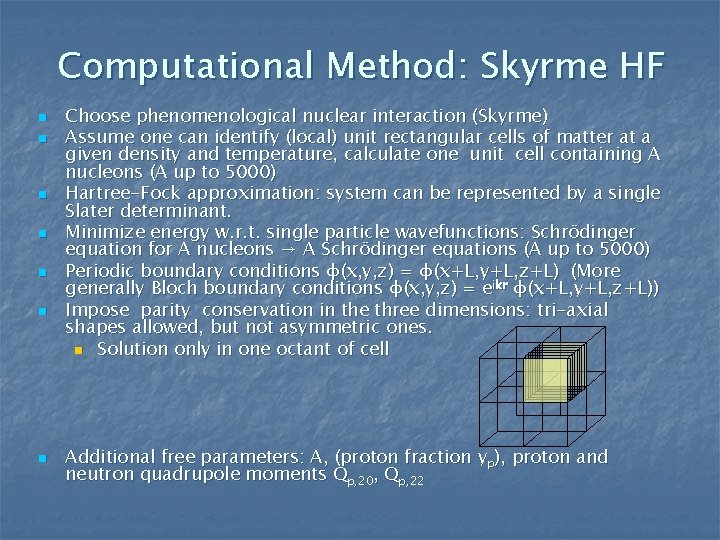
Computational Method: Skyrme HF n n n n Choose phenomenological nuclear interaction (Skyrme) Assume one can identify (local) unit rectangular cells of matter at a given density and temperature, calculate one unit cell containing A nucleons (A up to 5000) Hartree-Fock approximation: system can be represented by a single Slater determinant. Minimize energy w. r. t. single particle wavefunctions: Schrödinger equation for A nucleons → A Schrödinger equations (A up to 5000) Periodic boundary conditions φ(x, y, z) = φ(x+L, y+L, z+L) (More generally Bloch boundary conditions φ(x, y, z) = eikr φ(x+L, y+L, z+L)) Impose parity conservation in the three dimensions: tri-axial shapes allowed, but not asymmetric ones. n Solution only in one octant of cell Additional free parameters: A, (proton fraction yp), proton and neutron quadrupole moments Qp, 20, Qp, 22
Unconstrained calculation at 8 -3 densities between 0. 01 fm and 0. 12 fm-3, T=0 Me. V, yp=0. 03: Self-consistent dissolution of nuclear structure
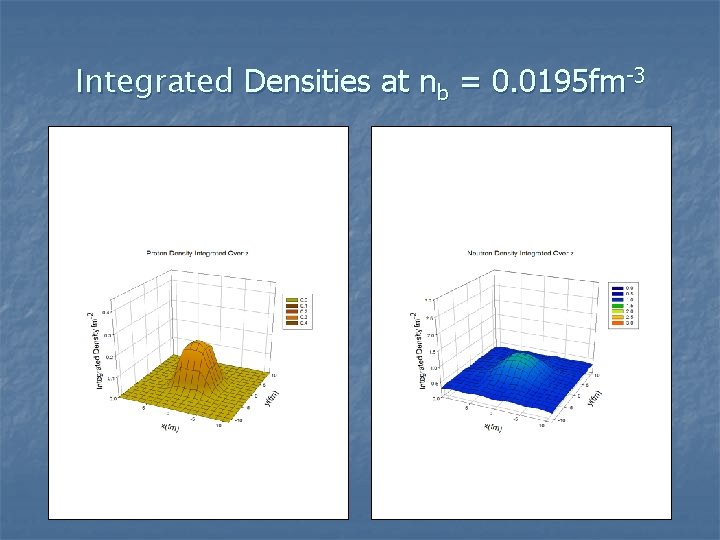
Integrated Densities at nb = 0. 0195 fm-3
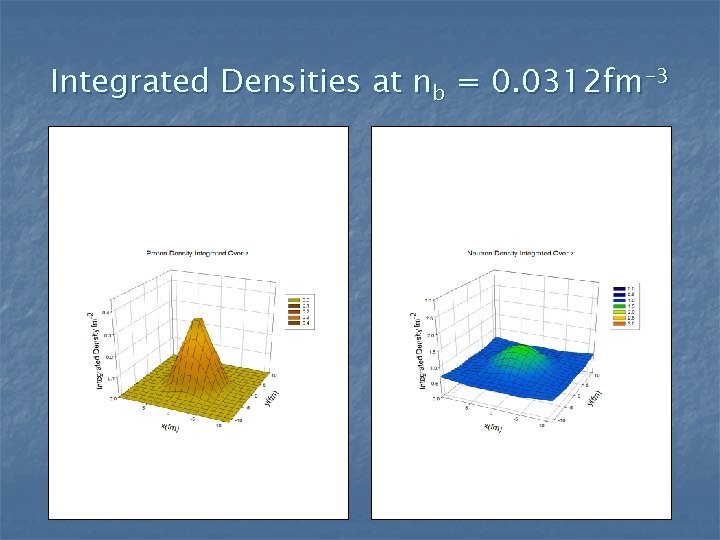
Integrated Densities at nb = 0. 0312 fm-3
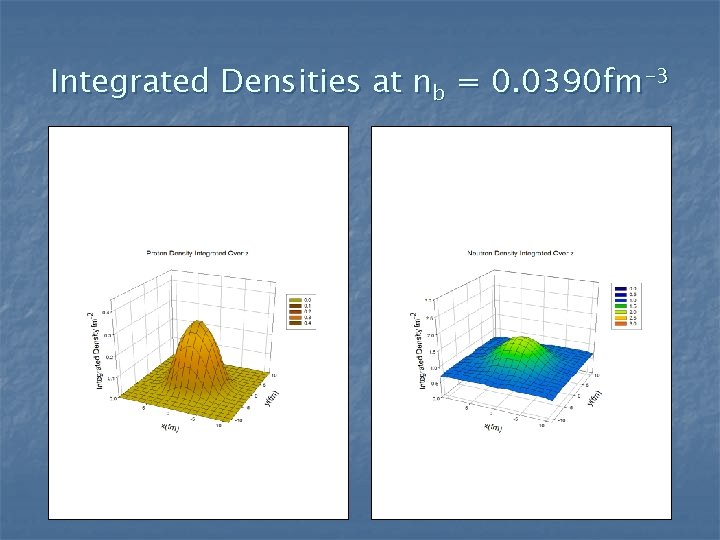
Integrated Densities at nb = 0. 0390 fm-3
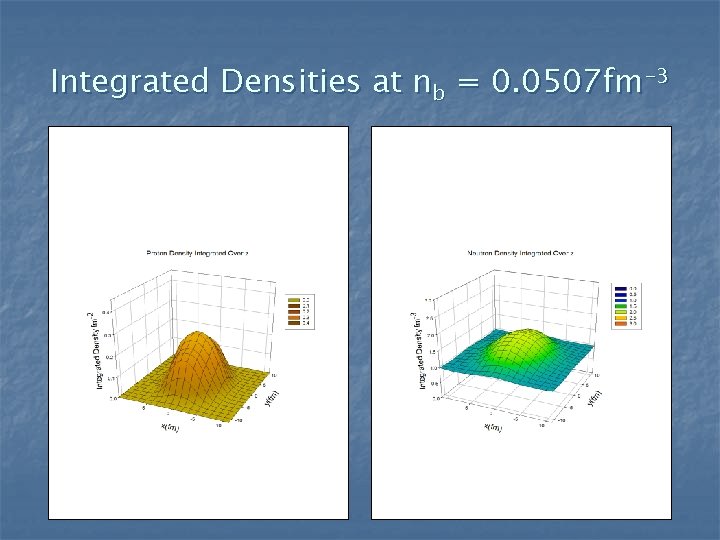
Integrated Densities at nb = 0. 0507 fm-3
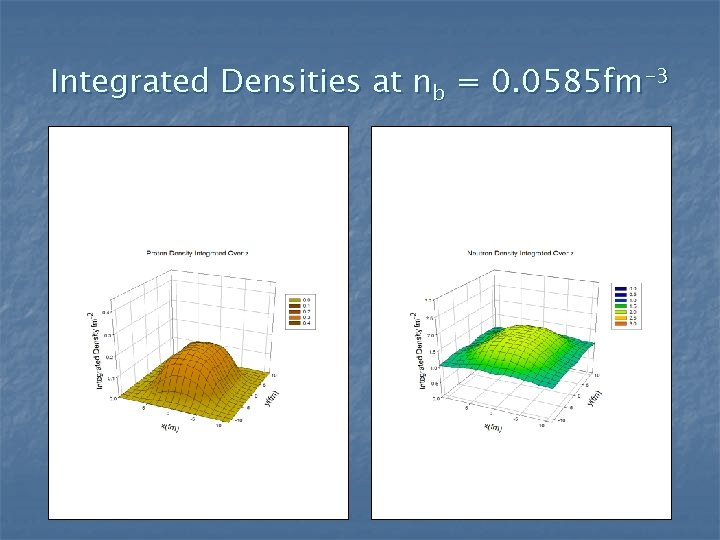
Integrated Densities at nb = 0. 0585 fm-3
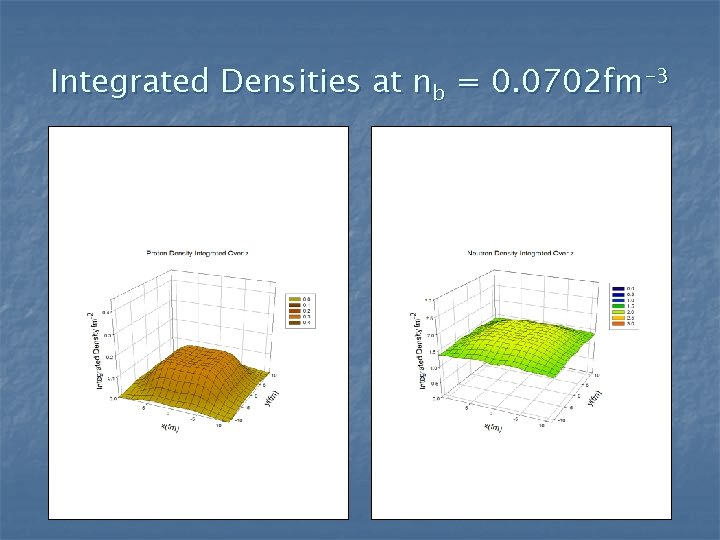
Integrated Densities at nb = 0. 0702 fm-3
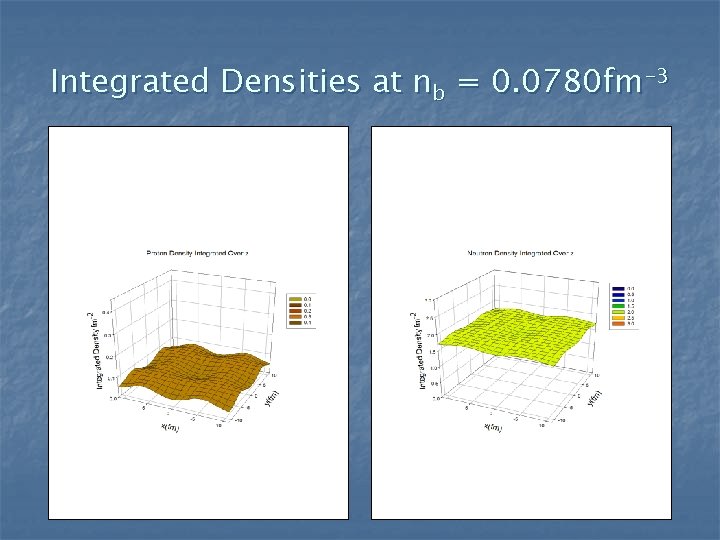
Integrated Densities at nb = 0. 0780 fm-3
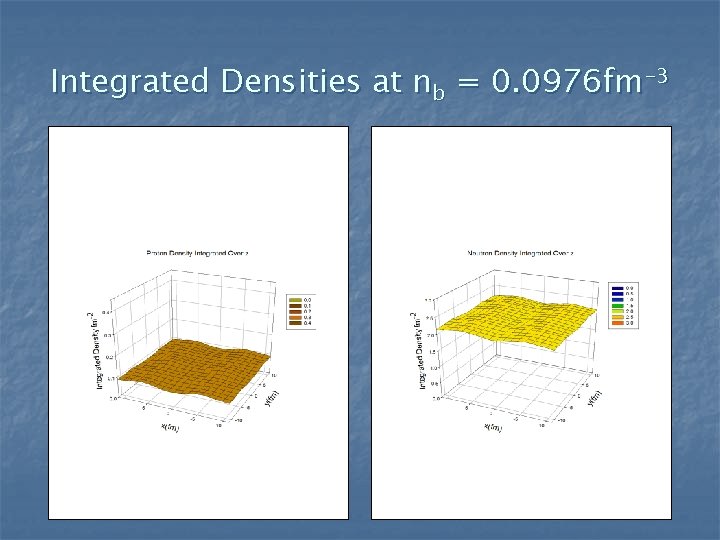
Integrated Densities at nb = 0. 0976 fm-3
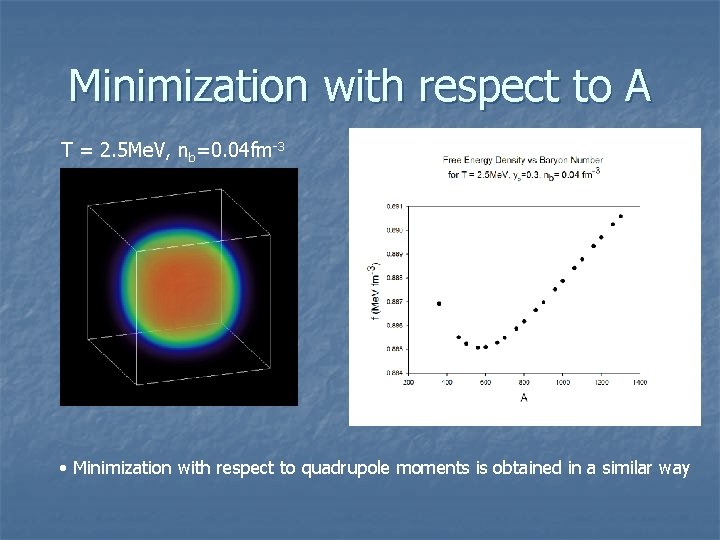
Minimization with respect to A T = 2. 5 Me. V, nb=0. 04 fm-3 • Minimization with respect to quadrupole moments is obtained in a similar way
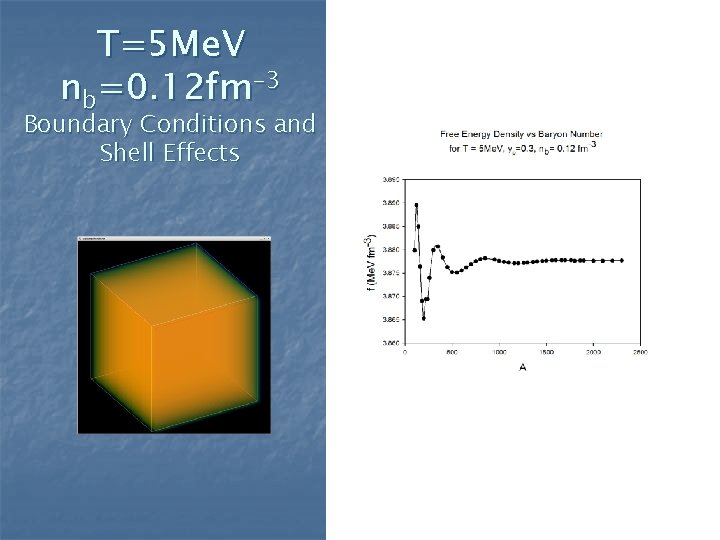
T=5 Me. V nb=0. 12 fm-3 Boundary Conditions and Shell Effects
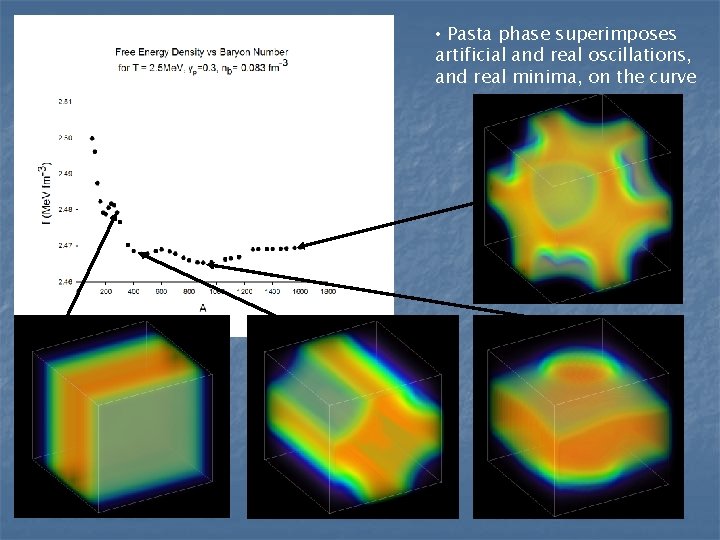
• Pasta phase superimposes artificial and real oscillations, and real minima, on the curve
Conclusions and Future n n The properties of matter in the density region 1013 < ρ < 2× 10¹⁴ g/cm 3 are an important ingredient in NS and SN models Thorough microphysical description of transition to uniform matter – the nuclear pasta phases – is underway n n n Generalize boundary conditions to the Bloch form: φ(x, y, z) = eikr φ(x+L, y+L, z+L) Calculate entrainment coefficient Examine response of matter to perturbation n n neutrino interactions mechanical properties Investigate effects of BCS pairing The Future(? ) n n Hydrodynamical modeling of pasta phases Mesoscopic structures
- Slides: 27