
Submitting to Digital Learning Repositories and Copyright Releases
Submitting to Digital Learning Repositories (and Copyright Releases) Instructional Design Technology Roundtable Shalin Hai-Jew Jan. 29, 2009

Rationales Share research and academic work through wider distribution channels. Access the work of colleagues and others for academic and research uses. Learn new methods for teaching and learning online. Offer more open-source learning resources for students. Raise the university profile in academic and public circles. 2 Submitting to Digital Learning Repositories (and Copyright Releases)
Global Digital Learning Repositories / Referatories MERLOT (Multimedia Educational Resource for Learning and Online Teaching) National Science Digital Library Project Gutenberg, (http: //en. wikipedia. org/wiki/Project_Gutenberg), a preservationist endeavor around cultural works with public domain books Ibiblio , (http: //en. wikipedia. org/wiki/Ibiblio), the digitization of various collections Commonwealth of Learning (COL) Learning Object Repository 3 Submitting to Digital Learning Repositories (and Copyright Releases)
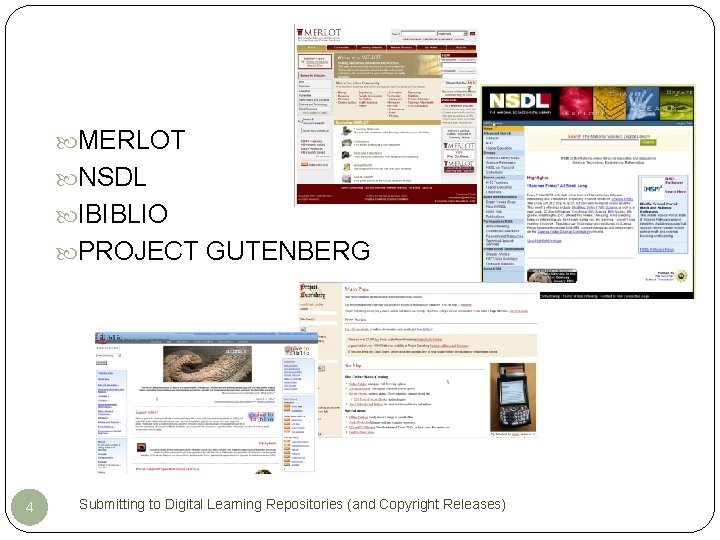
MERLOT NSDL IBIBLIO PROJECT GUTENBERG 4 Submitting to Digital Learning Repositories (and Copyright Releases)

University-Based Digital Repositories E-Commons @ Cornell, Cornell DRUM (Digital Repository of the U of Maryland), University of Maryland IU Scholar. WORKS Repository, Indiana University E-scholarship Repository, University of California Digital Library UR Research, University of Rochester Texas A&M University of Tennessee Wisconsin Online Resource Center (WISC) Campus Alberta Repository of Educational Objects 5 Submitting to Digital Learning Repositories (and Copyright Releases)
Subject-Based Digital Repositories Digital Learning Objects: DLearn Open Educational Resources OWL Learning Object Repository: DLORN: Distributed Learning Object Repository Network Educational Materials: Gateway to Educational Materials (GEM) Packages of E-Learning Materials: Maricopa Learning e. Xchange (MLX) E-Learning Resource Links: RDN: The Resource Discovery Network (UK) Georeferenced Materials: Alexandria Digital Library 6 Submitting to Digital Learning Repositories (and Copyright Releases)
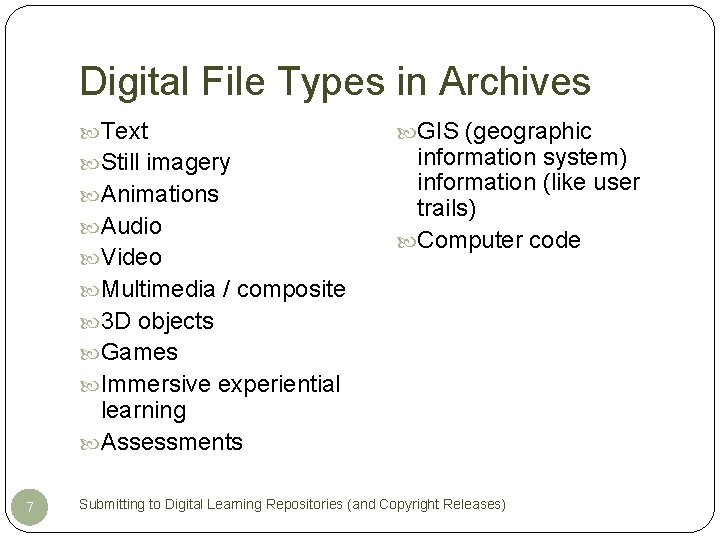
Digital File Types in Archives Text Still imagery Animations Audio Video GIS (geographic information system) information (like user trails) Computer code Multimedia / composite 3 D objects Games Immersive experiential learning Assessments 7 Submitting to Digital Learning Repositories (and Copyright Releases)
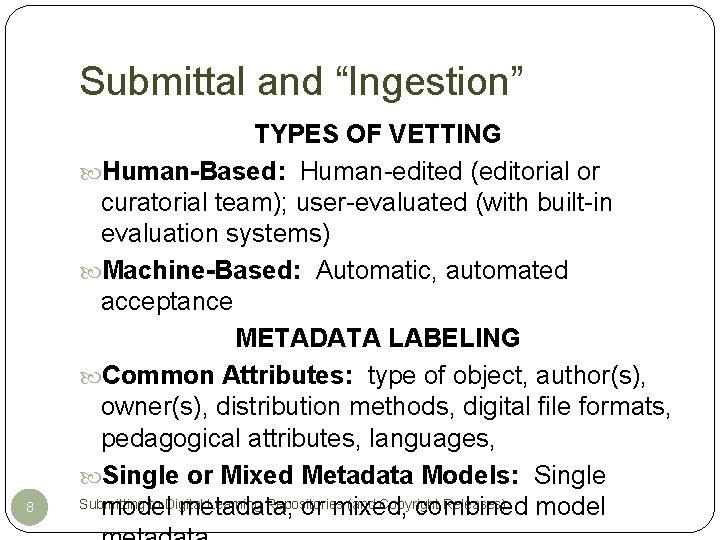
Submittal and “Ingestion” 8 TYPES OF VETTING Human-Based: Human-edited (editorial or curatorial team); user-evaluated (with built-in evaluation systems) Machine-Based: Automatic, automated acceptance METADATA LABELING Common Attributes: type of object, author(s), owner(s), distribution methods, digital file formats, pedagogical attributes, languages, Single or Mixed Metadata Models: Single Submitting to Digital Learning Repositories (and Copyright Releases) model metadata; or mixed, combined model
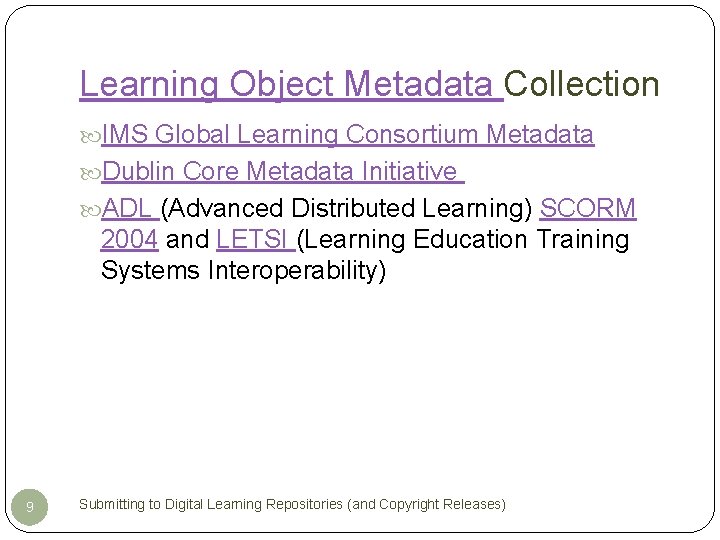
Learning Object Metadata Collection IMS Global Learning Consortium Metadata Dublin Core Metadata Initiative ADL (Advanced Distributed Learning) SCORM 2004 and LETSI (Learning Education Training Systems Interoperability) 9 Submitting to Digital Learning Repositories (and Copyright Releases)
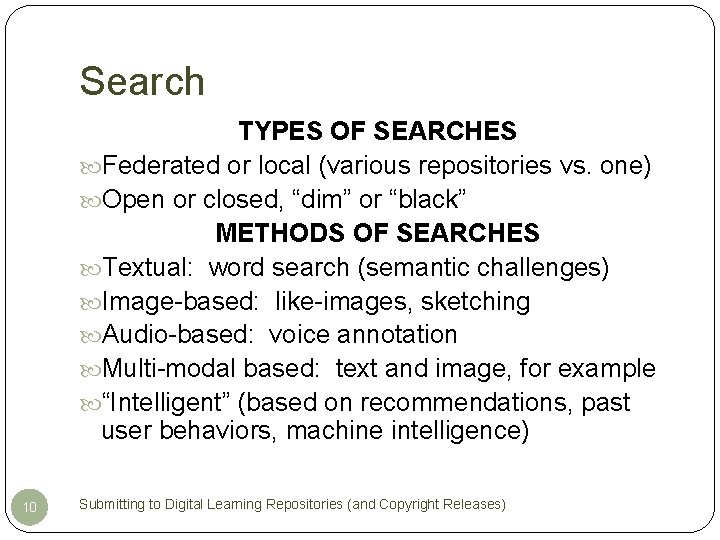
Search TYPES OF SEARCHES Federated or local (various repositories vs. one) Open or closed, “dim” or “black” METHODS OF SEARCHES Textual: word search (semantic challenges) Image-based: like-images, sketching Audio-based: voice annotation Multi-modal based: text and image, for example “Intelligent” (based on recommendations, past user behaviors, machine intelligence) 10 Submitting to Digital Learning Repositories (and Copyright Releases)
Distribution Free or subscription-based Download file formatting and versioning Open Web-based or closed network systems Anonymous or tracked 11 Submitting to Digital Learning Repositories (and Copyright Releases)
Archival Functions Updating to newer technological versioning Metadata maintenance Public, semi-public or closed repositories (availability) Content portability Accessibility 12 Submitting to Digital Learning Repositories (and Copyright Releases)
Security Data integrity: The sanctity and correctness of 13 the data in various incarnations and transfers (protection from accidental or malicious alteration) User privacy: Authentication into repositories and protection of private user data (e. g. what people view or download) and what working contents they create while on the repository site if that is a feature of the site File versioning: Records maintenance of file versions Downstream uses: The uses of contents after theytohave been. Repositories downloaded of the site? Submitting Digital Learning (and Copyrightoff Releases)
Information-based Community on some Digital Libraries / Repositories Social Technologies Integration: wikis, blogs, individual accounts, and shared work spaces User Created Value: The idea here is that the users may add value to the contents by contributing some of their own contents. Also, collaboration among users will add value. 14 Submitting to Digital Learning Repositories (and Copyright Releases)

Intellectual Property and Copyright Releases to Repositories Attribution Share Alike Noncommercial No Derivative Works 15 Submitting to Digital Learning Repositories (and Copyright Releases)
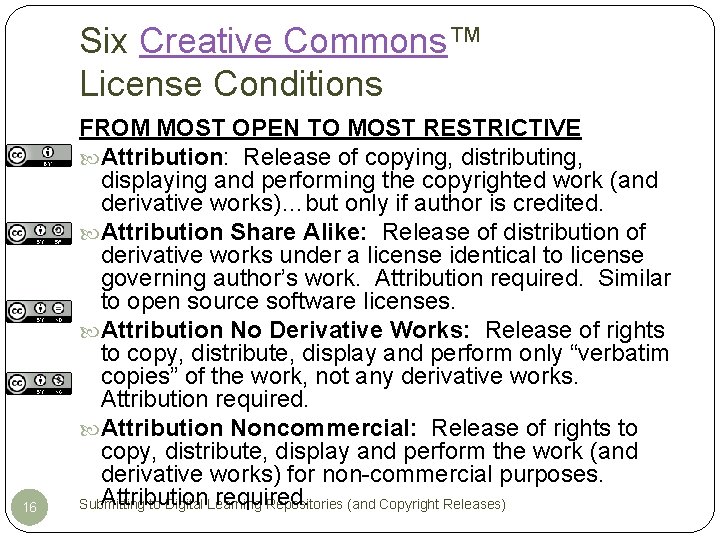
Six Creative Commons™ License Conditions 16 FROM MOST OPEN TO MOST RESTRICTIVE Attribution: Release of copying, distributing, displaying and performing the copyrighted work (and derivative works)…but only if author is credited. Attribution Share Alike: Release of distribution of derivative works under a license identical to license governing author’s work. Attribution required. Similar to open source software licenses. Attribution No Derivative Works: Release of rights to copy, distribute, display and perform only “verbatim copies” of the work, not any derivative works. Attribution required. Attribution Noncommercial: Release of rights to copy, distribute, display and perform the work (and derivative works) for non-commercial purposes. Attribution required. Submitting to Digital Learning Repositories (and Copyright Releases)
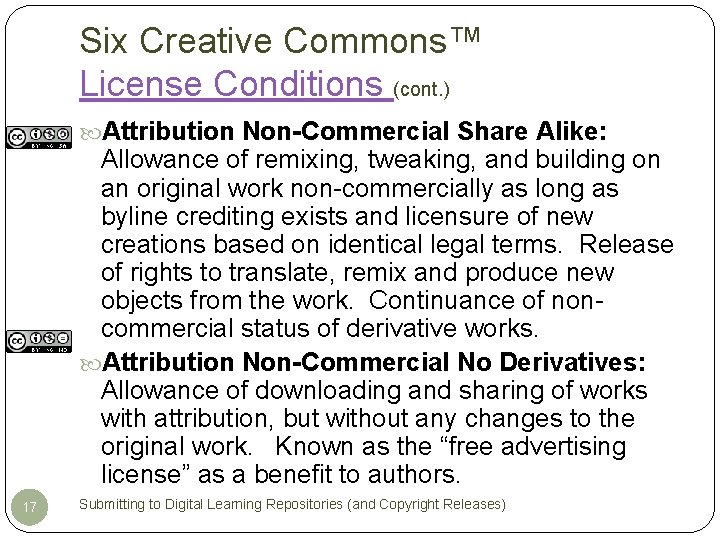
Six Creative Commons™ License Conditions (cont. ) Attribution Non-Commercial Share Alike: Allowance of remixing, tweaking, and building on an original work non-commercially as long as byline crediting exists and licensure of new creations based on identical legal terms. Release of rights to translate, remix and produce new objects from the work. Continuance of noncommercial status of derivative works. Attribution Non-Commercial No Derivatives: Allowance of downloading and sharing of works with attribution, but without any changes to the original work. Known as the “free advertising license” as a benefit to authors. 17 Submitting to Digital Learning Repositories (and Copyright Releases)
Links About … Institutional Repositories Types of Digital Libraries Digital Repositories in Higher Ed Whitepaper (JISC) Open Source Licensing MIT Open Courseware 18 Submitting to Digital Learning Repositories (and Copyright Releases)
Open Digital Repositories Probably Not For… R&D: Contents with Research & Development (R&D) value or anything that may be used with business ventures Shared IP: Contents with shared intellectual property (IP) (as with the university) Many Formal Journals: Contents that will be submitted for publication and copyrighted for academic journals (with stringent policies) Many Formal Conferences: Contents that will be submitted to conferences that will require signover of rights to the materials 19 Submitting to Digital Learning Repositories (and Copyright Releases)
Intellectual Property Resources at K-State Academic Personnel / K-State http: //www. k-state. edu/academicpersonnel/intprop/ K-State IP Policy http: //www. kstate. edu/academicpersonnel/fhbook/fhxr. html Legal Counsel at K-State http: //www. k-state. edu/attys/ Note: All questions regarding copyright need to be reviewed on a case-by-case basis. 20 Submitting to Digital Learning Repositories (and Copyright Releases)
Conclusion and Contact Dr. Shalin Hai-Jew, Instructional Designer Kansas State University shalin@k-state. edu (785) 532 -5262 (work phone) (785) 532 -3199 (fax number) Instructional Design Open Studio (IDOS) Blog Disclaimer: This presenter is not a lawyer or copyright specialist, and none of this is to be construed as advisement. This is provided as information only and is used at the individual’s own risk. 21 Submitting to Digital Learning Repositories (and Copyright Releases)
- Slides: 21