
Submitted by the experts of the European Commission
Submitted by the experts of the European Commission UNR 157 -03 -10 Proposal for amendments to ECE/TRANS/WP. 29/2020/81 complemented by ECE/TRANS/WP. 29/GRVA/2020/32 and ECE/TRANS/WP. 29/GRVA/2020/33 3 rd Session of the Special Interest Group on UN-R 157 18 March 2021
Amendment proposal scope and objectives • The proposal submitted by the European Commission focuses on both the Current UN-R 157 (ECE/TRANS/WP. 29/2020/81) and to the two amendment proposals for speed increase and lane change (as defined in ECE/TRANS/WP. 29/GRVA/2020/32 and […]/33) • Objectives • Operationalise the previous comments submitted by the European Commission • Help simplify/improve the current text • Strenghten/clarify requirements for ALKS vehicles able to cover the full speed range and/or able to perform lane-changes
01. Definition of and requirement for stability • The current text makes several references to «stable» vehicle position • When the position evolves over time it would be better to use the term «motion» . Proposal for changing this is made throughout the text where relevant • In general, “stability” refers to the equilibrium of the vehicle-driver system and its capability to restore it after a perturbation • It is a very important property of the vehicle-driver system and should definitely be explicitly included among the ALKS requirements
01. Definition of and requirement for stability • To clarify the meaning of stability and ensure that it is included as a requirement we propose the following two additions • 2. 26. “Stability of vehicle and driver system” is the ability of the system composed by the vehicle and the driver, either human or non-human, to recover the initial safe motion after a disturbance. • 5. 2. 7 The stability of the vehicle and driver system is a necessary condition that must be always met, provided that effects of unplanned events disturbing the safe motion are within reasonable limits. This shall be demonstrated in the assessment of the tests carried out in accordance with Annex 4 and 5 of this Regulation • A specific test procedure has not yet been proposed in Annex 5 as there are other tests included that can be used to assess stability (e. g. 4. 2). To be discussed

02. Definition of, requirement and test procedure for string stability String stable platoon • “String stability” is the property of a vehicle/driver system to react to a perturbation in the speed profile of the vehicle in front with a perturbation in its speed profile of equal or lower magnitude • It has important implications for safety and traffic flow • Considering that current lower-level automation vehicles generally showing string-unstable properties and although acknowledging the superior capabilities of the future ADSs, we consider as proportionate to include a requirement on string stability String unstable platoon
02. Definition of, requirement and test procedure for string stability • The following text has been proposed as an addition to the current text to achieve this objective: • 2. 27 “String stability” is the capability of the ALKS vehicle to react to a perturbation in the speed profile of the vehicle in front, whose speed profile directly affects the speed profile of the ALKS vehicle, with a perturbation in its speed profile of lower or equal absolute magnitude. • 5. 2. 8 While following another vehicle the ALKS vehicle shall be string stable. This shall be demonstrated in accordance with Annex 5 of this Regulation. • A specific test procedure is proposed in Annex 5
02. Definition of, requirement and test procedure for string stability • The test procedure includes the possibility of demonstrating string stability either by the ALKS vehicle alone with a target vehicle or by a platoon of ALKS vehicles (max 5) • In the case of a platoon of ALKS vehicles, only the last vehicle is considered for assessing the string stability requirement (usually referred to as weak string stability)
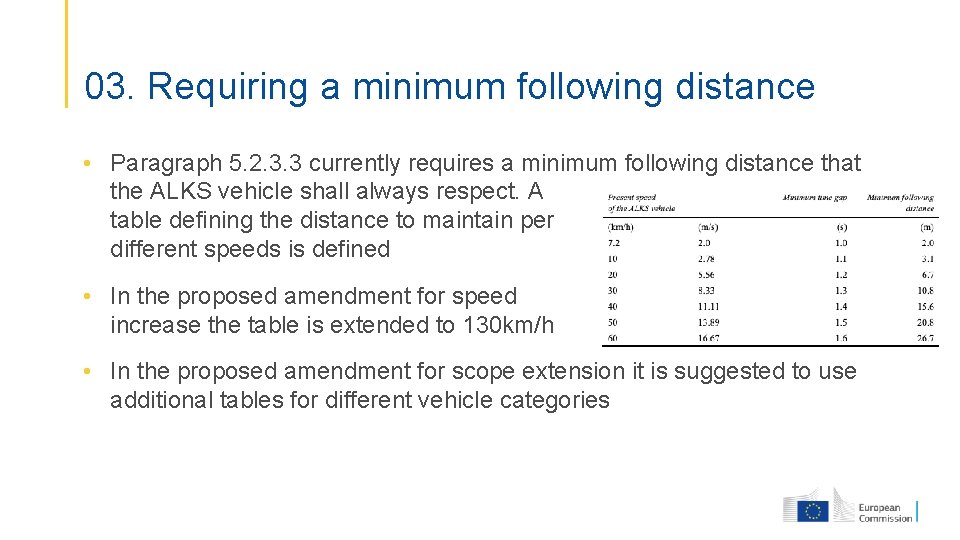
03. Requiring a minimum following distance • Paragraph 5. 2. 3. 3 currently requires a minimum following distance that the ALKS vehicle shall always respect. A table defining the distance to maintain per different speeds is defined • In the proposed amendment for speed increase the table is extended to 130 km/h • In the proposed amendment for scope extension it is suggested to use additional tables for different vehicle categories
03. Requiring a minimum following distance • The European Commission has already asked whether these tables are a proportionate requirement considering the following additional requirements • 5. 2. 3. 3. The activated system shall detect the distance to the next vehicle in front as defined in paragraph 7. 1. 1. and shall adapt the vehicle speed in order to avoid a collision. • 5. 2. 5. 1. The activated system shall avoid a collision with a leading vehicle which decelerates up to its full braking performance provided that there was no undercut of the minimum following distance the ALKS vehicle would adjust to a leading vehicle at the present speed due to a cut in manoeuvre of this lead vehicle.
03. Requiring a minimum following distance • If the minimum safety distance comes from traffic rules, then they will be automatically respected by the fullfillment of the requirement on respecting traffic rules • Since respecting the minimum distance is not a sufficient condition for safety, the only reason to request the respect of a minimum distance may be linked to the need not to confuse the other drivers
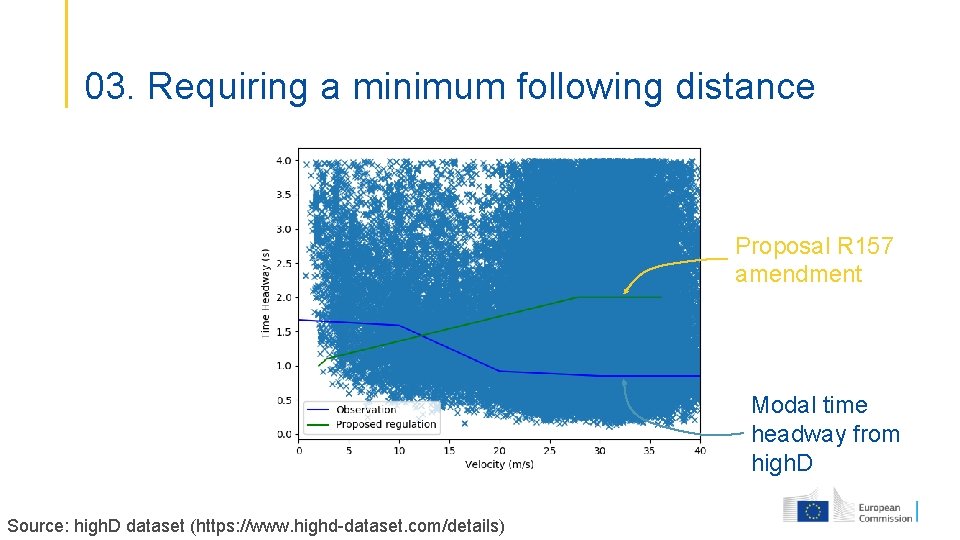
03. Requiring a minimum following distance Proposal R 157 amendment Modal time headway from high. D Source: high. D dataset (https: //www. highd-dataset. com/details)
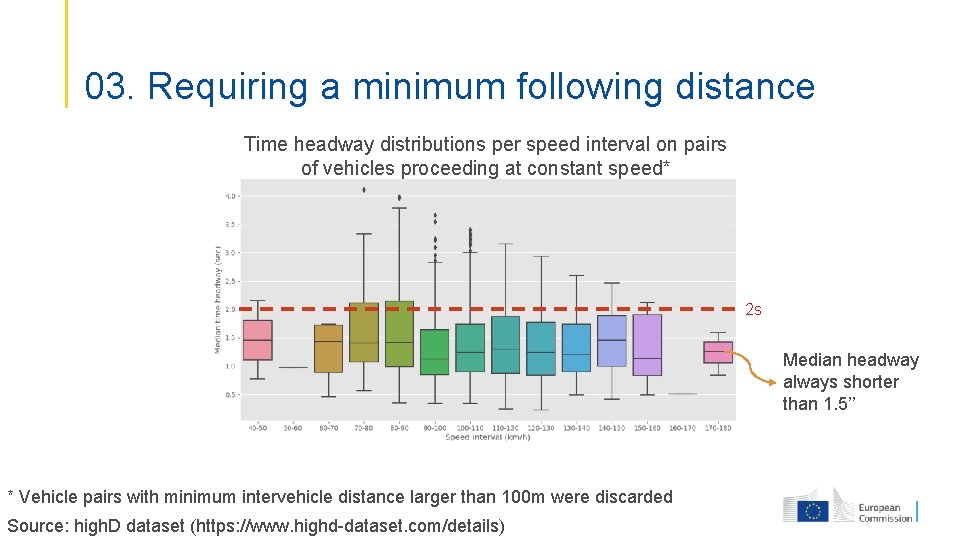
03. Requiring a minimum following distance Time headway distributions per speed interval on pairs of vehicles proceeding at constant speed* 2 s Median headway always shorter than 1. 5’’ * Vehicle pairs with minimum intervehicle distance larger than 100 m were discarded Source: high. D dataset (https: //www. highd-dataset. com/details)
03. Requiring a minimum following distance • Comparing the minimum distance with real-world data, the selected values (especially for speed higher than 60 km/h) does not seem motivated. • Keeping the requirement could • hinder innovation as ADS use cases focusing on short headways for fuel savings and traffic efficiency would not be allowed • expose the ALKS to (unnecessary) continuous cut-ins by other drivers with comfort and safety implications • The EC proposal is therefore to remove the minimum following distance requirement
03. Requiring a minimum following distance • The following proposal for amending par 5. 2. 3. 3 is therefore introduced: • 5. 2. 3. 3. The activated system shall detect the distance to the next vehicle in front as defined in paragraph 7. 1. 1. and shall adapt the vehicle speed in order to avoid a collision. • deleted • In case this cannot be respected temporarily because of other road users (e. g. vehicle is cutting in, decelerating lead vehicle, etc. ), the vehicle shall readjust the following distance at the next available opportunity without any harsh braking unless an emergency manoeuvre would become necessary. • deleted • The requirements of this paragraph are without prejudice to other requirements in this Regulation, most notably paragraphs 5. 2. 4. and 5. 2. 5. with subparagraphs. “
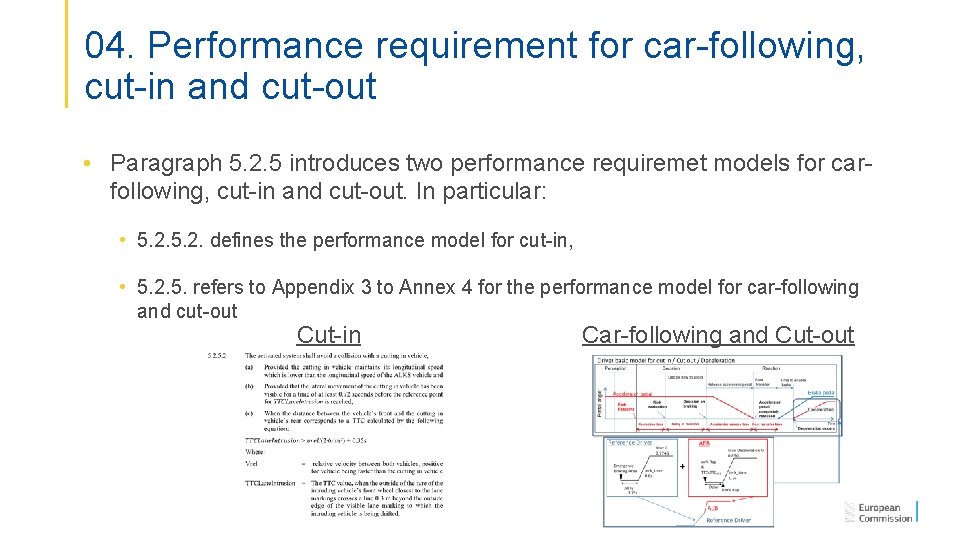
04. Performance requirement for car-following, cut-in and cut-out • Paragraph 5. 2. 5 introduces two performance requiremet models for carfollowing, cut-in and cut-out. In particular: • 5. 2. defines the performance model for cut-in, • 5. 2. 5. refers to Appendix 3 to Annex 4 for the performance model for car-following and cut-out Cut-in Car-following and Cut-out
04. Performance requirement for car-following, cut-in and cut-out • The performance model of Appendix 3 to Annex 4 does not show any condition for which car-following and cut-out would generate an accident. Therefore the only actual performance requirement is introduced for cutin • The two proposed performance models are equally valid approaches to determine “unpreventable” cut-ins • Their only limitation is to always treat the cut-in as an “emergency” situation in which the vehicle has either to do nothing or to apply maximum deceleration capabilities • In reality humans (as well as the future ADSs) apply proportionate reactions and count very much on anticipation (tactical safety)
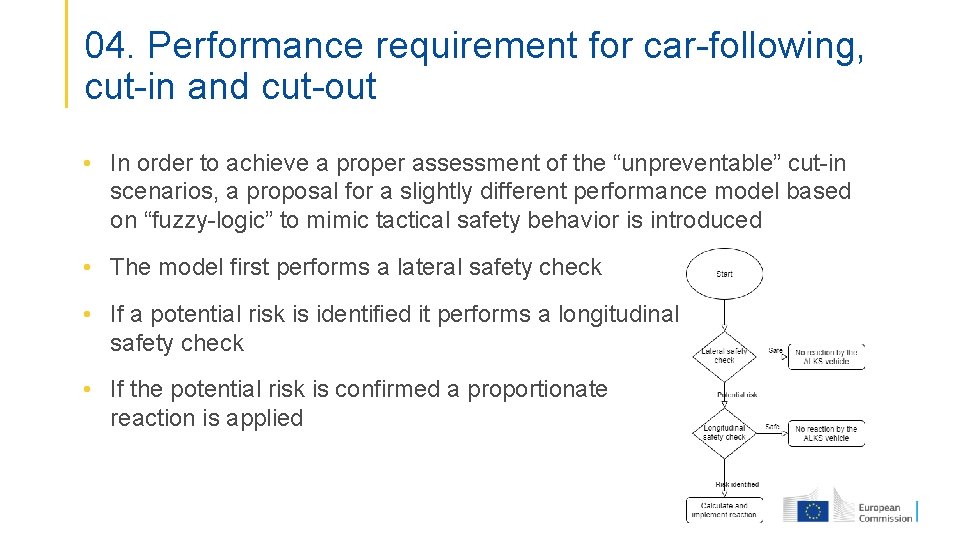
04. Performance requirement for car-following, cut-in and cut-out • In order to achieve a proper assessment of the “unpreventable” cut-in scenarios, a proposal for a slightly different performance model based on “fuzzy-logic” to mimic tactical safety behavior is introduced • The model first performs a lateral safety check • If a potential risk is identified it performs a longitudinal safety check • If the potential risk is confirmed a proportionate reaction is applied
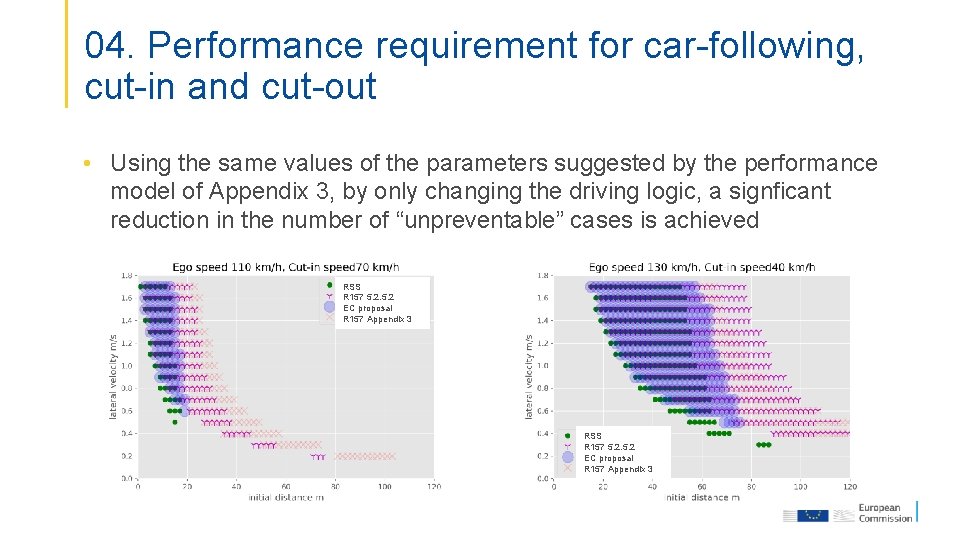
04. Performance requirement for car-following, cut-in and cut-out • Using the same values of the parameters suggested by the performance model of Appendix 3, by only changing the driving logic, a signficant reduction in the number of “unpreventable” cases is achieved RSS R 157 5. 2 EC proposal R 157 Appendix 3
04. Performance requirement for car-following, cut-in and cut-out • For the above considerations an amendment proposal is introduced to • Limit the use of the performance model only to cut-in • Have only 1 model left in the regulation (the EC proposal) fully described in Appendix 3 • Paragraph 5. 2. 5 and Appendix 3 have been amended to introduce these changes • The EC is also available to produce an open software implementation of the performance model and to keep it on a public web-site
05. Lane Change Procedure – Assessment of the target lane • The current proposal requires that in performing a lane-change the ALKS vehicle shall not force the approaching vehicle in the target lane to “unmanageably” decelerate • This is translated into a safety-distance like requirement which does not provide any direct measure of the safety of the approaching vehicle. • In the case of no approaching vehicle detected, a not entirely clear requirement for the assessment of the target lane is introduced • A proposal is here introduced to amend the text in order to make the assessment of the target lane conceptually more straightforward
05. Lane Change Procedure – Assessment of the target lane • In particular it is here proposed that: • To ensure that the approaching vehicle is not exposed to a high a risk of collision, at the end of the LCM it is left with a TTC higher than [4]s* • When an approaching vehicle is not detected it is assumed that an approaching vehicle does exist and it is placed at the limit of the rearward detection distance and proceeds with the highest possible speed allowed on that road • In addition it is also proposed that: • Par 5. 2. 6. 6. The ALKS vehicle verifies that it is able to keep a safe distance from the vehicle in front in the target lane, and • Par 5. 2. 6. 7. In case of a slower approaching vehicle in the target lane, the residual time gap at the end of the LCM shall be calculated using the longitudinal distance * 4 s is the upper bound of TTC values proposed in literature to identify unsafe traffic situations according to Mahmud et al. (2018) Micro. Simulation Modelling for Traffic Safety: A Review and Potential Application to Heterogeneous Traffic Environment. IATSS Research, 2018. https: //doi. org/10. 1016/j. iatssr. 2018. 07. 002.
06. Additional testing scenarios • The present amendment proposal also slightly modifies requirements in Par 5. 2. 4 and 5. 2. 5: • 5. 2. 4. The activated system shall be able to handle in a safe way the presence in the same lane of bring the vehicle to a complete stop behind a stationary vehicle, a stationary road user, a passable or unpassable obstacle [debris, lost cargo, etc. ], or a blocked lane of travel to avoid a collision. This shall be ensured up to the maximum operational speed of the system. • 5. 2. 5. The activated system shall detect the risk of collision in particular with another road user ahead or beside the vehicle, due to a decelerating lead vehicle, a cutting in vehicle, a vehicle proceeding in the opposite direction or a suddenly appearing obstacle and shall automatically perform appropriate manoeuvres to minimize risks to safety of the vehicle occupants and other road users.
06. Additional testing scenarios • Also to assess these requirements an additional set of test scenarios are introduced to Annex 5 to verify: • The rear detection range • The lane change capabilities • Response to traffic rules and specific road furnitures • Avoid braking before a passable object in the lane • String stability • Oncoming traffic / wrong way driver
07. Additional comments • 1. Is the current proposal able to take into account the case of a transition demand initiated by either the driver or the system during the execution of a Lane Change Procedure? • 2. A definition of “evasive manoeuvre” (introduced in paragraph 5. 3. 2. ) should be provided • 3. The numbering of Sub-sections of Section 5 of Annex 5 is wrong • 4. A definition of “early enough” in paragraph 5. 4. 2. 1. should be provided
07. Additional comments • 5. How can the requirement introduced in paragraph 5. 4. 4. 1. 1. (namely “In case of a severe ALKS or vehicle failure the ALKS may no longer be capable of fulfilling the requirements of this Regulation, but it shall aim at enabling a safe transition of control back to the driver”) be verified? • 6. Should reference to “technical services” throughout the Regulation be replaced by reference to “relevant authorities” • 7. To simplify the regulatory text and make it more flexible to the subsequent evolutions, the performance model described in Appendix 3 of Annex 4 could be embedded in an open software package that can be made freely available and kept updated. The JRC is available to take on board this task as recently done for other software used for regulatory purposes (e. g. CO 2 MPAS, VECTO, etc. )
Thank you © European Union 2020 Unless otherwise noted the reuse of this presentation is authorised under the CC BY 4. 0 license. For any use or reproduction of elements that are not owned by the EU, permission may need to be sought directly from the respective right holders. Slide xx: element concerned, source: e. g. Fotolia. com; Slide xx: element concerned, source: e. g. i. Stock. com
- Slides: 26