
Submitted by the experts from ATP and Idiada
Submitted by the experts from ATP and Idiada Mr. Klaus Vosteen ATP Executive Director Mr. Fran Martínez IDIADA Proving Ground Supervisor Informal document GRRF-75 -42 (75 th GRRF, 17 -19 February 2013, agenda item 13(d)) Proposal to Modify Homologation Brake Test Procedure to Improve Safety on Proving Ground 18/09/2013
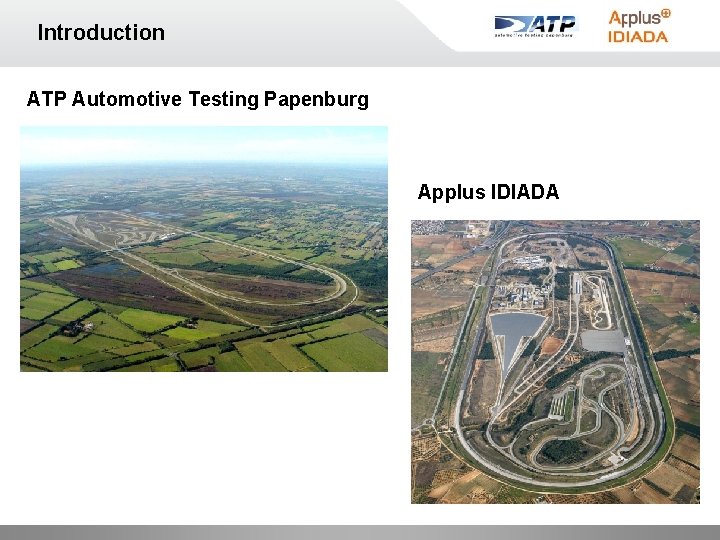
Introduction ATP Automotive Testing Papenburg Applus IDIADA
Introduction EPGSA (www. EPGSA. eu) • The European Proving Ground Safety Assoiciation EPGSA is a forum for the discussion of safety related items regarding vehicle testing. • EPGSA was founded in 2002. • It is not the intention of the organization to develop standards, but to collectively share possible solutions to safety related issues. • It is a non-profit organization. • The membership is limited to vehicle testing organizations with proving grounds. Members: • Arctic Falls (Sweden), ATP (Germany), Bosch (Germany), Bridgestone (Italy), Bruntingthorpe (UK), UTAC -CERAM (France), Continental (Germany), DEKRA (Germany), Ford (Belgium), Goodyear. Dunlop (France), Icemakers (Sweden), IDIADA (Spain), Jaguar/Land Rover (UK), Opel (Germany), Millbrook (UK), MIRA (UK), Nardo (Italy), Renault (France), Volvo (Sweden),
Homologation Brake Test ECE R 13 (Heavy Vehicles) ECE R 13 H (Passenger cars) ECE R 90 (Replacement brake linings)
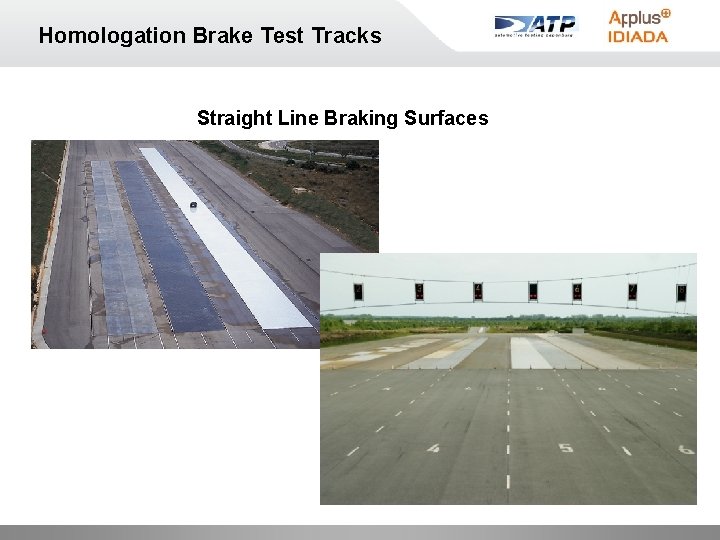
Homologation Brake Test Tracks Straight Line Braking Surfaces
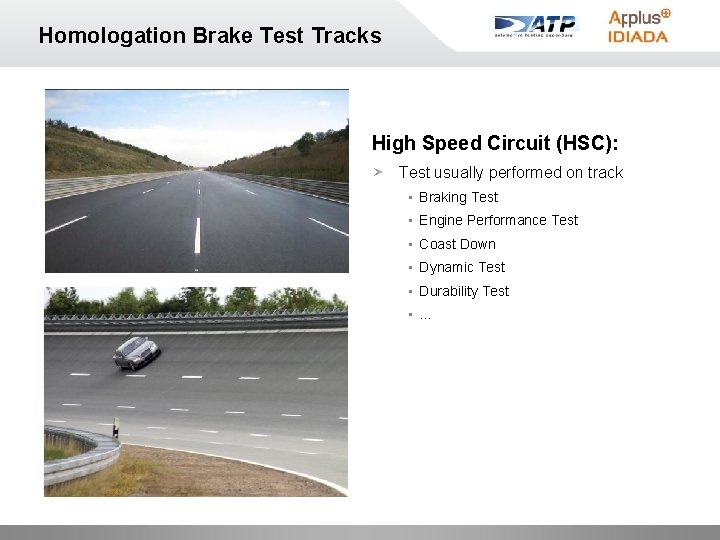
Homologation Brake Test Tracks High Speed Circuit (HSC): Test usually performed on track • Braking Test • Engine Performance Test • Coast Down • Dynamic Test • Durability Test • …
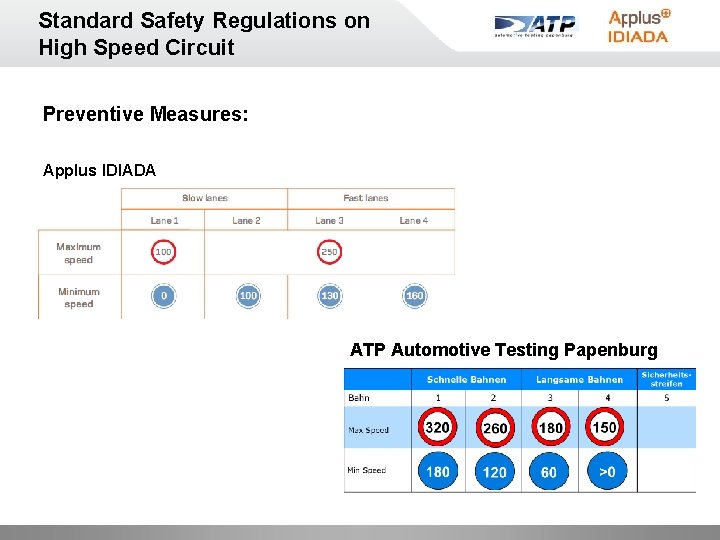
Standard Safety Regulations on High Speed Circuit Preventive Measures: Applus IDIADA ATP Automotive Testing Papenburg
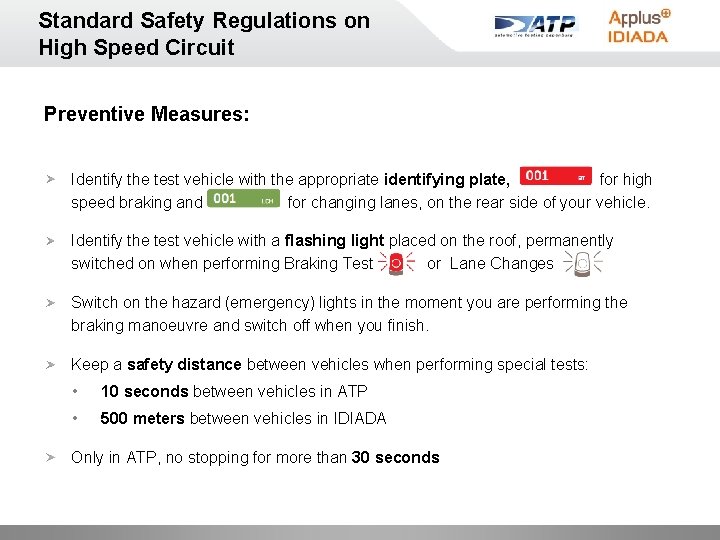
Standard Safety Regulations on High Speed Circuit Preventive Measures: Identify the test vehicle with the appropriate identifying plate, for high speed braking and for changing lanes, on the rear side of your vehicle. Identify the test vehicle with a flashing light placed on the roof, permanently switched on when performing Braking Test or Lane Changes Switch on the hazard (emergency) lights in the moment you are performing the braking manoeuvre and switch off when you finish. Keep a safety distance between vehicles when performing special tests: • 10 seconds between vehicles in ATP • 500 meters between vehicles in IDIADA Only in ATP, no stopping for more than 30 seconds
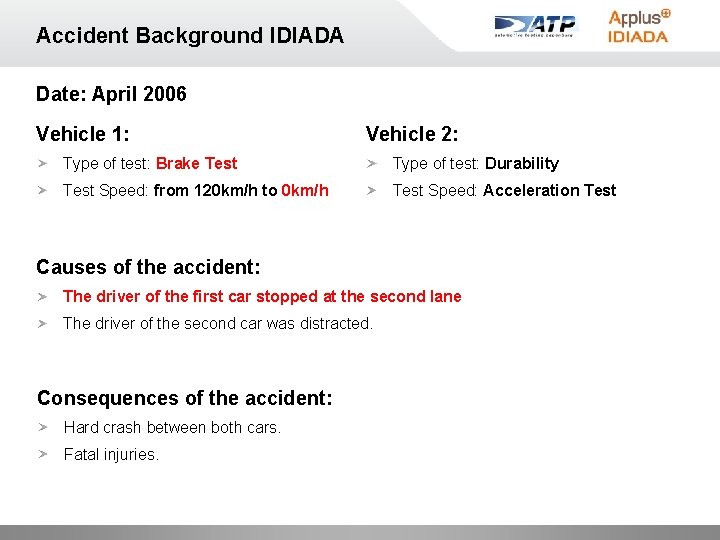
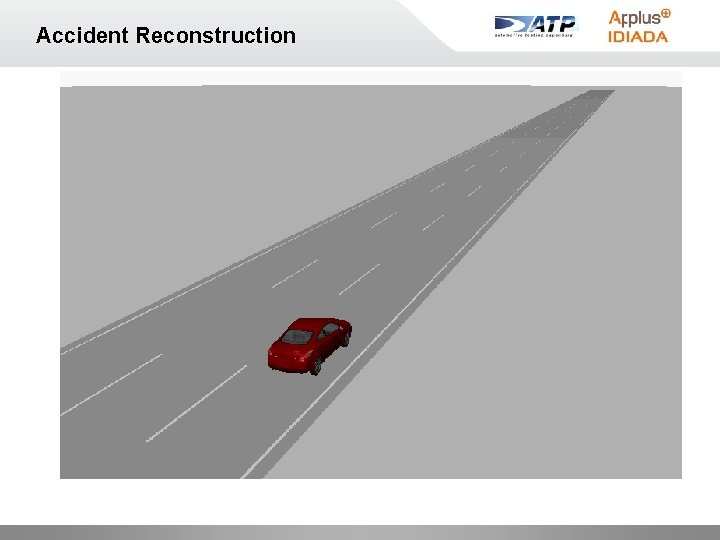
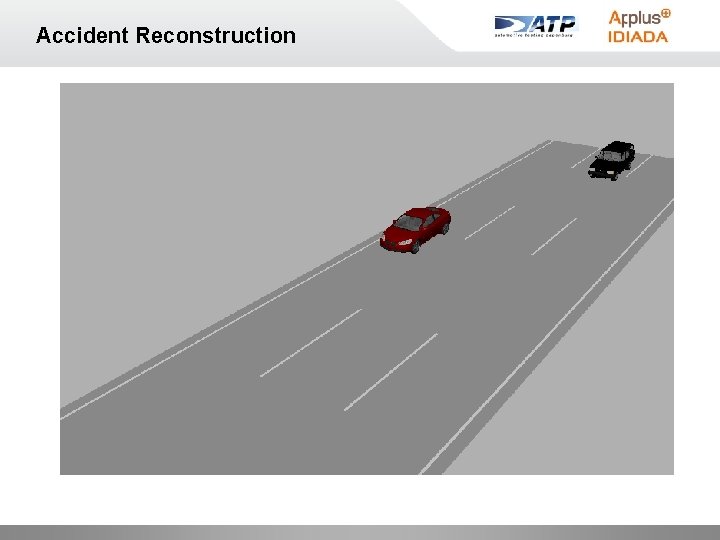
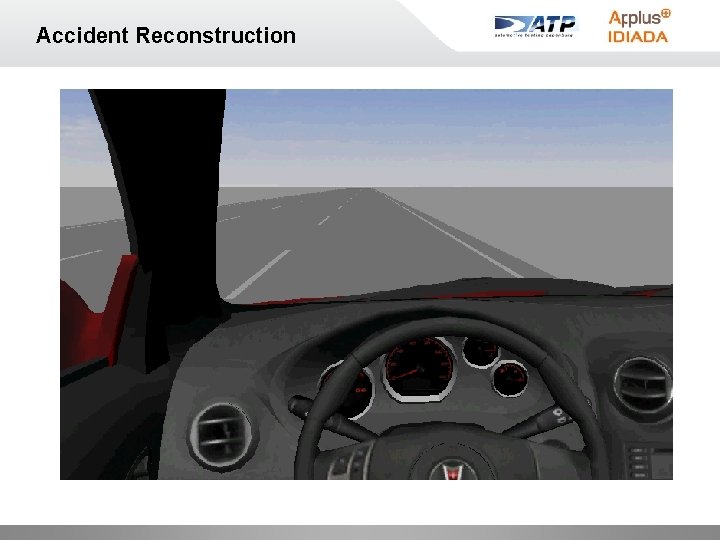
Accident Background IDIADA Date: April 2006 Vehicle 1: Vehicle 2: Type of test: Brake Test Type of test: Durability Test Speed: from 120 km/h to 0 km/h Test Speed: Acceleration Test Causes of the accident: The driver of the first car stopped at the second lane The driver of the second car was distracted. Consequences of the accident: Hard crash between both cars. Fatal injuries.
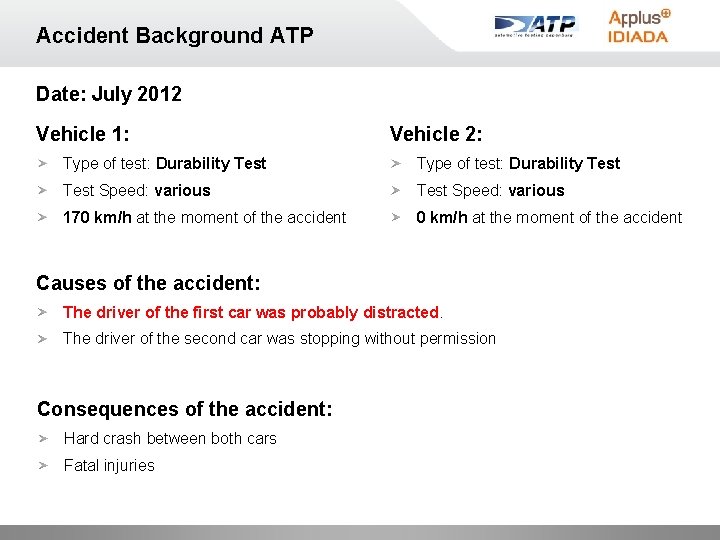
Accident Background ATP Date: July 2012 Vehicle 1: Vehicle 2: Type of test: Durability Test Speed: various 170 km/h at the moment of the accident Causes of the accident: The driver of the first car was probably distracted. The driver of the second car was stopping without permission Consequences of the accident: Hard crash between both cars Fatal injuries
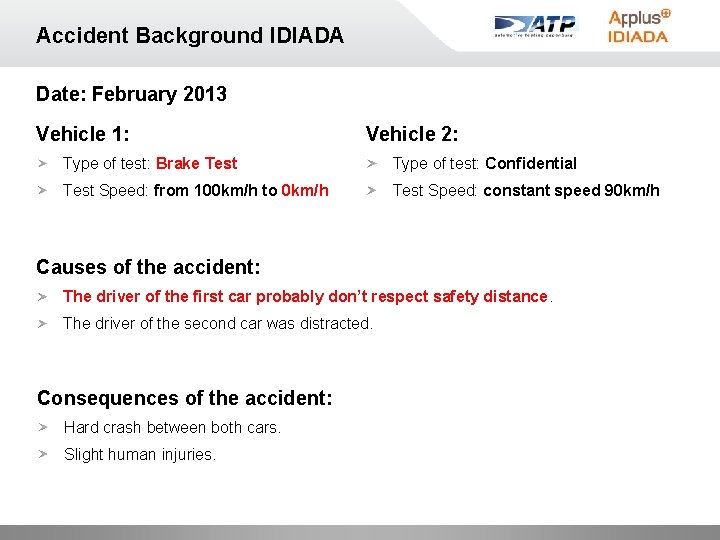
Accident Background IDIADA Date: February 2013 Vehicle 1: Vehicle 2: Type of test: Brake Test Type of test: Confidential Test Speed: from 100 km/h to 0 km/h Test Speed: constant speed 90 km/h Causes of the accident: The driver of the first car probably don’t respect safety distance. The driver of the second car was distracted. Consequences of the accident: Hard crash between both cars. Slight human injuries.
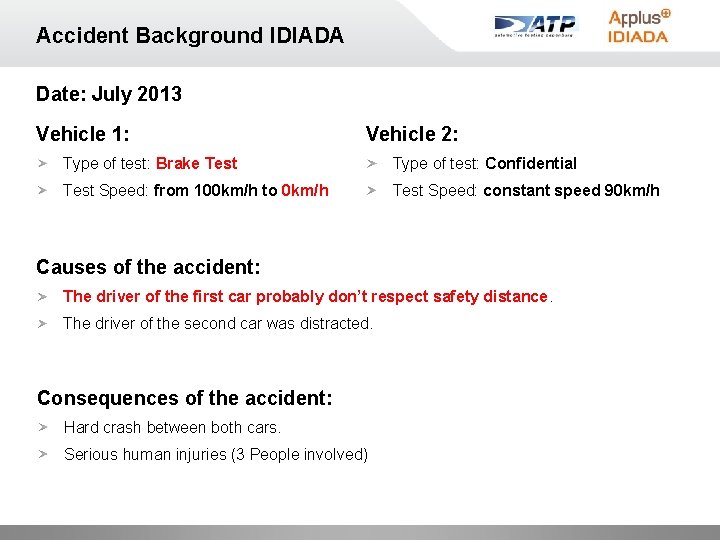
Accident Background IDIADA Date: July 2013 Vehicle 1: Vehicle 2: Type of test: Brake Test Type of test: Confidential Test Speed: from 100 km/h to 0 km/h Test Speed: constant speed 90 km/h Causes of the accident: The driver of the first car probably don’t respect safety distance. The driver of the second car was distracted. Consequences of the accident: Hard crash between both cars. Serious human injuries (3 People involved)
Accident Reconstruction
Accident Reconstruction
Accident Reconstruction
Accident Background Description of the problem 1. Performance tests at high decelerations (eg 1 g) from high speeds to ZERO Stopped vehicles at the High Speed Track with vehicles driving at high speed. 2. Fade tests that have to be performed at rigid periods of time (eg every 45 seconds), and if one stop fails or is aborted, the whole test including all the preparation and bedding of the samples is not valid and need to be repeated. It makes the driver do not fulfil the safety regulations mainly the safety distance.
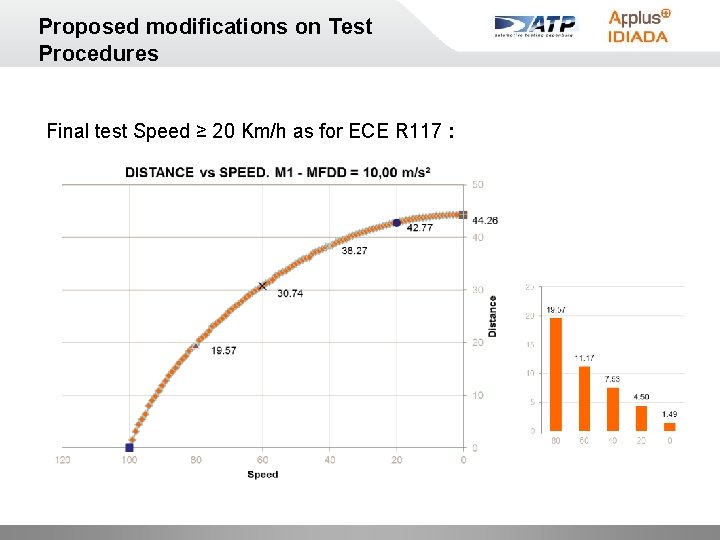
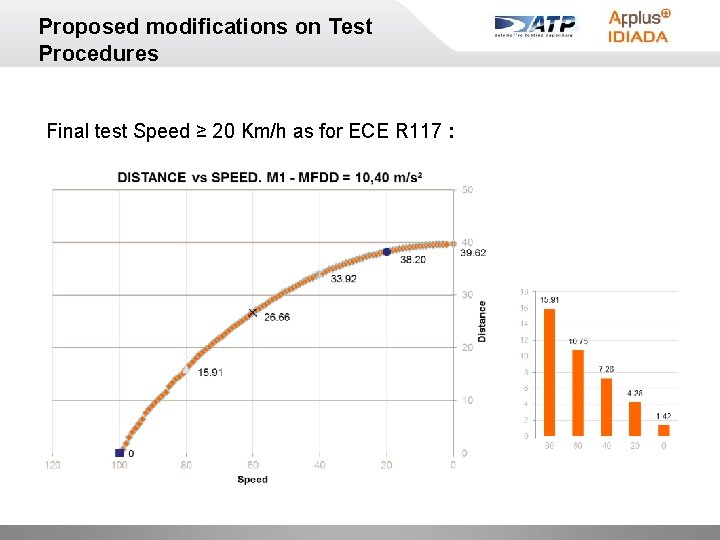
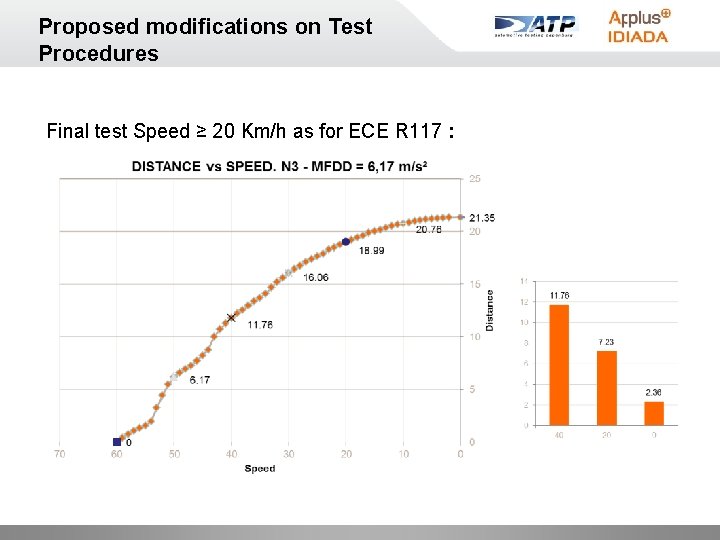
Proposals to improve safety Proposal for slight modifications on Brake Test Procedures on High Speed Track: Final test Speed ≥ 20 Km/h. More flexibility on Fading Tests
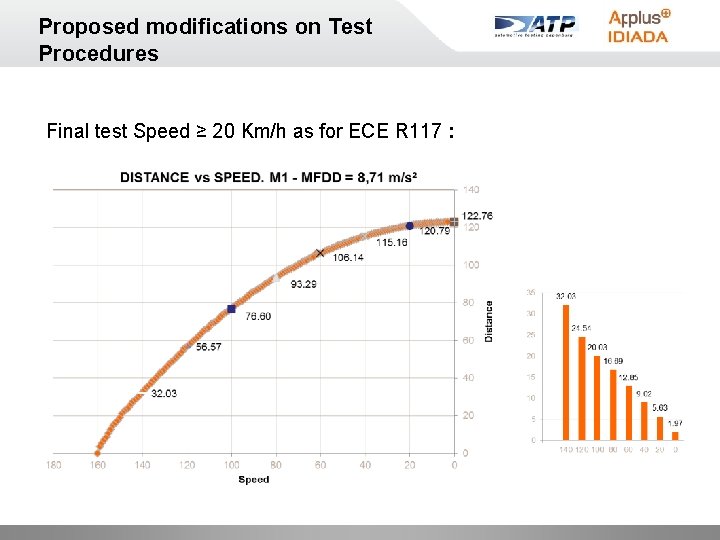
Proposed modifications on Test Procedures Final test Speed ≥ 20 Km/h as for ECE R 117 :
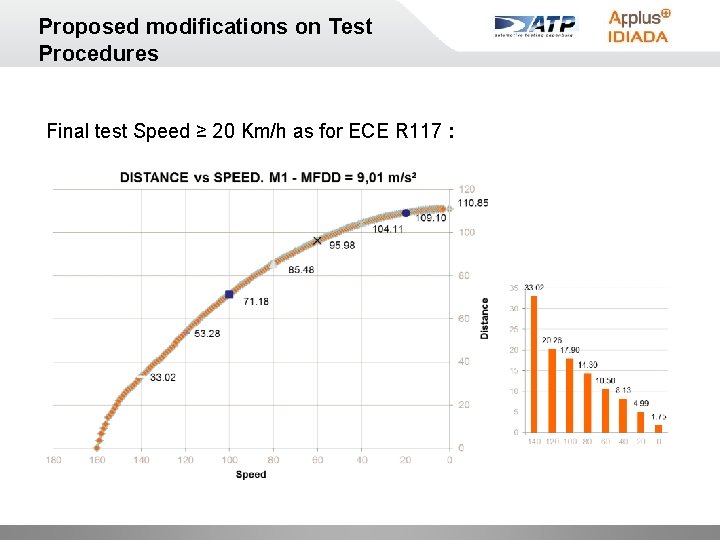
Proposed modifications on Test Procedures Final test Speed ≥ 20 Km/h as for ECE R 117 :
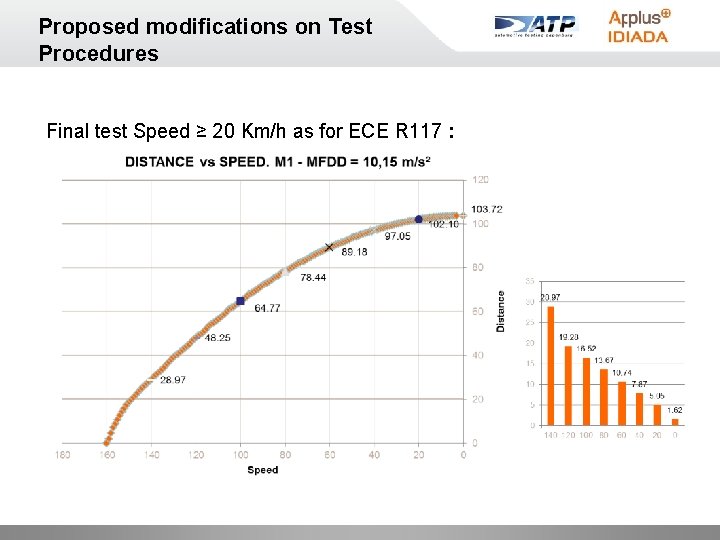
Proposed modifications on Test Procedures Final test Speed ≥ 20 Km/h as for ECE R 117 :
Proposed modifications on Test Procedures Final test Speed ≥ 20 Km/h as for ECE R 117 :
Proposed modifications on Test Procedures Final test Speed ≥ 20 Km/h as for ECE R 117 :
Proposed modifications on Test Procedures Final test Speed ≥ 20 Km/h as for ECE R 117 :
Proposed modifications on Test Procedures More flexibility on Fading Tests : We would like to propose a certain tolerance in the frequency and even more, a scape possibility, if during the 15 snubs, there is a need of extend some of the periods due to safety aspects, at discretion of the technical service, this might be compensated by one additional snub to ensure that the brakes have been sufficiently heated.
Thank you very much for your kind attention For further information: Mr. Klaus Vosteen T +494961975312 Klaus_Vosteen@ATP-Papenburg. de Mr. Fran Martínez T +34 977 16 60 04 fmartinez@idiada. com
- Slides: 25