
SUBLATTICES SUBCRYSTALS Part of MATERIALS SCIENCE A Learners
SUBLATTICES & ‘SUBCRYSTALS’ Part of MATERIALS SCIENCE & A Learner’s Guide ENGINEERING AN INTRODUCTORY E-BOOK Anandh Subramaniam & Kantesh Balani Materials Science and Engineering (MSE) Indian Institute of Technology, Kanpur- 208016 Email: anandh@iitk. ac. in, URL: home. iitk. ac. in/~anandh http: //home. iitk. ac. in/~anandh/E-book. htm
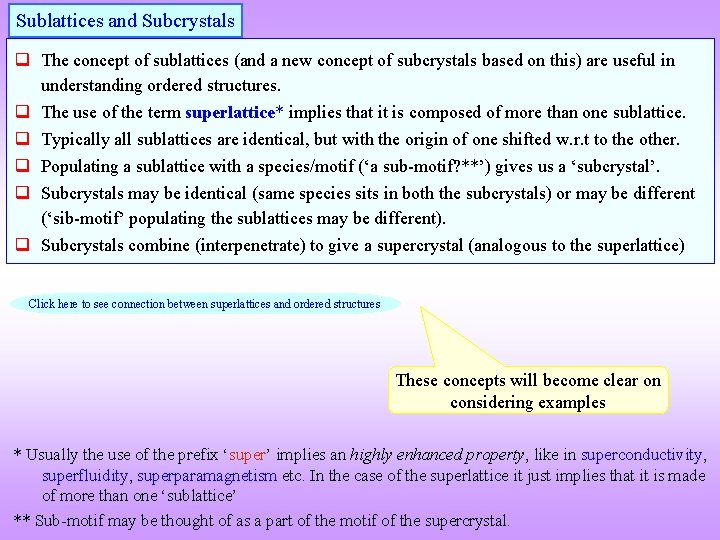
Sublattices and Subcrystals q The concept of sublattices (and a new concept of subcrystals based on this) are useful in understanding ordered structures. q The use of the term superlattice* implies that it is composed of more than one sublattice. q Typically all sublattices are identical, but with the origin of one shifted w. r. t to the other. q Populating a sublattice with a species/motif (‘a sub-motif? **’) gives us a ‘subcrystal’. q Subcrystals may be identical (same species sits in both the subcrystals) or may be different (‘sib-motif’ populating the sublattices may be different). q Subcrystals combine (interpenetrate) to give a supercrystal (analogous to the superlattice) Click here to see connection between superlattices and ordered structures These concepts will become clear on considering examples * Usually the use of the prefix ‘super’ implies an highly enhanced property, like in superconductivity, superfluidity, superparamagnetism etc. In the case of the superlattice it just implies that it is made of more than one ‘sublattice’ ** Sub-motif may be thought of as a part of the motif of the supercrystal.
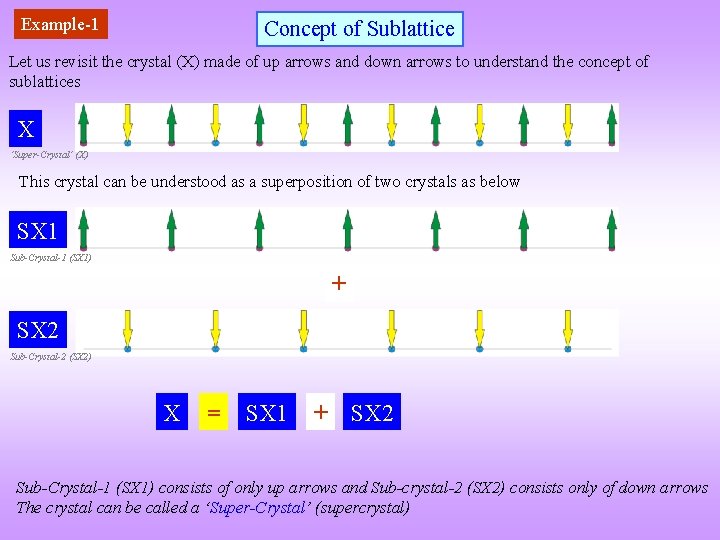
Example-1 Concept of Sublattice Let us revisit the crystal (X) made of up arrows and down arrows to understand the concept of sublattices X ‘Super-Crystal’ (X) This crystal can be understood as a superposition of two crystals as below SX 1 Sub-Crystal-1 (SX 1) + SX 2 Sub-Crystal-2 (SX 2) X = SX 1 + SX 2 Sub-Crystal-1 (SX 1) consists of only up arrows and Sub-crystal-2 (SX 2) consists only of down arrows The crystal can be called a ‘Super-Crystal’ (supercrystal)
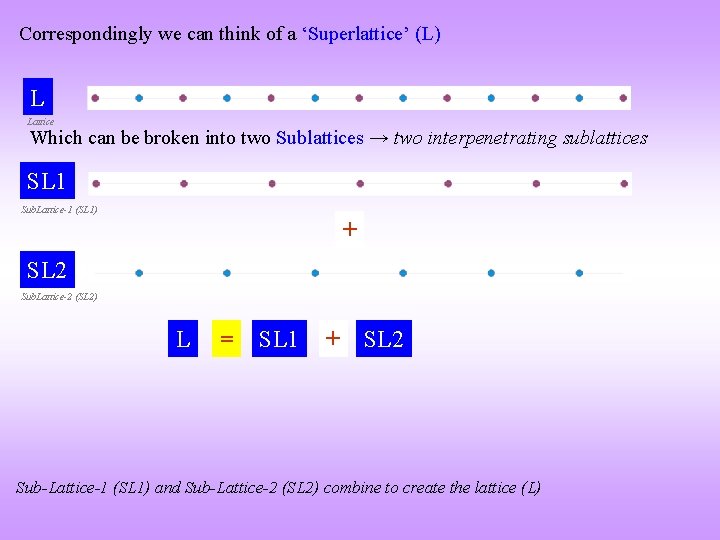
Correspondingly we can think of a ‘Superlattice’ (L) L Lattice Which can be broken into two Sublattices → two interpenetrating sublattices SL 1 Sub. Lattice-1 (SL 1) + SL 2 Sub. Lattice-2 (SL 2) L = SL 1 + SL 2 Sub-Lattice-1 (SL 1) and Sub-Lattice-2 (SL 2) combine to create the lattice (L)
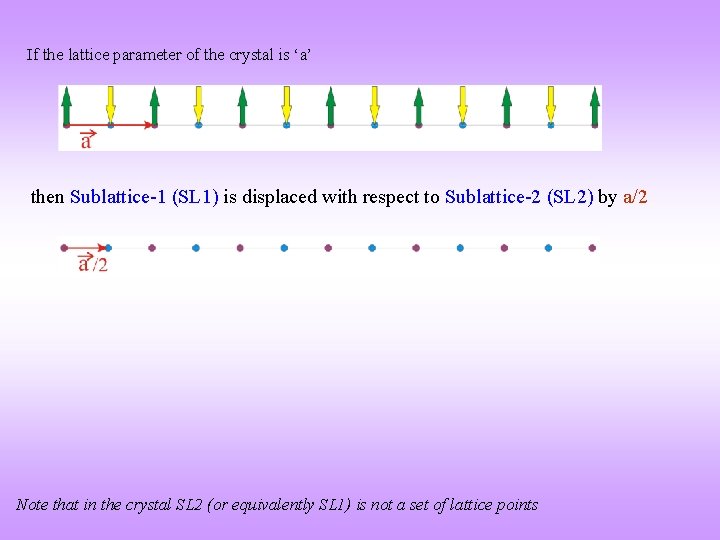
If the lattice parameter of the crystal is ‘a’ then Sublattice-1 (SL 1) is displaced with respect to Sublattice-2 (SL 2) by a/2 Note that in the crystal SL 2 (or equivalently SL 1) is not a set of lattice points

Example-2 Let us consider another example to understand the concept of sublattice (now in 2 D) Simple Square Crystal X ‘Super-Crystal’ (X) This is the familiar crystal which we had considered before
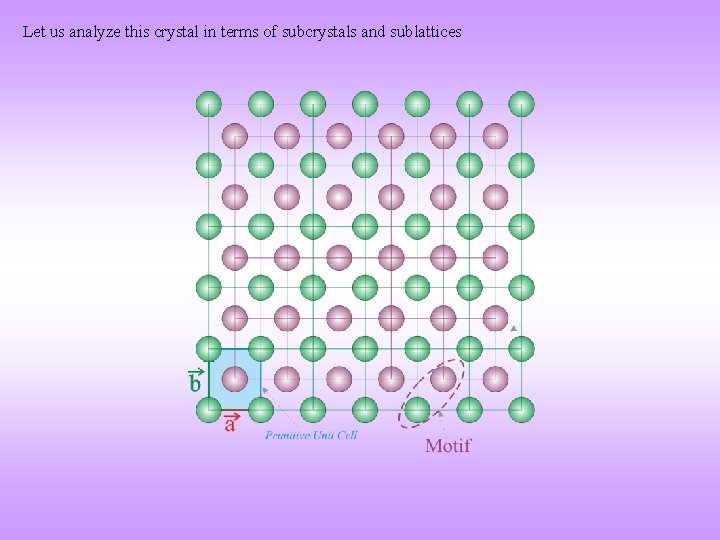
Let us analyze this crystal in terms of subcrystals and sublattices
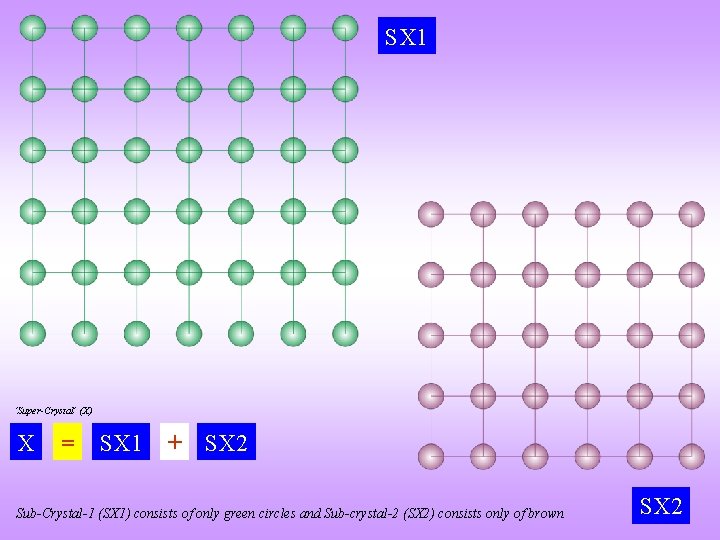
SX 1 ‘Super-Crystal’ (X) X = SX 1 + SX 2 Sub-Crystal-1 (SX 1) consists of only green circles and Sub-crystal-2 (SX 2) consists only of brown SX 2
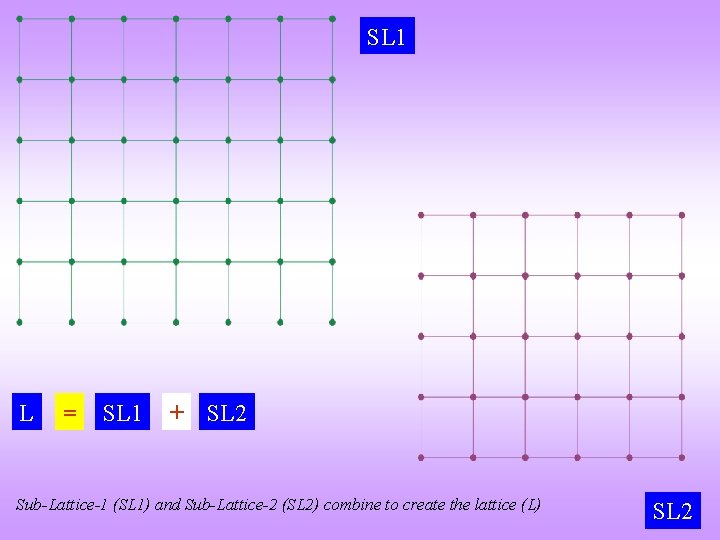
SL 1 L = SL 1 + SL 2 Sub-Lattice-1 (SL 1) and Sub-Lattice-2 (SL 2) combine to create the lattice (L) SL 2
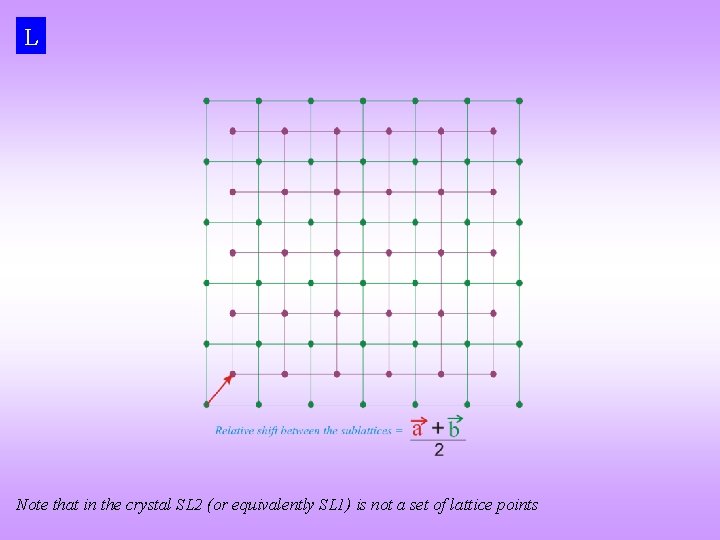
L Note that in the crystal SL 2 (or equivalently SL 1) is not a set of lattice points
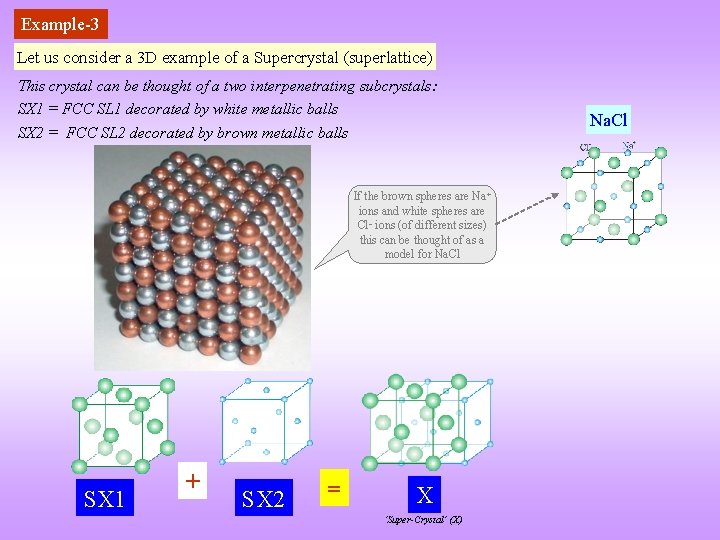
Example-3 Let us consider a 3 D example of a Supercrystal (superlattice) This crystal can be thought of a two interpenetrating subcrystals: SX 1 = FCC SL 1 decorated by white metallic balls SX 2 = FCC SL 2 decorated by brown metallic balls If the brown spheres are Na+ ions and white spheres are Cl ions (of different sizes) this can be thought of as a model for Na. Cl SX 1 + SX 2 = X ‘Super-Crystal’ (X) Na. Cl
- Slides: 11