
SUBJUNCTIVE VS INDICATIVE WHEN TO USE THE SUBJUNCTIVE
SUBJUNCTIVE VS INDICATIVE
WHEN TO USE THE SUBJUNCTIVE V INDICATIVE • The subjunctive mood is used to talk about desires, doubts, wishes, conjectures, and possibilities. • The indicative mood is used to talk about facts and statements that are believed to be true and concrete. • The imperative mood is used to give commands.
MOOD V TENSE MOOD • Grammatical mood reflects a speaker's attitude toward a statement. • Spanish has three moods: the subjunctive, the indicative, and the imperative. TENSE • Grammatical tense refers to when an action takes place. • Spanish has three tenses: the past, the present, and the future.
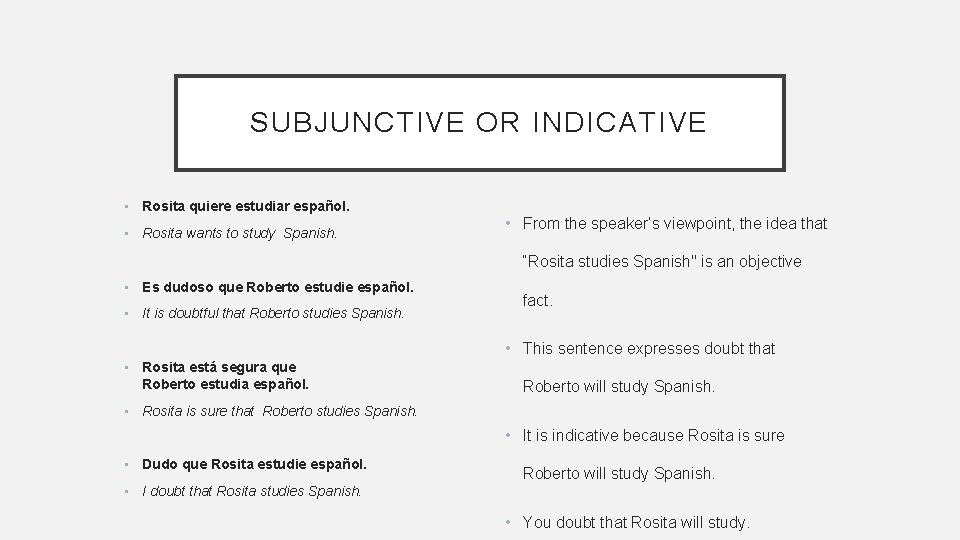
SUBJUNCTIVE OR INDICATIVE • Rosita quiere estudiar español. • Rosita wants to study Spanish. • From the speaker’s viewpoint, the idea that “Rosita studies Spanish" is an objective • Es dudoso que Roberto estudie español. • It is doubtful that Roberto studies Spanish. fact. • This sentence expresses doubt that • Rosita está segura que Roberto estudia español. Roberto will study Spanish. • Rosita is sure that Roberto studies Spanish. • It is indicative because Rosita is sure • Dudo que Rosita estudie español. Roberto will study Spanish. • I doubt that Rosita studies Spanish. • You doubt that Rosita will study.
TYPES OF SENTENCES THAT USE THE SUBJUNCTIVE q. Two subjects q. Two verbs
TWO SUBJECTS • Most subjunctive sentences will have one subject in the main clause and one in the secondary clause. The attitude of the subject in the main clause is what triggers the use of the subjunctive in the secondary clause. • Rosita quiere que tú limpies el baño. • Rosita wants you to clean the bathroom.
TWO VERBS • Most subjunctive sentences have two verbs: a verb in the indicative meaning in the present/future tense in the main clause and a verb in the present subjunctive in the secondary clause. • Rosita quiere que tú hagas la tarea. • Rosita wants you to do the homework.
WORDS AND PHRASES THAT TRIGGER THE SUBJUNCTIVE OR INDICATIVE • Another way to understand the differences between the subjunctive and the indicative is understanding that certain words or phrases trigger the use of each mood. For example, words and phrases that indicate uncertainty trigger the subjunctive, while those that indicate certainty trigger the indicative. • Many of the words and phrases that trigger the subjunctive fit into the acronym WEIRDO, which stands for: Wishes, Emotions, Impersonal expressions, Recommendations, Doubt/Denial, and Ojalá.
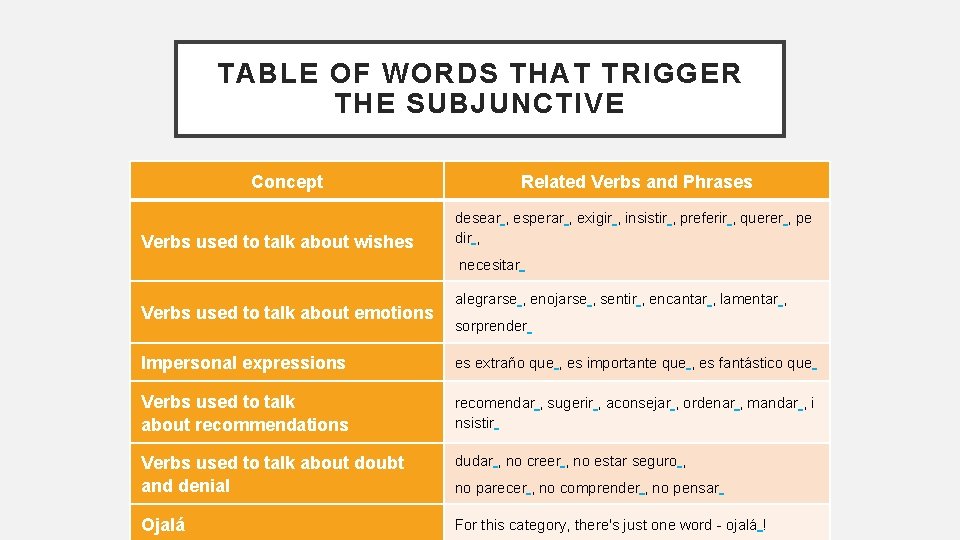
TABLE OF WORDS THAT TRIGGER THE SUBJUNCTIVE Concept Verbs used to talk about wishes Related Verbs and Phrases desear , esperar , exigir , insistir , preferir , querer , pe dir , necesitar Verbs used to talk about emotions alegrarse , enojarse , sentir , encantar , lamentar , sorprender Impersonal expressions es extraño que , es importante que , es fantástico que Verbs used to talk about recommendations recomendar , sugerir , aconsejar , ordenar , mandar , i nsistir Verbs used to talk about doubt and denial dudar , no creer , no estar seguro , Ojalá For this category, there's just one word - ojalá ! no parecer , no comprender , no pensar
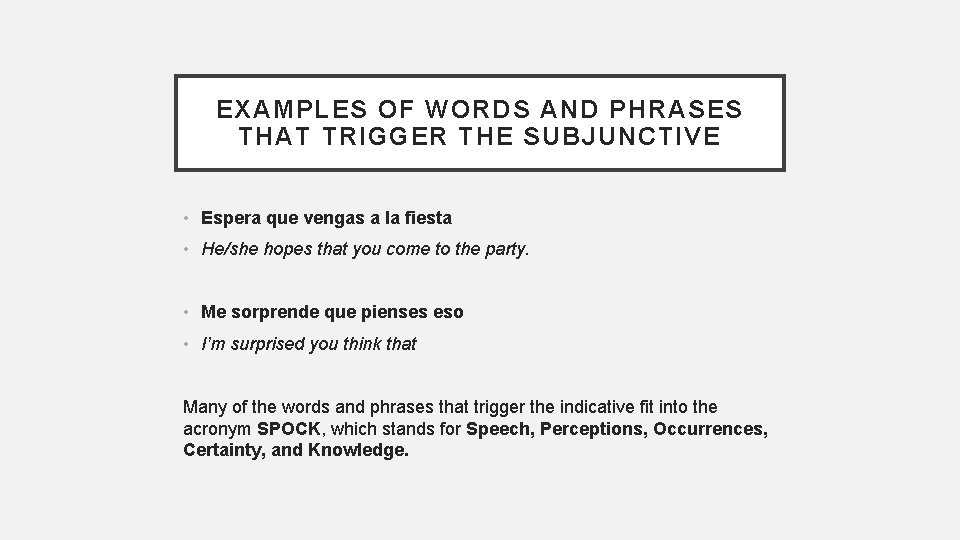
EXAMPLES OF WORDS AND PHRASES THAT TRIGGER THE SUBJUNCTIVE • Espera que vengas a la fiesta • He/she hopes that you come to the party. • Me sorprende que pienses eso • I’m surprised you think that Many of the words and phrases that trigger the indicative fit into the acronym SPOCK, which stands for Speech, Perceptions, Occurrences, Certainty, and Knowledge.
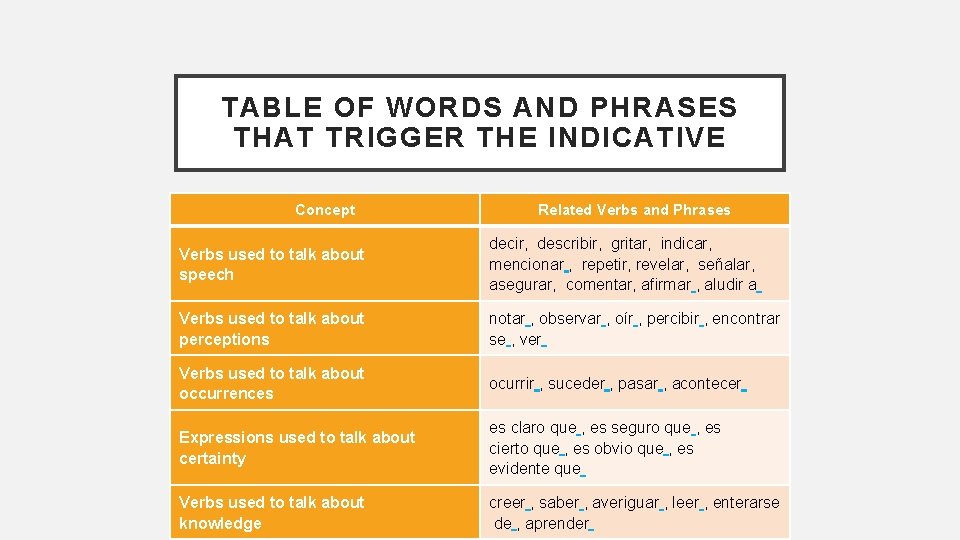
TABLE OF WORDS AND PHRASES THAT TRIGGER THE INDICATIVE Concept Related Verbs and Phrases Verbs used to talk about speech decir, describir, gritar, indicar, mencionar , repetir, revelar, señalar, asegurar, comentar, afirmar , aludir a Verbs used to talk about perceptions notar , observar , oír , percibir , encontrar se , ver Verbs used to talk about occurrences ocurrir , suceder , pasar , acontecer Expressions used to talk about certainty es claro que , es seguro que , es cierto que , es obvio que , es evidente que Verbs used to talk about knowledge creer , saber , averiguar , leer , enterarse de , aprender
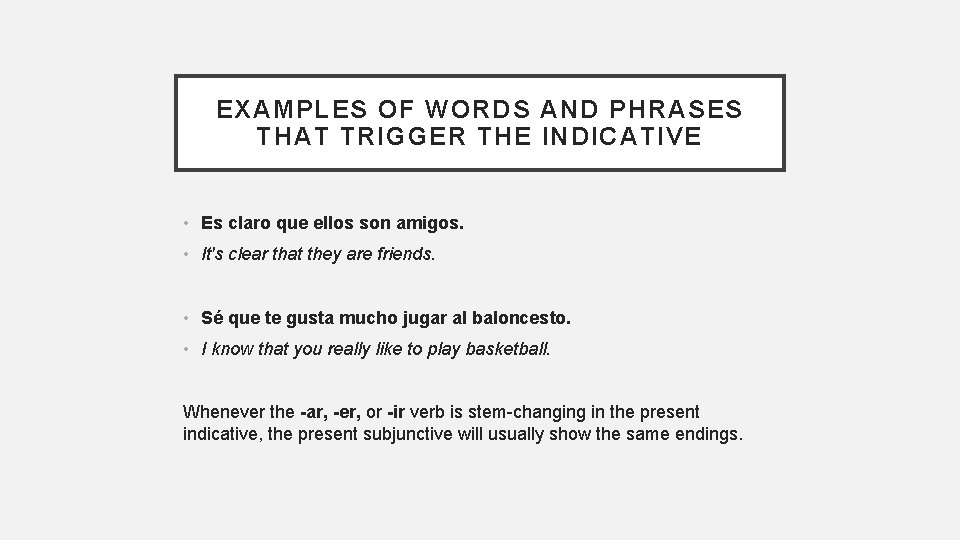
EXAMPLES OF WORDS AND PHRASES THAT TRIGGER THE INDICATIVE • Es claro que ellos son amigos. • It's clear that they are friends. • Sé que te gusta mucho jugar al baloncesto. • I know that you really like to play basketball. Whenever the -ar, -er, or -ir verb is stem-changing in the present indicative, the present subjunctive will usually show the same endings.
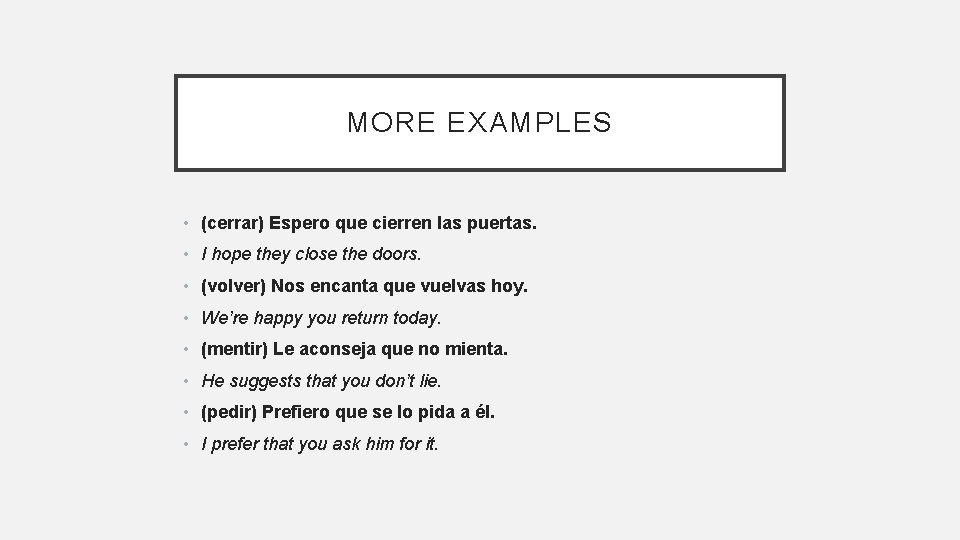
MORE EXAMPLES • (cerrar) Espero que cierren las puertas. • I hope they close the doors. • (volver) Nos encanta que vuelvas hoy. • We’re happy you return today. • (mentir) Le aconseja que no mienta. • He suggests that you don’t lie. • (pedir) Prefiero que se lo pida a él. • I prefer that you ask him for it.
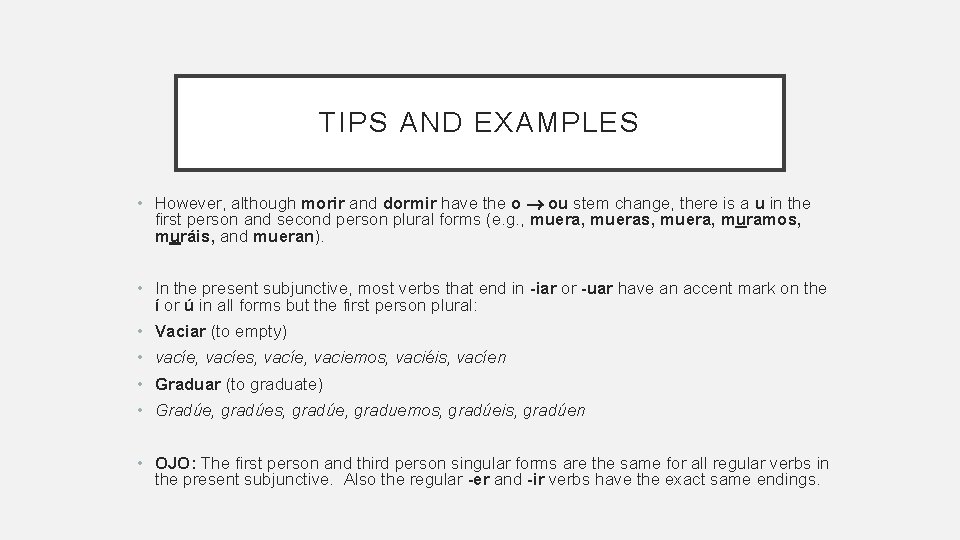
TIPS AND EXAMPLES • However, although morir and dormir have the o ou stem change, there is a u in the first person and second person plural forms (e. g. , mueras, muera, muramos, muráis, and mueran). • In the present subjunctive, most verbs that end in -iar or -uar have an accent mark on the í or ú in all forms but the first person plural: • Vaciar (to empty) • vacíe, vacíes, vacíe, vaciemos, vaciéis, vacíen • Graduar (to graduate) • Gradúe, gradúes, gradúe, graduemos, gradúeis, gradúen • OJO: The first person and third person singular forms are the same for all regular verbs in the present subjunctive. Also the regular -er and -ir verbs have the exact same endings.
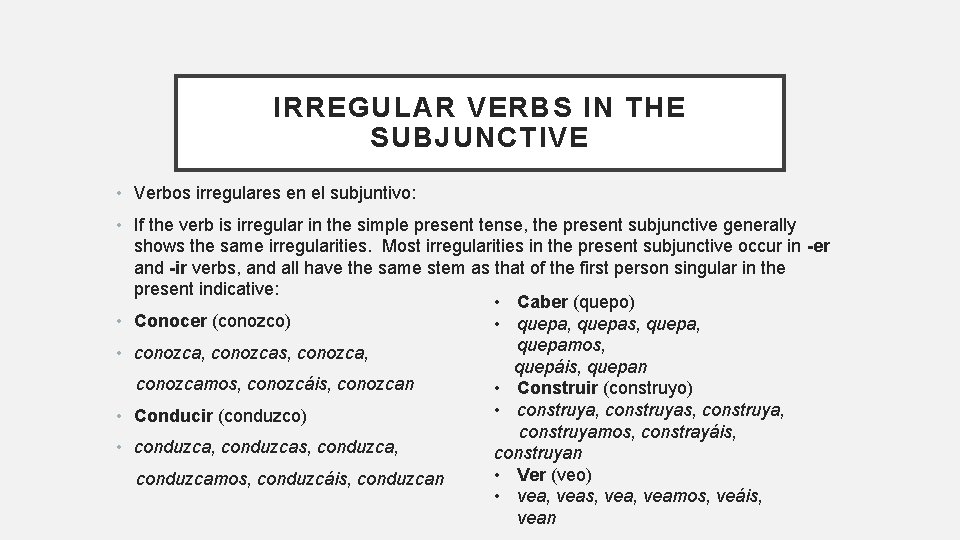
IRREGULAR VERBS IN THE SUBJUNCTIVE • Verbos irregulares en el subjuntivo: • If the verb is irregular in the simple present tense, the present subjunctive generally shows the same irregularities. Most irregularities in the present subjunctive occur in -er and -ir verbs, and all have the same stem as that of the first person singular in the present indicative: • Caber (quepo) • Conocer (conozco) • quepa, quepas, quepamos, • conozca, conozcas, conozca, quepáis, quepan conozcamos, conozcáis, conozcan • Construir (construyo) • construya, construyas, construya, • Conducir (conduzco) construyamos, constrayáis, • conduzca, conduzcas, conduzca, construyan • Ver (veo) conduzcamos, conduzcáis, conduzcan • vea, veas, veamos, veáis, vean
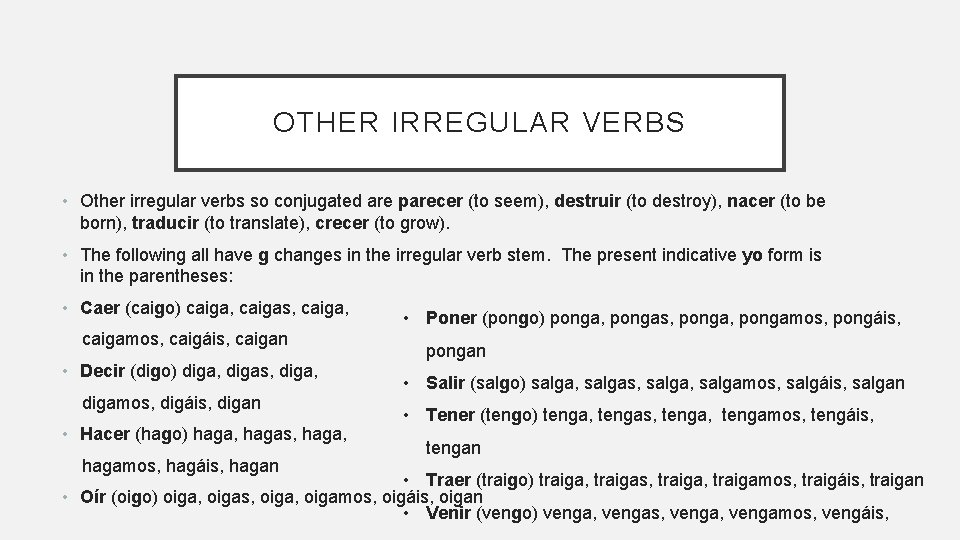
OTHER IRREGULAR VERBS • Other irregular verbs so conjugated are parecer (to seem), destruir (to destroy), nacer (to be born), traducir (to translate), crecer (to grow). • The following all have g changes in the irregular verb stem. The present indicative yo form is in the parentheses: • Caer (caigo) caiga, caigas, caigamos, caigáis, caigan • Decir (digo) diga, digas, digamos, digáis, digan • Hacer (hago) haga, hagas, hagamos, hagáis, hagan • Poner (pongo) ponga, pongas, pongamos, pongáis, pongan • Salir (salgo) salga, salgas, salgamos, salgáis, salgan • Tener (tengo) tenga, tengas, tengamos, tengáis, tengan • Traer (traigo) traiga, traigas, traigamos, traigáis, traigan • Oír (oigo) oiga, oigas, oigamos, oigáis, oigan • Venir (vengo) venga, vengas, vengamos, vengáis,
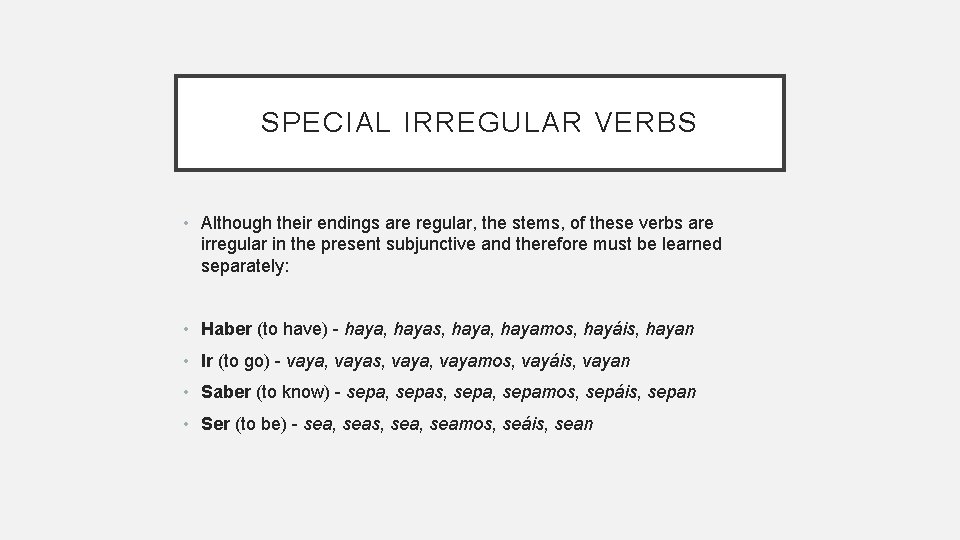
SPECIAL IRREGULAR VERBS • Although their endings are regular, the stems, of these verbs are irregular in the present subjunctive and therefore must be learned separately: • Haber (to have) - haya, hayas, hayamos, hayáis, hayan • Ir (to go) - vaya, vayas, vayamos, vayáis, vayan • Saber (to know) - sepa, sepas, sepamos, sepáis, sepan • Ser (to be) - sea, seas, seamos, seáis, sean
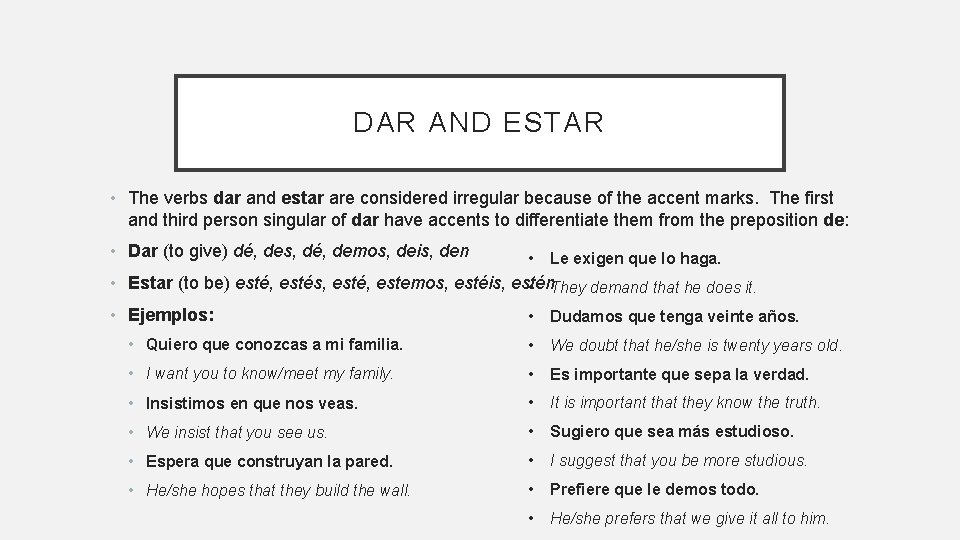
DAR AND ESTAR • The verbs dar and estar are considered irregular because of the accent marks. The first and third person singular of dar have accents to differentiate them from the preposition de: • Dar (to give) dé, des, dé, demos, deis, den • Le exigen que lo haga. • Estar (to be) esté, estés, esté, estemos, estéis, estén • They demand that he does it. • Ejemplos: • Dudamos que tenga veinte años. • Quiero que conozcas a mi familia. • We doubt that he/she is twenty years old. • I want you to know/meet my family. • Es importante que sepa la verdad. • Insistimos en que nos veas. • It is important that they know the truth. • We insist that you see us. • Sugiero que sea más estudioso. • Espera que construyan la pared. • I suggest that you be more studious. • He/she hopes that they build the wall. • Prefiere que le demos todo. • He/she prefers that we give it all to him.
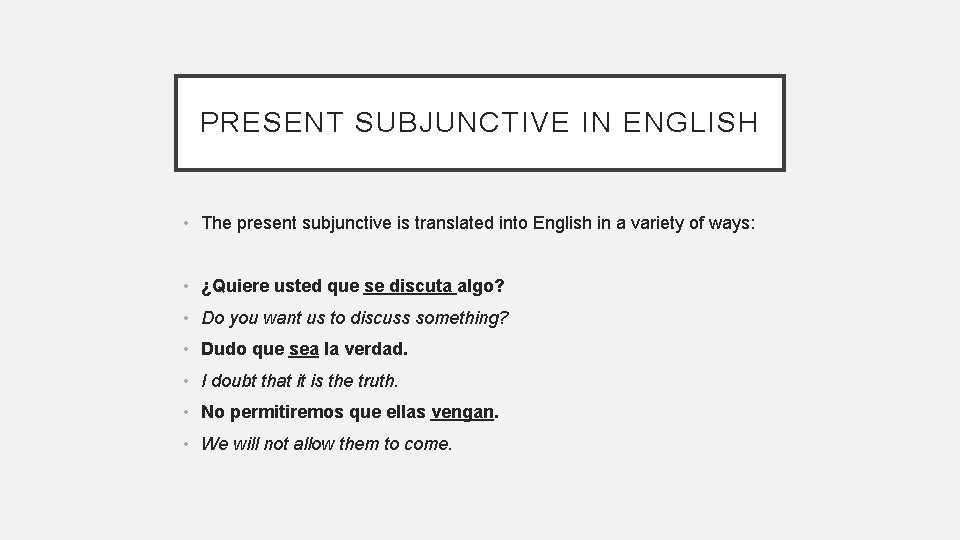
PRESENT SUBJUNCTIVE IN ENGLISH • The present subjunctive is translated into English in a variety of ways: • ¿Quiere usted que se discuta algo? • Do you want us to discuss something? • Dudo que sea la verdad. • I doubt that it is the truth. • No permitiremos que ellas vengan. • We will not allow them to come.
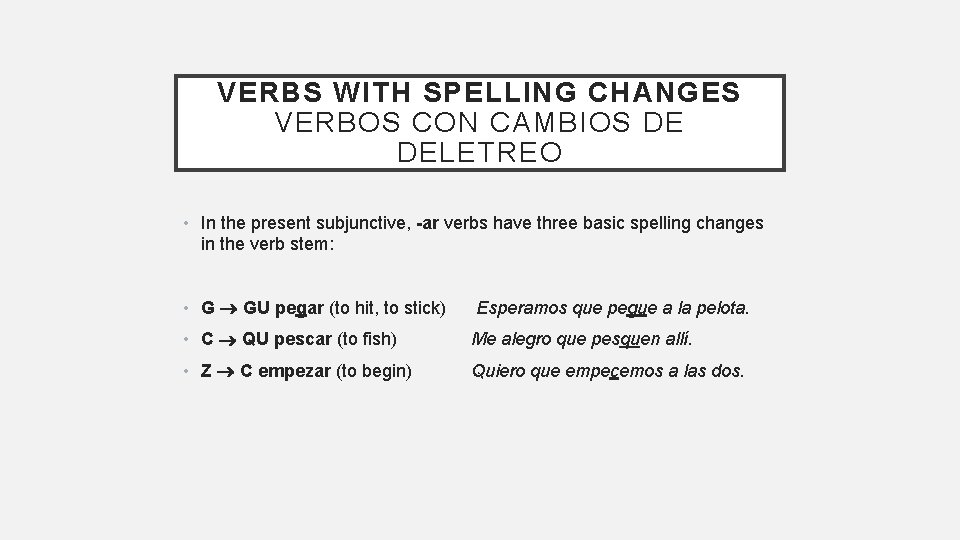
VERBS WITH SPELLING CHANGES VERBOS CON CAMBIOS DE DELETREO • In the present subjunctive, -ar verbs have three basic spelling changes in the verb stem: • G GU pegar (to hit, to stick) Esperamos que pegue a la pelota. • C QU pescar (to fish) Me alegro que pesquen allí. • Z C empezar (to begin) Quiero que empecemos a las dos.
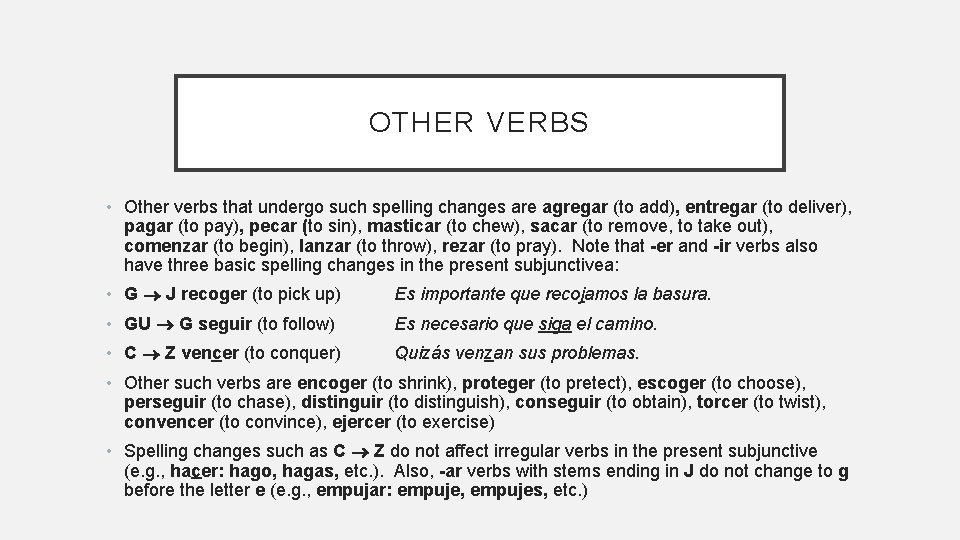
OTHER VERBS • Other verbs that undergo such spelling changes are agregar (to add), entregar (to deliver), pagar (to pay), pecar (to sin), masticar (to chew), sacar (to remove, to take out), comenzar (to begin), lanzar (to throw), rezar (to pray). Note that -er and -ir verbs also have three basic spelling changes in the present subjunctivea: • G J recoger (to pick up) Es importante que recojamos la basura. • GU G seguir (to follow) Es necesario que siga el camino. • C Z vencer (to conquer) Quizás venzan sus problemas. • Other such verbs are encoger (to shrink), proteger (to pretect), escoger (to choose), perseguir (to chase), distinguir (to distinguish), conseguir (to obtain), torcer (to twist), convencer (to convince), ejercer (to exercise) • Spelling changes such as C Z do not affect irregular verbs in the present subjunctive (e. g. , hacer: hago, hagas, etc. ). Also, -ar verbs with stems ending in J do not change to g before the letter e (e. g. , empujar: empuje, empujes, etc. )
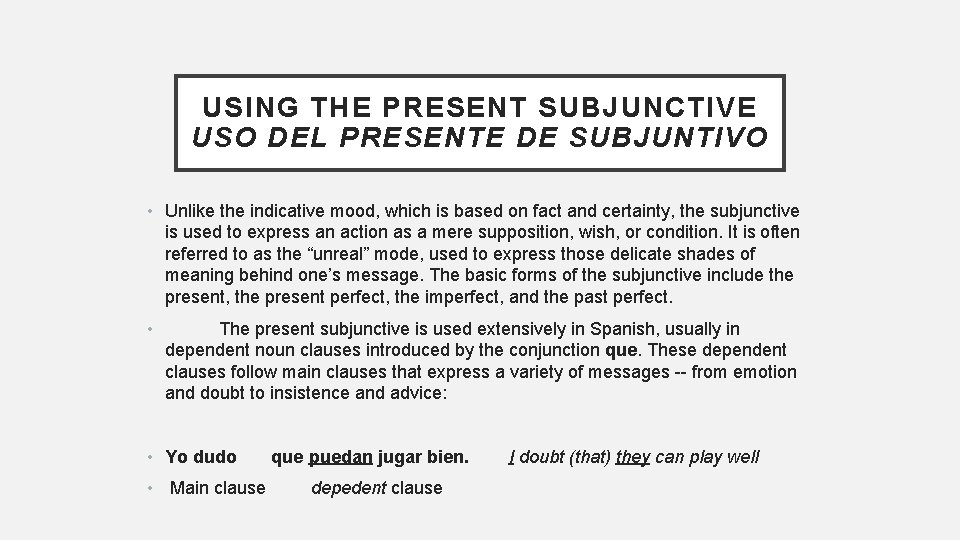
USING THE PRESENT SUBJUNCTIVE USO DEL PRESENTE DE SUBJUNTIVO • Unlike the indicative mood, which is based on fact and certainty, the subjunctive is used to express an action as a mere supposition, wish, or condition. It is often referred to as the “unreal” mode, used to express those delicate shades of meaning behind one’s message. The basic forms of the subjunctive include the present, the present perfect, the imperfect, and the past perfect. • The present subjunctive is used extensively in Spanish, usually in dependent noun clauses introduced by the conjunction que. These dependent clauses follow main clauses that express a variety of messages -- from emotion and doubt to insistence and advice: • Yo dudo • Main clause que puedan jugar bien. depedent clause I doubt (that) they can play well
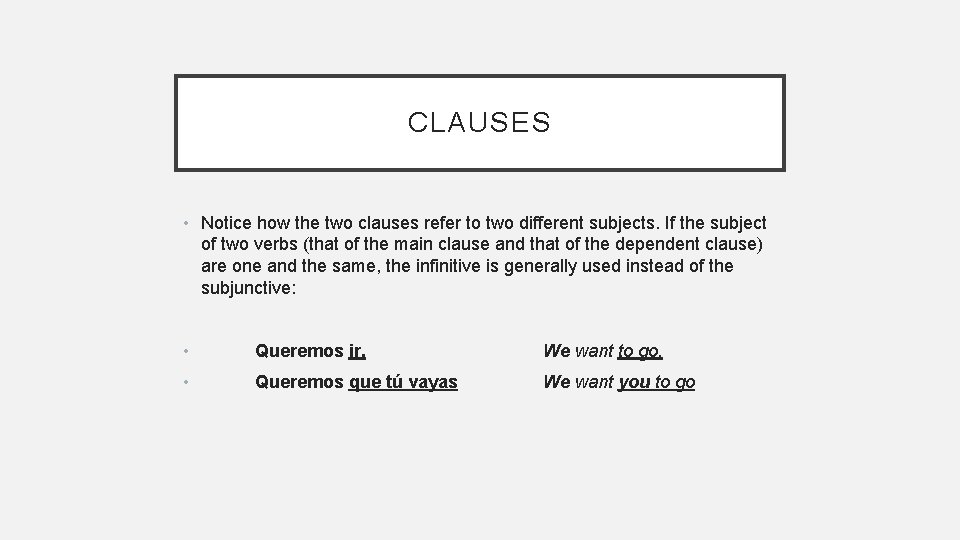
CLAUSES • Notice how the two clauses refer to two different subjects. If the subject of two verbs (that of the main clause and that of the dependent clause) are one and the same, the infinitive is generally used instead of the subjunctive: • Queremos ir. We want to go. • Queremos que tú vayas We want you to go
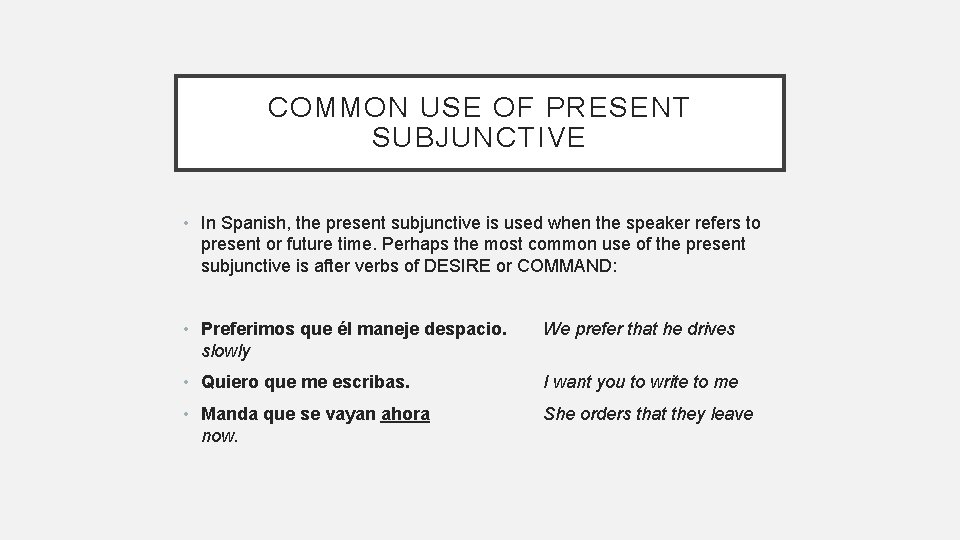
COMMON USE OF PRESENT SUBJUNCTIVE • In Spanish, the present subjunctive is used when the speaker refers to present or future time. Perhaps the most common use of the present subjunctive is after verbs of DESIRE or COMMAND: • Preferimos que él maneje despacio. slowly We prefer that he drives • Quiero que me escribas. I want you to write to me • Manda que se vayan ahora now. She orders that they leave
VERBS TO EXPRESS EMOTION OR ATTITUDE • Other such verbs are exigir (to demand), desear (to desire), pedir (to ask for), insistir (to insist), sugerir (to suggest), rogar (to beg), avisar (to advise), esperar (to hope), aconsejar (to counsel), recomendar (to recommend), permitir (to allow), decir (to tell), proponer (to propose), convencer (to convince), impeder (to prevent), advertir (to warn), suplicar (to implore), dejar (to allow) • The present subjunctive also follows expressions that express an EMOTION or ATTITUDE: • Me sorprende que no tenga carro. car It surprises me you don’t have a • Tememos que él llegue tarde We fear that he’ll arrive late. • Le gusta que compremos dulces. He likes that we’re buying candy
VERBS TO EXPRESS NEGATIVITY • Other similar verbs are alegrarse (to be happy), tener miedo (to fear), lamentarse (to mourn), extrañarse (to find strange), sentir (to be sorry), avergonzarse (to be ashamed), molestarse (to be bothered), enojarse (to be angry). • The present subjunctive also follows verbs of DOUBT, DENIAL, and REFUSAL, or verbs that are used negatively or interrogatively expressing belief or understanding: • Dudamos que lo compren. We doubt that they’ll buy it • Ella niega que lo tenga él. She denies that he has it • Te prohibe que manejes el carro He prohibits you from driving the car.
MAIN CLAUSES • Other such verbs are no pensar (to not think), no creer (to not believe), no imaginarse (to not imagine), no estar seguro (to not be sure). • Remember that the subjunctive never makes a direct statement or asks a direct question, because it is usually part of a dependent noun clause; that is, one that depends on the meaning of the main clause. Notice how the verb of the main clause often causes another person or thing to act (or not act) in the dependent clause: • (Yo) prefiero que (ella) lo haga • MAIN NOUN CLAUSE (subject) DEPENDENT NOUN CLAUSE (object) • (I’d prefer that she does it) • (Nosotros) exigimos que (tú) no manejes • MAIN NOUN CLAUSE (subject) DEPENDENT NOUN CLAUSE (object) • (We order that you don’t drive).
EXAMPLES • When used with the subjunctive, the following verbs often include an indirect object pronoun: • PEDIR: Nos pide que lleguemos temprano She asks us to arrive early • PERMITIR: Te permito que me llames I allow you to call me • SUGERIR: Le sugirieron que se vaya They suggested that he leave • Other such verbs are sorprender (to surprise), mandar (to send), extrañar (to miss), gustar (to like), decir (to say), convencer (to convince), advertir (to warn), aconsejar (to advise), exigir (to demand), prohibir (to prohibit), rogar (to beg).
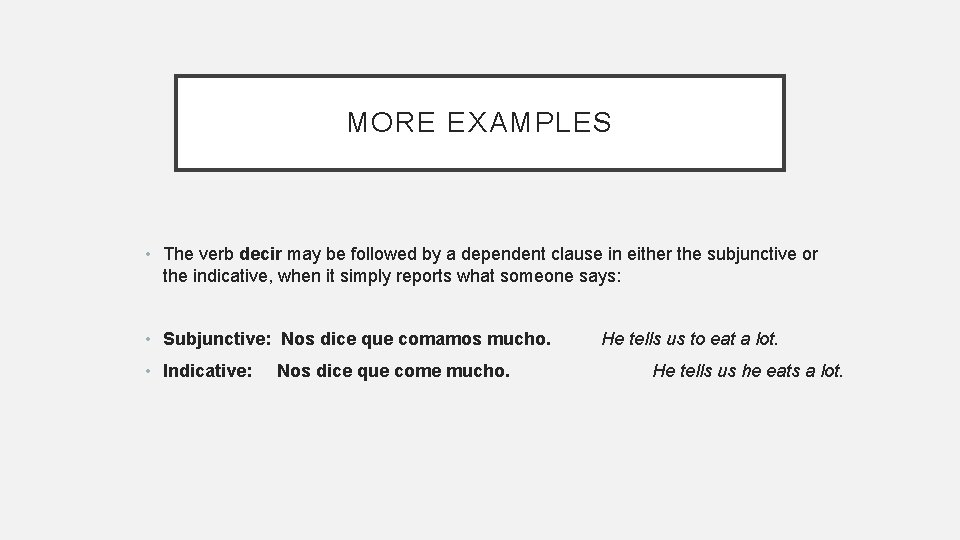
MORE EXAMPLES • The verb decir may be followed by a dependent clause in either the subjunctive or the indicative, when it simply reports what someone says: • Subjunctive: Nos dice que comamos mucho. • Indicative: Nos dice que come mucho. He tells us to eat a lot. He tells us he eats a lot.
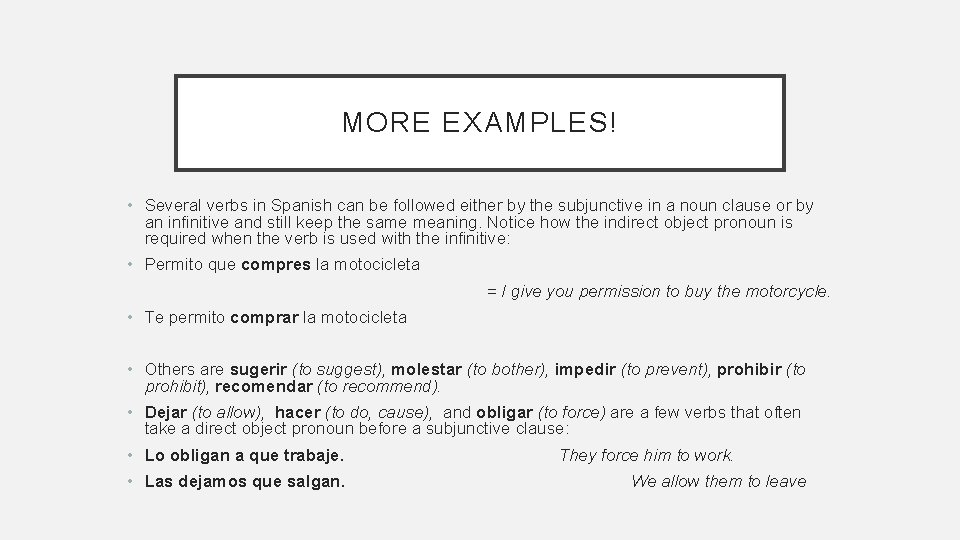
MORE EXAMPLES! • Several verbs in Spanish can be followed either by the subjunctive in a noun clause or by an infinitive and still keep the same meaning. Notice how the indirect object pronoun is required when the verb is used with the infinitive: • Permito que compres la motocicleta = I give you permission to buy the motorcycle. • Te permito comprar la motocicleta • Others are sugerir (to suggest), molestar (to bother), impedir (to prevent), prohibir (to prohibit), recomendar (to recommend). • Dejar (to allow), hacer (to do, cause), and obligar (to force) are a few verbs that often take a direct object pronoun before a subjunctive clause: • Lo obligan a que trabaje. • Las dejamos que salgan. They force him to work. We allow them to leave
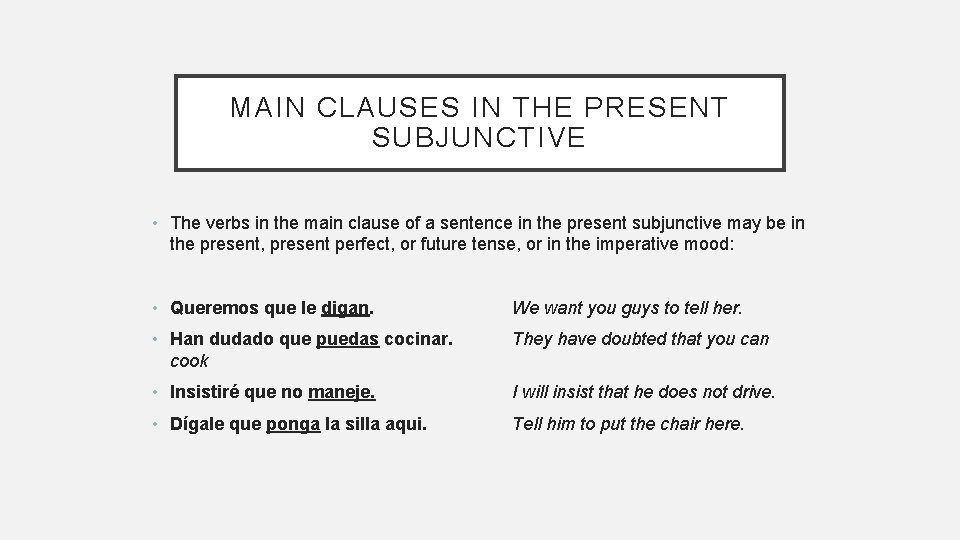
MAIN CLAUSES IN THE PRESENT SUBJUNCTIVE • The verbs in the main clause of a sentence in the present subjunctive may be in the present, present perfect, or future tense, or in the imperative mood: • Queremos que le digan. We want you guys to tell her. • Han dudado que puedas cocinar. cook They have doubted that you can • Insistiré que no maneje. I will insist that he does not drive. • Dígale que ponga la silla aqui. Tell him to put the chair here.
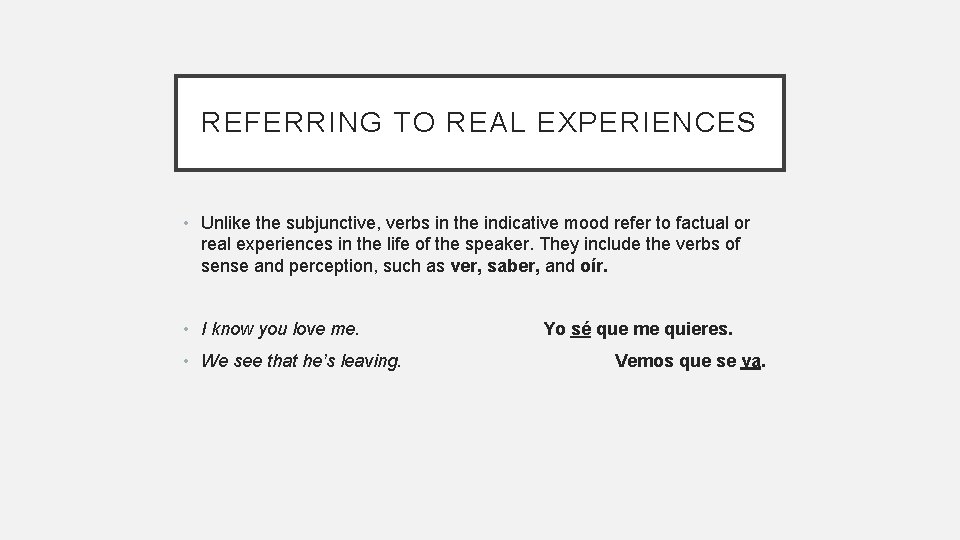
REFERRING TO REAL EXPERIENCES • Unlike the subjunctive, verbs in the indicative mood refer to factual or real experiences in the life of the speaker. They include the verbs of sense and perception, such as ver, saber, and oír. • I know you love me. • We see that he’s leaving. Yo sé que me quieres. Vemos que se va.
- Slides: 32