
SubjectVerb Word Order in th 15 th 19
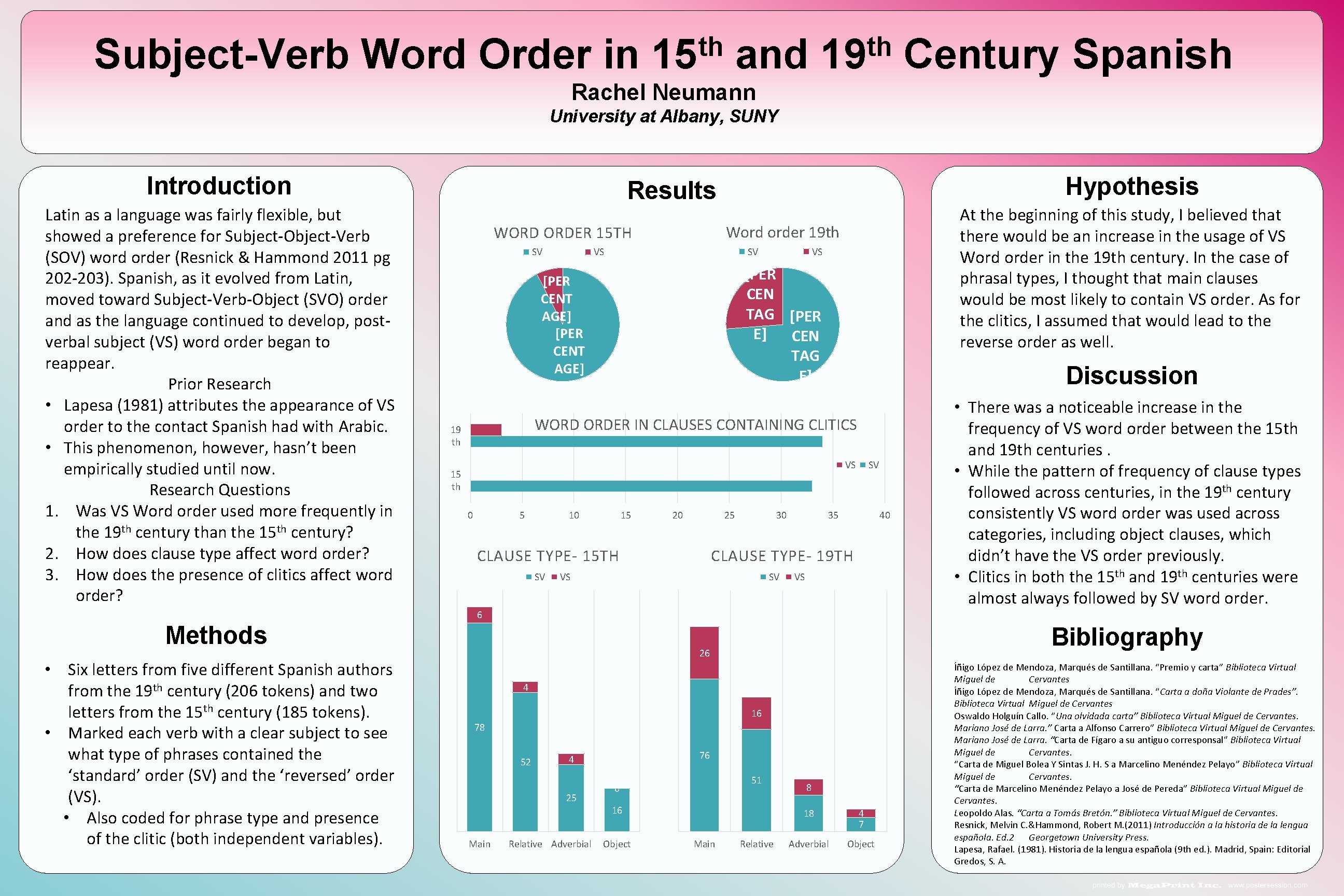
Subject-Verb Word Order in th 15 th 19 and Century Spanish Rachel Neumann University at Albany, SUNY Introduction Latin as a language was fairly flexible, but showed a preference for Subject-Object-Verb (SOV) word order (Resnick & Hammond 2011 pg 202 -203). Spanish, as it evolved from Latin, moved toward Subject-Verb-Object (SVO) order and as the language continued to develop, postverbal subject (VS) word order began to reappear. Prior Research • Lapesa (1981) attributes the appearance of VS order to the contact Spanish had with Arabic. • This phenomenon, however, hasn’t been empirically studied until now. Research Questions 1. Was VS Word order used more frequently in the 19 th century than the 15 th century? 2. How does clause type affect word order? 3. How does the presence of clitics affect word order? Hypothesis Results Word order 19 th WORD ORDER 15 TH SV At the beginning of this study, I believed that there would be an increase in the usage of VS Word order in the 19 th century. In the case of phrasal types, I thought that main clauses would be most likely to contain VS order. As for the clitics, I assumed that would lead to the reverse order as well. SV VS VS [PER CEN TAG [PER E] CEN TAG E] [PER CENT AGE] Discussion WORD ORDER IN CLAUSES CONTAINING CLITICS 19 th VS 15 th 0 5 10 15 20 25 CLAUSE TYPE- 15 TH SV 30 SV 35 40 CLAUSE TYPE- 19 TH VS SV VS • There was a noticeable increase in the frequency of VS word order between the 15 th and 19 th centuries. • While the pattern of frequency of clause types followed across centuries, in the 19 th century consistently VS word order was used across categories, including object clauses, which didn’t have the VS order previously. • Clitics in both the 15 th and 19 th centuries were almost always followed by SV word order. 6 Methods • Six letters from five different Spanish authors from the 19 th century (206 tokens) and two letters from the 15 th century (185 tokens). • Marked each verb with a clear subject to see what type of phrases contained the ‘standard’ order (SV) and the ‘reversed’ order (VS). • Also coded for phrase type and presence of the clitic (both independent variables). Bibliography 26 4 16 78 52 25 Main 76 4 Relative Adverbial 51 0 16 Object Main Relative 8 18 4 7 Adverbial Object Íñigo López de Mendoza, Marqués de Santillana. “Premio y carta” Biblioteca Virtual Miguel de Cervantes Íñigo López de Mendoza, Marqués de Santillana. “Carta a doña Violante de Prades”. Biblioteca Virtual Miguel de Cervantes Oswaldo Holguín Callo. “Una olvidada carta” Biblioteca Virtual Miguel de Cervantes. Mariano José de Larra. ” Carta a Alfonso Carrero” Biblioteca Virtual Miguel de Cervantes. Mariano José de Larra. “Carta de Fígaro a su antiguo corresponsal” Biblioteca Virtual Miguel de Cervantes. “Carta de Miguel Bolea Y Sintas J. H. S a Marcelino Menéndez Pelayo” Biblioteca Virtual Miguel de Cervantes. “Carta de Marcelino Menéndez Pelayo a José de Pereda” Biblioteca Virtual Miguel de Cervantes. Leopoldo Alas. “Carta a Tomás Bretón. ” Biblioteca Virtual Miguel de Cervantes. Resnick, Melvin C. &Hammond, Robert M. (2011) Introducción a la historia de la lengua española. Ed. 2 Georgetown University Press. Lapesa, Rafael. (1981). Historia de la lengua española (9 th ed. ). Madrid, Spain: Editorial Gredos, S. A.
- Slides: 1