
Subjectverb Agreement Subject Verb Object The basic parts

Subject-verb Agreement
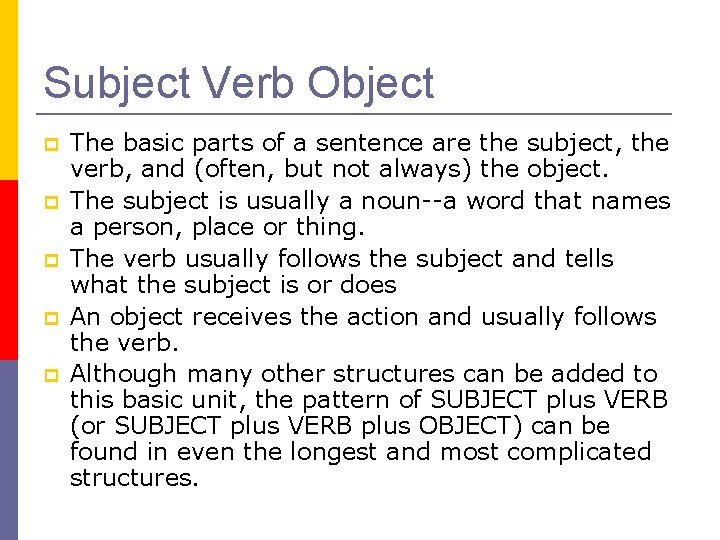
Subject Verb Object The basic parts of a sentence are the subject, the verb, and (often, but not always) the object. The subject is usually a noun--a word that names a person, place or thing. The verb usually follows the subject and tells what the subject is or does An object receives the action and usually follows the verb. Although many other structures can be added to this basic unit, the pattern of SUBJECT plus VERB (or SUBJECT plus VERB plus OBJECT) can be found in even the longest and most complicated structures.
Why do we need to know this? Every sentence has a subject and a verb. Being able to identify these parts of a sentence can help correct some grammatical errors.

Subject-verb Agreement The subject of a sentence is the noun to which the verb in the sentence's main clause refers, and these two must always agree in number. Singular subjects must be paired with singular verbs, and plural subjects with plural verbs. In the following slides, you will read the conditions under which subjects and verbs agree. The subject will be underlined and the verb will be printed in bold for easy identification.
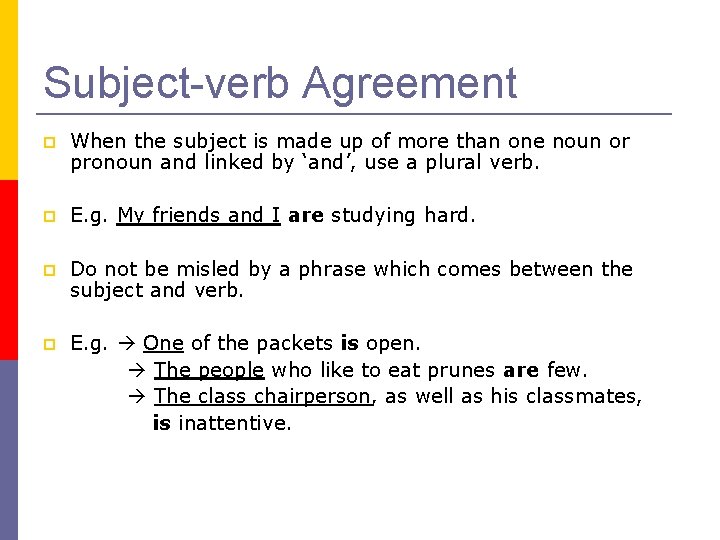
Subject-verb Agreement When the subject is made up of more than one noun or pronoun and linked by ‘and’, use a plural verb. E. g. My friends and I are studying hard. Do not be misled by a phrase which comes between the subject and verb. E. g. One of the packets is open. The people who like to eat prunes are few. The class chairperson, as well as his classmates, is inattentive.

Subject-verb Agreement Nouns such as Civics, Mathematics, Economics, dollars and news agree with singular verbs. E. g. Mathematics is my weakest subject. N. B. : The word, ‘dollars’ is a special case. When talking about a sum of money, it requires a singular verb. However, when talking about the dollars themselves, a plural verb is needed. E. g. Five dollars is a lot of money. vs Dollars are often used instead of pounds in Singapore.
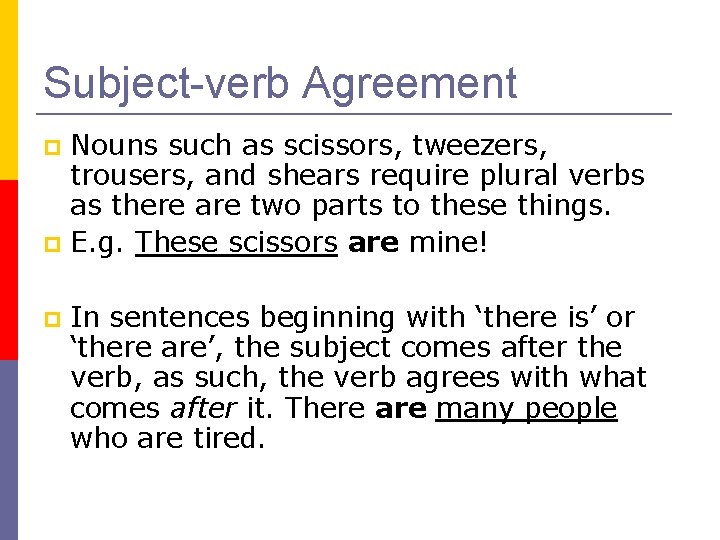
Subject-verb Agreement Nouns such as scissors, tweezers, trousers, and shears require plural verbs as there are two parts to these things. E. g. These scissors are mine! In sentences beginning with ‘there is’ or ‘there are’, the subject comes after the verb, as such, the verb agrees with what comes after it. There are many people who are tired.
Subject-verb Agreement Collective nouns are words that imply more than one person/animal/thing but that are considered singular and take a singular verb. E. g. This flock of birds is seen everyday. The discipline committee works very hard. My family likes to visit the zoo every Sunday. The staff is very cohesive. (N. B. There is no plural to the word ‘staff’ and ‘stuff’, just like ‘furniture’)
Subject-verb Agreement Expressions such as together with, including accompanied by, in addition to, or as well as, do not change the number of the subject. If the subject is singular, the verb is singular too. E. g. The Principal, together with the viceprincipal and teachers, is traveling to China. All of the fruits, including those oranges, are rotten.
Acknowledgements Notes and questions on SVA adapted from http: //www. cityu. edu. hk/elc/quiz/subverb 1. htm and http: //owl. english. purdue. edu/owl/resourc e/599/01/
- Slides: 10