
SubjectVerb Agreement Prepositions n Prepositions express relations to

Subject-Verb Agreement
Prepositions n Prepositions express relations to another noun/pronoun. n Examples: n About, above, across, among, around, as, at, before, behind, beneath, below, but, by, during, except, inside, into, like, near, regarding, towards, under, until, upon, with.
Prepositional Phrases n Prepositional Phrases: n Begin with a preposition n n Describe the subject Answer the question: which one?
Prepositional Phrases n At home n With me n By singing n About what we need n Along the busy, six-lane highway
Prepositional Phrases n Ex. The book on the bathroom floor was swollen from shower steam. n Which book? Answer: The one ________.
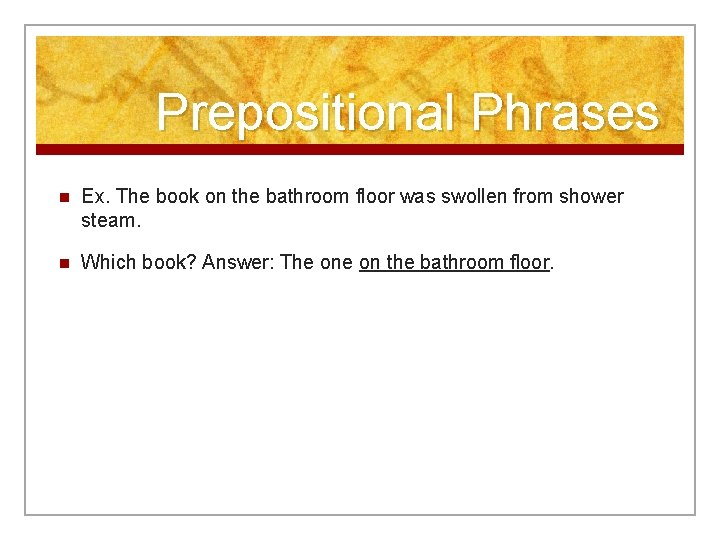
Prepositional Phrases n Ex. The book on the bathroom floor was swollen from shower steam. n Which book? Answer: The on the bathroom floor.
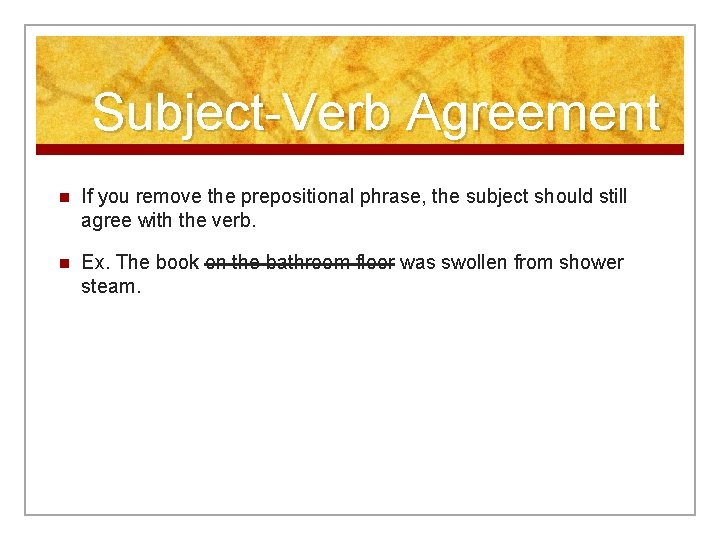
Subject-Verb Agreement n If you remove the prepositional phrase, the subject should still agree with the verb. n Ex. The book on the bathroom floor was swollen from shower steam.
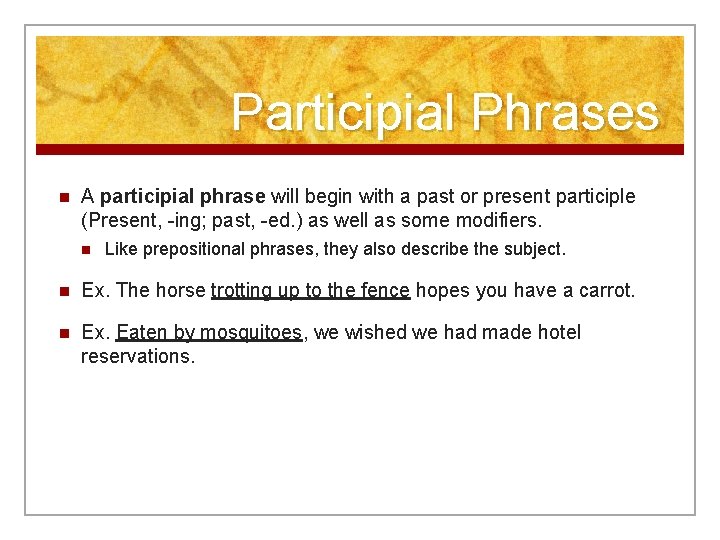
Participial Phrases n A participial phrase will begin with a past or present participle (Present, -ing; past, -ed. ) as well as some modifiers. n Like prepositional phrases, they also describe the subject. n Ex. The horse trotting up to the fence hopes you have a carrot. n Ex. Eaten by mosquitoes, we wished we had made hotel reservations.
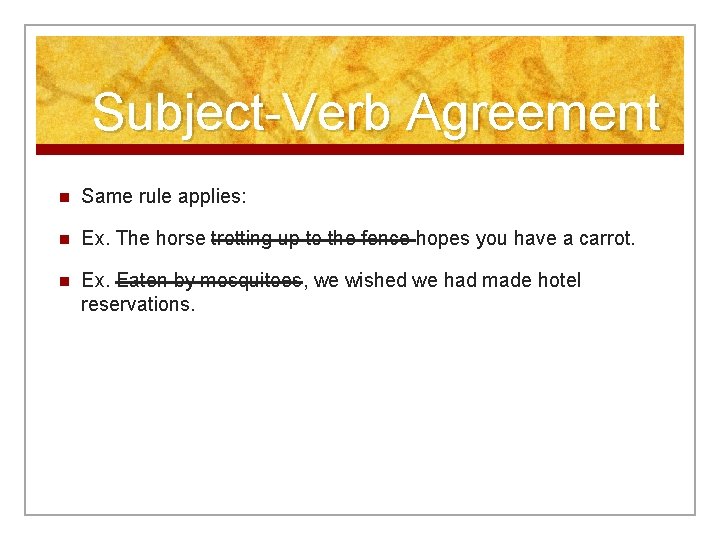
Subject-Verb Agreement n Same rule applies: n Ex. The horse trotting up to the fence hopes you have a carrot. n Ex. Eaten by mosquitoes, we wished we had made hotel reservations.
Verb preceeding the subject n Ex. Over the ripples glides ______. n Ex. There were many _______ at the movie premiere.

Verb preceeding the subject n Ex. Over the ripples glides a small canoe. n Ex. There were many actors at the movie premiere.

Subject-Verb Agreement n How did we fill in the blanks? n Singular verb (glides) calls for a singular subject. n Plural verb (were) calls for a plural subject.
Subjects joined by “and” n The ranger and the camper ____ the bear.
Subjects joined by “and” n The ranger and the camper see the bear. n Ranger = singular n Camper = singular n See = plural
Subjects separated by “or” or “nor” n Ex. Neither the ranger nor the camper _____ the bear.
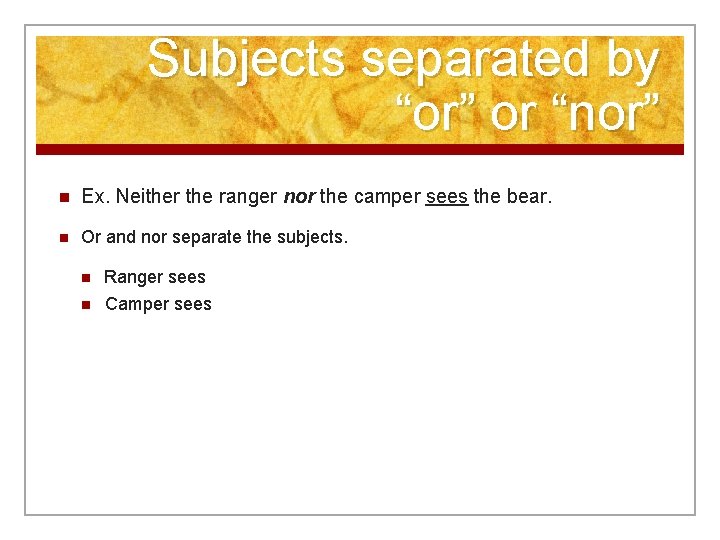
Subjects separated by “or” or “nor” n Ex. Neither the ranger nor the camper sees the bear. n Or and nor separate the subjects. n Ranger sees n Camper sees
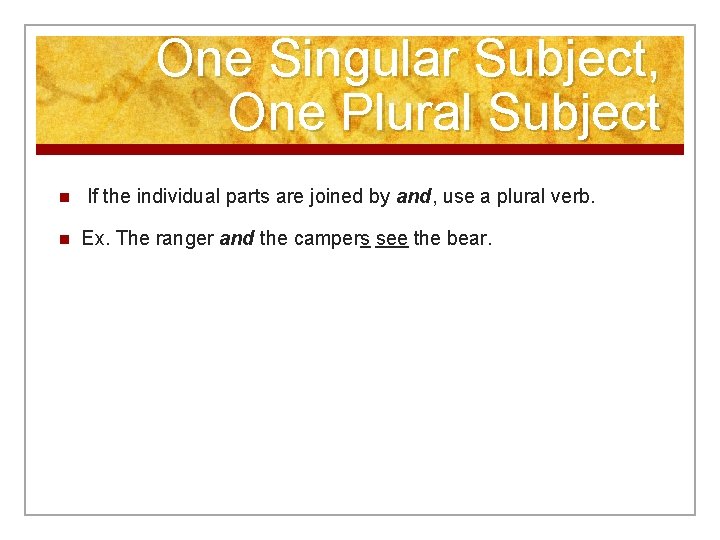
One Singular Subject, One Plural Subject n n If the individual parts are joined by and, use a plural verb. Ex. The ranger and the campers see the bear.
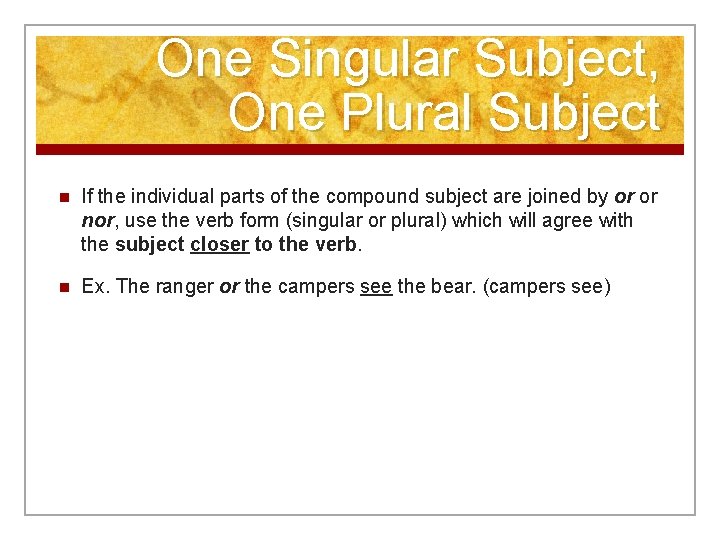
One Singular Subject, One Plural Subject n If the individual parts of the compound subject are joined by or or nor, use the verb form (singular or plural) which will agree with the subject closer to the verb. n Ex. The ranger or the campers see the bear. (campers see)
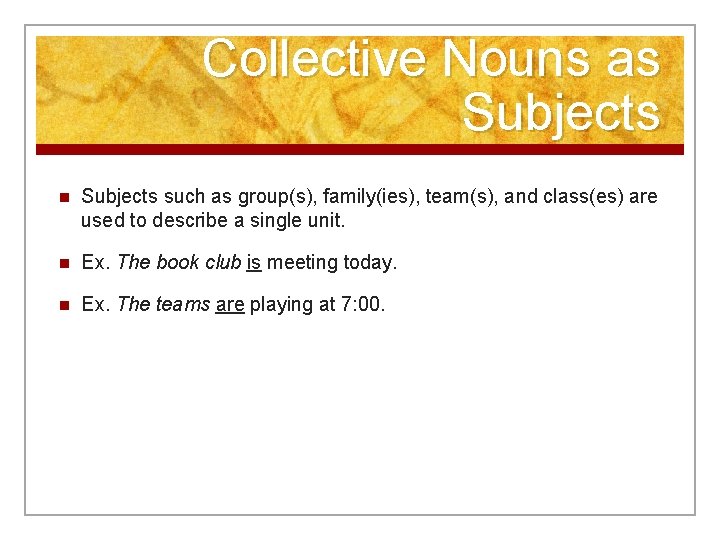
Collective Nouns as Subjects n Subjects such as group(s), family(ies), team(s), and class(es) are used to describe a single unit. n Ex. The book club is meeting today. n Ex. The teams are playing at 7: 00.
Collective Nouns as Subjects n Sometimes, group nouns can be considered as individual members within a single unit and, thus, take a plural verb. n Ex. The orchestra are tuning their instruments.
Collective Nouns as Subjects n Sometimes, it sounds funny, so we can make the subject plural. n Ex. The orchestra members are tuning their instruments.
- Slides: 21