
Subjects and Predicates An exploration into the components
Subjects and Predicates An exploration into the components of a sentence
What makes up a sentence? • Sentences are made of two parts: subjects and predicates. • These both can be simple or compound.
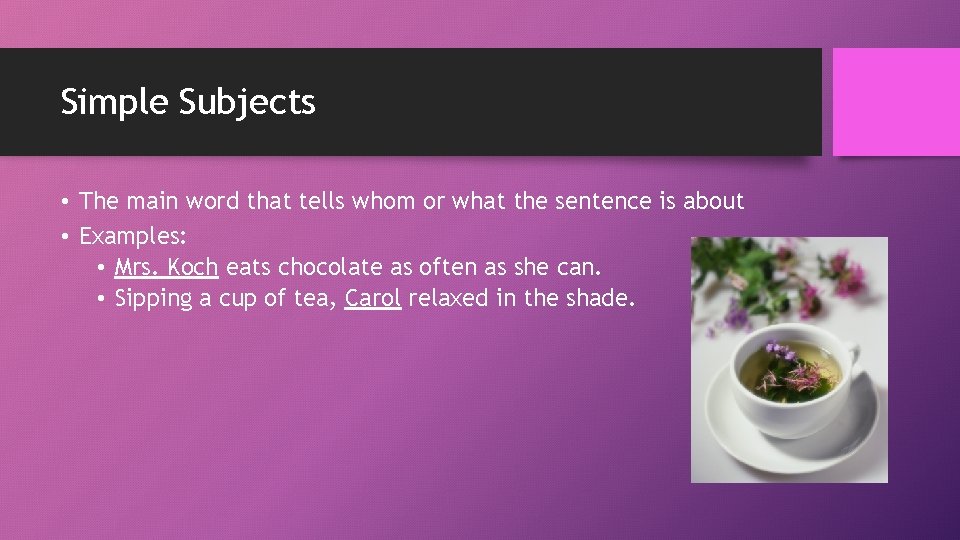
Simple Subjects • The main word that tells whom or what the sentence is about • Examples: • Mrs. Koch eats chocolate as often as she can. • Sipping a cup of tea, Carol relaxed in the shade.
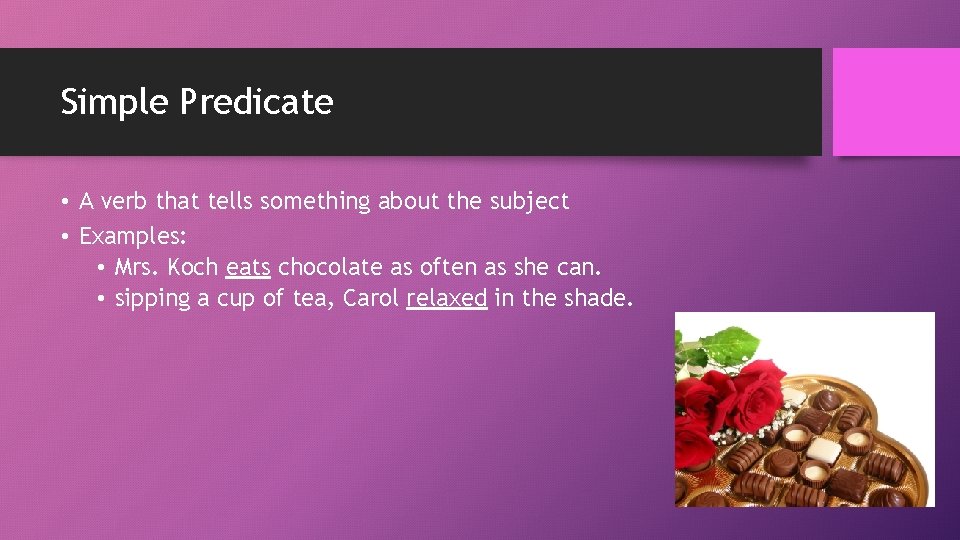
Simple Predicate • A verb that tells something about the subject • Examples: • Mrs. Koch eats chocolate as often as she can. • sipping a cup of tea, Carol relaxed in the shade.
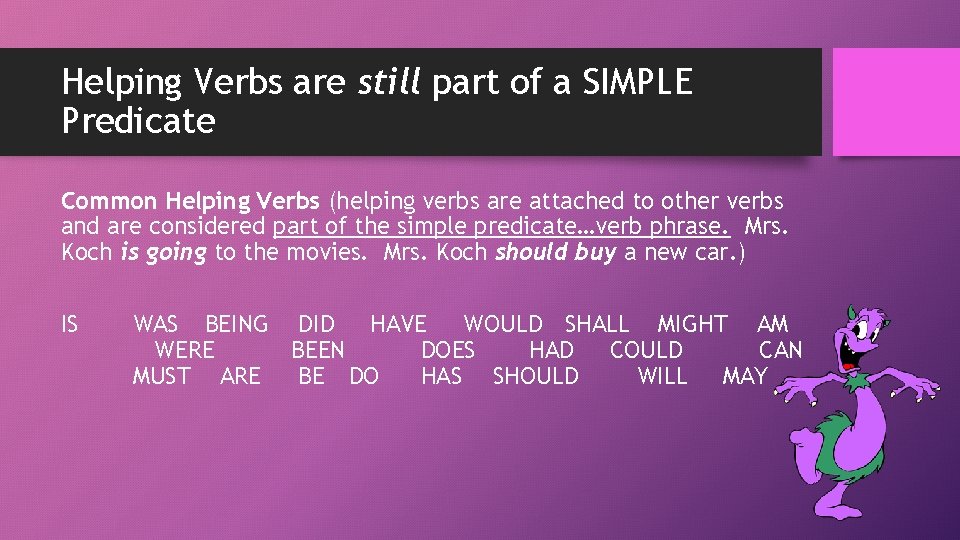
Helping Verbs are still part of a SIMPLE Predicate Common Helping Verbs (helping verbs are attached to other verbs and are considered part of the simple predicate…verb phrase. Mrs. Koch is going to the movies. Mrs. Koch should buy a new car. ) IS WAS BEING DID HAVE WOULD SHALL MIGHT AM WERE BEEN DOES HAD COULD CAN MUST ARE BE DO HAS SHOULD WILL MAY
Helping Verbs can be Simple Predicates on Their Own… Common Linking/Being Verbs (linking verbs are considered a simple predicate on their own)—they express a state of being. “I was there” or “Chocolate is awesome” IS ARE WAS WERE BE BEEN AM SMELL SEEM GROW BECOME APPEAR SOUND TASTE FEEL REMAIN STAY LOOK TURN GET
Practice together… • Together, let’s identify the simple subject and simple predicate in each sentence. Circle the subject and underline the predicate. • I practice soccer everyday. • The textbooks were delivered.
Compound Subjects • Consists of 2 or more subjects that are joined by a conjunction and have the same verb • EXAMPLE: • My students and my children love to sing grammar songs.
Compound Predicates • Consists of 2 or more verbs that are joined by a conjunction and have the same subject • EXAMPLE: • Mrs. Koch walks into and trips over things every day.

Practice together… • The coach and his team won the championship. • Tim tripped, fell, and landed in the pool.
Complete Subjects • The simple subject and ALL words, phrases or clauses that modify (describe or relate) it. • EXAMPLE: • Uncle Harry, my mom’s brother, gave aunt Mary flowers for her birthday.
Complete Predicates • The simple predicate and ALL words, phrases or clauses that modify (describe or relate) it. • EXAMPLE: • Uncle Harry, my mom’s brother, gave aunt Mary flowers for her birthday.
Practice together… • Circle the complete subject and underline the complete predicate. 1. Susie was married in July to a very tall and skinny man named Jeremy. 2. Susie, who always seems to have the worst taste in men no matter what her friends tell her, married Jeremy in July.
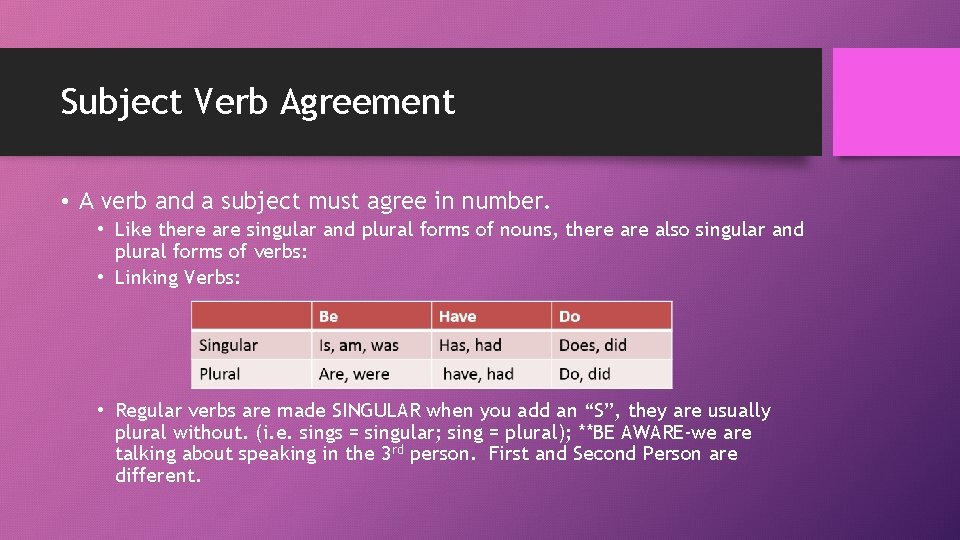
Subject Verb Agreement • A verb and a subject must agree in number. • Like there are singular and plural forms of nouns, there also singular and plural forms of verbs: • Linking Verbs: • Regular verbs are made SINGULAR when you add an “S”, they are usually plural without. (i. e. sings = singular; sing = plural); **BE AWARE-we are talking about speaking in the 3 rd person. First and Second Person are different.
Subject Verb Agreement (continued) • Sometimes prepositional phrases come between a subject and the verb. Don’t let these fool you. The verb still needs to agree with the subject, not a word in the prepositional phrase. • i. e. One of my sisters sings well. • One is still the subject and it must agree with sing.
Subject Verb Agreement (continued…again) • Compound subjects: • If the compound subject is linked with the word “and” it is always plural and takes the plural verb. • i. e. Caleb and Rachel are both very silly children. • If the compound subject is linked by an “or” or a “nor”, use the subject that appears closest to the verb to make your choice. • i. e. Either my parents or my aunt hosts Thanksgiving each year.
Subject Verb Agreement Tricks of the Trade • There are some variations and tricky situations to look out for… • If the two subjects joined by “and” refer to the same thing, then the verb is singular. • Peanut butter and jelly is my favorite sandwich. • The verb is singular for units of measurement or time. • Five minutes is enough time. • The verb is singular for collective nouns. • The crowd is yelling. • The verb is singular for titles of books and movies. • The Birds is a scary movie.
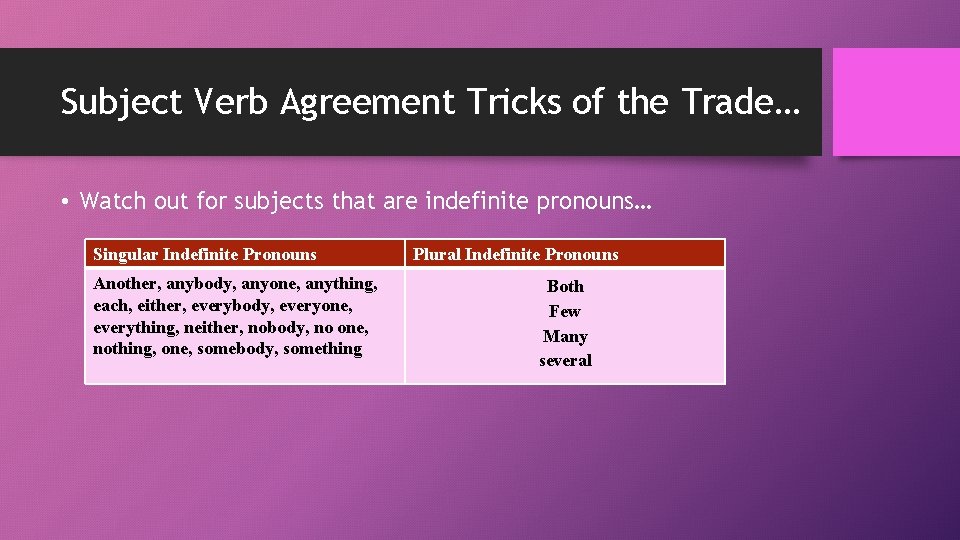
Subject Verb Agreement Tricks of the Trade… • Watch out for subjects that are indefinite pronouns… Singular Indefinite Pronouns Another, anybody, anyone, anything, each, either, everybody, everyone, everything, neither, nobody, no one, nothing, one, somebody, something Plural Indefinite Pronouns Both Few Many several
You are Subject and Predicate Superheroes!
- Slides: 19