
Subject Wireless Communication Topic Wireless Application Protocol WAP
Subject: Wireless Communication Topic: Wireless Application Protocol (WAP) By Prof. S. S. Khapre
Wireless Application Protocol (WAP) To avoid many incompatible solutions, the Wireless Application Protocol Forum (WAP Forum) was founded in June 1997 by Ericsson, Motorola, Nokia, and Unwired Planet. In summer 2002, the Sync. ML initiative formed the open mobile alliance (OMA). WAP Forum standards, this name was kept throughout the description of WAP. The basic objectives of the WAP Forum and now of the OMA are to bring diverse internet content and other data services to digital cellular phones and other wireless, mobile terminals.
WAP Architecture
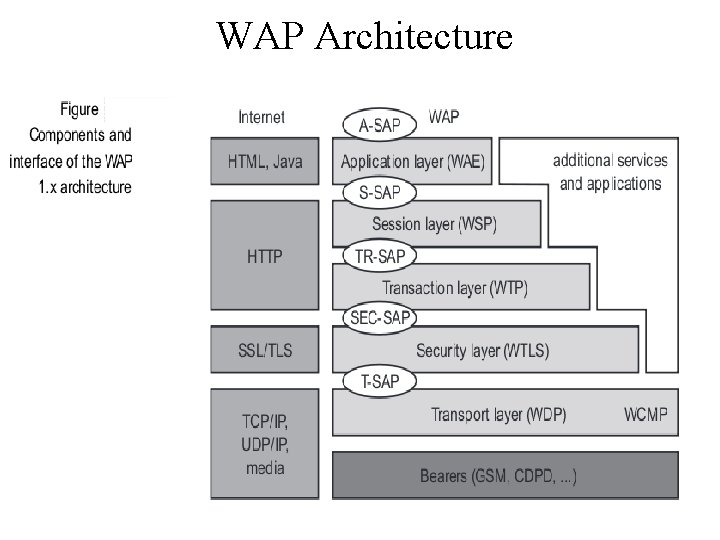
Figure gives an overview of the WAP architecture. The basis for transmission of data is formed by different bearer services. WAP does not specify bearer services, but uses existing data services and will integrate further services. No special interface has been specified between the bearer service and the next higher layer. The transport layer with its wireless datagram protocol (WDP) and the additional wireless control message protocol (WCMP), because the adaptation of these protocols are bearer-specific.
The transport layer offers a bearer independent, consistent datagram-oriented service to the higher layers of the WAP architecture. Communication is done transparently over one of the available bearer services. The transport layer service access point (T-SAP ) is the common interface to be used by higher layers independent of the underlying network. The next higher layer, the security layer with its wireless transport layer security protocol WTLS offers its service at the security SAP (SEC-SAP).

The WAP transaction layer with its wireless transaction protocol (WTP) offers a light weight transaction service at the transaction SAP (TR-SAP). This service efficiently provides reliable or unreliable requests and asynchronous transactions. Tightly coupled to this layer is the next higher layer, if used for connection-oriented service. The session layer with the wireless session protocol (WSP) currently offers two services at the session-SAP (S-SAP), one connection-oriented and one connectionless if used directly on top of WDP. A special service for browsing the web (WSP/B) has been defined that offers HTTP/1. 1 functionality, long-lived session state, session suspend and resume, session migration and other features needed for wireless mobile access to the web.
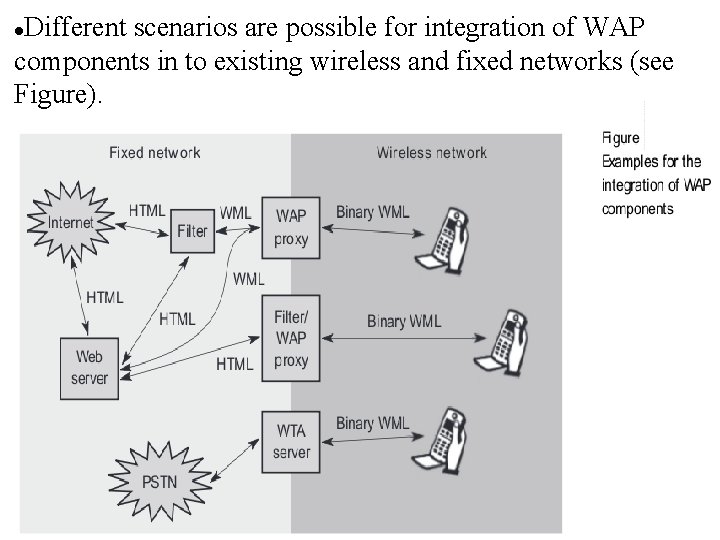
Different scenarios are possible for integration of WAP components in to existing wireless and fixed networks (see Figure).
On the left side, different fixed networks, such as the traditional internet and the public switched telephone network (PSTN), are shown. The current www in the internet offers web pages with the help of HTML and web servers. To be able to browse these pages or additional pages with handheld devices, a wireless markup language (WML) has been defined in WAP. Special filters within the fixed network can now translate HTML into WML.

THANK YOU
- Slides: 9