
Subject Theory of Automata Topic Conversion from NFA
Subject: Theory of Automata Topic: Conversion from NFA to DFA
Conversion from NFA to DFA • An NFA can have zero, one or more than one move from a given state on a given input symbol. An NFA can also have NULL moves (moves without input symbol). • On the other hand, DFA has one and only one move from a given state on a given input symbol. •
Conversion from NFA to DFA Suppose there is an NFA N < Q, ∑, q 0, δ, F > which recognizes a language L. Then the DFA D < Q’, ∑, q 0, δ’, F’ > can be constructed for language L as: Step 1: Initially Q’ = ɸ. Step 2: Add q 0 to Q’. Step 3: For each state in Q’, find the possible set of states for each input symbol using transition function of NFA. If this set of states is not in Q’, add it to Q’. Step 4: Final state of DFA will be all states with contain F (final states of NFA)

Example
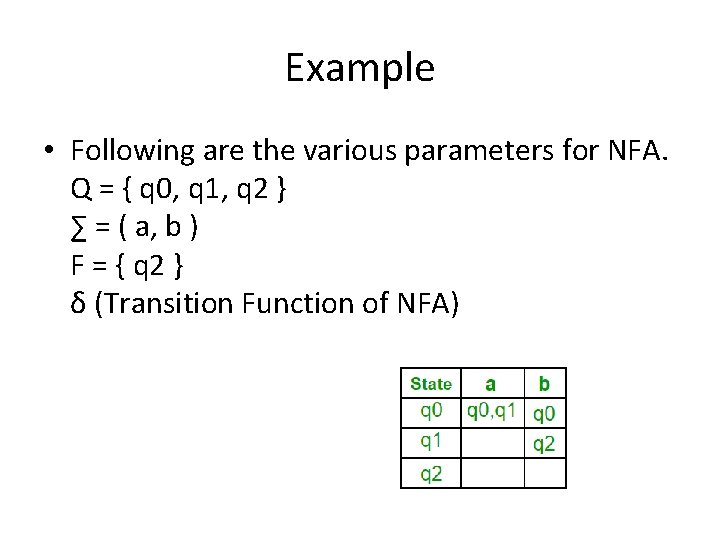
Example • Following are the various parameters for NFA. Q = { q 0, q 1, q 2 } ∑ = ( a, b ) F = { q 2 } δ (Transition Function of NFA)

Example • Step 1: Q’ = ɸ Step 2: Q’ = {q 0} Step 3: For each state in Q’, find the states for each input symbol. Currently, state in Q’ is q 0, find moves from q 0 on input symbol a and b using transition function of NFA and update the transition table of DFA. • δ’ (Transition Function of DFA) •

Example • Now, moves from state { q 0, q 1 } on different input symbols are not present in transition table of DFA, we will calculate it like: δ’ ( { q 0, q 1 }, a ) = δ ( q 0, a ) ∪ δ ( q 1, a ) = { q 0, q 1 } δ’ ( { q 0, q 1 }, b ) = δ ( q 0, b ) ∪ δ ( q 1, b ) = { q 0, q 2 } Now we will update the transition table of DFA. • δ’ (Transition Function of DFA) •
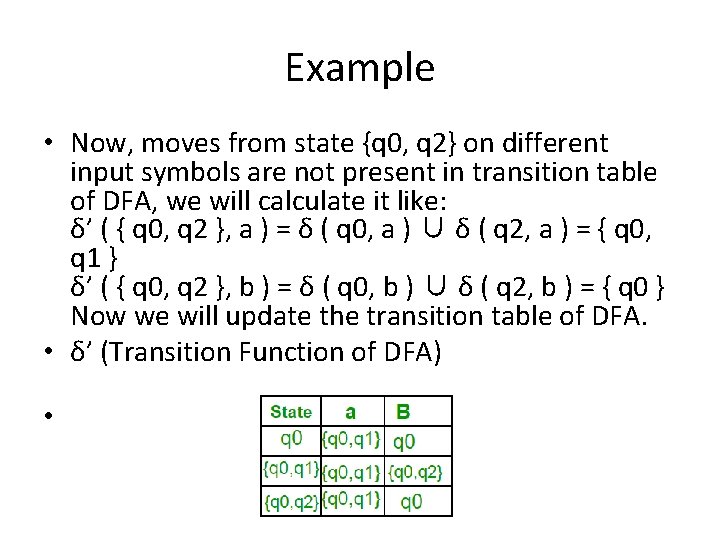
Example • Now, moves from state {q 0, q 2} on different input symbols are not present in transition table of DFA, we will calculate it like: δ’ ( { q 0, q 2 }, a ) = δ ( q 0, a ) ∪ δ ( q 2, a ) = { q 0, q 1 } δ’ ( { q 0, q 2 }, b ) = δ ( q 0, b ) ∪ δ ( q 2, b ) = { q 0 } Now we will update the transition table of DFA. • δ’ (Transition Function of DFA) •
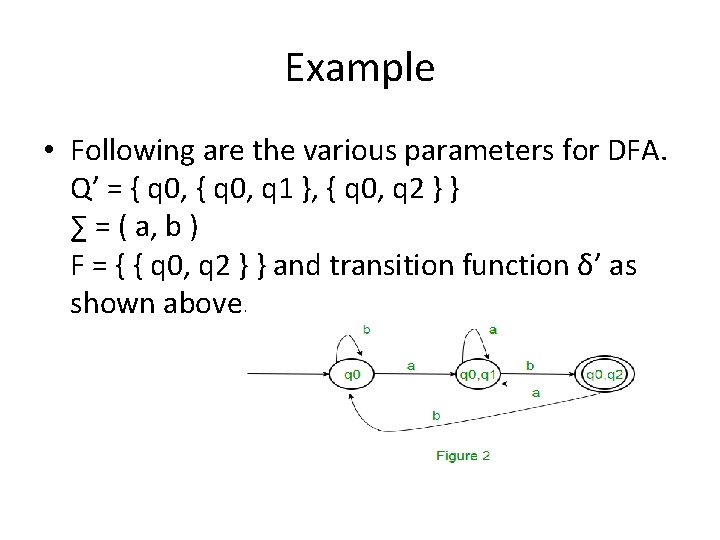
Example • Following are the various parameters for DFA. Q’ = { q 0, q 1 }, { q 0, q 2 } } ∑ = ( a, b ) F = { { q 0, q 2 } } and transition function δ’ as shown above.
- Slides: 9