
Subject Pronouns SINGULAR 1 st person yo I
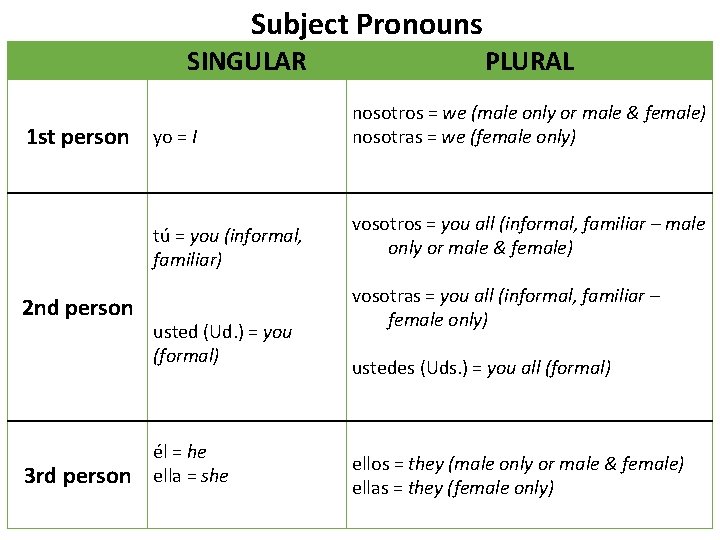
Subject Pronouns SINGULAR 1 st person yo = I 2 nd person 3 rd person tú = you (informal, familiar) usted (Ud. ) = you (formal) él = he ella = she PLURAL nosotros = we (male only or male & female) nosotras = we (female only) vosotros = you all (informal, familiar – male only or male & female) vosotras = you all (informal, familiar – female only) ustedes (Uds. ) = you all (formal) ellos = they (male only or male & female) ellas = they (female only)
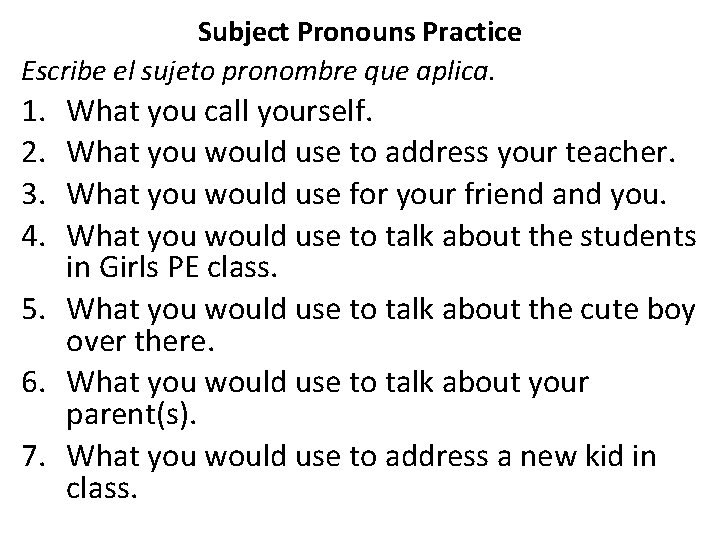
Subject Pronouns Practice Escribe el sujeto pronombre que aplica. 1. 2. 3. 4. What you call yourself. What you would use to address your teacher. What you would use for your friend and you. What you would use to talk about the students in Girls PE class. 5. What you would use to talk about the cute boy over there. 6. What you would use to talk about your parent(s). 7. What you would use to address a new kid in class.
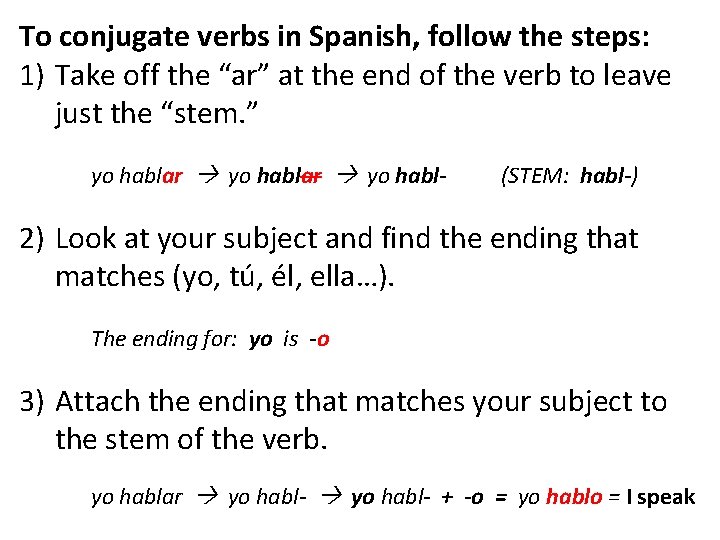
To conjugate verbs in Spanish, follow the steps: 1) Take off the “ar” at the end of the verb to leave just the “stem. ” yo hablar yo habl- (STEM: habl-) 2) Look at your subject and find the ending that matches (yo, tú, él, ella…). The ending for: yo is -o 3) Attach the ending that matches your subject to the stem of the verb. yo hablar yo habl- + -o = yo hablo = I speak

Regular AR Verbs yo -o nosotros/as -amos tú -as vosotros/as -áis -a ellos ellas -an él ella Usted (Ud. ) Ustedes (Uds. )
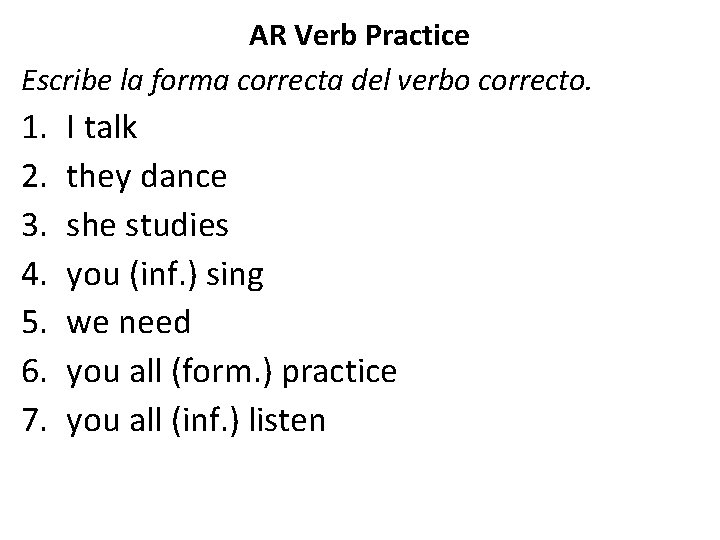
AR Verb Practice Escribe la forma correcta del verbo correcto. 1. 2. 3. 4. 5. 6. 7. I talk they dance she studies you (inf. ) sing we need you all (form. ) practice you all (inf. ) listen
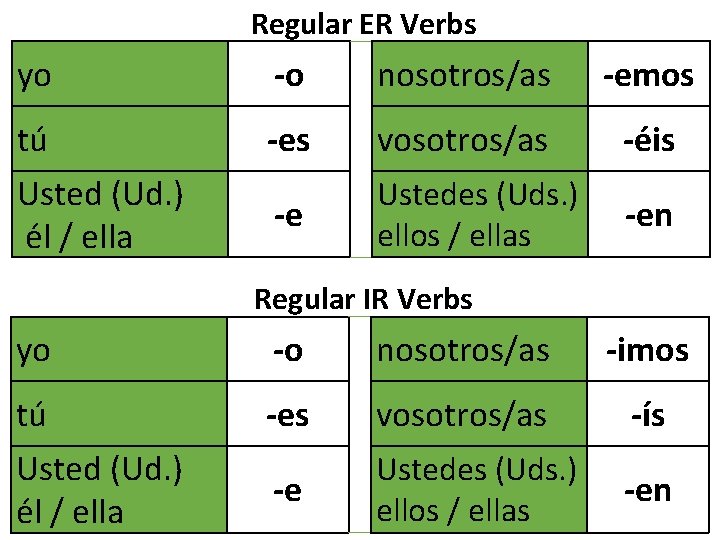
Regular ER Verbs yo -o nosotros/as -emos tú Usted (Ud. ) él / ella -es vosotros/as -éis -e Ustedes (Uds. ) ellos / ellas -en Regular IR Verbs yo -o nosotros/as -imos tú -es vosotros/as -ís -e Ustedes (Uds. ) ellos / ellas -en Usted (Ud. ) él / ella
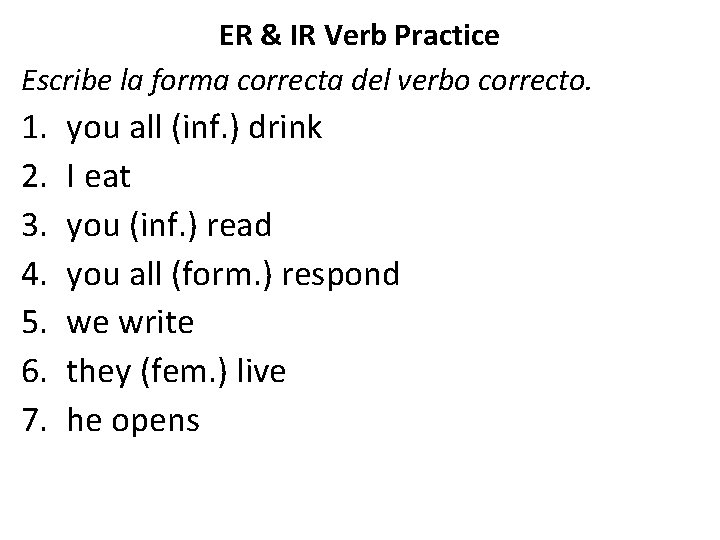
ER & IR Verb Practice Escribe la forma correcta del verbo correcto. 1. 2. 3. 4. 5. 6. 7. you all (inf. ) drink I eat you (inf. ) read you all (form. ) respond we write they (fem. ) live he opens

Verbs with an irregular YO form estar to be (condition, emotion, location) dar ver to give to see saber to know conocer hacer traer poner salir to bring to put to leave, to go out (something, information, how to do) (acquainted with, familiar with) to know to do/ to make yo estoy doy veo sé conozco hago tú estás das ves sabes conoces haces traes pones sales usted (Ud. ) está da ve sabe conoce hace trae pone sale él/ella está da ve sabe conoce hace trae pone sale nosotros(as) traigo pongo salgo estamos damos vemos sabemos conocemos hacemos traemos ponemos salimos vosotros(as) estáis dais veis sabéis conocéis hacéis traéis ponéis salís ustedes (Uds. ) están dan ven saben conocen hacen traen ponen salen ellos/ellas están dan ven saben conocen hacen traen ponen salen
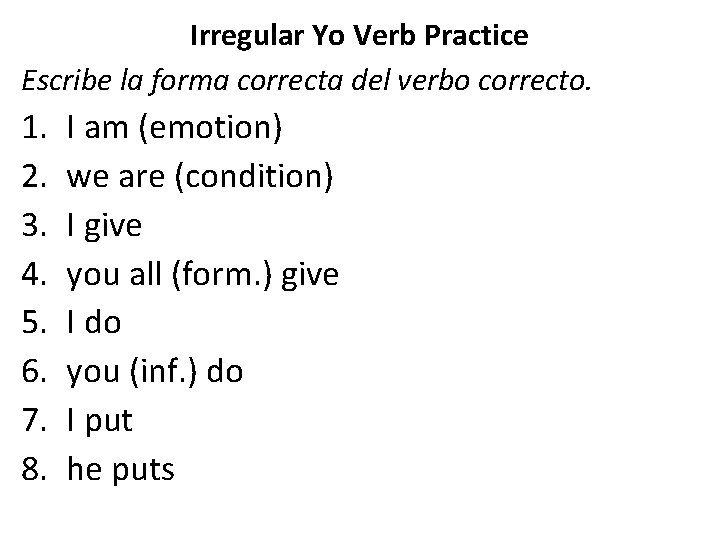
Irregular Yo Verb Practice Escribe la forma correcta del verbo correcto. 1. 2. 3. 4. 5. 6. 7. 8. I am (emotion) we are (condition) I give you all (form. ) give I do you (inf. ) do I put he puts
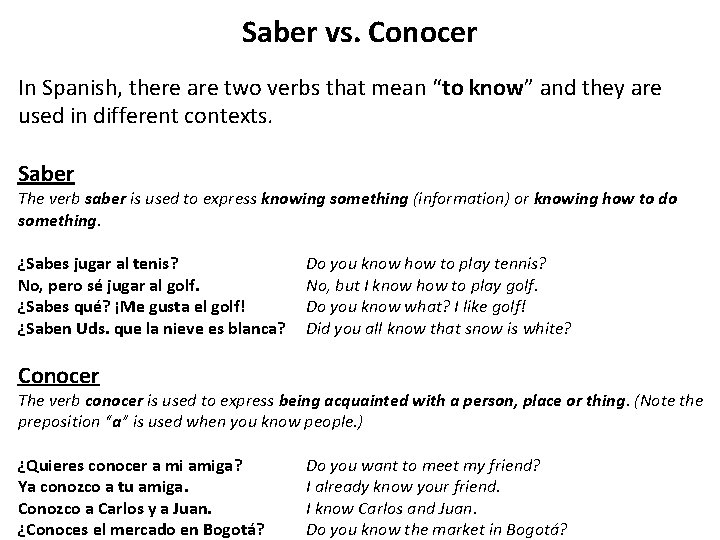
Saber vs. Conocer In Spanish, there are two verbs that mean “to know” and they are used in different contexts. Saber The verb saber is used to express knowing something (information) or knowing how to do something. ¿Sabes jugar al tenis? Do you know how to play tennis? No, pero sé jugar al golf. No, but I know how to play golf. ¿Sabes qué? ¡Me gusta el golf! Do you know what? I like golf! ¿Saben Uds. que la nieve es blanca? Did you all know that snow is white? Conocer The verb conocer is used to express being acquainted with a person, place or thing. (Note the preposition “a” is used when you know people. ) ¿Quieres conocer a mi amiga? Ya conozco a tu amiga. Conozco a Carlos y a Juan. ¿Conoces el mercado en Bogotá? Do you want to meet my friend? I already know your friend. I know Carlos and Juan. Do you know the market in Bogotá?
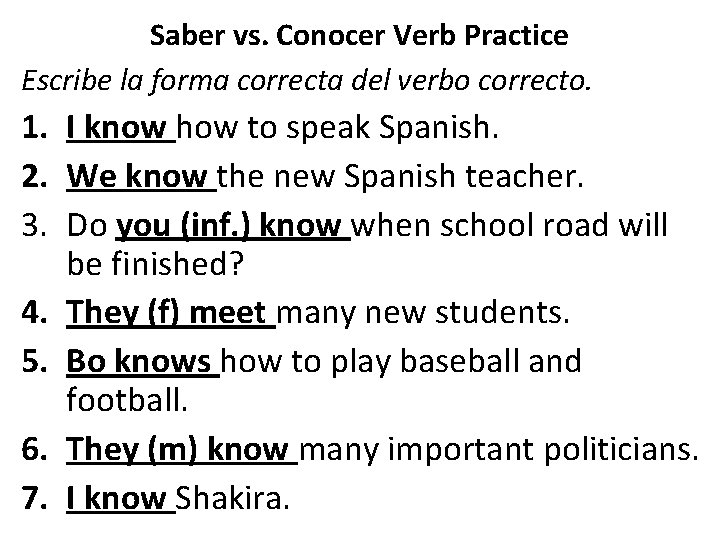
Saber vs. Conocer Verb Practice Escribe la forma correcta del verbo correcto. 1. I know how to speak Spanish. 2. We know the new Spanish teacher. 3. Do you (inf. ) know when school road will be finished? 4. They (f) meet many new students. 5. Bo knows how to play baseball and football. 6. They (m) know many important politicians. 7. I know Shakira.
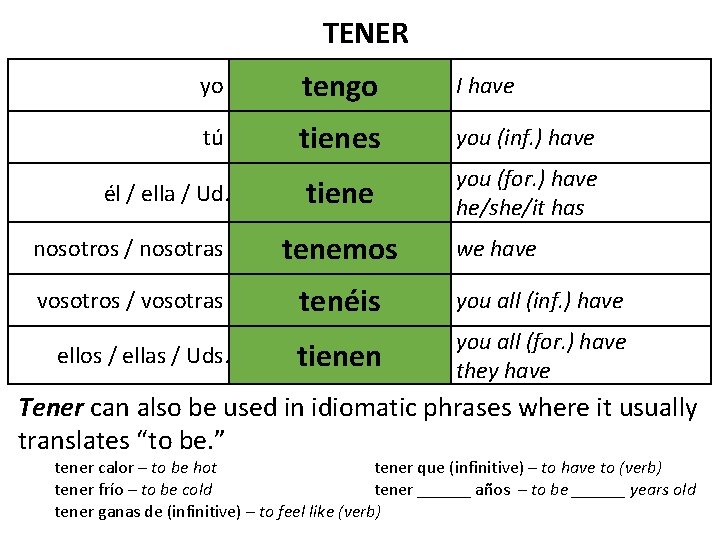
TENER yo tengo I have tú tienes you (inf. ) have tiene you (for. ) have he/she/it has él / ella / Ud. nosotros / nosotras tenemos vosotros / vosotras tenéis you all (inf. ) have tienen you all (for. ) have they have ellos / ellas / Uds. we have Tener can also be used in idiomatic phrases where it usually translates “to be. ” tener calor – to be hot tener que (infinitive) – to have to (verb) tener frío – to be cold tener ______ años – to be ______ years old tener ganas de (infinitive) – to feel like (verb)

Tener Verb Practice Escribe las oraciones con forma correcta del verbo TENER. 1. 2. 3. 4. 5. 6. 7. You (inf. ) have friends. I have seven pencils. We are cold. They have to study. He has the vocabulary. You all (inf. ) feel like sleeping. You (form. ) are 40 years old.
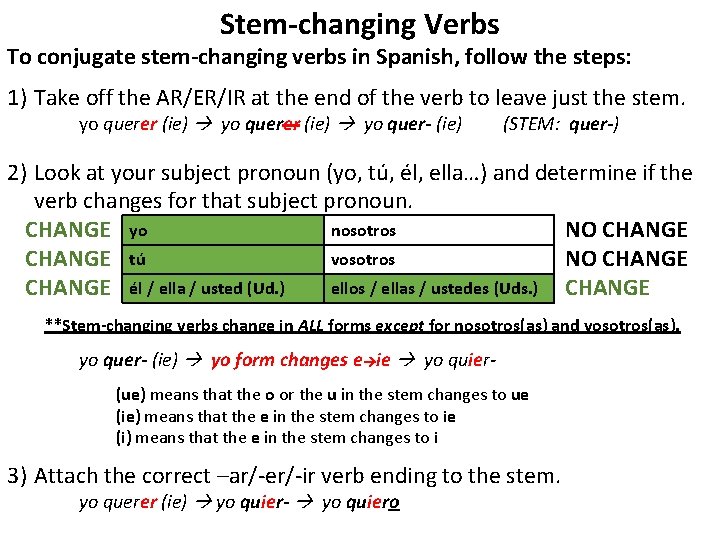
Stem-changing Verbs To conjugate stem-changing verbs in Spanish, follow the steps: 1) Take off the AR/ER/IR at the end of the verb to leave just the stem. yo querer (ie) yo quer- (ie) (STEM: quer-) 2) Look at your subject pronoun (yo, tú, él, ella…) and determine if the verb changes for that subject pronoun. nosotros CHANGE yo NO CHANGE vosotros CHANGE tú NO CHANGE ellos / ellas / ustedes (Uds. ) CHANGE él / ella / usted (Ud. ) **Stem-changing verbs change in ALL forms except for nosotros(as) and vosotros(as). yo quer- (ie) yo form changes e ie yo quier(ue) means that the o or the u in the stem changes to ue (ie) means that the e in the stem changes to ie (i) means that the e in the stem changes to i 3) Attach the correct –ar/-er/-ir verb ending to the stem. yo querer (ie) yo quier- yo quiero

Stem-changing Verbs ALMORZAR QUERER SERVIR O UE stem-change -ar verb endings E IE stem-change -er verb endings E I stem-change -ir verb endings yo almuerzo quiero sirvo tú almuerzas quieres sirves él ella usted/Ud. almuerza quiere sirve nosotros almorzamos queremos servimos vosotros almorzáis queréis servís ellos ellas ustedes/Uds. almuerzan quieren sirven
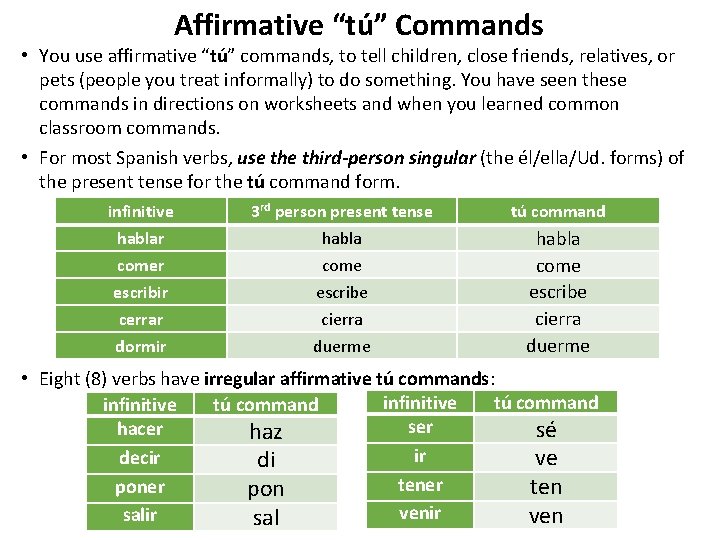
Affirmative “tú” Commands • You use affirmative “tú” commands, to tell children, close friends, relatives, or pets (people you treat informally) to do something. You have seen these commands in directions on worksheets and when you learned common classroom commands. • For most Spanish verbs, use third-person singular (the él/ella/Ud. forms) of the present tense for the tú command form. infinitive 3 rd person present tense tú command hablar comer escribir cerrar dormir habla come escribe cierra duerme • Eight (8) verbs have irregular affirmative tú commands: infinitive tú command ser hacer sé haz ir decir ve di tener poner ten pon venir salir ven sal

ESTAR yo estoy I am tú estás you (inf. ) are está you (for. ) are he/she/it is él / ella / Ud. nosotros / nosotras estamos vosotros / vosotras estáis you all (inf. ) are están you all (for. ) are they are ellos / ellas / Uds. we are Estar is used to describe emotions, conditions, and locations.
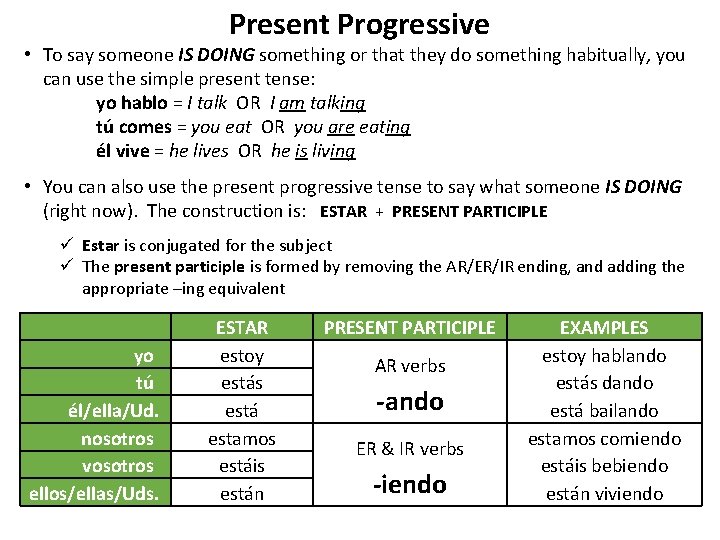
Present Progressive • To say someone IS DOING something or that they do something habitually, you can use the simple present tense: yo hablo = I talk OR I am talking tú comes = you eat OR you are eating él vive = he lives OR he is living • You can also use the present progressive tense to say what someone IS DOING (right now). The construction is: ESTAR + PRESENT PARTICIPLE ü Estar is conjugated for the subject ü The present participle is formed by removing the AR/ER/IR ending, and adding the appropriate –ing equivalent yo tú él/ella/Ud. nosotros vosotros ellos/ellas/Uds. ESTAR estoy estás está estamos estáis están PRESENT PARTICIPLE AR verbs -ando ER & IR verbs -iendo EXAMPLES estoy hablando estás dando está bailando estamos comiendo estáis bebiendo están viviendo
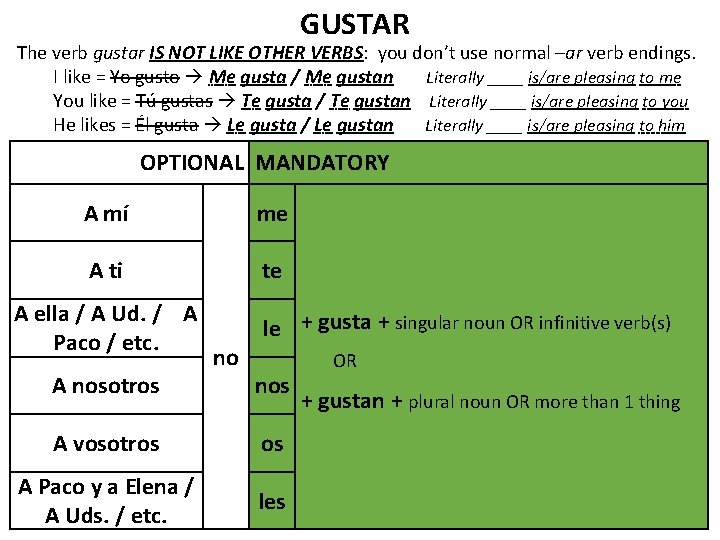
GUSTAR The verb gustar IS NOT LIKE OTHER VERBS: you don’t use normal –ar verb endings. I like = Yo gusto Me gusta / Me gustan Literally ____ is/are pleasing to me You like = Tú gustas Te gusta / Te gustan Literally ____ is/are pleasing to you He likes = Él gusta Le gusta / Le gustan Literally ____ is/are pleasing to him OPTIONAL MANDATORY A mí me A ti te A ella / A Ud. / A Paco / etc. A nosotros no le + gusta + singular noun OR infinitive verb(s) nos A vosotros os A Paco y a Elena / A Uds. / etc. les OR + gustan + plural noun OR more than 1 thing
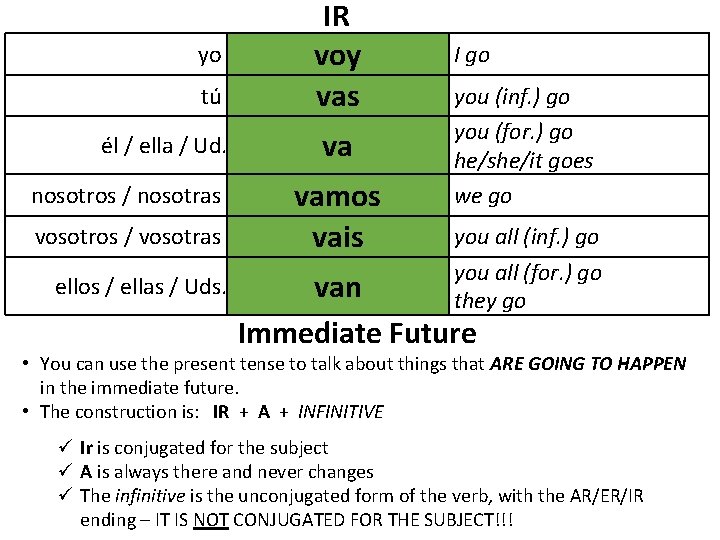
yo tú él / ella / Ud. nosotros / nosotras vosotros / vosotras ellos / ellas / Uds. IR voy vas va vamos vais I go you (inf. ) go you (for. ) go he/she/it goes we go you all (inf. ) go you all (for. ) go they go van Immediate Future • You can use the present tense to talk about things that ARE GOING TO HAPPEN in the immediate future. • The construction is: IR + A + INFINITIVE ü Ir is conjugated for the subject ü A is always there and never changes ü The infinitive is the unconjugated form of the verb, with the AR/ER/IR ending – IT IS NOT CONJUGATED FOR THE SUBJECT!!!
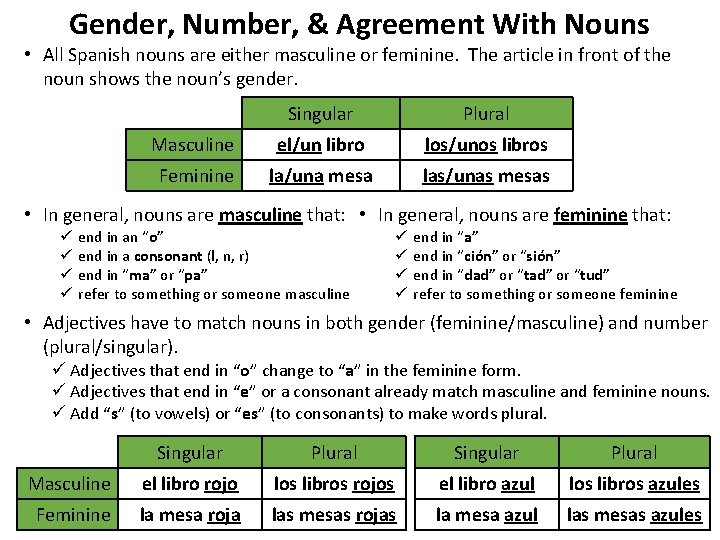
Gender, Number, & Agreement With Nouns • All Spanish nouns are either masculine or feminine. The article in front of the noun shows the noun’s gender. Singular Plural Masculine el/un libro los/unos libros Feminine la/una mesa las/unas mesas • In general, nouns are masculine that: • In general, nouns are feminine that: ü ü end in an “o” end in a consonant (l, n, r) end in “ma” or “pa” refer to something or someone masculine ü ü end in “a” end in “ción” or “sión” end in “dad” or “tud” refer to something or someone feminine • Adjectives have to match nouns in both gender (feminine/masculine) and number (plural/singular). ü Adjectives that end in “o” change to “a” in the feminine form. ü Adjectives that end in “e” or a consonant already match masculine and feminine nouns. ü Add “s” (to vowels) or “es” (to consonants) to make words plural. Singular Plural Masculine el libro rojo los libros rojos el libro azul los libros azules Feminine la mesa roja las mesas rojas la mesa azul las mesas azules
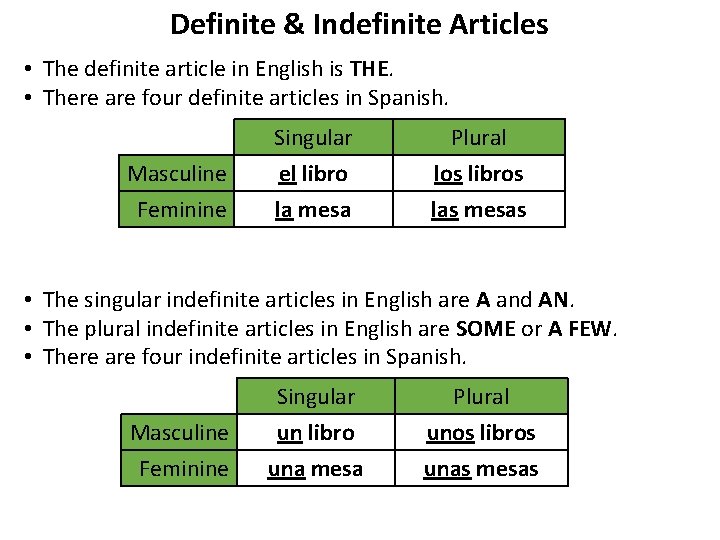
Definite & Indefinite Articles • The definite article in English is THE. • There are four definite articles in Spanish. Masculine Feminine Singular el libro la mesa Plural los libros las mesas • The singular indefinite articles in English are A and AN. • The plural indefinite articles in English are SOME or A FEW. • There are four indefinite articles in Spanish. Masculine Feminine Singular un libro una mesa Plural unos libros unas mesas
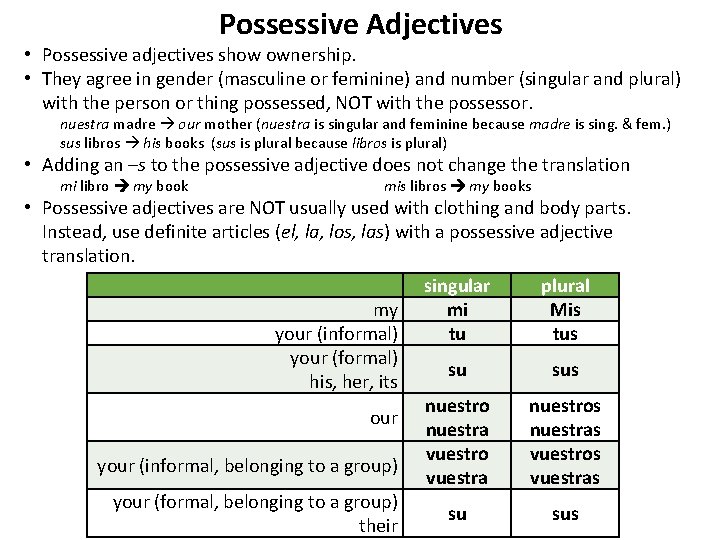
Possessive Adjectives • Possessive adjectives show ownership. • They agree in gender (masculine or feminine) and number (singular and plural) with the person or thing possessed, NOT with the possessor. nuestra madre our mother (nuestra is singular and feminine because madre is sing. & fem. ) sus libros his books (sus is plural because libros is plural) • Adding an –s to the possessive adjective does not change the translation mi libro my book mis libros my books • Possessive adjectives are NOT usually used with clothing and body parts. Instead, use definite articles (el, la, los, las) with a possessive adjective translation. singular plural my mi Mis your (informal) tu tus your (formal) su sus his, her, its nuestros our nuestras vuestros your (informal, belonging to a group) vuestras your (formal, belonging to a group) su sus their
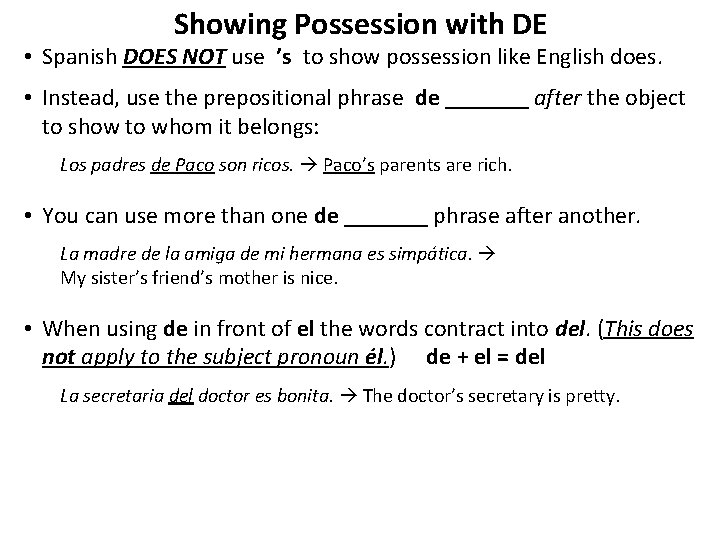
Showing Possession with DE • Spanish DOES NOT use ’s to show possession like English does. • Instead, use the prepositional phrase de _______ after the object to show to whom it belongs: Los padres de Paco son ricos. Paco’s parents are rich. • You can use more than one de _______ phrase after another. La madre de la amiga de mi hermana es simpática. My sister’s friend’s mother is nice. • When using de in front of el the words contract into del. (This does not apply to the subject pronoun él. ) de + el = del La secretaria del doctor es bonita. The doctor’s secretary is pretty.
- Slides: 24