
Subject Name GSM Subject Code 10 EC 843
Subject Name: GSM Subject Code: 10 EC 843 Prepared By: Gopika D K, Shruthi N Department: ECE Date
Unit 2 Radio Link Features in GSM Systems SYLLABUS • Introduction • GSM frequency bands • GSM PLMN • Objectives of a GSM PLMN • GSM PLMN Services, GSM Subsystems • GSM interfaces • Mapping of GSM layers onto OSI Layers. 12/24/2021
INTRODUCTION • The GSM system uses a number of interference reducing mechanism These include • Adaptive Power Control(APC) • Discontinuous Transmission(DTX) • Slow Frequency Hopping(SFH) 12/24/2021
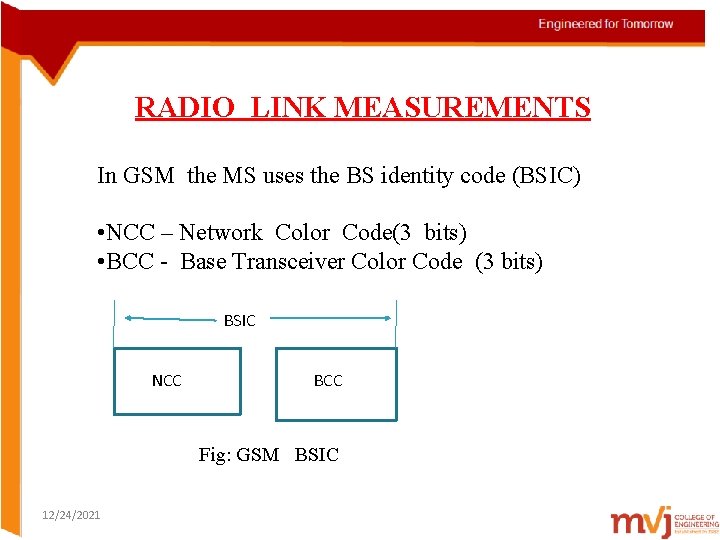
RADIO LINK MEASUREMENTS In GSM the MS uses the BS identity code (BSIC) • NCC – Network Color Code(3 bits) • BCC - Base Transceiver Color Code (3 bits) BSIC NCC BCC Fig: GSM BSIC 12/24/2021

RADIO LINK FEATURES OF GSM • Dynamic Power Control • Discontinuous Transmission(DTX) • Slow Frequency Hopping(SFH) 12/24/2021
Dynamic Power Control • The GSM network is designed so that the MS is instructed to use only the minimum power level necessary to achieve effective communication with the BTS • The receive power level in d. Bm is mapped to a value between 0 and 63 • For the BTS the power output is nominally controlled in 2 d. B steps to provide better co channel interference performance. • Both MS and BTS power control is performed in 2 d. B steps • The use of minimum transmitting power to access the network helps to increase the battery life of the mobile set and reduce interference 12/24/2021
DISCONTINUOUS TRANSMISSION (DTX) • The transmitter is active only 50 percent of the time then the average interference can be reduced by 3 d. B • DTX activity factor v of the transmitter to the occupancy • E. g if v=0. 4, Poccup =0. 8 then the effective channel occupancy Pactive=0. 4*0. 8 = 0. 32 Poccup is used to determine the capacity • DTX in GSM feature in which speech is transmitted only when there is speech available to transmit • This helps to reduce interference in MSs. a Voice Activity Detector is used to initiate the switching Process. 12/24/2021
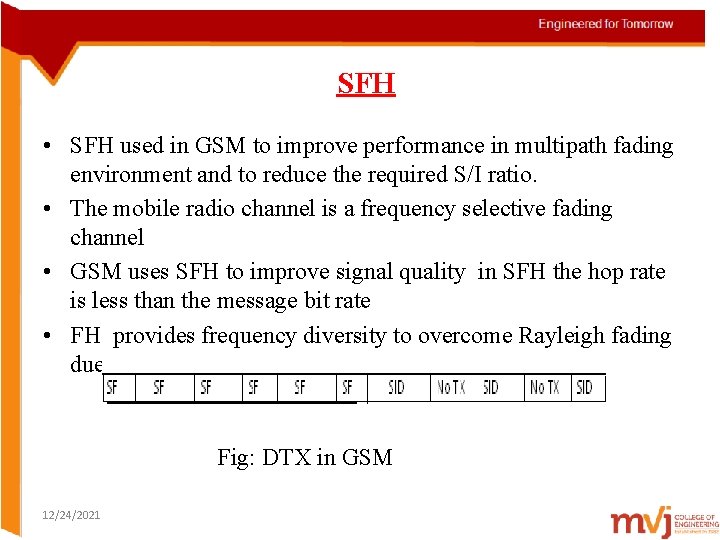
SFH • SFH used in GSM to improve performance in multipath fading environment and to reduce the required S/I ratio. • The mobile radio channel is a frequency selective fading channel • GSM uses SFH to improve signal quality in SFH the hop rate is less than the message bit rate • FH provides frequency diversity to overcome Rayleigh fading due to multipath propogation Fig: DTX in GSM 12/24/2021
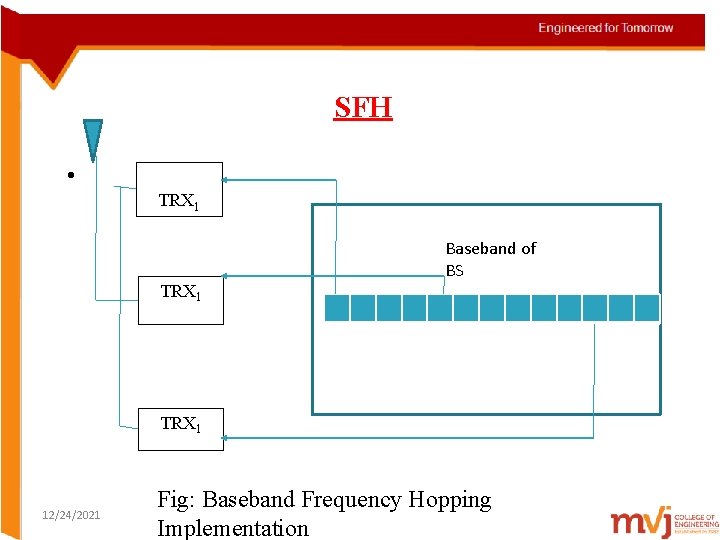
SFH • TRX 1 Baseband of BS TRX 1 12/24/2021 Fig: Baseband Frequency Hopping Implementation
FUTURE TECHNIQUES TO REDUCE INTERFERENCE IN GSM • Channel borrowing management or • Advanced antenna technology 12/24/2021 effective channel
CHANNEL BORROWING • Dynamic Channel Allocation(DCA) • Hybrid Channel Assignment (HCA) • Channel Borrowing without Locking (CBWL) 12/24/2021
CHANNEL BORROWING • A channel is borrowed from the pool by a BS for use on a call • The channel assignment is based on interference consideration • The interference level of the idle channels is measured and by means of the signal level from the preferred BS the resulting S/I ratio is estimated. • Channel licking is used to prevent an increase in cochannel interference • The CBWL exhibits better performance in light as well as in heavy traffic loads. 12/24/2021
SMART ANTENNAS Adaptive antennas would be considerably beneficial in the following areas • Coverage • Capacity • Signal Quality • Portable terminal transmit power 12/24/2021
SMART ANTENNAS • Way to reduce interference is to use smart or intelligent antennas • A smart antennas evaluates signal conditions continuously of each signal that is transmitted or received. • It belongs to two basic classes Ø Switched beam Ø Adaptive 12/24/2021
- Slides: 14