
Subject Languages Scope and semantics Subject Languages Today
Subject Languages Scope and semantics
Subject Languages • Today is an introduction to subject languages – informs the Subject Classification assignment • In your descriptive schema: – you defined a set of objects – and a set of attributes for describing those objects • In your subject classification – you will be creating a more complex expression of a particular attribute
Challenges • Semantics – Questions of meaning – On what basis does a classificationist determine what to include, what to exclude, and how to define and relate what is included • Structure – How to establish relationships that are both semantically meaningful and systematic in terms of clarifying the basis of each relationship
Goals of subject languages • Ranganathan – To provide a helpful sequence of documents so that: – Readers discover topics that may be useful – Books can display their potential to readers • Svenonius – To improve collocation in retrieval – To navigate the bibliographic universe – To represent knowledge • (as opposed to information)
Components of subject languages • Subject languages contain concepts represented as terms. • an example concept: – p. H of water components of soil, and the effects of the p. H on the soil's use in supporting plant life • a term to represent that concept: – soil acidity
Defining subject language scope • An important aspect of designing a subject language is to determine the boundaries of the subject we are trying to represent • What marks the composition and extent of a subject? • Should a classification of "information organization" as a subject include information retrieval? • Should it include philosophy of language? • Should it include critical theory? • How does one make such decisions?
Warrant • Generally, a warrant is the basis for including, defining, and relating terms (and the concepts they label) in a subject language – Begthol: a method for establishing semantic validity • The types of warrant are not mutually exclusive – All of them might be used to make decisions for a particular classification – But they may lead to different determinations
Varieties of warrant • Literary – classfication concepts are derived from subjects of books • Terminological – classification concepts are derived from terms used in documents • Scientific/philosophical – classification concepts are derived from scientific consensus abou what constitutes knowledge • Educational – classification concepts are derived from educational consensus about how to teach this knowledge
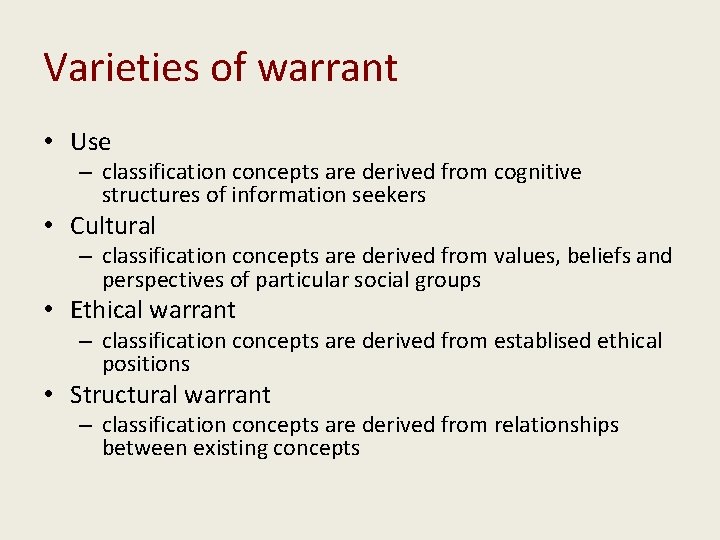
Varieties of warrant • Use – classification concepts are derived from cognitive structures of information seekers • Cultural – classification concepts are derived from values, beliefs and perspectives of particular social groups • Ethical warrant – classification concepts are derived from establised ethical positions • Structural warrant – classification concepts are derived from relationships between existing concepts
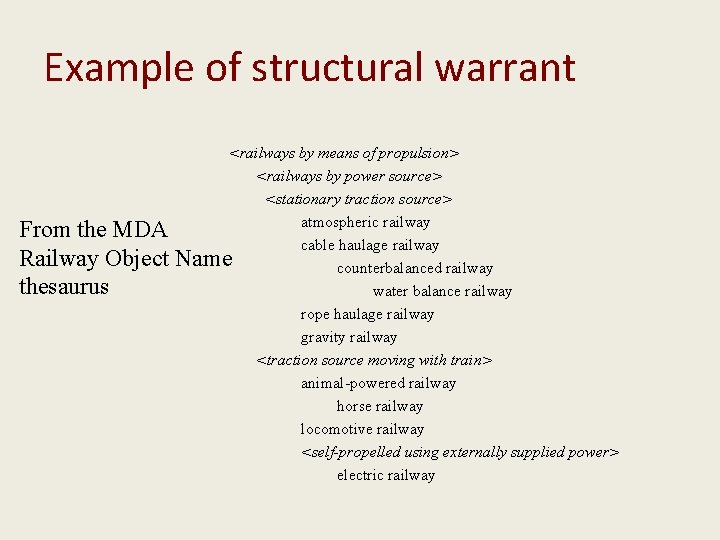
Example of structural warrant From the MDA Railway Object thesaurus <railways by means of propulsion> <railways by power source> <stationary traction source> atmospheric railway cable haulage railway Name counterbalanced railway water balance railway rope haulage railway gravity railway <traction source moving with train> animal-powered railway horse railway locomotive railway <self-propelled using externally supplied power> electric railway
Domain analysis • Hjørland Albrechtsen argue that information systems should be based on discourse communities of academic disciplines. • In this view, the field of psychology is what psychology researchers say – because this is the closest we can get to the "reality" of psychology • This is sort of an evolved variety of literary warrant – It restricts the literature to that which is accepted and legitimized within a domain • "The main problem for information systems is to reflect the domain, not the users"
Domains have competing ideas • Domain experts may have widely differing views – even on basic concepts • H&A contend that a domain analysis should uncover these schools of thought – in order to represent them in an information system
Domain analysis • Domain analysis acknowledges problems with the semantic validity of information systems • It asserts the need for systematic and rigorous justification for knowledge representations • It clarifies that a subject may have many interpretations – and provides a means for validating some of those interpretations • Domain analysis specifies that a classificationist needs to understand the various schools of thought that are operating in a domain – in order to disentangle what those concepts mean
domain analysis • note that the domain analytic approach ignores concerns related to an information system’s audience and purpose. • and it doesn’t explain how to decide between competing approaches to a subject. • domain analysis provides information to use in making those decisions • every classification is a type of argument for a particular interpretation of a subject – the classificationist is ultimately the author of this argument – not "the domain"
Performing a domain analysis Find documents that help you determine ontology (important things), epistemology (important problems, theories, methods and practices), and social structures in the selected domain. For example: – – – FAQs, beginners’ guides, and textbooks. Bibliographies. Professional organizations. Online user forums. Actual people!
First steps in your classification project 1. Determine a prelminary domain, or subject area 2. Perform a basic domain analysis to identify potential concepts to include in the classification 3. Begin to construct a version of the subject – by selecting concepts that align with your audience and purpose, defining the composition and extent of the domain • we will practice step 3 today
Next steps in your classification/taxonomy project 4. Define and select preferred labels for concepts 5. Establish relationships between concepts 6. Clarify how concepts are to be used to describe and arrange documents, via usage notes 7. Document your classification via alphabetic and classified representations no. 5 can be complicated, we will practice it at our next meeting
Subject classification / taxonomy project components • • Introduction Classified representation Alphabetical representation Reflective essay
- Slides: 18