
SUBJECT ENTREPRENEURIAL DEVELOPMENT SUBJECT CODE 16 CCBB 15

SUBJECT: ENTREPRENEURIAL DEVELOPMENT SUBJECT CODE: 16 CCBB 15 M. ELAMPIRAI ASSISTANT PROFESSOR AND HEAD OF MANAGEMENT GOVERNMENT ARTS AND SCIENCE COLLEGE FOR WOMEN, ORATHANADU, THANJAVUR

UNIT-IV PROJECT MANAGEMENT
PROJECT DEFINITION A project may be defined as “ A complex, non-routine, one time effort limited by time, budget, resources and performance specifications designed to meet customer needs. ”
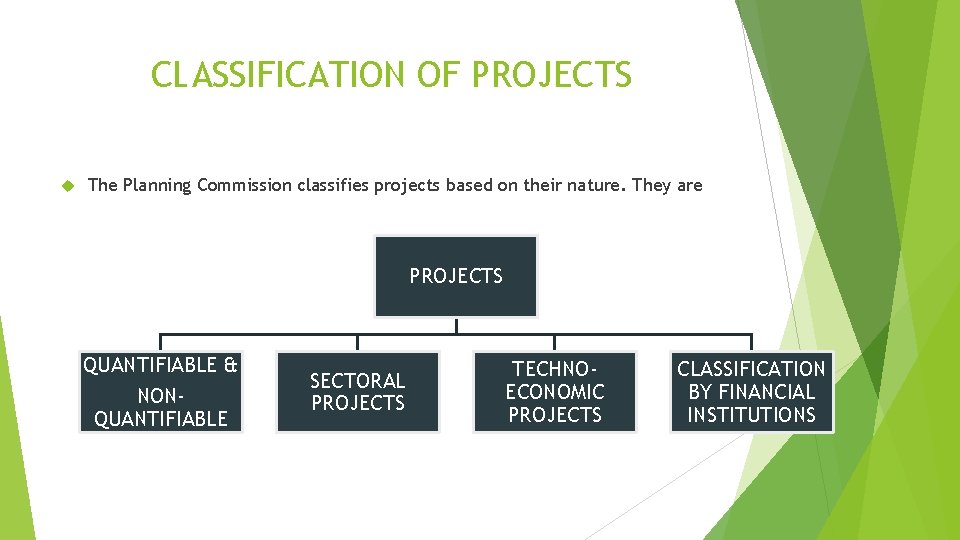
CLASSIFICATION OF PROJECTS The Planning Commission classifies projects based on their nature. They are PROJECTS QUANTIFIABLE & NONQUANTIFIABLE SECTORAL PROJECTS TECHNOECONOMIC PROJECTS CLASSIFICATION BY FINANCIAL INSTITUTIONS
QUANTIFIABLE & NON-QUANTIFIABLE PROJECTS QUANTIFIABLE- Quantitative assessment of benefits can be made. Eg: - Projects with i. Industrial development ii. Power Generation iii. Mineral Development NON- QUANTIFIABLE- Such an assessment is not possible. Eg: i. Health ii. Education iii. Defence
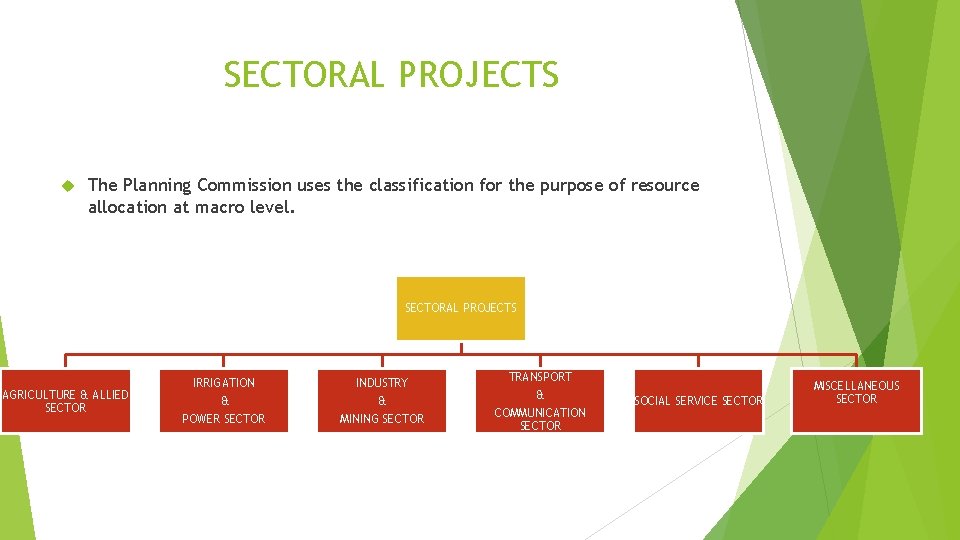
SECTORAL PROJECTS The Planning Commission uses the classification for the purpose of resource allocation at macro level. SECTORAL PROJECTS AGRICULTURE & ALLIED SECTOR IRRIGATION INDUSTRY & POWER SECTOR & MINING SECTOR TRANSPORT & COMMUNICATION SECTOR SOCIAL SERVICE SECTOR MISCELLANEOUS SECTOR
TECHNO ECONOMIC PROJECTS INTENSITY FACTOR 1. Capital Intensive 2. Labour Intensive CAUSE BASED ORIENTED PROJECTS 1. Demand 2. Raw Material or the source 3. Import Substitution 4. Export Based Projet ON THE BASIS OF MAGNITUDE OF INVESTMENT & OPERATIONS 1. Large Scale , Medium Scale , Small Scale, Tiny Scale
INTERNATIONAL STANDARD INDUSTRIAL CLASSIFICATION (ISIC) Division 0 – Agriculture, Forestry, Hunting, Fishing Division 1 – Mining & Quarrying Division 2 & 3 - Manufacturing Division 4 – Construction Division 5 - Electricity, Gas, Water & Sanitary Services Division 6 - Commerce Division 7 - Transport, Storage and Communication Division 8 – Services Division 9 - Activities not adequately described
CLASSIFICATION BY FINANCIAL INSTITUTIONS Financial Institutions classify the projects according to their age, experience and purpose for which the project is being taken up. PROFIT ORIENTED i. New Project ii. Expansion Project iii. Modernisation Project iv. Diversification Project SERVICE PROJECTS i. Welfare Projects ii. Service Projects iii. Research & Development Projects iv. Educational Projects
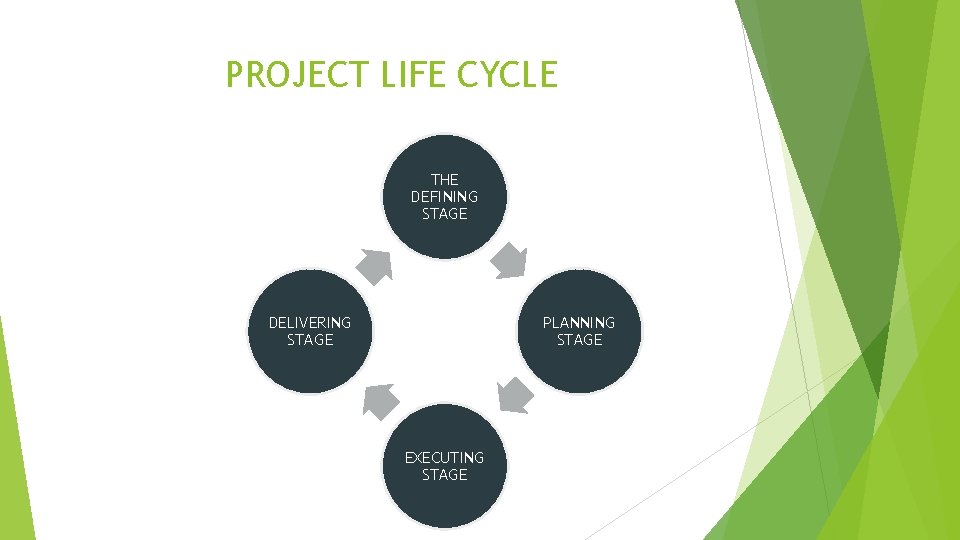
PROJECT LIFE CYCLE THE DEFINING STAGE DELIVERING STAGE PLANNING STAGE EXECUTING STAGE
DEFINING STAGE It is the first phase. Project Specifications are defined. Objectives are established. Terms are formed. Tasks and Responsibilities are assigned.
PLANNING STAGE Determine a) What to do? b) When to do? c) Who will do it? d)What is the level of quality to be maintained? e)Forecasting f) risks Estimating Staffing
EXECUTING STAGES Projects planned are implemented. Ideas in paper are converted into work. Product is produced, time, cost & specification measures are used for control. The following are analysed a) Is the project on schedule on budget and meeting specifications? b) What are the forecasts of each of these measures? c) What revision/changes are necessary?
DELIVERY STAGE It includes activities such as a) Delivering the product. b) Customer Training and Transferring Documents. c) Re-deploying project resources. After the delivery of the product, the resources are diverted to other projects and new assignments are found for team members.
PROJECT IDENTIFICATION It is an important step in project formulation. Project Identification is a process of generating a few ideas about the possible projects. The project ideas can be discovered from various internal and external sources. It is apprehensive with the collection, compilation and analysis of economic data for the eventual purpose of locating probable opportunities for investment. Project identification means identifying some possible projects having a good market.

PROJECT IDEAS It is the first and foremost task of an entrepreneur to find out suitable business. Entrepreneur has to first search for a sound of workable business idea. A variety of sources should be trapped to stimulate the generation of project ideas.
SOURCES OF PROJECT IDEAS Success story of friends/relatives. Experience of others in manufacture/ scale of product. Examining the inputs and outputs of industries. Plan outlays and government guidelines. Suggestions of financial institutions and developmental agencies. Economic and social trend of the economy. New technological developments. Project profiles and industrial potential surveys. Visit to trade fairs. Unfulfilled psychological needs.
PROJECT FORMULATION NEED FOR PROJECT FOMULATION Selection of appropriate technology Influence of External Economies Non-Availability of Technical Manpower Resource Mobilisation Legal Scenario
ELEMENTS OF PROJECT FORMULATION Feasibility Analysis Techno-Economic Analysis Project Design and Network Analysis Input Analysis Financial Analysis Social Cost-Benefit Analysis Project Appraisal
PROJECT APPRAISAL It is a process of transmitting information accumulated through feasibility studies into a comprehensive form in order to enable a decision maker undertake a comparative appraisal of various projects. PROFITABILITY APPRAISAL METHODS Payback Period Return on Investment Discounted Cash Flow Internal Rate of Return Net Present Value Profitability Index
PAY BACK PERIOD It is also called payout or payoff or replacement period method. It represents the number of years in which the investment is expected to ‘pay for itself’. Payback Period = Initial Investment/ CFAT p. a. = Profit after tax+ Depreciation This method is suitable for relatively small projects that are expected to be completed in a short time. The basis is liquidity and not profitability.
RETURN ON INVESTMENT(ROI) ROI is defined as the ratio of profit(net of depreciation and taxes) to initial capital outlay. If the project does not yield the desired ROI, it is not accepted. If there are number of projects under consideration, then they are ranked on the basis of ROI and the project with the best ROI or those above the desired ROI is/are selected. Average Rate of Return (ARR)= Annual Net Income/Average Investment × 100 Average Investment=(Initial Investment + Scrap value of the asset)/ Life of the asset.
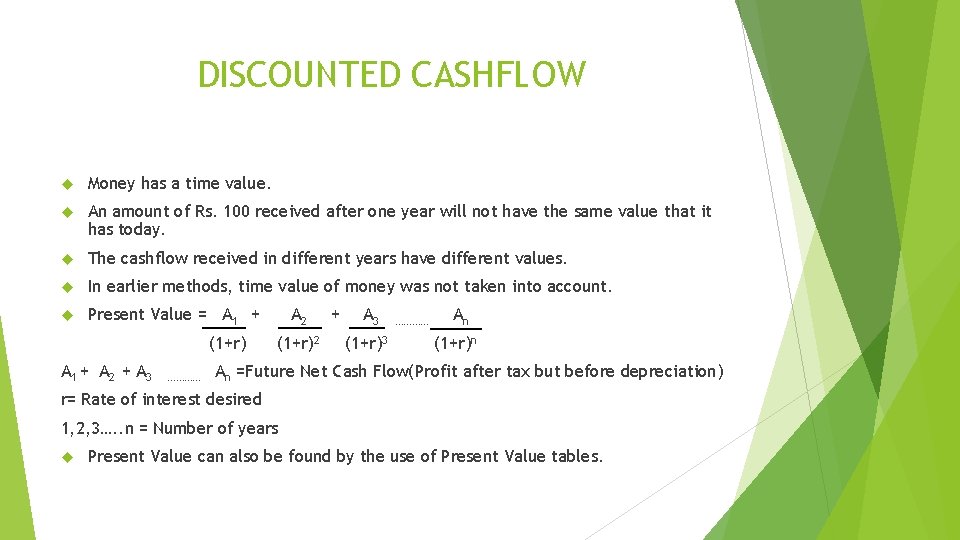
DISCOUNTED CASHFLOW Money has a time value. An amount of Rs. 100 received after one year will not have the same value that it has today. The cashflow received in different years have different values. In earlier methods, time value of money was not taken into account. Present Value = A 1 + (1+r) A 1 + A 2 + A 3 ………… A 2 (1+r)2 + A 3 (1+r)3 ………… An (1+r)n An =Future Net Cash Flow(Profit after tax but before depreciation) r= Rate of interest desired 1, 2, 3…. . n = Number of years Present Value can also be found by the use of Present Value tables.
INTERNAL RATE OF RETURN It is also known as Marginal Rate of Return Method or Time Adjusted Rate of Return Method. IRR is the rate of return at which the sum of discounted cash inflows equal the sum of discounted cash outflows. This method is generally employed when cost of investment and annual cash inflows are known, while the unknown rate of return (i. e. rate of cost of capital ) is to be ascertained.
INTERNAL RATE OF RETURN WHEN CASH INFLOWS ARE UNIFORM FOR ALL THE YEARS F=I/C where F=Factors to be located, I=Initial Investment, C=Cash Inflow per year. WHEN CASH INFLOWS ARE NOT UNIFORM IRR= Lower Rate+ (Positive NPV/Difference in Calculated Present Values) × Difference in rate. Accept the project if IRR is higher than or equal to minimum required rate of return. While evaluating two or more projects, project giving higher IRR should be preferred.
NET PRESENT VALUE In this method the discount rate should be equal to the company’s weighted average cost of capital. The difference between the present value of cash inflows and outflows is called Net Present Value(NPV). The best project is the one which has the highest Net Present Value.
PROFITABILITY INDEX It is also known as Benefit Cost Ratio or Present Value of Profitability Index. It is also based on the basic concept of discounting the future cash flows and is ascertained by comparing the present value of cash inflows with the present value of cash outflows. Profitability Index(PI)= Present Value of Cash Inflows/Present Value of Cash Outflows.
PROJECT REPORT Project report is the presentation of detailed business plan in writing. The project reports are used primarily for raising capital. It is a blue print of the business plan. The objective of business plan is to attract investors and lenders. Banks and financial institutions appraise a project on the basis of the project report submitted.
PURPOSE OF A PROJECT REPORT Development Tool Clarification of Venture’s vision and mission Defining Planning and Evaluation Guidelines Securing Financial Resources Guiding Growth
OUTLINE OF PROJECT REPORT Cover Table of Content i. Executive Summary ii. The industry and the company, its products or services iii. Market Research and Analysis iv. The Economics of Business v. Marketing Plan vi. Design and Development Plans vii. Manufacturing and Operation Plan
OUTLINE OF PROJECT REPORT (Contn. ) viii. Management Team ix. Overall Schedule x. Critical risks, problems and assumptions xi. Financial Plan xii. Proposed company offering xiii. Appendices

THANK YOU
- Slides: 32