
subject activities This weeks Transition Activities come from
subject activities This week’s Transition Activities come from the following subjects: English: • Bookmark Challenge • School Leaver Challenge Drama: • Theatre Challenge French: • Facts about France Challenge History: • Using Sources to Investigate Diversity in History Challenge PE: • The Physical Bingo Challenge All the activities from this week will need to be handed in to your new subject teachers when you start in September. For all tasks, follow the instructions given on how to complete them. Where there is an opportunity to complete a task in the booklet you can do so either by writing on a printed version or completing it electronically on the Power. Point slide. Remember to focus on good scholarship, which means making sure you work is well organised and neatly presented, whether you are working on paper or electronically. If you are completing the tasks electronically, you can add them to your overall Transition Activities Booklet or save them as separate subject documents if this is easier. If you do this, just make sure your files are properly labelled e. g. PHS History Activity – Your Name Good luck!
English: Book. Mark We can’t wait to see Challenge you here in English and hope that you enjoy the lessons as much as we do! To help you prepare for English in Year 7, we would like you to read as regularly as you can and take part in our competition. What do I need to do? You could win a prize and Epraise points by designing a new school bookmark. Your design might also be chosen to represent your house! We will select one winning design from a Kingsley, Armstrong and Magellan student. The winners will have their designs printed for everyone to use. Use the template provided and make sure that your full name and tutor group (once you know it) are clearly marked on the back. How do I hand it in? Bring your completed design along in your first week at Pershore and hand it to your English teacher. We will judge them and award the prizes soon after that. GOOD LUCK!
English: SCHOOL LEAVER Challenge Now that you are moving up to high school, you will be a middle school expert! Think back to your first year at middle school: What were you worried about? What were you looking forward to? What did you enjoy? Or not? ! What advice would you give to someone starting middle school? What do I need to do? Write a letter that could be given to a Year 5 student, explaining what they can expect from middle school. You might like to include information about: • • The new subjects they will study Sports and activities they can get involved with Trips and other events What they are and aren’t allowed to do in middle school! The English team at Pershore would love to find out about your ideas and see a great example of your writing. Try to keep your letter to one side of A 4 and remember to use correct punctuation and paragraphs. We will select the best example from each middle school and send a copy to them. Your letter could be given to real Year 5 students in your old school! How do I hand it in? Hand your letter in to your English teacher when you start lessons in September. We will read through all of the letters and decide which ones to send to the middle schools. GOOD LUCK and GET WRITING!
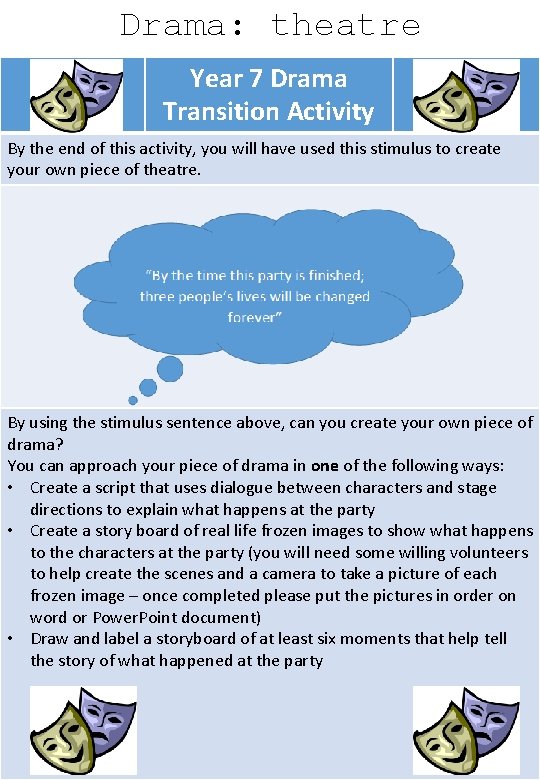
Drama: theatre challenge Year 7 Drama Transition Activity By the end of this activity, you will have used this stimulus to create your own piece of theatre. By using the stimulus sentence above, can you create your own piece of drama? You can approach your piece of drama in one of the following ways: • Create a script that uses dialogue between characters and stage directions to explain what happens at the party • Create a story board of real life frozen images to show what happens to the characters at the party (you will need some willing volunteers to help create the scenes and a camera to take a picture of each frozen image – once completed please put the pictures in order on word or Power. Point document) • Draw and label a storyboard of at least six moments that help tell the story of what happened at the party
French: facts about france challenge When learning a language it is important to get to know a country’s culture and history to help understand its language. Go to www. euroclub-schools. org Enter the French Zone Click on Facts About France 1 By scrolling up and down the webpage, can you find answers to the following questions? What is the official name of the country of France? Write three words that are the motto of France. Name some of the symbols of France. What is the national anthem of France? Write the name of the flag of France. Which emblem is used on the sportswear of the national teams? Write the name and date of an important French holiday. Which historic event started in 1789? Who is the patron saint of France and Paris? Write the motto of Paris.
Which structure was completed in 1889? Which sea separates England France? Name a famous museum in Paris. Which famous painting by Leonardo da Vinci hangs in a museum in Paris? Write the name of the Paris underground network of trains. On which ground does the Eiffel Tower stand? Which French town has a one-letter name? Who is the current President of France? Write the nickname of the French island of Corsica. Which building is the official resting place of the kings and queens of France? Write the name of the glass structure situated at a museum in Paris. Write the French name of the Channel Tunnel.
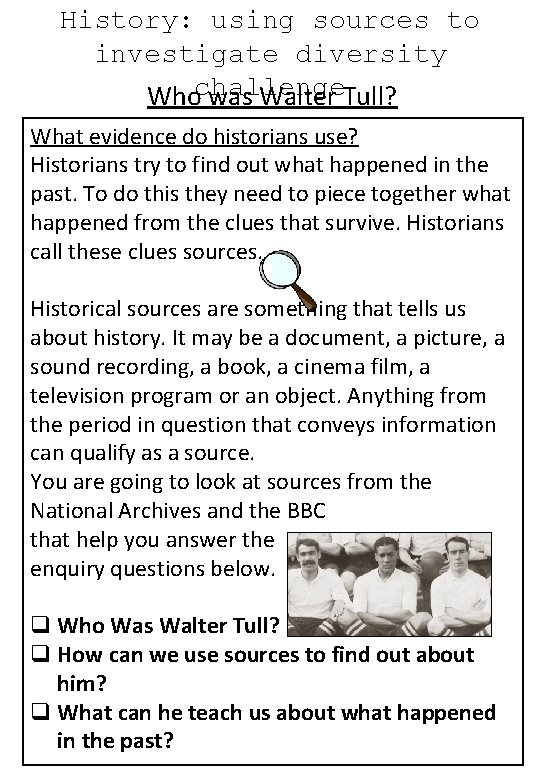
History: using sources to investigate diversity challenge Who was Walter Tull? What evidence do historians use? Historians try to find out what happened in the past. To do this they need to piece together what happened from the clues that survive. Historians call these clues sources. Historical sources are something that tells us about history. It may be a document, a picture, a sound recording, a book, a cinema film, a television program or an object. Anything from the period in question that conveys information can qualify as a source. You are going to look at sources from the National Archives and the BBC that help you answer the enquiry questions below. q Who Was Walter Tull? q How can we use sources to find out about him? q What can he teach us about what happened in the past?
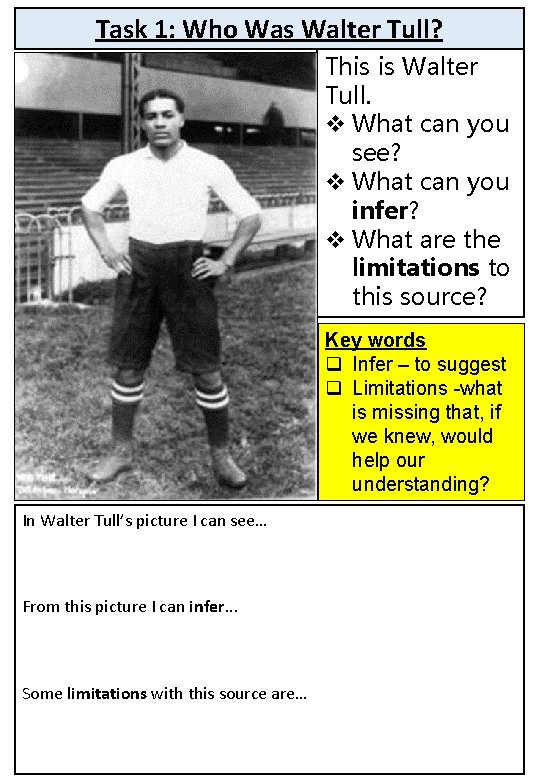
Task 1: Who Was Walter Tull? This is Walter Tull. v What can you see? v What can you infer? v What are the limitations to this source? Key words q Infer – to suggest q Limitations -what is missing that, if we knew, would help our understanding? In Walter Tull’s picture I can see… From this picture I can infer. . . Some limitations with this source are…
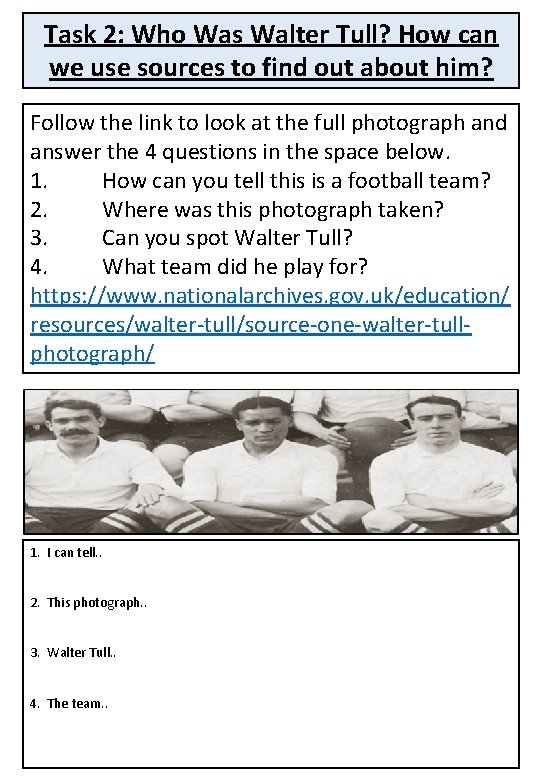
Task 2: Who Was Walter Tull? How can we use sources to find out about him? Follow the link to look at the full photograph and answer the 4 questions in the space below. 1. How can you tell this is a football team? 2. Where was this photograph taken? 3. Can you spot Walter Tull? 4. What team did he play for? https: //www. nationalarchives. gov. uk/education/ resources/walter-tull/source-one-walter-tullphotograph/ 1. I can tell. . 2. This photograph. . 3. Walter Tull. . 4. The team. .
Task 3: Who Was Walter Tull? How can we use sources to find out about him? What can he teach us about what happened in the past? Follow the links to look at the sources and answer the following questions. You will find space on the next page to write or type your answers. 5. What was Walter Tull’s full name? When was his birthday? 6. Was Walter Tull married? 7. Did he have siblings? Can you find out? 8. Was he able to ride? 9. What age was he when his parents died? 10. Did Walter eventually become an officer? Use the document to find out. 11. How old was he when he died? Can you find out? 12. Use this document to explain why Walter was important in history. 13. How do you think he felt being the first African. Caribbean man to change history in this way? https: //www. nationalarchives. gov. uk/education/re sources/walter-tull/source-two-walter-tulltemporary-commission/ https: //www. bbc. co. uk/bitesize/topics/zqhyb 9 q/articles/zbgxbdm
Task 3: My Answers 5. 6. 7. 8. 9. 10. 11. 12. 13.
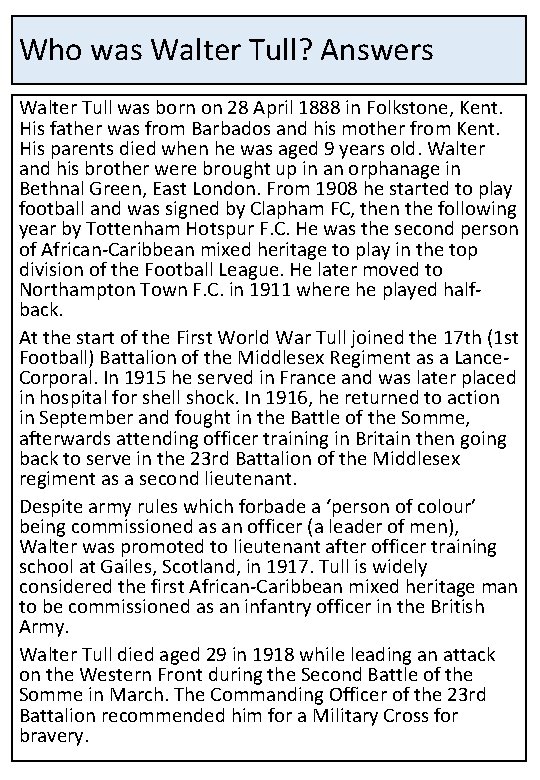
Who was Walter Tull? Answers Walter Tull was born on 28 April 1888 in Folkstone, Kent. His father was from Barbados and his mother from Kent. His parents died when he was aged 9 years old. Walter and his brother were brought up in an orphanage in Bethnal Green, East London. From 1908 he started to play football and was signed by Clapham FC, then the following year by Tottenham Hotspur F. C. He was the second person of African-Caribbean mixed heritage to play in the top division of the Football League. He later moved to Northampton Town F. C. in 1911 where he played halfback. At the start of the First World War Tull joined the 17 th (1 st Football) Battalion of the Middlesex Regiment as a Lance. Corporal. In 1915 he served in France and was later placed in hospital for shell shock. In 1916, he returned to action in September and fought in the Battle of the Somme, afterwards attending officer training in Britain then going back to serve in the 23 rd Battalion of the Middlesex regiment as a second lieutenant. Despite army rules which forbade a ‘person of colour’ being commissioned as an officer (a leader of men), Walter was promoted to lieutenant after officer training school at Gailes, Scotland, in 1917. Tull is widely considered the first African-Caribbean mixed heritage man to be commissioned as an infantry officer in the British Army. Walter Tull died aged 29 in 1918 while leading an attack on the Western Front during the Second Battle of the Somme in March. The Commanding Officer of the 23 rd Battalion recommended him for a Military Cross for bravery.
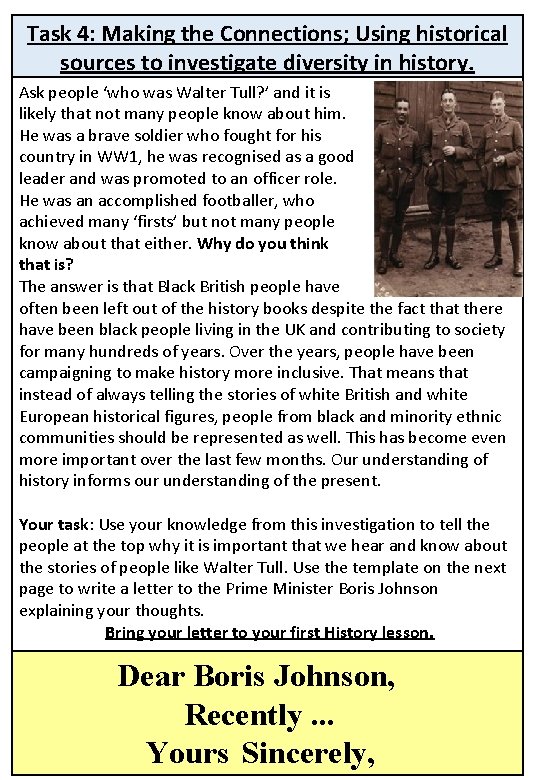
Task 4: Making the Connections; Using historical sources to investigate diversity in history. Ask people ‘who was Walter Tull? ’ and it is likely that not many people know about him. He was a brave soldier who fought for his country in WW 1, he was recognised as a good leader and was promoted to an officer role. He was an accomplished footballer, who achieved many ‘firsts’ but not many people know about that either. Why do you think that is? The answer is that Black British people have often been left out of the history books despite the fact that there have been black people living in the UK and contributing to society for many hundreds of years. Over the years, people have been campaigning to make history more inclusive. That means that instead of always telling the stories of white British and white European historical figures, people from black and minority ethnic communities should be represented as well. This has become even more important over the last few months. Our understanding of history informs our understanding of the present. Your task: Use your knowledge from this investigation to tell the people at the top why it is important that we hear and know about the stories of people like Walter Tull. Use the template on the next page to write a letter to the Prime Minister Boris Johnson explaining your thoughts. Bring your letter to your first History lesson. Dear Boris Johnson, Recently. . . Yours Sincerely,
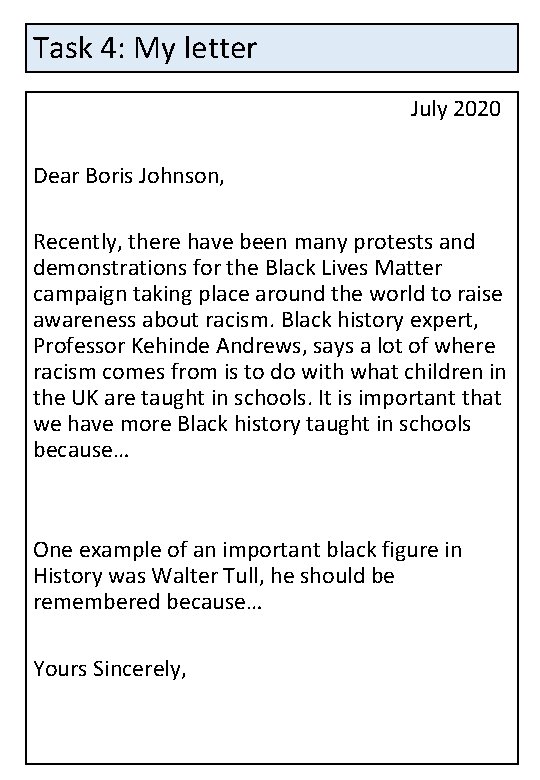
Task 4: My letter July 2020 Dear Boris Johnson, Recently, there have been many protests and demonstrations for the Black Lives Matter campaign taking place around the world to raise awareness about racism. Black history expert, Professor Kehinde Andrews, says a lot of where racism comes from is to do with what children in the UK are taught in schools. It is important that we have more Black history taught in schools because… One example of an important black figure in History was Walter Tull, he should be remembered because… Yours Sincerely,
Dig Deeper: Challenge Yourself to Become an Independent Learner Use these websites for further research and extra tasks to expand your knowledge of History and current affairs: The National Archives https: //www. nationalarchives. gov. uk/blackhistory/ Black British History Competition https: //www. 100 greatblackbritons. co. uk/compe tition. html BBC Newsround https: //www. bbc. co. uk/newsround#morestories-3 BBC Bitesize https: //www. bbc. co. uk/bitesize/topics/zqhyb 9 q /articles/zbgxbdm BBC Sport article https: //www. bbc. co. uk/sport/football/4350444 8
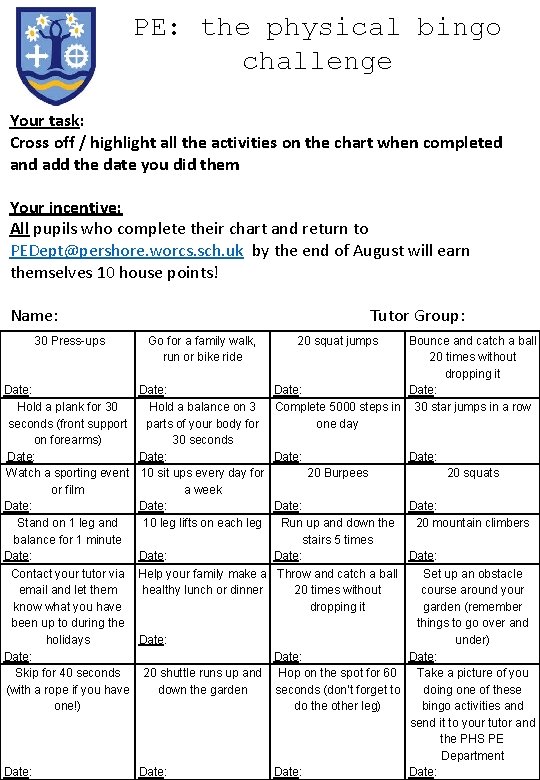
PE: the physical bingo challenge Your task: Cross off / highlight all the activities on the chart when completed and add the date you did them Your incentive: All pupils who complete their chart and return to PEDept@pershore. worcs. sch. uk by the end of August will earn themselves 10 house points! Name: 30 Press-ups Date: Hold a plank for 30 seconds (front support on forearms) Date: Watch a sporting event or film Date: Stand on 1 leg and balance for 1 minute Date: Contact your tutor via email and let them know what you have been up to during the holidays Date: Skip for 40 seconds (with a rope if you have one!) Date: Tutor Group: Go for a family walk, run or bike ride 20 squat jumps Bounce and catch a ball 20 times without dropping it Date: Hold a balance on 3 Complete 5000 steps in 30 star jumps in a row parts of your body for one day 30 seconds Date: 10 sit ups every day for 20 Burpees 20 squats a week Date: 10 leg lifts on each leg Run up and down the 20 mountain climbers stairs 5 times Date: Help your family make a Throw and catch a ball Set up an obstacle healthy lunch or dinner 20 times without course around your dropping it garden (remember things to go over and Date: under) Date: 20 shuttle runs up and Hop on the spot for 60 Take a picture of you down the garden seconds (don’t forget to doing one of these do the other leg) bingo activities and send it to your tutor and the PHS PE Department Date:
- Slides: 16