
Subintimal Tracking and Reentry for CTO STAR Method
Subintimal Tracking and Reentry for CTO STAR Method Craig A. Thompson, M. D. , MMSc. Director, Invasive Cardiology and Vascular Medicine Yale University School of Medicine/Yale New Haven Hospital Executive Director, Yale-University College London Cardiovascular Device Development Program Consultant (Hon) Heart Hospital, London and London Chest Hospital Author : John K. Forrest, M. D Updated : June 2009 CRT 2011, Washington, DC

Craig A. Thompson, MD § Consulting Fees – Abbott Vascular – Bridgepoint – Terumo – Volcano I intend to reference off label or unapproved uses of drugs or devices in my presentation. I intend to discuss DES, guidewires, PTCA balloons/catheters in CTO

YALE SCHOOL OF MEDICINE Subintimal Tracking and Reentry (STAR) rationale and historical perspective • Alternative technique for distal true lumen access • Adaptation of technique in peripheral CTO intervention • Devascularized vessel in CTO = devitalized tissue at media – Natural dissection plane – Used by surgeons for endarterectomy • Reentry – ? Path of least resistance in distal “normal” vessel toward lumen • Smaller distal vessel less likely to propagate dissection CRT 2011, Washington, DC
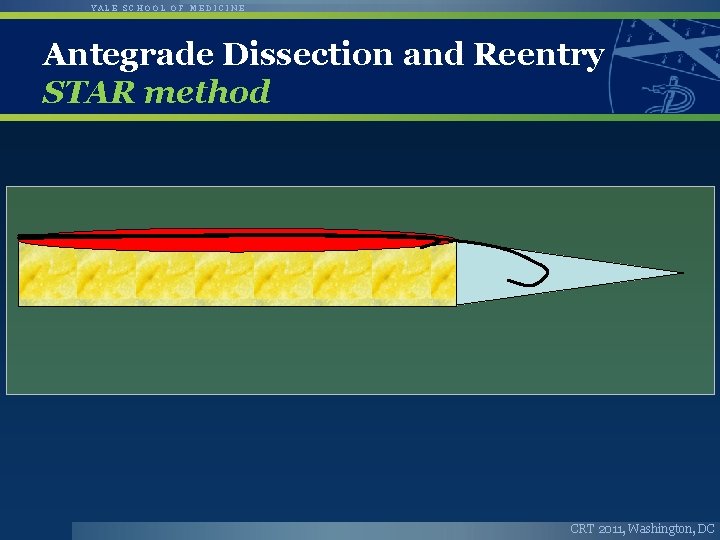
YALE SCHOOL OF MEDICINE Antegrade Dissection and Reentry STAR method CRT 2011, Washington, DC
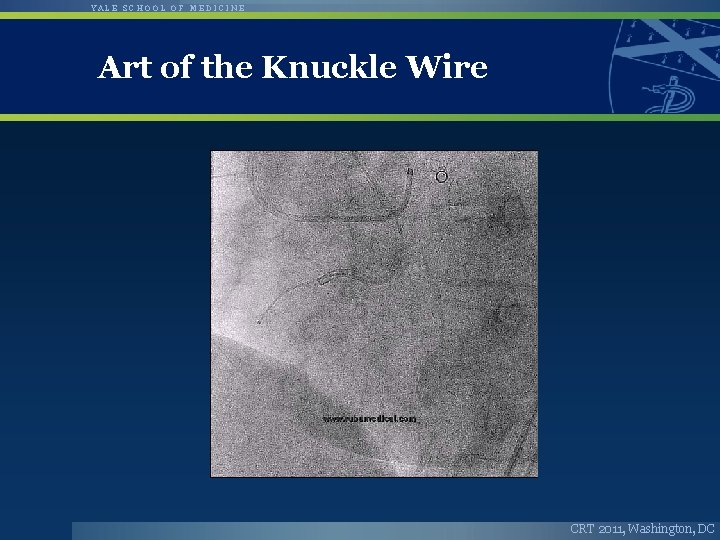
YALE SCHOOL OF MEDICINE Art of the Knuckle Wire CRT 2011, Washington, DC

YALE SCHOOL OF MEDICINE Knuckle wire IVUS CRT 2011, Washington, DC
YALE SCHOOL OF MEDICINE Subintimal Tracking and Reentry (STAR) Patient Selection • • Failure with conventional wire strategies No retrograde opportunity Relatively healthy distal vessel beyond CTO Minimal important branches in shear/dissection zone (RCA, OM) • Strong clinical indication • This is final measure, not first measure • Better methods have been developed! CRT 2011, Washington, DC
YALE SCHOOL OF MEDICINE Subintimal Tracking and Reentry (STAR) technique • Supportive 8 Fr guide • Create or use existing dissection in proximal CTO (Miracle, Confianza, etc. ) • 1. 5 mm balloon into track • Fielder XT/Whisper/Pilot 50 with tight “J” tip/”umbrella tip” • Advance with balloon support, avoid spinning wire if possible – May need pilot 150, 200 for proximal – Use softest wire possible for distal (whisper) • Reentry CRT 2011, Washington, DC

YALE SCHOOL OF MEDICINE Antegrade Dissection and Reentry Minimal subadventitial space Occlusion Enlarged subadventitial space Occlusion CRT 2011, Washington, DC
YALE SCHOOL OF MEDICINE Subintimal Tracking and Reentry (STAR) Side branch rescue • Runoff is key to durability • Miracle/Confianza – parallel wire • Mini-STAR – – Wire in SB ostium 1. 5 balloon to ostium Exchange for Whisper “J” tip Mini-STAR CRT 2011, Washington, DC

YALE SCHOOL OF MEDICINE Subintimal Tracking and Reentry (STAR) Tips • Stiffer polymer wire (“J”) proximally if needed but always softer distally – “J-bend” ~ < media-to-media diameter • Runoff vessels are key • Don’t lose true lumen distal branch, multiple wires if necessary • PTCA pre-stent conservative size, pressures <12 ATM • Bifurcation stenting only if absolutely necessary • SB dissections may be OK • DES • Consider angiographic follow-up CRT 2011, Washington, DC

YALE SCHOOL OF MEDICINE Subintimal Tracking and Reentry (STAR) CRT 2011, Washington, DC
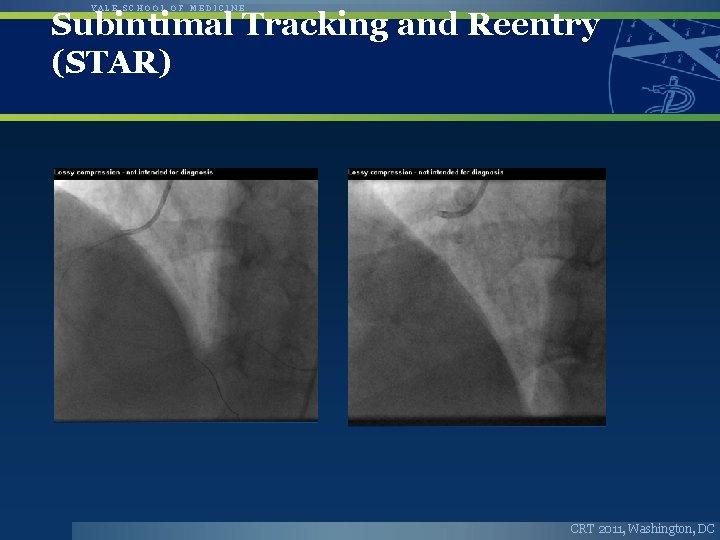
YALE SCHOOL OF MEDICINE Subintimal Tracking and Reentry (STAR) CRT 2011, Washington, DC
YALE SCHOOL OF MEDICINE Subintimal Tracking and Reentry (STAR) Complications • • • Perforation Side branch loss Runoff Vessel Loss Unpredictable dissection Relatively high restenosis Failure CRT 2011, Washington, DC

YALE SCHOOL OF MEDICINE STAR Technique baseline demographics 112 patients, 119 lesions CTO Length Criterion for STAR Courtesy M Carlino, A Colombo CRT 2011, Washington, DC

YALE SCHOOL OF MEDICINE STAR Technique acute outcome and complications (112 pt. /119 lesion) Recanalization with Angiographic success in 103/119 lesions (86. 6%) 4 (3. 4%) Dissection limiting procedure 3 (2. 5%) vessel rupture [3 PTFE stent] Courtesy M Carlino, A Colombo 1 acute thrombosis 5 (4. 2%) wire perforation limiting procedure CRT 2011, Washington, DC
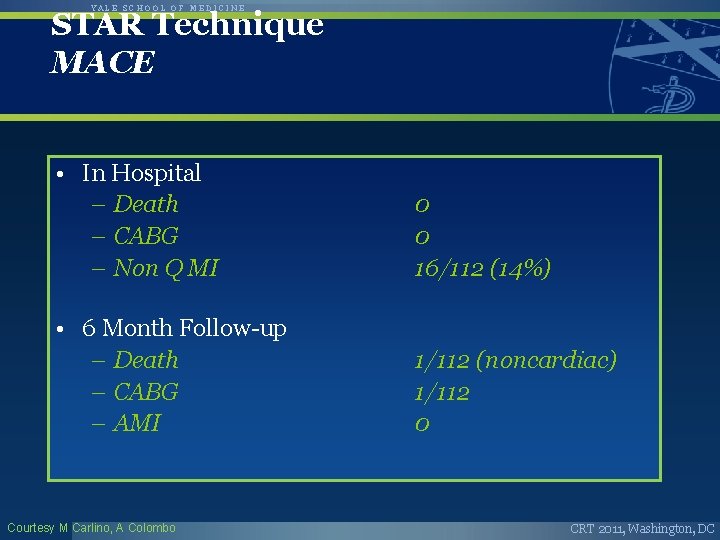
YALE SCHOOL OF MEDICINE STAR Technique MACE • In Hospital – Death – CABG – Non Q MI 0 0 16/112 (14%) • 6 Month Follow-up – Death – CABG – AMI 1/112 (noncardiac) 1/112 0 Courtesy M Carlino, A Colombo CRT 2011, Washington, DC
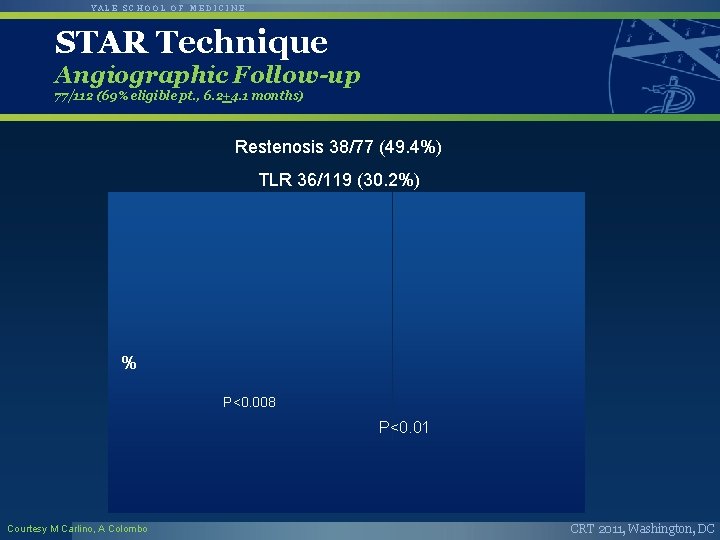
YALE SCHOOL OF MEDICINE STAR Technique Angiographic Follow-up 77/112 (69% eligible pt. , 6. 2+4. 1 months) Restenosis 38/77 (49. 4%) TLR 36/119 (30. 2%) % P<0. 008 P<0. 01 Courtesy M Carlino, A Colombo CRT 2011, Washington, DC
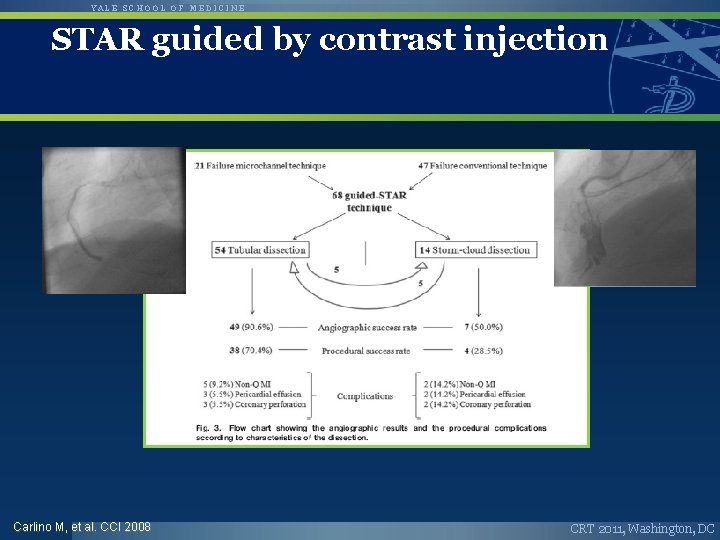
YALE SCHOOL OF MEDICINE STAR guided by contrast injection Carlino M, et al. CCI 2008 CRT 2011, Washington, DC
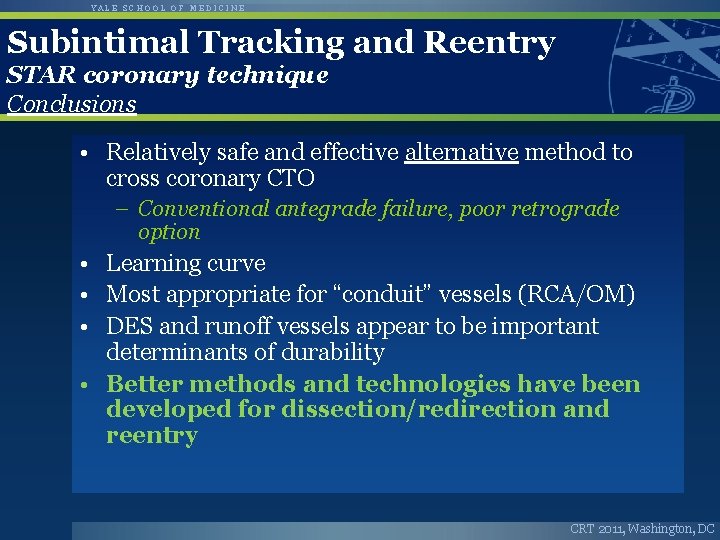
YALE SCHOOL OF MEDICINE Subintimal Tracking and Reentry STAR coronary technique Conclusions • Relatively safe and effective alternative method to cross coronary CTO – Conventional antegrade failure, poor retrograde option • Learning curve • Most appropriate for “conduit” vessels (RCA/OM) • DES and runoff vessels appear to be important determinants of durability • Better methods and technologies have been developed for dissection/redirection and reentry CRT 2011, Washington, DC
- Slides: 20